
At its core, home design AI is a set of tools that uses artificial intelligence to create, edit, and reimagine images of interior spaces in seconds. Think of it as your own personal special effects studio for real estate, allowing you to stage, declutter, restyle, or even visualize complete renovations with just a few clicks.
What Is Home Design AI and How Does It Work
We’ve all been there. You have a listing with fantastic bones, but the photos of the empty rooms just don’t pop online. They look cold, uninviting, and buyers scroll right past.
For years, the only solution was to hire a staging company, sink thousands of dollars into rental furniture, and wait weeks for everything to be set up. It’s expensive, slow, and locks you into a single look. This is exactly the problem home design AI solves.
Instead of moving couches, AI moves pixels. It’s like swapping a paint roller for Photoshop. You just upload a photo of a vacant room, and the AI gets to work, analyzing the space’s dimensions, lighting, and architecture. From there, you can instantly fill it with photorealistic furniture and decor in any style you can imagine.
Beyond Empty Rooms
But this technology does so much more than just furnish empty spaces. What about a property that’s lived-in, a little cluttered, or just plain dated? Home design AI can handle that, too.
- Declutter Instantly: Digitally erase personal photos, kids' toys, and bulky furniture. This creates a clean, neutral space that lets buyers see the home’s features, not the seller’s stuff.
- Restyle On-Demand: Transform a room’s entire vibe with a click. Take a living room straight out of the 1980s and turn it into a modern farmhouse, a minimalist Scandinavian retreat, or a chic industrial loft to appeal to today's buyers.
- Visualize Renovations: This is the game-changer. You can show buyers exactly what that kitchen could look like with new quartz countertops and shaker cabinets. Or turn that dark, unfinished basement into the bright, cozy family room they've always wanted.
These tools give agents the power to fix common listing problems without the cost or hassle of physical work. Many modern platforms also include features for room planning, which helps buyers map out and truly visualize how they’d use the space.
The real magic is the speed and flexibility. You’re no longer stuck with one expensive physical staging concept. Instead, you can generate dozens of virtual designs to attract different types of buyers, all in the time it takes to grab a coffee.
Essentially, home design AI gives you a marketing toolkit that used to be reserved for high-end architectural firms. It helps you tell a better story for every single property, showing not just what it is, but everything it could be. You’re closing the imagination gap for buyers, making it infinitely easier for them to see themselves living there.
The Technology Behind Instant Visuals
So, how exactly does an AI take a simple photo of a room and spit out a stunning, photorealistic redesign moments later? It’s not magic, but it’s close. The engine behind it all is a powerful form of artificial intelligence called generative AI.
At its core, generative AI is a creative machine. It analyzes an existing image and then generates entirely new content—like a different sofa, a fresh coat of paint, or a completely new design style—based on your instructions.
A simple way to picture it is to imagine a brilliant artist and a brutally honest critic working together at an impossible speed. This is the basic idea behind a technology called Generative Adversarial Networks (GANs). One part of the AI (the "artist") creates a new image, while another part (the "critic") judges how real it looks. This back-and-forth happens thousands of times a second, with the artist constantly trying to fool the critic until the final image is nearly indistinguishable from an actual photograph.
This rapid-fire process is what lets you get such high-quality results so quickly. It's also why you can ask for endless revisions without waiting days for a human designer to send back new drafts.
The Generative AI Engine
The growth in this space is staggering. According to in-depth research on generative AI, the global market for generative AI in design was valued at USD 993.90 million in 2025 and is expected to hit USD 16,893.37 million by 2035.
That explosive growth is a clear signal: tools like Bounti are becoming non-negotiable for property marketers. When you can restyle a room or mock up a renovation in minutes instead of days, you gain a massive competitive advantage. Given that first impressions seal 73% of sales, and properties with AI-enhanced images sell 32% faster on average, that speed translates directly to closed deals.
This simple map breaks down the typical workflow.
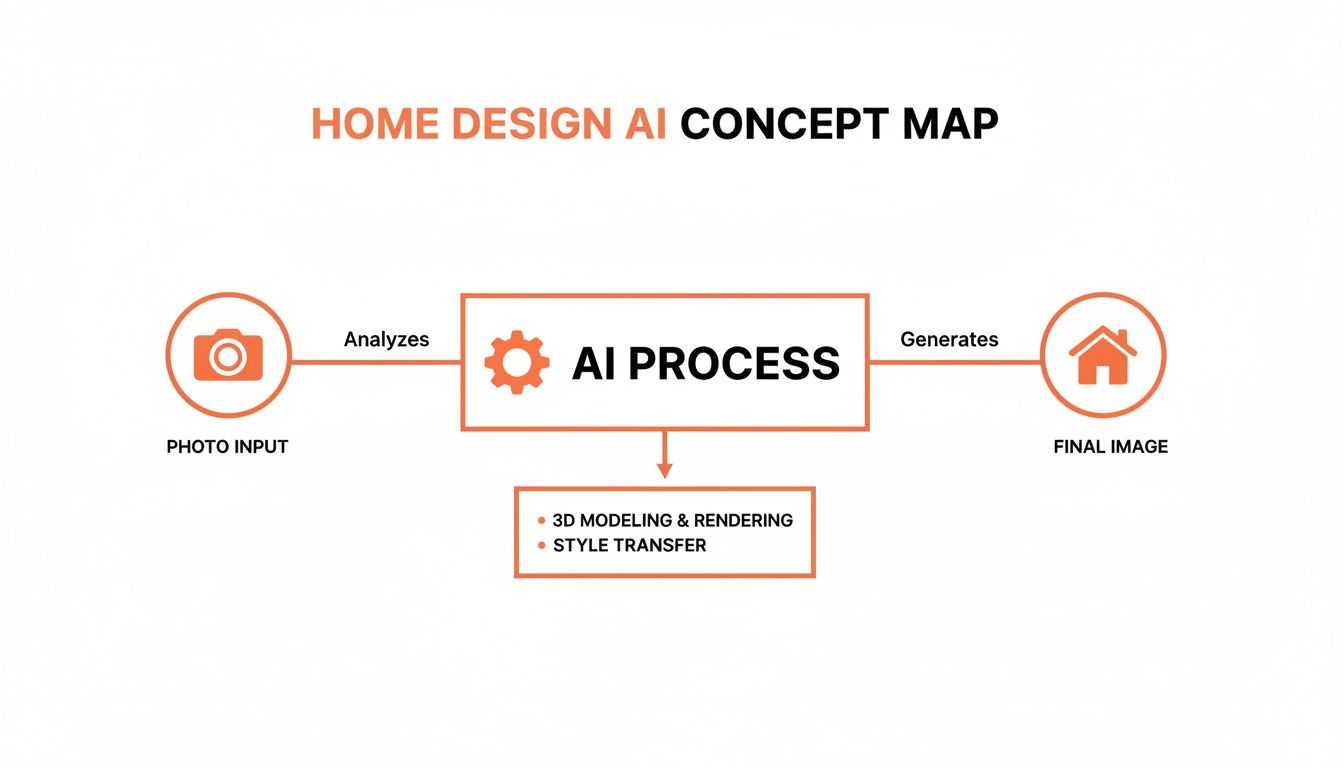
It really is that straightforward: you provide the photo, the AI does the heavy lifting, and you get a marketing-ready image.
Practical Applications of AI Models
Different AI models are trained for different jobs, which is what makes these platforms so versatile. Think of it like a team of specialists. One model might be an expert at identifying and removing clutter, while another specializes in adding furniture that perfectly matches a room's lighting and perspective.
- Object Recognition: First, the AI scans your photo and identifies the basic building blocks: walls, floors, windows, and existing furniture.
- Semantic Segmentation: Next, it figures out the context. It doesn't just see a rectangle; it understands that one rectangle is a sofa and the one next to it is a coffee table.
- Image Generation: Finally, based on your request, it generates brand new pixels to create the final image—whether that’s an empty room or a fully furnished one.
The key takeaway is that home design AI isn't just a faster way to edit photos; it's a content creation partner. It understands spatial relationships and design principles, helping agents produce visuals that aren't just pretty, but persuasive.
This builds on the foundations of digital imaging, a field AI continues to reshape. You can learn more about its impact in our guide to the best AI photo editing software. By tapping into these trained models, agents can cater to any buyer's taste in an instant.
How Agents Use Home Design AI to Sell Faster

Forget the technical jargon for a second. The real magic of home design AI is how it solves the messy, everyday problems that agents face on the ground. It’s a practical toolkit for getting past the most common things that make a sale drag on, from cluttered rooms to dated decor.
We've all been there—telling buyers to "use their imagination." Now, the sharpest agents are simply showing them what’s possible. Let’s break down the four biggest ways agents are using these tools to build listings that grab attention and get to the closing table faster.
Create a Clean Slate with AI Decluttering
You walk into a seller's home, and it’s… lived in. Family photos on every surface, bookshelves overflowing, toys everywhere. For a buyer, all that personal stuff is just noise, making it almost impossible for them to picture their own life in the space.
This is where AI decluttering is a game-changer. With a single click, you can upload a photo and digitally erase the clutter, leaving behind a clean, depersonalized image that lets the home’s best features—like the gorgeous hardwood floors or crown molding—finally shine. You get a perfect blank canvas to work with.
Furnish Empty Rooms with AI Virtual Staging
On the flip side, vacant properties can feel cold, sterile, and confusing online. Photos of empty rooms do a terrible job of showing a space's true scale or how it could actually be used.
AI virtual staging fixes this instantly. Take a photo of that empty living room, and in seconds, you can fill it with a stylish sofa, a coffee table, and a rug. It doesn't just make the room feel warm and inviting; it helps buyers see exactly how their furniture might fit. The speed is everything—agents can stage an entire property in minutes, not weeks.
If you want to go deeper on this, check out our complete virtual staging guide.
Before: An agent lists a family home, but it's packed with the sellers' personal belongings. Buyers online and during showings can't see past the stuff.
After: The agent uses AI to declutter the photos, creating a clean version of each room. They then virtually stage the main living area in a popular "modern farmhouse" style, which immediately attracts a new flood of buyers who finally see the home’s potential.
Update Dated Decor with AI Restyling
So many homes have great bones but are stuck in another decade. Think dated wallpaper, brass fixtures, and tired furniture. AI restyling gives agents the power to execute a complete digital makeover without lifting a paintbrush.
You can take a photo of a kitchen with 1990s honey oak cabinets and, with a simple text prompt like "modern white shaker cabinets with quartz countertops," generate an image showing what it could be. This simple move helps buyers see past the current finishes and fall in love with the home’s future.
Visualize Major Changes with AI Virtual Renovations
What about properties that need more than just a cosmetic lift? For these listings, AI virtual renovations are unbelievably powerful. This technology lets you visualize major structural changes, like knocking down a non-load-bearing wall to create an open-concept living space or adding a new deck off the back.
By showing buyers a photorealistic "after" image, you take all the fear and guesswork out of a renovation project. Suddenly, the property appeals to a much wider audience—not just investors, but also buyers who want a move-in-ready feel. It's about selling the vision, not just the reality.
Understanding the AI Interior Design Market Growth
The explosion of home design AI isn't just a passing fad; it's a massive industry shift with serious money behind it. This technology has become essential to real estate marketing because it solves expensive, real-world problems for agents, sellers, and marketers.
We're not just talking about niche software for designers. According to a recent deep dive, the global AI interior design market hit USD 3,282.3 million in 2025. It's now on track to skyrocket to USD 15,004.5 million by 2033. That’s not a slow burn—it’s a wildfire fueled by a 20.9% compound annual growth rate (CAGR), a clear signal of sustained investor confidence. You can see the full breakdown in the AI interior design market report.
The Residential Sector Is Leading the Charge
So, where is all this growth coming from? The biggest driver, by far, is residential real estate.
This slice of the market is set to expand even faster, at a blistering 22.0% CAGR. This number tells a story: agents are desperately seeking an edge in a crowded digital marketplace, and compelling online listings are that edge.
The technology itself has met this demand head-on. Cloud-based tools, which already owned a massive 69.5% of the market in 2025, are what make platforms like Bounti so accessible. Any agent can use them, anywhere, without needing a supercomputer or a degree in graphic design.
The numbers don't lie. For real estate professionals, adopting home design AI is no longer an "if" but a "when." It's about getting in sync with a major technological wave that's already changing how properties are marketed and sold.
A Broader Strategy for Business Growth
For agents, who are essentially small business owners, tools like these fit perfectly into a larger marketing playbook. The principles of using AI for small business marketing apply directly here, helping agents punch above their weight in outreach and sales.
At the end of the day, the market data points to one clear conclusion: AI-powered visuals give you an undeniable advantage. They create better first impressions and fundamentally improve the buyer’s journey from start to finish. To see just how deep this impact goes, check out these 10 ways AI is reshaping the buyer experience.
Calculating the ROI of Home Design AI

The visual magic of home design AI is obvious, but let's get to the real question every agent asks: does it actually make financial sense? The answer is a clear and simple yes. Calculating the return on investment (ROI) isn't just about saving a few bucks; it's about generating more revenue by marketing smarter and faster.
The business case for this technology really boils down to three things: slashing direct costs, getting listings to market way faster, and grabbing more buyer attention. It tackles the most expensive and time-consuming headaches of prepping a property for sale.
This isn’t just a niche tool; it’s part of a massive shift. The AI in design market is projected to jump from USD 20.1 billion in 2025 to USD 60.7 billion by 2030. For agents, that means AI can cut down design and marketing prep time by a whopping 50-70%. That’s a game-changer when 90% of homebuyers start their search online and make a snap judgment in seconds. You can dig deeper into the growing impact of AI in design.
The Direct Cost Savings
The easiest ROI to see is what you don't spend on physical staging. Getting a pro to stage a home can easily set you back $2,000 to $6,000 (or more), plus monthly fees if the property lingers. It adds up.
Now, compare that to an affordable AI tool. For less than the cost of staging a single property, you can digitally stage, restyle, and declutter every listing in your pipeline.
- Physical Staging: Heavy upfront costs, nagging rental fees, and a logistical nightmare.
- Home Design AI: A small monthly subscription, zero physical labor, and limitless creative freedom.
Speed to Market and Scalability
In real estate, time is quite literally money. Every single day a property isn't listed is a day you’re not reaching potential buyers. AI tools completely crush that marketing timeline.
Forget waiting weeks for stagers and photographers to align their schedules. You can generate incredible visuals the very same day you get the keys. This speed gets your listings live sooner, which naturally leads to faster sales.
Think about what this means for your workload. With the old way, marketing ten listings meant ten times the cost and ten times the effort. With home design AI, the cost and effort are practically flat, letting you market your entire portfolio effectively without burning through your budget.
This isn’t just about convenience—it’s a competitive weapon. It helps you win more listings by showing sellers you have a modern, efficient, and cost-effective marketing plan that actually works.
Enhanced Buyer Engagement
It's simple: better visuals get more clicks. More clicks lead to more inquiries, and more inquiries lead to more showings. Agents in the U.S. using AI-generated visuals are already reporting 20-40% higher engagement rates on their online listings.
That surge in interest creates a competitive buzz around your property, which often translates into multiple offers and a higher final sale price. Suddenly, that small monthly subscription doesn't just pay for itself; it can multiply its value in a single deal.
Answering the Questions Every Agent Is Asking About Home Design AI
Whenever a new piece of tech comes along, a little skepticism is healthy. The results from home design AI look incredible, sure, but agents on the ground need to know: Is this stuff actually practical for my day-to-day work?
Let's cut right to it. These tools aren't built for Silicon Valley coders or interior design gurus. They’re made for the fast-paced, time-crunched world of real estate. So, let’s tackle the biggest questions head-on.
Is Home Design AI Actually Easy for Agents to Use?
One hundred percent. Modern AI design platforms were built from the ground up for real estate pros, not software engineers. The whole point is to be intuitive.
It usually starts with you uploading a photo or video of a room. From there, it’s as simple as clicking a button or typing a quick command. Think selecting "declutter this space" from a menu or just telling it to "stage with modern furniture."
The AI handles all the complicated stuff behind the scenes, analyzing the image and spitting out a brand-new version based on your request. You get professional-looking marketing visuals in minutes, no design degree required.
How Does AI Staging Really Stack Up Against Traditional Staging?
This isn't even a fair fight. AI virtual staging wins on cost, speed, and creative flexibility—by a mile. Traditional staging is a budget-killer, takes days or weeks to get right, and locks you into one specific look. Good luck changing it once the truck leaves.
AI staging, on the other hand, costs a tiny fraction of the price and delivers results almost instantly. Better yet, it gives you the power to show a single property in endless styles. Want to show that living room as minimalist, then bohemian, then industrial? A few clicks and you're done. This lets you connect with a much bigger pool of buyers online, all at the same time.
Can AI Help Me Sell a Tough or Outdated Listing?
This is where AI becomes an agent's secret weapon. We all get those listings—the ones that are cluttered, dated, or just plain empty. AI creates an aspirational vision that helps buyers see past the current reality and connect with the home's potential.
Use AI to:
- Declutter a room and instantly reveal how spacious it really is.
- Restyle dated decor to appeal to today's buyers.
- Show what a renovation could look like, from knocking down a wall to installing a whole new kitchen.
It helps buyers get over those mental blocks that make them swipe left on a listing. For any property that needs a little extra help to shine, this is a game-changer.
The goal isn’t to hide a home’s flaws; it’s to unlock its potential. When you show what a home could be, you’re not just selling four walls—you’re selling a future they can get excited about.
Aren't AI-Generated Images Misleading to Buyers?
Only if you’re not transparent, which is a big no-no. Honesty is everything. The industry standard—and the right thing to do—is to always disclose when an image has been virtually staged or altered.
A simple watermark that says "Virtually Staged" or a quick note in the listing description is all it takes. This builds trust and makes sure everyone is on the same page. The point of using AI isn't to trick anyone; it’s to help them visualize what's possible.
When you're upfront about it, AI becomes a powerful tool that educates buyers and helps them make a more confident decision. It’s a win for everyone.
Ready to transform your listings and close deals faster? Bounti is the AI assistant that automatically creates stunning photos, descriptions, and virtual designs from a single video. See how it can work for you.