
Home staging is more than just cleaning up and hiding clutter. Think of it as the art of making a property look so good that buyers can't help but fall in love. It’s a strategic marketing play—arranging furniture, adding just the right decor, and highlighting a home's best features to create a feeling of warmth and possibility.
The goal? Help buyers see themselves living there from the moment they walk in.
Why Home Staging Is Your Most Powerful Marketing Tool
Imagine trying to sell a great book with a blank, white cover. No matter how incredible the story is, most people will just walk right by. An unstaged home is that book. Staging is the irresistible cover art that grabs a buyer's attention and makes them desperate to see what's inside.
That first impression is everything, especially since most buyers start their search online. Eye-catching photos of a perfectly staged home will stop the scroll, leading to more clicks, more showings, and ultimately, more offers.
The Psychology Behind a Great First Impression
Staging isn't just about making things look pretty; it taps directly into buyer psychology. It’s what transforms a property from a generic "house" into someone's future "home."
An empty room feels cold, impersonal, and confusing. It forces buyers to guess if their sofa will fit or how the space could function. A staged room removes the guesswork. It shows them exactly how to live in the space, creating an immediate emotional connection.
This is the secret sauce. That connection is what drives faster decisions and better offers. Buyers are simply more willing to pay a premium for a home that feels move-in ready and matches the lifestyle they're dreaming of. For sellers looking to truly nail this, figuring out how to choose an interior designer can be a game-changer.
Tangible Benefits for Real Estate Agents and Sellers
The perks of home staging real estate are anything but theoretical. We're talking about a proven strategy with a serious financial return. The data doesn't lie—staged homes consistently crush it in two key areas:
- Higher Sale Prices: Agents regularly see staging boost offer values by 1% to 10%. On a $400,000 property, that's an extra $4,000 to $40,000 straight into the seller's pocket.
- Faster Sales: Staged homes just don't sit on the market. They sell quicker, which means fewer carrying costs for the seller and less pressure to drop the price.
The good news is that the industry has evolved beyond just expensive physical staging. Modern tools, especially AI-powered staging, now give agents fast, affordable, and scalable ways to make every single listing look its absolute best. As we dive deeper in our complete guide to virtual home staging, you'll see how these new approaches are completely changing the marketing game.
Unpacking the Financial Impact of Staging Your Listings
For both you and your clients, every decision boils down to the bottom line. It's easy to see staging as just another line item on a long list of selling expenses, but the data tells a very different story.
Home staging isn't a cost—it's one of the highest-return investments a seller can make. It’s the strategic move that puts a property in its best light, directly impacting the final sale price and how quickly it gets there.
Staging goes beyond making a house look pretty. It creates tangible financial value. You’re setting the property up to hit its peak potential from day one, which naturally attracts more serious buyers and sparks the kind of competition that drives up offers.
The Numbers Don't Lie: Higher Offers Follow
The link between a well-presented home and a higher price tag is more than just a gut feeling; it's a proven fact. Staged homes consistently fetch more money because they solve a huge problem for buyers: the failure of imagination.
Most people can't visualize the potential of a vacant room or see past someone else's clutter. Staging bridges that gap. Instead of seeing empty space, they see a life they want to live.
That emotional connection is what opens up wallets.
A landmark report from the National Association of Realtors (NAR) confirms this. Their data revealed that 29% of agents saw a 1% to 10% increase in the dollar value offered for staged homes compared to similar unstaged properties. Get more details from the full NAR staging report.
In a hot market, that small percentage can easily translate into tens of thousands of extra dollars for your seller. The staging pays for itself, and then some.
Breaking Down the Return on Investment
Let's talk real numbers. The ROI on staging isn't just about the final sale price; it's about the multiple on that initial investment. Time and again, the upfront spend is dwarfed by the gains at the closing table.
Think of it this way: if a seller invests $2,500 in professional staging and that leads to a $15,000 higher sale price, they've just made a 6x return on their cash. This isn't a lottery ticket; it's a predictable outcome.
Here’s a classic scenario we see all the time:
- Property: A standard three-bedroom suburban home.
- Listing Price (Unstaged): $450,000
- The Problem: The home is vacant. Online, the rooms look cold, small, and uninspiring.
- Investment: $3,000 for professional physical staging of key areas like the living room, primary bedroom, and kitchen.
Suddenly, the online photos pop. The property feels warm and aspirational, leading to a flood of showing requests. Within 10 days, the home is under contract with multiple offers.
- Final Sale Price (Staged): $472,000
- Gross Gain Attributed to Staging: $22,000
- Net Profit: $19,000 (after subtracting the $3,000 staging cost)
That seller’s $3,000 investment generated over a 600% return. This isn't an outlier. It’s what happens when you market a property strategically.
Staging Isn't an Expense, It's a Profit Strategy
At the end of the day, the decision to stage is a business decision. For your seller, it's about maximizing the value of their single largest asset. For you, it's about delivering the kind of results that build a rock-solid reputation and a thriving referral pipeline.
When you frame staging as a profit-generating tool, the conversation with sellers changes completely. It’s no longer, "How much does it cost?" but rather, "How much more can we make?"
And with today's incredibly effective and affordable digital and AI staging solutions, this powerful strategy is no longer a luxury—it's accessible for every single listing.
How Staging Slashes Days on Market and Gets Homes Sold Faster
In real estate, time kills deals. A listing that just sits there loses its shine fast, leading to painful price-reduction talks and anxious sellers. This is where home staging becomes your secret weapon—it’s all about creating urgency and speeding up the entire sale.
A beautifully staged home doesn’t just look better; it feels different. It hooks buyers emotionally from the first glance, turning casual online window shoppers into motivated people who book a tour. When a property feels like "the one" right from the listing photos, it creates a powerful sense of scarcity that pushes buyers to act.
That immediate connection is everything when it comes to cutting down a listing’s Days on Market (DOM). Instead of letting a property get stale, you’re hitting the market with an irresistible first impression that drives traffic and encourages buyers to jump before someone else does.
The Make-or-Break First Impression Online
Let's be real: for almost every buyer, the home search starts on a phone or laptop. Your listing photos are their first point of contact, and an empty, awkward-looking space is a guaranteed scroll-past. Staging makes sure your listing doesn't just stop the scroll—it makes them want to see more.
Gorgeous photos of a thoughtfully presented home give you an instant edge. They’re not just pictures of rooms; they tell the story of a lifestyle someone wants to buy into, making the property seem more valuable and ready for move-in day. This visual punch translates directly into more showing requests, which is the first domino to fall on the way to an offer.
The goal is to make a buyer feel a pang of loss at the thought of anyone else owning that home. Staging does this by showing them exactly what’s possible, making the decision to book a viewing feel less like a chore and more like an opportunity they can't miss.
That initial wave of interest is critical. A listing that gets a flood of attention in its first week is exponentially more likely to attract strong, competitive offers, heading off the slow bleed that almost always ends in a price cut.
From Showings to Offers in Record Time
Once buyers are actually in the house, staging continues to work its magic. A well-laid-out space lets them mentally place their own furniture and see their life unfolding there. It’s that emotional bridge that often gives them the final nudge they need to write an offer.
If a room is empty, you’re forcing buyers to use their imagination—and that’s a huge gamble. Staging removes the guesswork. It answers questions like "Will my couch fit here?" before they even have to ask, giving them the confidence to move forward quickly and decisively.
The data doesn't lie. Staging consistently and dramatically cuts down how long a property sits on the market. In fact, industry reports show staged homes in the U.S. sell 30% to 50% faster than their unstaged competition. That’s a massive win for sellers sweating over carrying costs. The National Association of Realtors backs this up, with nearly half of all agents (49%) reporting that staging shortened a property's selling time. You can dig deeper into these numbers in the 2026 U.S. home staging forecast.
Dodging the Dreaded Price Reduction
Every week a home lingers on the market, the pressure to drop the price mounts. Staging is your best defense against having that conversation. By launching the property looking its absolute best, you attract serious buyers who are ready to compete and pay what it’s worth.
Think about it: the investment in staging is almost always a fraction of the cost of that first price reduction. It’s a smart, calculated move to lock in the property’s value and protect your client’s bottom line. Ultimately, staging lets you control the story, positioning the home as a premium offering that sells on your terms—not the market’s.
Choosing Your Staging Method: Physical, Virtual, or AI
Deciding on the right home staging real estate strategy can feel like a big lift, but it really just boils down to the specific needs of your listing. You've got three main paths to choose from—physical, virtual, and AI—and each comes with its own playbook. The trick is matching the method to the property's condition, your seller's budget, and your marketing timeline.
Here’s a simple way to think about it. Physical staging is like renting a Rolls-Royce for a big event. It’s impressive, high-impact, and delivers an incredible experience, but it comes with a hefty price tag and a lot of coordination. Standard virtual staging is like calling an Uber; it’s affordable and gets the job done, but you might have to wait, and the process can involve some frustrating back-and-forth.
Then there's AI-powered staging. That’s like having your own car, ready to go the second you need it, giving you total control, speed, and flexibility.
The Classic Approach: Physical Staging
Physical staging is the OG of the industry. It means bringing in actual furniture, rugs, art, and decor to turn an empty house into a home. A professional stager comes in, maps out a design, coordinates all the deliveries, and makes sure every last pillow is perfectly fluffed for in-person tours.
The biggest win here is the tangible reality of it. Buyers can walk through the space, open doors, and physically feel how their own life might fit into the rooms. For high-end luxury listings where that premium, in-person feel is everything, it’s tough to beat.
But the trade-offs are real. Physical staging is easily the most expensive option, often running thousands of dollars a month. It also eats up a ton of time with consultations, furniture selection, and delivery logistics. And if the home is already occupied? Forget about it. It’s a non-starter.
This simple decision tree nails a fundamental truth: a staged home is a home that’s on the fast track to selling.
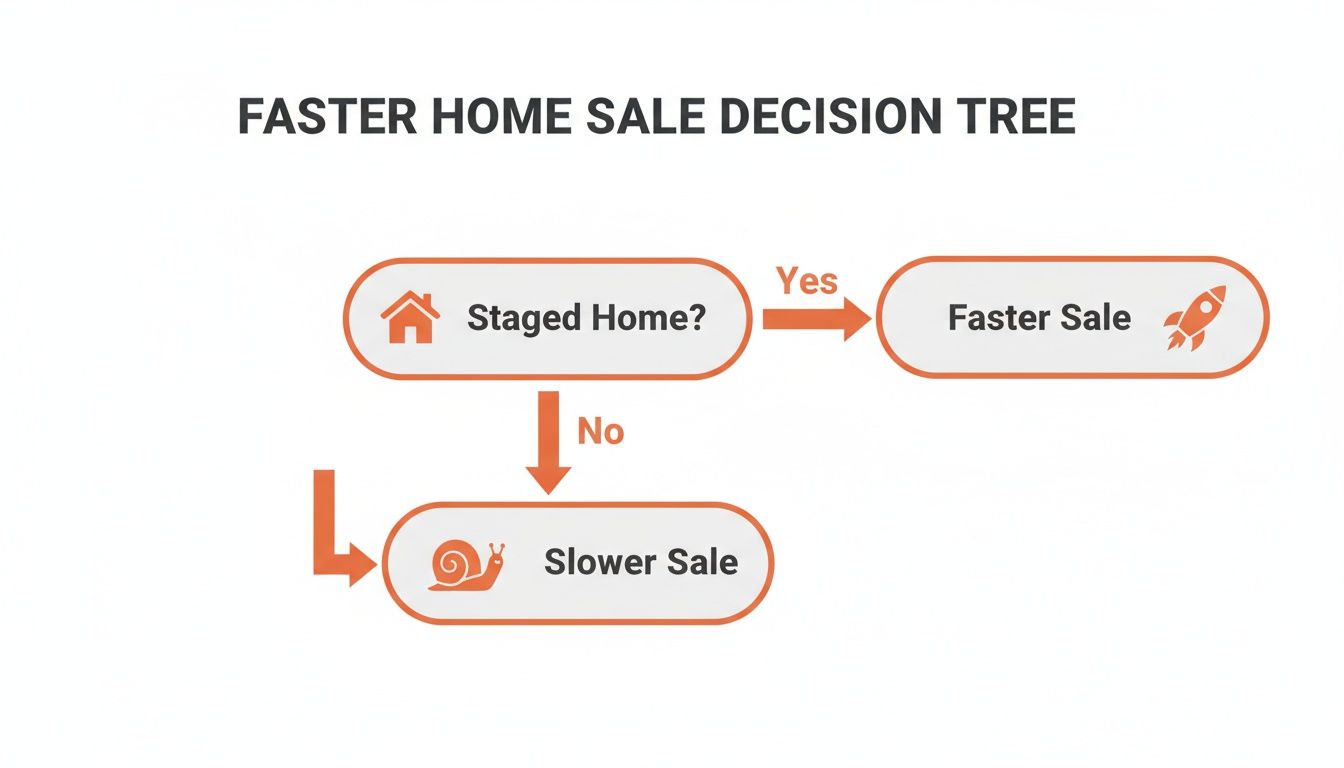
The takeaway is crystal clear. Choosing to stage a property puts it in the express lane, while leaving it empty is a gamble that almost always results in more days on market.
The Digital Alternative: Standard Virtual Staging
Virtual staging showed up as a game-changer, offering a budget-friendly way to furnish a home digitally. An agent sends photos of empty rooms to a designer, who then uses 3D models and photo editing software to place furniture and decor into the images.
The main draw is the price. It costs just a tiny fraction of physical staging, which opens the door for agents to stage almost any listing, regardless of price point. It’s the perfect fix for vacant properties, helping buyers see past the empty shell and imagine the home’s true potential.
Want a deeper look? Check out our complete virtual staging guide.
The catch? It’s a trade-off between cost and time. The process can drag on for days, and if you need revisions, you’re back in the queue. That back-and-forth can create frustrating delays right when you’re trying to get a listing live.
The Modern Solution: AI-Powered Staging
AI staging is the next leap forward, automating the entire process with intelligent tech. Instead of emailing photos to a designer and waiting, agents can just upload a quick video of a room. The AI does the rest—suggesting design styles and generating a whole library of high-quality staged images in minutes.
It’s truly the best of both worlds: the affordability of virtual staging with a speed that’s in a class of its own.
With AI-powered tools like Bounti, you get unbelievable efficiency. You can instantly declutter a messy room, give a dated kitchen a modern facelift, or even show what a full renovation could look like—all from your phone.
The flexibility here is what really changes the game. Need to show a spare bedroom as a home office, a nursery, and a guest room to appeal to different buyers? AI can knock that out in minutes. This lets you create hyper-targeted marketing visuals that were simply never possible before, all without the extra costs or delays.
Home Staging Method Comparison for Real Estate Agents
To make the decision even clearer, we've broken down how these three methods stack up against each other. This table compares the critical factors—cost, speed, and flexibility—to help you pick the right tool for your next listing.
Ultimately, having all three options in your toolkit is what makes you a versatile and effective agent. You can pull out the perfect solution for any client, any property, and any budget.
Integrating AI Staging into Your Real Estate Workflow
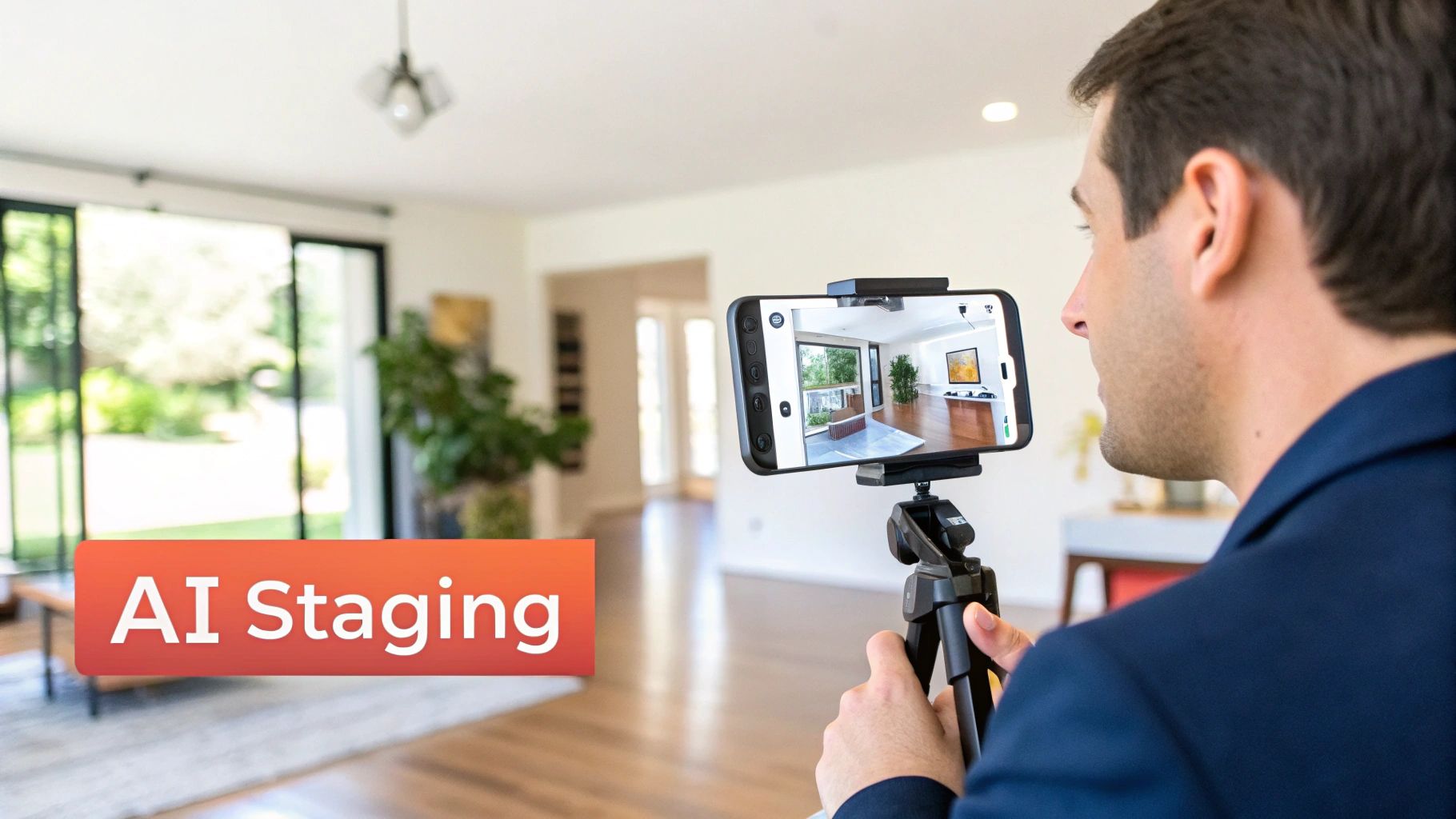
Getting the raw material for AI staging is as simple as it looks. You don’t need a production crew—just the phone you already carry everywhere.
This simple capture process is what puts high-end marketing within reach for every single listing, not just the million-dollar ones.
Step 1 Capture the Space During the First Walkthrough
Your AI staging workflow starts the second you walk through the door of a new listing. While you're talking with the client and taking notes, just pull out your smartphone. Your new goal is to grab a simple, steady video of each room you plan to feature.
That’s it. No need to schedule a separate trip for a photographer just to get staging shots. You’re grabbing all the visual data you need right then and there, saving yourself—and your client—a ton of time and hassle.
Think of it as your new listing appointment superpower. As you’re talking numbers and marketing strategy, you’re also creating the foundation for a complete set of stunning visuals. It's a proactive move that shows immediate value to your sellers.
Step 2 Instantly Generate a Full Suite of Marketing Assets
Got the video? Now the AI platform does the heavy lifting. With a tool like Bounti, you just upload the clip and let the system go to work. It’s not just staging a photo; it’s building out an entire marketing kit from one video.
In a matter of minutes, the AI can:
- Pull High-Quality Stills: The software scans your video and intelligently extracts the sharpest, most compelling frames to use as your base photos.
- Create MLS-Ready Photos: It doesn’t just pull the stills; it automatically enhances and optimizes them for Zillow, Redfin, and your local MLS.
- Draft Compelling Property Descriptions: The AI even analyzes the visuals and property data to write engaging listing copy that sells.
This is more than a time-saver—it’s a complete overhaul of the old, slow process. The days of waiting on photographers, stagers, and copywriters are over. You can have a listing almost ready to launch before you even back out of the driveway.
It's this kind of speed and efficiency that’s fueling a boom in the home staging market, which is projected to grow at a CAGR of 9.10% from 2020 to 2033 as buyer expectations for top-tier visuals soar.
Step 3 Transform Any Space with a Single Click
This is where AI staging really changes the game for home staging real estate. Once your photos are generated, you can apply different design styles, declutter a messy room, or even visualize potential renovations with a click.
Let's say you're listing a house with a dated, cluttered kitchen. Instead of trying to tell buyers about its potential, you can show them.
With AI, you can present multiple versions of the same space. One click declutters the existing countertops. Another applies a 'Modern Farmhouse' restyle. A third can showcase a full gut renovation with new cabinets and an open-concept layout.
This level of visual marketing used to be reserved for big-budget developers. Now, any agent can offer this for any listing. And as you get deeper into it, specialized AI product staging tools can take your visual marketing even further.
Before and After The Power of AI Visualization
The real "aha!" moment comes when you see the before-and-afters. AI staging bridges the gap between what a property is and what it could be.
- The Lived-In Family Home: It’s impossible for sellers to pack up their entire life for photos. AI can digitally erase the family pictures, the kids' toys, and the general clutter, replacing it with neutral, inviting decor that helps more buyers picture themselves there.
- The Dated Kitchen: That 1990s oak kitchen is a dealbreaker for a lot of today's buyers. AI can restyle it with on-trend white cabinets, quartz countertops, and a modern backsplash, helping buyers see past the cosmetic work.
- The Vacant New Build: An empty room just looks cold and small online. AI can instantly furnish it in multiple styles—from Scandinavian to Mid-Century Modern—letting you connect with different buyer tastes.
This workflow doesn't just make your listings look better. It makes you a faster, smarter, and more strategic agent. You get a powerful tool that helps you win more listings and market them for the best possible outcome.
And if you want to take your visuals to the next level, check out our guide on the best AI photo editing software on the market today.
Common Home Staging Questions Answered
Even when agents and sellers see the numbers, a few practical questions always pop up before they commit to staging. Let’s get straight to the ones we hear most often so you can feel confident you’re making the right move.
Is Staging Worth the Cost for Lower-Priced Homes?
One hundred percent. People often think staging is just for luxury listings, but the ROI is massive across the board. For a more affordable home, great staging is what makes it pop in a crowded market.
It's the difference-maker that gets your listing noticed online, pulls in more foot traffic, and helps you land offers at or above asking—which is a lot better than having to stomach a price cut down the road. With new AI staging tools, it's also incredibly cost-effective to give any listing a professional touch.
Can You Stage an Occupied Home?
You absolutely can, and this is where technology has become a game-changer for agents. Trying to physically stage a home while the sellers are still living there is a logistical nightmare. But AI-powered tools make it simple.
You can walk into a room full of family photos and personal clutter, snap a few pictures, and instantly generate images of a clean, perfectly staged space. This lets you market the home’s true potential without asking your clients to pack up their entire lives. Talk about a stress-saver.
How Do Buyers Really Feel About Virtually Staged Photos?
Buyers love it—as long as you’re upfront about it. High-quality virtual staging helps them see past an empty, sterile space and actually picture themselves living there. It creates an emotional pull that a vacant room just can’t match.
The golden rule here is transparency. Always, always label virtually staged photos clearly in your marketing and on the MLS. Honesty builds trust. Buyers can appreciate the vision you're showing them while still understanding what the physical space looks like.
Modern AI also creates hyper-realistic results that are worlds away from the clunky, obviously fake staging of the past.
Which Rooms Should I Stage First?
If you’re on a budget, you need to focus your efforts where they'll have the biggest impact. Buyers are emotionally drawn to certain rooms more than others, and the data backs this up.
According to the National Association of Realtors, these are the heavy hitters:
- The Living Room: This is where buyers picture themselves relaxing after a long day or hosting friends.
- The Primary Bedroom: It needs to feel like a private, peaceful escape.
- The Kitchen: People still call it the heart of the home for a reason. A great kitchen can seal the deal.
Nailing the staging in these three areas will give you the most bang for your buck and make the strongest impression on potential buyers.
Ready to see this in action? With Bounti, you can declutter, restyle, and stage an entire property from a single video in just minutes. It’s the simplest way to make sure every home you list looks its absolute best. Find out how Bounti's AI assistant can help you win more listings at https://www.bounti.ai.