Picking the right property management software is a huge decision. Get it right, and you’ve built an operational backbone that automates everything from rent collection to keeping tenants happy. Get it wrong, and you're stuck with glorified spreadsheets that create more work than they save.
A proper property management software comparison is the only way to cut through the noise and find a platform that actually fits how you do business.
Choosing Your Property Management Software

The property tech scene has exploded. We’ve moved way past simple rent collection tools. Today’s platforms are full-blown command centers for leasing, maintenance, accounting, and tenant communications, all in one place. This isn't just about convenience; it's about making smarter, data-driven decisions.
The market growth tells the same story. Valued at USD 7.1 billion in 2025, it’s expected to hit USD 17.1 billion by 2035—that’s a compound annual growth rate of 9.3%. Clearly, these digital tools are no longer optional for managing real estate effectively.
As you start looking, a detailed property management software comparison is your best friend for navigating this crowded space.
Key Evaluation Criteria
Before you start getting demos and comparing logos, you need a framework. The best software for a DIY landlord with two units is completely different from what a large brokerage needs. It all comes down to your specific business model.
Here’s what you absolutely need to nail down:
- Core Functionality: Does it handle the basics—tenant and lease management, maintenance tickets, and accounting—without causing headaches?
- Scalability: Can this platform grow with you? Or will you be forced to switch systems (and migrate all your data) in two years?
- User Experience: Is it intuitive? If your team, tenants, and owners can't figure it out easily, it’s a failure, no matter how many features it has.
- Integration Capabilities: Does it play nice with other tools you rely on, like marketing platforms or smart home tech? A siloed system is a dead end.
The best software isn't just a tool; it's a strategic partner. It should solve today’s operational pains while being flexible enough to handle whatever the market—and your business growth—throws at it tomorrow.
Comparing Foundational Software Needs
Your business model dictates your priorities. A solo landlord just wants something that works on their phone. A mid-sized firm is focused on automating workflows to handle more doors without hiring more people.
Let’s break down how different needs stack up.
In the end, this is a balancing act between features, cost, and pure usability. If you have a crystal-clear picture of your operational needs, you’ll find a platform that truly empowers your business. This guide will give you the analysis you need to make that choice confidently.
If you want to dive deeper into streamlining your operations, you can learn more about the tools available to improve your property management workflows.
Comparing Core Features Of Leading Platforms
You have to look past the marketing slicks to find out how property management software really works day-to-day. A platform can list a hundred features, but its actual value comes out when you're trying to run payroll, handle a late-night maintenance call, or get a lease signed.
Let's cut through the noise and look at how top platforms like AppFolio, Buildium, Entrata, and Yardi handle the fundamentals. This isn't just a checklist; it's a look at the nuance of each system to see where they shine and where they might fall short for your specific needs. As you start digging in, it's smart to see how different tools stack up against each other, for example by checking out a direct comparison like Chalet vs. other property management solutions.
To get a clearer picture of how these platforms differ in practice, let's break down their core functionalities side-by-side.
Side-by-Side Core Feature Analysis
The table below offers a snapshot of how each platform approaches the essential pillars of property management. It’s designed to help you quickly identify which system aligns best with your portfolio's complexity and operational style.
This comparison highlights the trade-offs: AppFolio’s slick automation, Buildium’s simplicity, Yardi's enterprise-grade power, and Entrata's focus on the multifamily leasing machine. Your "best" choice depends entirely on which of these strengths solves your biggest operational headaches.
Financial Management And Accounting
The accounting module is the heart of your software. It has to be accurate, compliant, and transparent—no exceptions. While every platform handles basic rent collection, the differences become obvious when you get into more complex financial tasks.
Yardi Voyager has long been the heavyweight champion for massive, complex portfolios, especially in commercial real estate. Its strength is its deep accounting modules that can wrestle with job costing, complex budgeting, and granular CAM reconciliations. But all that power comes with a notoriously steep learning curve and clunky UI, making it total overkill for most firms.
AppFolio, on the other hand, delivers a powerful accounting suite that’s surprisingly easy to use. It automates tricky CAM reconciliations and spits out owner statements instantly, making it a favorite for mixed portfolios. Its mobile-first approach means you can approve an invoice from the field, which is a game-changer for managers who aren't chained to a desk.
For smaller to mid-sized portfolios, Buildium provides a rock-solid accounting core. It nails the essentials like online ACH payments and security deposit management. You won't find the deep customization of Yardi, but its clean interface makes it far easier for non-accountants to run the daily finances without getting lost.
Entrata strikes a balance, offering robust accounting tools that are fine-tuned for large multifamily and student housing operators. Its open API is a huge plus for integrating other financial tools, though its reporting can feel less flexible than what big enterprises sometimes need.
The real differentiator today is how deeply AI is integrated into the accounting workflow. The best systems are now using it to process invoices and enter data automatically, which slashes manual work and pretty much eliminates human error.
The entire industry is moving to the cloud for exactly this reason. Cloud-based property management software is leaving on-premise solutions in the dust, driven by the need for scalability, remote access, and AI features. In fact, the accounting and cash flow segment is projected to grow at a 12.0% CAGR—the fastest of any category—all thanks to the accessibility and automation the cloud enables.
Tenant And Lease Administration
Managing tenants isn't just about filing away a PDF of the lease. It's a constant loop of communication, renewals, and making sure you're compliant. The best platforms turn this into one smooth, centralized workflow.
AppFolio really gets this right. Its system is unified, handling everything from the initial online application and tenant screening to digital lease signing and automated reminders when it's time to renew. The tenant portal becomes the single source of truth for paying rent, logging maintenance, and sending messages, which goes a long way toward keeping residents happy.
Here's a look at AppFolio's clean interface, which shows its commitment to a simple user experience.
The dashboard gives you a quick, visual summary of your most important metrics, letting you see how the portfolio is doing at a glance.
Entrata is also a powerhouse here, with leasing tools designed to manage the entire resident journey. It has strong marketing features baked right into its leasing process, making it a go-to for operators who are laser-focused on keeping occupancy rates high.
Buildium offers great tenant and owner portals that make communication easy and transparent. Its lease management tools are perfect for residential properties—simple and effective. They might not have the heavy-duty customization needed for a complex commercial lease, but for most, they work perfectly. Yardi’s tenant tools are powerful, but they can feel disconnected across different modules, which means more setup and training time.
Maintenance Coordination Workflows
Handling maintenance efficiently is how you protect the value of your asset and keep your tenants from leaving. This is where automation and mobile access aren't just nice to have—they're essential. A work order shouldn't be a black hole; it needs a clear, trackable path from the moment it's submitted to the moment it's resolved.
This is where AppFolio's AI-driven approach really pulls away from the pack. Its system can actually read an incoming tenant request, figure out what kind of vendor is needed, dispatch them automatically, and keep the resident in the loop without a human ever touching it. That level of automation saves an incredible amount of time and prevents things from slipping through the cracks. Plus, your field staff can use the mobile app to upload photos and update work orders right from the property.
Buildium offers a solid and very intuitive maintenance ticketing system. Tenants submit requests through their portal (with photos), and managers can assign vendors and track everything in one place. It doesn't have the fancy AI of AppFolio, but it’s a super effective tool for managing maintenance for small to mid-sized portfolios.
Entrata's maintenance tools are split into different apps for facilities and leasing staff, which can make the workflow feel a bit disjointed. Yardi provides incredibly detailed maintenance management, but true to form, it’s part of a massive, complex system that requires a serious investment in training to use properly.
Leasing Automation And Marketing
In a tight market, how fast you can fill a vacancy is everything. Modern software does more than just push your listing out to Zillow. It automates the entire funnel, from the first inquiry to the final signature, to shrink your vacancy time.
Entrata is a leader here, with a clear focus on marketing and leasing. Its platform is built to help managers track leads, schedule tours, and automate follow-ups at scale. It's especially powerful for large multifamily operators juggling a high volume of prospects.
AppFolio weaves its marketing and leasing tools directly into the main platform. It offers virtual tour integrations and an AI leasing assistant that can handle initial lead qualification and even schedule showings on its own, freeing up your leasing agents to focus on closing. This end-to-end automation helps you move prospects through the pipeline much faster.
Buildium covers the basics with listing syndication and online applications, which is plenty for many smaller landlords. It just doesn't have the sophisticated lead management and automation you see in platforms built for larger operations. Yardi has powerful marketing tools, but they’re often sold as separate add-ons, which drives up the cost and complexity.
Matching Software To Your Business Model
The single most important feature in any property management software is how well it fits your actual business. Let's be honest: a solo landlord and a large brokerage operate in completely different universes, and their tech stack should reflect that. This is where we break down the best-fit solutions for different business models, helping you find a platform that solves today's headaches and is ready for tomorrow's growth.
Your portfolio size is the first, most critical fork in the road. This decision tree shows how your unit count should frame your initial search.
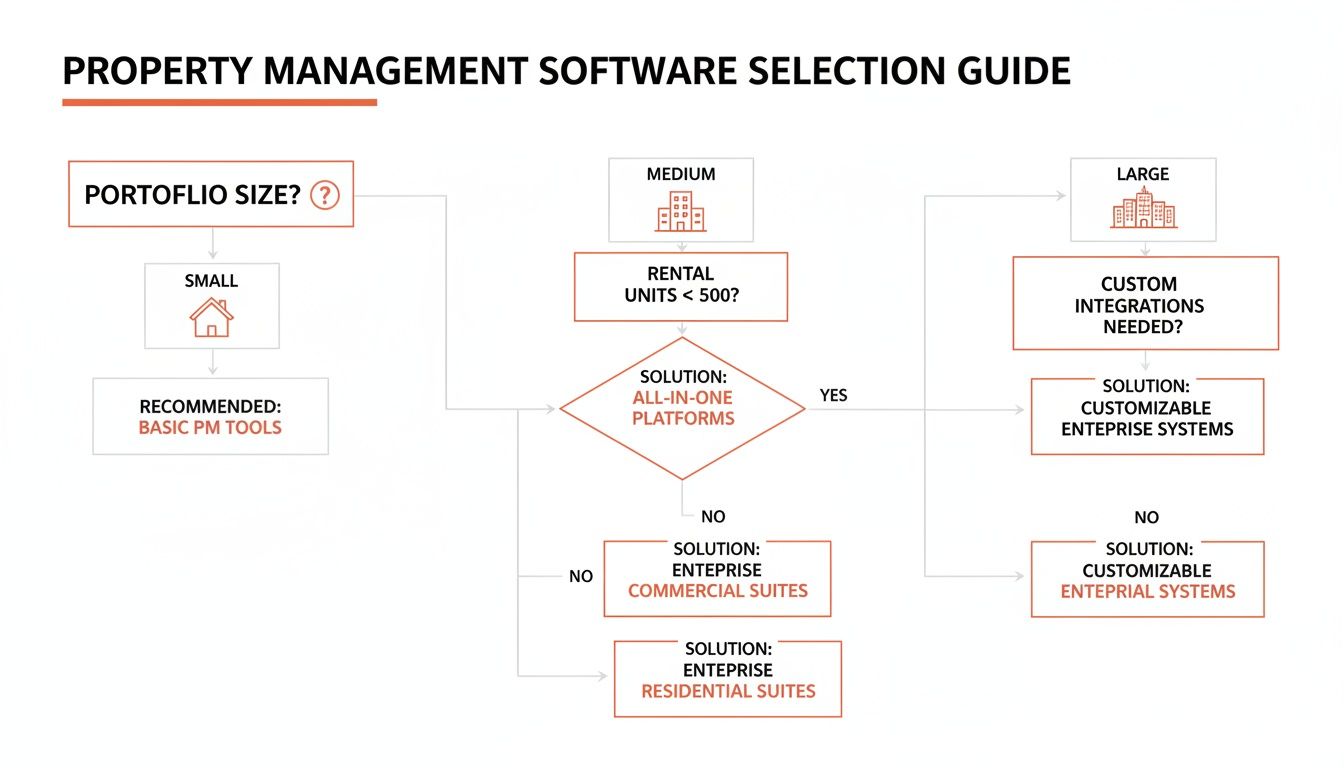
As you can see, the path splits quickly depending on whether you're managing a few properties or a huge portfolio. One size definitely does not fit all.
For The Individual Landlord And Small Portfolio Owner
If you’re managing a handful of properties, your world revolves around simplicity, mobile access, and just getting things done efficiently. You don't need a system bogged down with complex CAM reconciliation tools or granular user permissions. What you do need is a tool that automates rent collection, gives tenants an easy way to submit maintenance requests, and offers basic expense tracking you can pull up on your phone.
Platforms like Buildium or DoorLoop really nail this. They're built for ease of use, with clean interfaces that don't demand weeks of training. More importantly, their mobile apps are usually solid, letting you run your properties from anywhere.
For a small landlord, the best software feels like a simple, reliable tool—not a complex enterprise system. The goal is to cut down on admin work so you can focus on your tenants and properties.
My advice? Steer clear of platforms built for massive operations. Their feature lists might look impressive, but they come with a steep learning curve and a price tag that just doesn't pencil out for a smaller unit count. The complexity will end up creating more work, not less.
For The Mid-Sized Firm Focused On Growth
Once your portfolio blows past 50-100 units, your needs change—fast. Efficiency is still crucial, but now scalability and automation become the name of the game. You need a platform that can handle more doors without forcing you to double your staff. At this stage, a truly unified system becomes non-negotiable.
There’s a reason AppFolio is a major player here. Its platform is wired for automation, from AI-assisted maintenance coordination to slick leasing workflows. These aren't just bells and whistles; they're features designed to help you scale without chaos. Things like owner portals, deep reporting, and integrated accounting go from "nice-to-have" to absolutely essential for managing a growing business and keeping clients happy.
Look for software that delivers:
- Automated Workflows: Systems that can handle the routine grind—rent reminders, lease renewals, lead follow-ups—without you lifting a finger.
- Robust Reporting: The power to generate detailed financial statements, occupancy reports, and performance analytics with just a few clicks.
- Integrated Communications: A central hub for all tenant, owner, and vendor messages to keep everyone in the loop and create a clear paper trail.
For Large Residential Brokerages And Enterprises
At the enterprise level, the game changes again. You're juggling large teams, intricate financials, and maybe even mixed portfolios of residential, commercial, and HOA properties. Your software has to provide absolute control, deep analytics, and enterprise-grade security.
Platforms like Yardi Voyager and RealPage have traditionally owned this space. They offer incredibly powerful accounting modules that can handle complex financial structures and strict compliance requirements. You get the ability to set highly specific user permissions, build custom reports from the ground up, and integrate with a whole ecosystem of other proptech tools. The trade-off is often a less intuitive user experience and a serious investment in implementation and training.
Entrata is another heavy hitter, especially for large multifamily operators, with an intense focus on the entire resident journey from first contact to renewal. For big firms, knowing how to build and support high-performing real estate teams is just as critical as the software they run on.
For Specialized Commercial Property Managers
Commercial property management brings a whole different level of financial complexity that most residential-focused platforms just can't touch. You absolutely need the ability to manage Common Area Maintenance (CAM) charges, calculate tricky lease escalations, and track retail sales data.
While platforms like Yardi have long been the go-to for commercial, AppFolio has also made serious inroads with its commercial features, offering tools like automated CAM reconciliations that take the pain out of these intricate financial tasks. When you're vetting software for a commercial portfolio, your first and last question should be about the depth and flexibility of its accounting module. Make sure it can handle your specific lease structures and reporting needs without clumsy workarounds.
Evaluating Software Pricing And Scalability
The sticker price on a piece of software is just the opening bid. To really compare property management platforms, you have to look past the monthly fee and calculate the total cost of ownership. That means getting real about implementation fees, data migration charges, mandatory training, and support costs that can blow up your budget without warning.
Many platforms hook you with a simple per-unit, per-month model, but that can get expensive fast as you add doors. Others use tiered plans that lock critical features behind a more expensive subscription, forcing your hand when you need just one more tool. Getting a handle on these pricing games is the key to picking a platform that fuels your growth, not one that becomes a financial anchor.
Uncovering Hidden Costs
The monthly subscription is just the beginning; the real costs are often buried in the fine print. When you're talking to sales reps, you need to ask direct questions to get a clear picture of what you'll actually spend in your first year.
Here’s what you need to dig into:
- Implementation and Onboarding: Is there a one-time setup fee? Does it cover real training for your whole team, or is that extra?
- Data Migration: Moving years of financial and tenant data is messy. Most vendors charge a hefty fee for this, often based on how many units you have or how complex your records are.
- Payment Processing Fees: Online rent collection is a must-have, but the transaction fees for ACH and credit cards can be all over the map. Some platforms push these fees to tenants, while others skim off the top.
- Add-On Modules: Need better reporting, a marketing suite, or API access? Expect those to be sold as separate add-ons, each with its own monthly price tag.
The most affordable software on day one may become the most expensive by year three. A scalable pricing model is one that supports your growth, rewarding your expansion instead of penalizing it with disproportionate cost increases.
From 50 To 500 Units: Scalability In Practice
A platform that feels perfect for 50 units can turn into a complete nightmare at 500. True scalability isn't just about handling more data—it’s about whether the software’s cost and features can grow with you without forcing a painful switch to a new system down the road.
That simple pricing model might look great now, but if it doesn't offer volume discounts, your software bill could skyrocket as you expand. It’s a classic trap for growing firms.
For example, take a look at the pricing tiers from Buildium. They're clearly built around unit count and what features you get at each level.
This tiered model shows you exactly how costs climb with your portfolio. Notice how things like advanced analytics and an open API are held back for the higher-priced plans—a make-or-break detail for an ambitious business.
Assessing The Total Cost Of Ownership
To make a smart financial call, you need to map out your projected costs over the next three to five years. Think about your growth targets and how each platform's pricing will scale alongside you.
Let's run a quick scenario:
- Platform A: Looks cheap at $1.50 per unit per month, but they hit you with a $5,000 setup fee and charge extra for premium support.
- Platform B: Costs more upfront at $2.50 per unit, but setup, migration, and ongoing support are all included.
At 100 units, Platform A seems like the obvious winner. But once you hit 500 units and find yourself needing more support, the all-inclusive model of Platform B becomes way more predictable and cost-effective. You have to look at the entire picture to make sure your software remains an asset, not just another bill that gets bigger every year.
Integrating Visual Marketing Into Your Workflow

Let’s be honest: in today's rental market, a listing lives or dies by its visuals. While your property management software is the mission control for operations—tracking leases, handling maintenance, and syndicating listings—it's not a creative studio. Most platforms are built for logistics, not for creating the kind of high-impact photos and videos that actually grab the attention of great tenants.
This creates a serious bottleneck in the leasing process. A property manager flags a unit as vacant in their system, but then the real scramble begins. They have to juggle expensive photographers, stagers, and copywriters just to get a compelling listing together. It's a disjointed, slow, and expensive process that often leads to inconsistent quality, dragging out vacancy periods and eating into your ROI.
The solution isn't to ditch your PM software; it’s to bridge the gap. By plugging specialized visual marketing tools into your workflow, you let your core platform do what it does best (operations) while a dedicated tool handles the creative heavy lifting.
A Modern Leasing Workflow Example
Imagine a unit becomes available. You update its status in your PM software to kick off the leasing cycle. But instead of reaching for the phone to book a photographer, the process looks completely different.
Here’s how a modern, tech-forward workflow plays out:
- Capture Raw Content: You or a team member walks the property and shoots a single, continuous video with a smartphone. No fancy gear required.
- Generate Visual Assets: That video gets uploaded to an AI tool like Bounti. The platform automatically scans the footage, pulls out high-resolution stills, and enhances them into MLS-ready photos.
- Enhance and Stage: For an empty or dated unit, you can instantly add AI virtual staging, declutter the space, or even apply digital renovations to show prospects what’s possible.
- Create Compelling Copy: At the same time, the AI writes an engaging, SEO-friendly property description based on what it "sees" in the video.
This whole marketing package can be ready in minutes, not days. The polished photos and description are then uploaded right back into your property management software and pushed out to Zillow, Apartments.com, and other portals.
This integrated workflow transforms marketing from a logistical headache into a strategic advantage. You’re not just filling vacancies faster; you’re elevating your brand and attracting tenants who are willing to pay a premium for a well-presented property.
The ROI Of A Visual-First Strategy
This approach does more than just save time—it delivers a real return on investment that makes your core PM software even more valuable. The most obvious win is the drastic cut in marketing costs. Professional real estate photography can easily run hundreds of dollars per unit, and physical staging can cost thousands. With an AI tool, those recurring expenses are gone.
On top of that, you accelerate the entire leasing cycle. It's a simple fact: better visuals get more clicks and generate more inquiries, more tours, and better-qualified applicants. The faster you sign a lease, the less you lose in vacancy costs, which directly boosts the property’s net operating income. If you're curious about how AI is changing property visuals, check out our guide on the best AI photo editing software.
Ultimately, when you pair your operational software with a powerful visual marketing tool, you create a seamless, end-to-end leasing machine. This combination ensures every part of your process, from accounting to the final showing, is firing on all cylinders—making it a crucial factor in any complete property management software comparison.
Common Questions About Property Management Software
Picking the right platform is a huge decision, so it's normal to have questions that go way beyond a feature checklist. We’ll tackle some of the most common—and most important—questions that come up when you’re deep in a property management software comparison.
How Long Does It Take To Implement New Software?
There’s no single answer here. A solo landlord with a few properties might be up and running in a couple of days. But for a mid-sized firm, let alone a large one, you’re looking at a much more involved process.
The biggest hurdle is almost always migrating historical data. Think about it: you’re moving tenant info, lease documents, and years of financial records. That’s a heavy lift. A realistic timeline for a full migration and rollout is anywhere from four to twelve weeks.
A few things can really move that timeline:
- Data Cleaning: How clean are your current records? If they’re a mess, they need to be standardized before anything can be imported.
- Staff Training: Your team needs to actually learn the new system. That means adapting old habits and daily workflows, which takes time.
- System Integrations: If you’re hooking the new software into your accounting platform or other tools, that adds another layer of complexity.
Always ask for a detailed, week-by-week implementation plan. Better yet, ask for references from clients with a portfolio your size. Get the real story on how long it actually takes, not just the sales pitch.
What Are The Most Critical Features For A Small Landlord?
Small landlords are playing a different game. They need efficiency, not complexity. The best tools are the ones that automate the core, time-sucking tasks and can be used from anywhere. You should be looking for simplicity and a killer mobile app.
Here’s what to prioritize:
- Effortless Online Rent Collection: This is non-negotiable. It needs to be dead simple for tenants to pay and for you to track who’s paid and who hasn’t.
- Mobile Accessibility: You’re not chained to a desk. You need to handle maintenance requests and text with tenants while you’re on the go.
- Basic Expense Tracking: Just a clean, simple way to log what you’re spending and pull basic reports when tax time rolls around.
Compare that to a large property management company. They’re focused on control, deep analytics, and managing a team. They need features like trust accounting, super-customizable reporting, and user permissions to control who sees what. Their software is the central nervous system for a complex business.
Can I Switch Property Management Software Easily?
Let’s be direct: switching is a major project. It’s absolutely doable, but don't underestimate the effort. The biggest challenge, by far, is data migration. Moving years of detailed records from one system to another is a delicate operation where one mistake can cause massive headaches.
You have to make sure every historical financial record, lease agreement, and maintenance ticket gets exported cleanly and imported accurately. Then you have to audit everything to make sure nothing got lost or scrambled in the move.
Because it’s such an intensive process, you have to get your choice right the first time. Max out those free trials, sit through multiple demos, and talk to current users who run a business like yours. And before you sign anything, read the fine print on data ownership and export capabilities. That way, if you do need to make a change down the road, you’ll be able to get your data out without a fight.
Ready to create stunning visuals for your properties in minutes? With Bounti, you can transform a simple video walkthrough into a complete marketing package with MLS-ready photos, virtual staging, and compelling descriptions. See how it works at bounti.ai.