
Think of a real estate virtual assistant as the mission control for your business. They're the remote pros who handle all the administrative, marketing, and operational headaches so you don't have to.
They manage the complex logistics—the scheduling, the marketing campaigns, the lead follow-ups—allowing you to focus squarely on what makes you money: showing homes and closing deals.
What Is a Modern Real Estate Virtual Assistant

The old idea of a virtual assistant was someone who just answered emails and managed a calendar. That’s changed. Today's real estate VAs are strategic partners, an absolutely essential piece of any top-producing agent's toolkit. They aren't just managing your inbox; they're helping you manage your growth.
This isn't just a fleeting trend. It’s a fundamental shift in how the real estate business gets done. The global market for these services was valued at USD 785.50 million and is on track to hit USD 1,850.30 million by 2032. That's a massive 11.7% compound annual growth rate, as detailed in this market report, with North America leading the way.
The Core Value Proposition
When you boil it down, a real estate VA sells one thing: your time. Every hour you sink into tedious, low-impact tasks is an hour you’re not spending on activities that actually generate revenue. Think showing properties, negotiating offers, or nurturing client relationships.
A virtual assistant's primary job is to overhaul your workflow. They take the low-value tasks off your plate so you can pour your energy into the high-impact actions that directly grow your bottom line.
By offloading these responsibilities, you get back critical headspace and calendar slots. This shift lets you operate less like a frantic administrator and more like the CEO of your own business, focused on strategy and growth.
Two Types of Essential Support
Today, support for real estate pros comes in two main flavors, and knowing the difference is key to building a truly efficient operation. Each one has its own unique strengths.
- Dedicated Human VAs: These are skilled professionals who are brilliant at tasks needing a human touch—things like nuance, creative problem-solving, and personal interaction. They're perfect for transaction coordination, client communication, and navigating complex issues.
- Powerful AI Assistants: This is where tools like Bounti come in. AI is built for speed, scale, and data-heavy tasks. An AI assistant can whip up a dozen unique property descriptions or generate multiple virtual staging concepts in minutes—a job that would take a person hours to complete.
The smartest agents aren't picking one over the other. They’re building a hybrid system.
They lean on a human VA for the high-touch, relationship-focused work and unleash an AI assistant for high-volume content and creative asset generation. This combination creates a powerful, efficient engine that drives productivity through the roof.
What Can You Actually Hand Off to a Real Estate VA?
Knowing you can hire a virtual assistant is one thing. Knowing exactly what to take off your plate is where the magic happens.
The goal isn't just to get rid of busywork. It's to strategically delegate the tasks that keep you from doing what only you can do: building relationships and closing deals. Most of these tasks fall into three buckets: admin, marketing, and lead management.
Think of these as the support beams of your business. By handing them over, you free yourself up to focus on the high-value, dollar-productive activities that actually grow your income.
Administrative Powerhouse
Admin tasks are the engine of your business, but you shouldn't be the one stuck in the engine room. These are the critical, repetitive jobs that keep things running smoothly but can easily eat up more than a third of your week. A great real estate VA turns that operational drag into a well-oiled machine.
Common admin tasks include:
- Calendar and Schedule Juggling: Your VA can coordinate showings, schedule client meetings, and book inspections, making sure your calendar is tight, efficient, and free of conflicts. You just have to show up prepared.
- Transaction Coordination: From drafting offers to chasing down signatures and checking in with lenders and title companies, a VA can own the entire contract-to-close checklist. They make sure nothing gets missed and every deadline is met.
- Inbox Triage: Instead of drowning in a sea of emails, your VA can screen your inbox, handle routine questions, and flag only the messages that need your personal touch.
This kind of support shifts your workflow from reactive to proactive, instantly giving you back hours in your day.
Marketing Acceleration
Consistent marketing is absolutely essential for growth, but it's usually the first ball to get dropped when you're busy. A real estate VA can execute your marketing plan with precision, keeping your brand front and center.
Handing over marketing execution isn't about losing control. It's about empowering a specialist to consistently create high-quality materials that pull in leads while you focus on converting them.
A marketing-savvy VA can tackle a huge range of tasks to keep your pipeline full.
Here’s what that looks like:
- Social Media Management: A VA can build out a content calendar with "Just Listed" tours, "Under Contract" updates, and slick client testimonial graphics. They handle the posting, scheduling, and basic community engagement so you don't have to.
- Content Creation: Whether it's writing blog posts about local market trends or designing property flyers and email newsletters, a VA can produce the content that cements your status as the go-to expert.
- Listing Support: They can get your new listings loaded onto the MLS and other sites, write property descriptions that sell, and make sure every photo and detail is perfect.
With an assistant driving your marketing, your brand builds momentum even when you're tied up with clients.
Lead Nurturing and Management
Finally, every incoming lead is a potential commission. A real estate VA can be your first line of defense, making sure no opportunity slips through the cracks. They manage the top of the funnel so you can step in when a lead is qualified and ready to talk.
This usually involves a few key steps:
- CRM Cleanup: Your VA makes sure every new lead is logged correctly in your CRM, keeps contact info updated, and ensures your database stays clean and valuable.
- Initial Lead Qualification: They can field the first wave of inquiries from your website or Zillow, ask a few qualifying questions via email, and separate the serious buyers from the casual lookers.
- Appointment Setting: Once a lead is qualified, your VA can seamlessly book an initial call or consultation right on your calendar. All you have to do is take the meeting.
By delegating these foundational tasks, you build a system that captures and nurtures every single opportunity, giving you the best shot at growing your business.
Choosing Between Human VAs and AI Assistants
The conversation around getting help in real estate has shifted. It's no longer just about hiring an assistant; it's about choosing the right kind of help for the right job.
Deciding between a human real estate virtual assistant and an AI assistant isn’t about figuring out which one is "better." Instead, think of it like building a toolkit. You need different tools for different tasks, and the smartest agents know when to use which one.
A human VA is like a skilled artisan. They bring nuance, emotional intelligence, and creative problem-solving to your business. You lean on them for building client relationships, navigating the delicate back-and-forth of a tricky transaction, or handling unique problems that just need a human touch.
An AI assistant, on the other hand, is a high-performance engine. It's built for speed, scale, and repetitive, data-heavy tasks. An AI doesn't get tired, it doesn't have an off day, and it can process and create at a velocity no human can possibly match. The real skill is knowing when to call on the artisan and when to fire up the engine.
Analyzing Strengths Task by Task
To build a powerful, hybrid support system, you first have to understand where each type of assistant truly shines. Their core strengths aren't interchangeable; they're complementary. A human excels at high-touch interactions, while an AI dominates high-volume production.
Your human VA is your go-to for anything requiring empathy and complex negotiation. They're perfect for calming a frustrated client, interpreting the subtle tone of an email from another agent, or managing the intricate, multi-party communications needed to get a deal to the closing table.
AI, however, is the perfect solution for tasks that are definable and repeatable but incredibly time-consuming. Think of generating dozens of social media posts, analyzing market data, or creating marketing visuals from scratch.
The modern approach is to use human expertise for high-touch, relationship-driven work and deploy AI for high-volume, data-driven asset creation. This hybrid model maximizes efficiency without sacrificing the personal touch that defines real estate.
The Power of AI in Asset Creation
One of the biggest game-changers with AI assistants is in creating content and visual assets. This is where a tool like Bounti completely flips the script on an agent's workflow and marketing capabilities.
Imagine you just walked through a new listing. It's cluttered, dated, and tough to photograph. The old way? You'd hire a stager, then a photographer, then a copywriter. That process could take days or even weeks and cost a small fortune.
An AI-powered real estate AI assistant turns that entire workflow on its head.
- Automatically generate multiple unique, MLS-ready property descriptions.
- Pull high-resolution stills for all your marketing materials.
- Create virtually staged photos of every room in different design styles.
- Even produce "before and after" renovation mockups to show a property's hidden potential.
This entire suite of marketing assets can be ready in minutes, not days. A task that would normally require a whole team of human contractors is handled by the AI for a fixed, predictable cost, giving you incredible scale. If you want to dig deeper into AI's role in content, check out this modern guide to content creation with AI.
The image below breaks down the three main pillars of tasks a real estate assistant typically handles, whether human or AI.
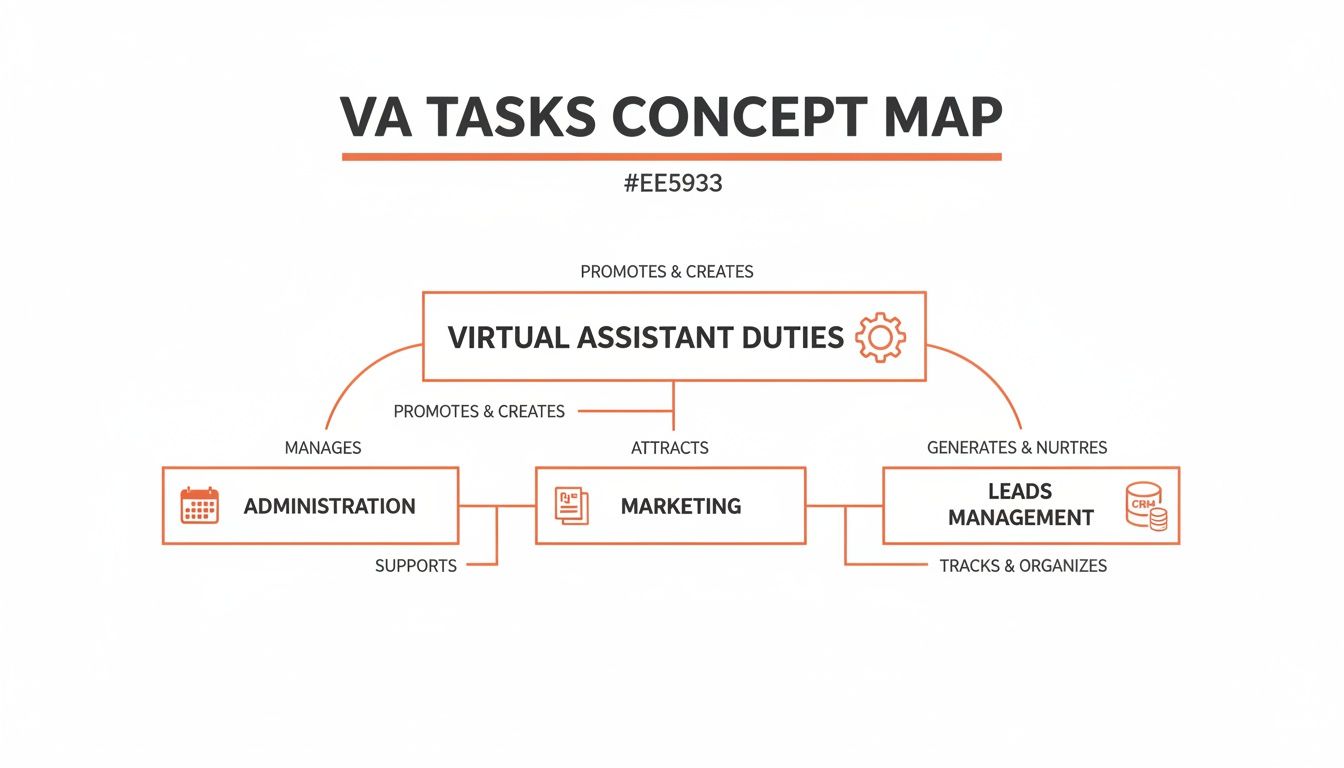
This visual helps clarify how both human and AI assistants can plug into your business across administrative, marketing, and lead management functions, each bringing their unique strengths to the table.
Making the Right Choice For Your Business
So, how do you decide where to start? The best way is to audit your own workflow. Pinpoint the bottlenecks that are costing you the most time and opportunity. This table can help you map your needs to the right solution.
Human VA vs AI Assistant Task Suitability
This breakdown makes it clear: it's not an "either/or" decision. The goal is to build a system where technology handles the scalable tasks, freeing up humans to manage the personal connections that drive the business.
By combining the strengths of a human real estate virtual assistant with an AI powerhouse like Bounti, you create a support structure that is both ruthlessly efficient and deeply personal.
How Top Real Estate Teams Use VAs

It's one thing to talk about what a real estate virtual assistant can do. It's another thing entirely to see how the top teams are actually putting them to work.
Let's get past the theory and look at some real-world scenarios. These aren't just about saving a little time here and there. They're about gaining a serious competitive edge, producing marketing that wows, and delivering a client experience that nobody else can match.
Think of these examples as clear "before and after" stories. Each one shows a shift from a slow, frustrating manual process to a fast, impressive result, all thanks to a smart blend of agent expertise and AI efficiency.
The Savvy Listing Agent Who Lists in Hours, Not Days
Meet Sarah, a busy listing agent who just landed a new property. The big problem? The home is packed with the owner's personal items, making it impossible to get good photos. The sellers are completely overwhelmed with their move and just don't have the bandwidth to declutter right away.
The Old Way: Sarah would have to call a stager, who might need a week just to do a consultation and prep the home. Then she'd book a photographer, which could easily add a few more days to the clock. All in, she's staring down a week or more of delays—with her clients getting more anxious by the day—before the home even hits the market.
The New Way with an AI Assistant:
Sarah does one quick walkthrough, capturing a video on her phone. She uploads it to her AI real estate virtual assistant, Bounti, and within minutes, she has a complete set of marketing assets ready to go.
- Instant Decluttering: The AI digitally scrubs all the clutter from the photos, revealing the home's true potential.
- Virtual Staging: She then applies beautiful, modern virtual staging to the now-empty rooms.
- Complete Marketing Kit: Bounti even whips up compelling property descriptions and social media captions based on the video.
The result? Sarah gets the property on the MLS that same afternoon, complete with stunning, professionally staged photos. Her clients are blown away by the speed, and the listing starts getting attention from buyers immediately.
By using an AI assistant, Sarah collapses a multi-day, multi-vendor process into a single afternoon. She saves thousands on staging and photography costs and gets a critical head start in a competitive market.
The Efficient Leasing Team That Fills Vacancies Faster
Now, let's look at a leasing team managing a large apartment building. They have several identical two-bedroom units sitting vacant. The challenge is that prospective tenants walk into an empty box and can't visualize how their own furniture will fit, which leads to hesitation and delay.
The Old Way: The team would show the same empty unit over and over, trying to verbally paint a picture for renters. They might have a single, physically staged model unit, but it only shows one style and can't be tailored to an individual's taste.
The New Way with an AI Assistant:
The leasing manager takes one video of a vacant apartment. Using Bounti, they instantly generate multiple furnished layouts for that exact floor plan.
- Multiple Design Options: In minutes, they create a version with a home office, another showcasing a nursery, and a third with a clean, minimalist vibe.
- Personalized Tours: When a prospect tours, the agent pulls up these different layouts on a tablet. "Do you work from home? Here’s how a desk could fit perfectly in the second bedroom."
- Digital Leave-Behinds: After the tour, they email the prospect their favorite virtually staged photos, keeping the property top-of-mind.
This personalized touch helps renters connect emotionally with the space, making them 73% more likely to apply. Vacancies get filled faster, which means less costly downtime for the property owner.
The Strategic Commercial Broker Who Sells Potential
Finally, picture Mark, a commercial broker trying to lease a raw, empty warehouse. It's a great location, but the concrete floors and exposed ductwork make it tough for potential tenants to see it as a vibrant office or retail spot.
The Old Way: Mark would have to rely on architectural renderings or complicated blueprints to show what's possible. These are expensive, take weeks to get, and can be hard for most people to understand. He’s stuck selling an idea, not a reality.
The New Way with an AI Assistant:
Mark shoots a simple video of the empty warehouse on his phone. He uses his AI assistant to generate photorealistic mockups of the finished space.
- He creates a concept showing a sleek, open-plan tech office with glass walls.
- Next, he generates a version as a high-end retail boutique with polished floors.
- Finally, he designs a mockup as a modern fitness studio.
Now, when he meets with different types of businesses, he presents a customized vision tailored to them. He’s no longer selling an empty box; he’s showing them their future headquarters. This kind of visual storytelling moves negotiations along faster and helps him close the deal at a premium lease rate.
How to Calculate the ROI of a Virtual Assistant
Hiring a virtual assistant, whether human or AI, isn't just about getting tasks off your plate. It's a business decision, and like any good investment, it needs to show a clear return. The good news is, proving that value is simpler than you might think.
We can break down the return on investment (ROI) into two buckets: recaptured time and direct financial growth. It starts by figuring out what your time is actually worth. An hour you spend wrestling with administrative work is an hour you’re not out there generating commissions.
Calculating the Value of Your Recaptured Time
First, let's put a real dollar value on your time. This quick calculation shows the immediate financial hit you take by doing low-value work yourself. The entire goal is to stop trading your valuable hours for tedious tasks and start investing them in client-facing activities that actually make you money.
Here’s a simple formula to find your hourly worth:
- Calculate Your Annual Gross Commission Income (GCI): Start with your total GCI from the last 12 months. Let's say it was $150,000.
- Estimate Your Total Hours Worked: Be honest about how many hours you work in a typical year. For example, 50 hours a week for 50 weeks comes out to 2,500 hours.
- Divide GCI by Hours: Now, just divide your GCI by your total hours. $150,000 / 2,500 hours = $60 per hour.
In this scenario, every single hour you spend on a task that isn't worth at least $60 is a financial loss. If a virtual assistant costs you $15 an hour and saves you 10 hours a week, you aren't just saving time—you're freeing up 10 hours to focus on $60/hour activities.
By delegating, you're essentially "hiring" someone to handle the $15/hour work so you can focus exclusively on the $60/hour (or more) work. This is the core principle of scaling your real estate business.
This shift makes a massive difference. We're seeing real estate teams use VAs to slash the administrative drag that eats up 30-40% of their day. The results? Tangible gains like 25% faster lead responses and 20% higher conversion rates, simply because agents can focus on what they do best: closing deals.
Connecting a VA to Financial Growth
Beyond just saving time, a great VA directly fuels your bottom line. They drive growth through better marketing, faster follow-up, and an increased capacity to handle more deals at once. This is where the ROI really takes off, especially when you bring AI into the mix.
A human VA is fantastic for making sure no lead gets dropped and your marketing calendar is always full, keeping your pipeline healthy. But an AI assistant like Bounti can deliver an exponential return.
- Unlimited Asset Creation: Think about it. Instead of shelling out $500 to a photographer or $2,000 to a staging company for each listing, you can use an AI assistant for one flat monthly cost. Generate unlimited photos, virtual staging, and property descriptions for every single property you take on.
- Speed to Market: An AI assistant can whip up a complete marketing package in minutes. This gets your listings in front of eager buyers days—or even weeks—sooner than your competition. More eyeballs, more offers, faster sales.
The financial gain here is crystal clear. The money you save on outside vendors alone can often justify the investment. But the real power comes from being able to market more properties, more effectively, without your per-listing costs spiraling out of control. To dig deeper into this, you can explore the impact of automation on real estate agent productivity.
This approach flips your marketing from a fluctuating expense into a scalable, predictable engine for growth.
Integrating a Virtual Assistant into Your Workflow
Taking the leap to hire a real estate virtual assistant is a big move, but making it stick requires a real plan. Whether you're bringing on a seasoned human professional or a powerful AI tool like Bounti, the goal is to create a seamless transition that starts adding value from day one.
The trick is to think of this as a strategic addition to your team, not just a task you're offloading. That shift in mindset is exactly why the virtual assistant industry is projected to explode from $19.5 billion to a massive $55.4 billion by 2035. Small and medium-sized businesses are catching on to the immense value of outsourced talent, a trend highlighted in recent industry trend reports.
Finding and Onboarding a Human VA
When you're hiring a person, your first step is to write a job description that actually sells the role. Don't just spit out a list of tasks; describe the impact you expect them to have on your business. Get specific about the skills that matter, whether that's deep transaction coordination experience or a natural flair for social media.
Once you get to the interview, go beyond the standard questions. Throw them a few curveballs with scenario-based questions to see how they think on their feet:
- "Walk me through a time you managed a difficult transaction with a crazy deadline."
- "How would you handle an urgent client inquiry if you couldn't reach me for an hour?"
- "What's your go-to CRM or project management tool, and why?"
After you’ve made your hire, a structured onboarding process is non-negotiable. Don't just email a list of passwords and hope for the best. You need clear Standard Operating Procedures (SOPs) for your most critical workflows. These documents are your playbook, ensuring every task is done right, every time, no matter who's doing it.
A well-defined SOP is the ultimate tool for delegation. It empowers your new virtual assistant to work autonomously and confidently, freeing you from constant oversight and micromanagement.
Integrating an AI Assistant Like Bounti
Bringing an AI assistant into your workflow is a much faster game, focused more on team adoption and simple technical setup. With a tool like Bounti—which can turn a simple video into a full-blown marketing package—the integration plan is refreshingly straightforward.
The real key is training your team on the new, simpler workflow. Instead of booking photographers, agents just need to learn how to capture a quick, clean video walkthrough of a new property. That single action becomes the trigger that generates everything else.
Your AI Integration Checklist:
- Team Training Session: Get everyone together for a quick huddle. Show them how to shoot effective property videos and use the Bounti platform to generate all the assets they need.
- Update Your Listing Process: Make it official. Add "Shoot Bounti video" as the very first step on your new listing checklist. No exceptions.
- Embed into Marketing Channels: Show your team exactly how to drop the AI-generated photos, virtual staging, and property descriptions directly into your MLS listings, social media posts, and email newsletters.
By standardizing this process, you create a scalable engine for churning out high-quality marketing at incredible speed. To see exactly how this can be implemented across your entire team, check out our guide on how to use Bounti for your team.
Common Questions About Real Estate VAs
Even after you're sold on the idea, taking that first step to hire a virtual assistant can feel like a pretty big leap. It’s completely normal to have questions about the cost, the security, and what the day-to-day will actually look like.
Let's walk through some of the most common hurdles agents run into.
How Much Is This Going to Cost?
This is usually the first question on everyone's mind, and the answer is almost always a pleasant surprise. Hiring a VA is significantly more cost-effective than bringing on a full-time, in-office employee. You're not paying for overhead like office space or benefits, and you can often hire on an hourly or project basis. That means you only pay for the exact support you need, when you need it.
Is My Client Data Safe?
Another major concern is trust and data security. You're handing over sensitive client information, so how do you know it's protected? It’s a totally valid point. This is precisely why you should never skip on clear contracts and non-disclosure agreements (NDAs). And if you're using a platform like Bounti, your data is already locked down with serious security protocols, so your property videos and client details stay confidential.
Where Do I Even Find Someone Good?
Okay, so you're ready to hire, but where do you look? Vetting candidates is the make-or-break step. The interview process is your best tool for finding the right fit, and knowing the essential VA interview questions can dramatically improve your chances of success. It helps you zero in on candidates with the right skills and, just as importantly, the right mindset for your business.
A lot of agents hesitate because they're worried about the time it'll take to train someone. The trick is to start small. Delegate one or two simple, repeatable tasks with crystal-clear instructions. Once your VA nails those, you can build from there as they learn your workflow.
At the end of the day, this is about building a partnership. Whether it’s a human VA managing your transactions or an AI assistant like Bounti creating your marketing materials, it all comes down to clear communication and setting solid expectations right from the start.
Ready to see how an AI assistant can instantly create your marketing materials? With a single video, Bounti generates MLS-ready photos, compelling property descriptions, and stunning virtual staging in minutes. https://www.bounti.ai