Twilight photos are so much more than just pretty pictures. They're a killer marketing tool that creates an immediate, almost subconscious emotional connection with a buyer.
By capturing a property in that soft, golden-hour glow, you’re not just showing a house; you’re selling a feeling. You’re selling the idea of home.
The Strategic Power of Twilight Photos
Let's be real: the online real estate marketplace is incredibly noisy. You have maybe three seconds to grab someone's attention before they scroll past your listing forever.
Standard daytime photos are fine. They’re functional. But they all tend to blur together, showing the facts of a property without ever capturing its soul. Twilight photography completely shatters that mold. It tells a story. That warm glow from the windows, the dramatic colors in the sky, the perfectly highlighted landscape lighting—it’s a vibe that a standard daytime shot just can't replicate.
This isn’t just about looking good; it's a calculated move to shape a buyer's perception. The contrast of warm interior lights against a cool, deep blue sky triggers feelings of comfort, safety, and aspiration. It gets potential buyers picturing themselves coming home to that, relaxing by the pool, or having friends over on the patio. That feeling is what drives offers.
Driving Engagement and Perceived Value
The numbers don't lie. When you look at the data, the impact of twilight photography on online engagement is staggering.
Listings that feature dusk-captured exteriors get an average of 66% more views. Even better, when you make that twilight shot the main "hero" image, you're looking at a 76% jump in views. That's not just a small bump; it’s the kind of competitive edge that leads to more clicks, more saves, and more calls for showings. You can see more on these kinds of powerful real estate photography trends on NadiaKhanEstates.com.
This infographic really drives the point home.
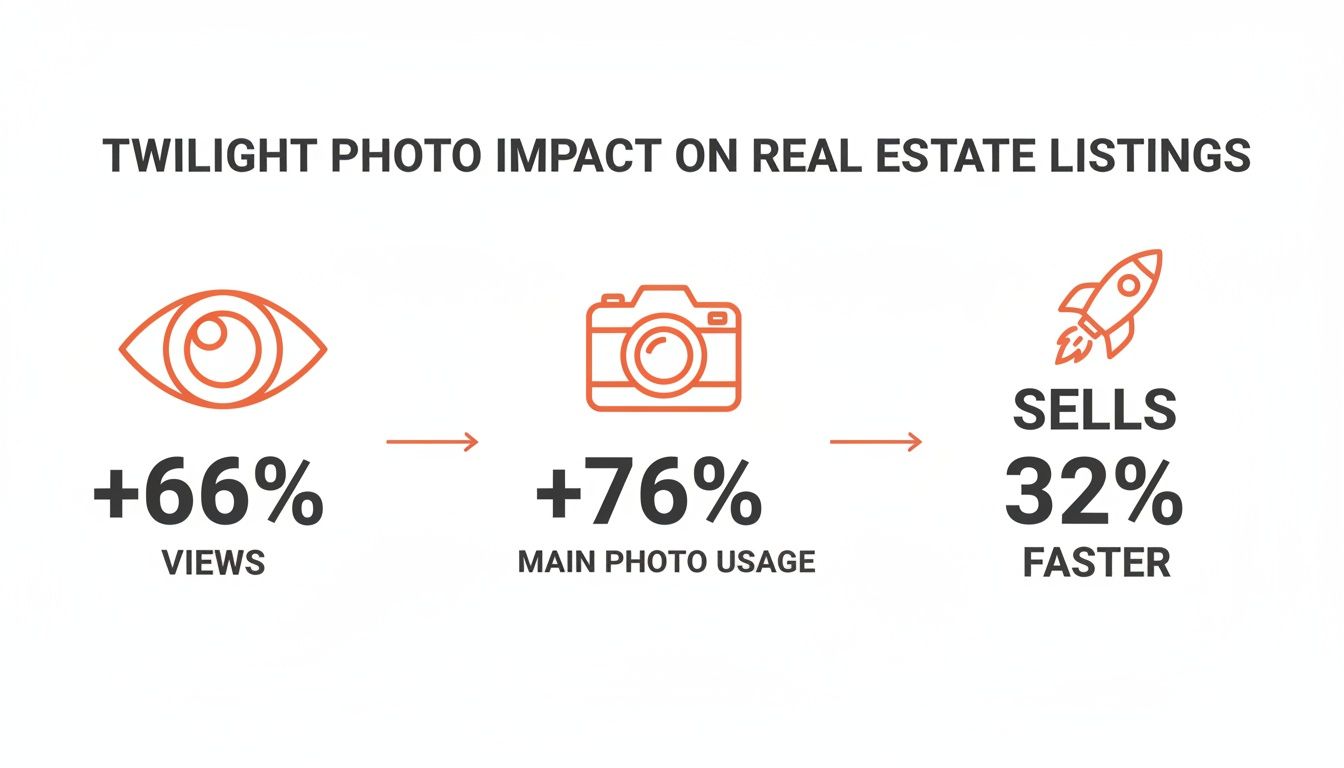
As you can see, twilight shots do more than just attract attention—they help you get to the closing table faster.
The data below offers a clear, side-by-side look at how much of a difference these photos can make for a listing's performance.
Real-World Impact of Twilight vs Standard Real Estate Photos
Ultimately, the goal is to stop the scroll and create an emotional hook. Twilight photos consistently outperform standard shots in every key metric that leads to a faster, more profitable sale.
The Financial Upside for Agents and Sellers
The smart use of twilight photos real estate goes way beyond just getting more clicks; it has a real impact on your bottom line. Listings that use high-quality professional photography, especially those including twilight shots, sell 32% quicker on average.
By creating a premium, high-end feel, twilight photography elevates a property's perceived value. This allows agents to justify higher listing prices and attract more serious, qualified buyers from the very beginning.
This creates a win-win for everyone involved. The seller gets their home sold faster, often for a better price. The agent builds a reputation for incredible marketing that helps them lock down future listings in a crowded market. It’s a small investment that pays for itself over and over again.
How to Plan and Stage the Perfect Twilight Shoot
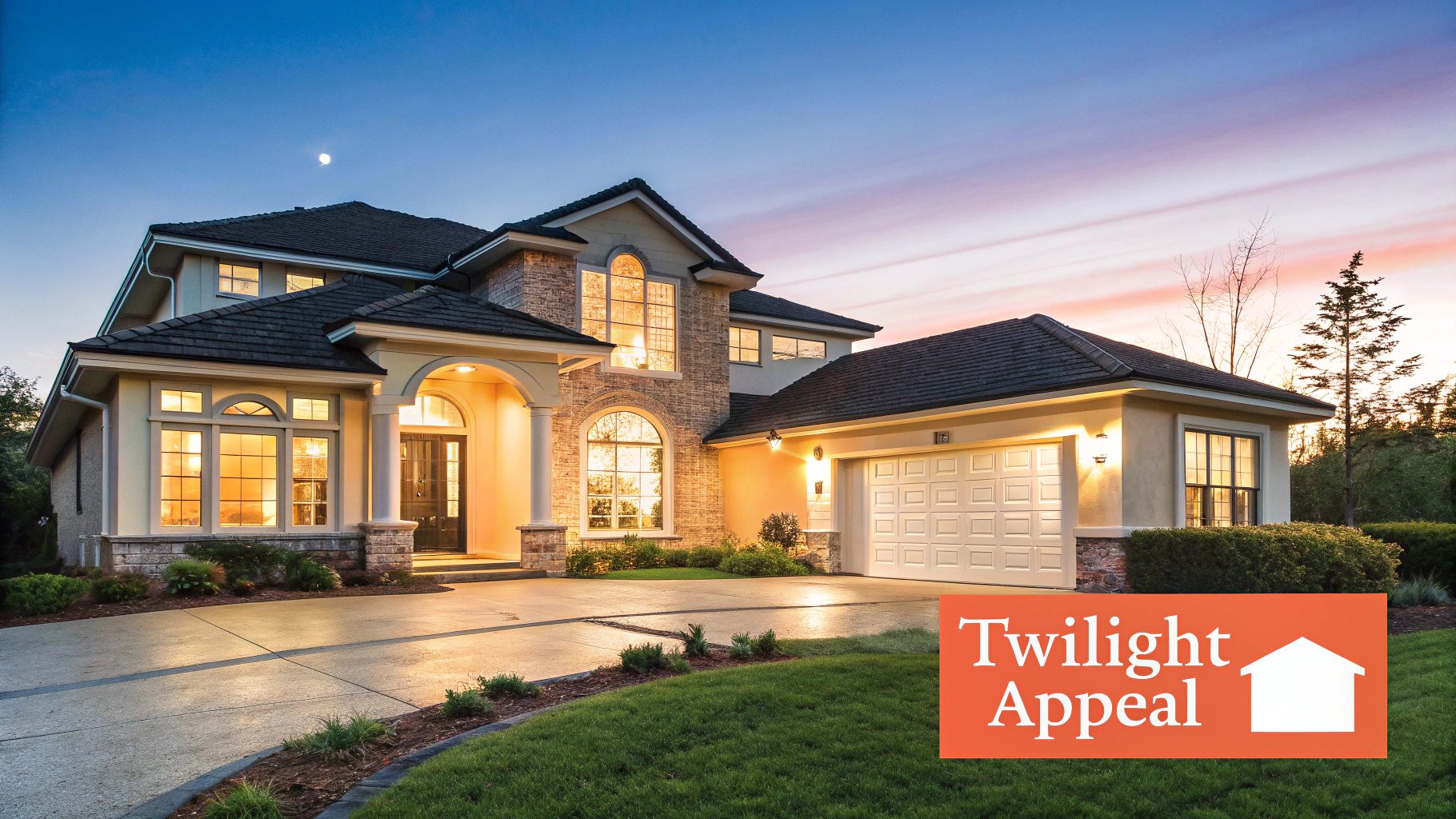
Let’s be honest: a truly killer twilight photo doesn’t just happen. It’s the direct result of careful planning and intentional staging. Get this part right, and you’ll create an image that literally stops buyers mid-scroll. It all starts long before the sun even thinks about setting.
Show up with plenty of daylight to burn. This isn't just about setting up your gear; it's your scouting mission. Walk the property, find that perfect angle—the money shot—that highlights the home's best architectural lines, the landscape lighting, and any killer features like a pool or patio.
The perfect window for twilight photos real estate is incredibly short, often just 20-30 minutes. This is the "blue hour," right after the sun disappears. The whole game is to capture that moment where the rich, deep blue of the sky is perfectly balanced by the warm, inviting light coming from the house.
Nailing the Timing and Lighting
To hit that brief window, you need to ditch the guesswork. I always use a solar calendar app like Sun Seeker or PhotoPills on my phone. They tell you the exact sunset time and the start and end of the blue hour for your precise location. Make a plan to be fully set up and ready to go at least 30 minutes before sunset.
Once the timing is set, it all comes down to the lighting. This is the soul of a twilight shot. Your mission is to make the home glow from the inside out, turning it into a warm beacon against the cool night sky. The first step? Turn on every single light.
- Interior Lights: Every lamp, overhead fixture, and sconce needs to be on. This creates beautiful layers of warmth and depth that draw the eye inward.
- Exterior Lights: Don’t stop inside. Hit the landscape lights, pathway markers, porch sconces, and any uplighting on the home's facade.
- Pool and Water Features: If there’s a pool or spa, its lights are a must. A glowing blue pool adds an immediate and undeniable touch of luxury.
The real secret to a pro-level twilight photo is creating a controlled, intentional glow. You want the property to feel alive and welcoming, not just blasted with light.
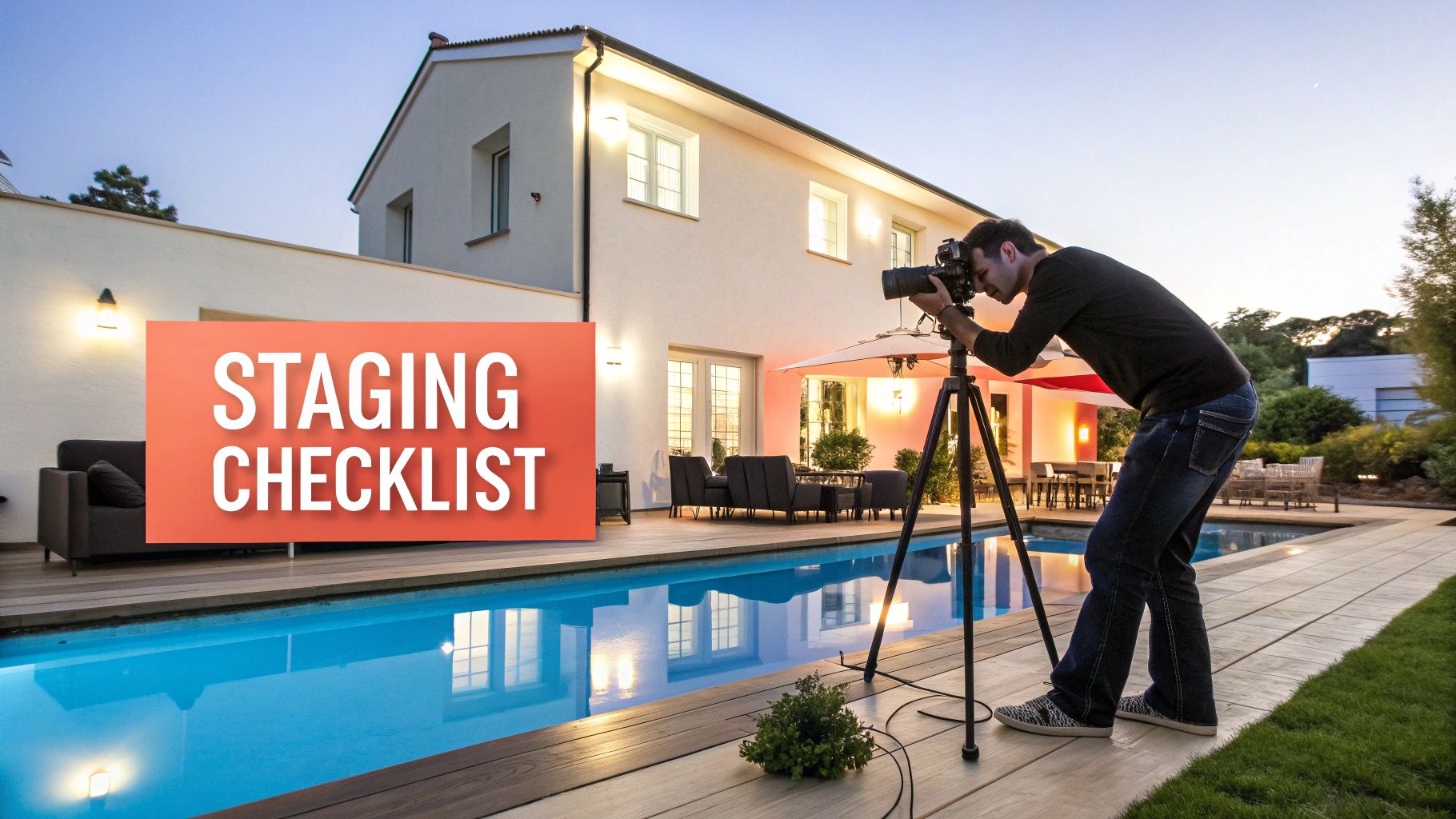
Your Essential Twilight Staging Checklist
Staging for a twilight shoot is all about the little details, because small misses become huge distractions in the final shot. Before you even touch your camera, run through this checklist.
Clean All Windows and Glass Doors: This one’s a deal-breaker. Dirty glass will kill that warm interior glow you're working so hard to create, making it look dull and hazy. Clean them inside and out.
Prep the Pool: Make sure the pool is sparkling clean, then turn off the pump about an hour before you start shooting. This lets the water become perfectly still, giving you a glassy, mirror-like surface for incredible reflections.
Manage Window Coverings: Open them all up. You want an unobstructed view into the cozy, well-lit interior. Make sure all the blinds are pulled up to the exact same height for a crisp, uniform look.
To see just how much of a difference this kind of prep makes, check out our guide on house staging before and after. The principles are exactly the same, but they become even more critical when every detail is silhouetted against the evening sky.
Mastering Camera Settings for Twilight Photography
Let's be clear: a brilliant twilight photo isn't magic. It's technique. While the final image looks effortless and dramatic, it’s built on a foundation of the right gear and dialed-in camera settings. Getting this part right is what separates a forgettable snapshot from a professional shot that stops the scroll.
First up, your gear. You simply can't hand-hold these shots. A sturdy tripod is absolutely essential. You’ll be using slow shutter speeds to soak in all that gorgeous ambient light, and the tiniest camera shake will turn your masterpiece into a blurry mess.
Next, pair that tripod with a solid wide-angle lens. A lens in the 16-35mm range is the sweet spot for capturing the full scale of the property, making it feel grand and inviting. This combination is the industry standard for a reason—it just works.
Dialing In the Perfect Exposure
With your gear locked in, it's time to take complete control. Flip that camera dial to Manual Mode (M). This puts you in the driver's seat for the three pillars of exposure: ISO, aperture, and shutter speed. This is the formula the pros use to create those stunning twilight shots.
- ISO: Keep it as low as it can go, which is usually ISO 100. A low ISO means less digital noise (or "grain"), which keeps your images looking sharp, clean, and professional.
- Aperture: Set your aperture somewhere between f/8 and f/11. This range gives you a deep depth of field, making sure everything from the welcome mat to the trees in the background is tack sharp.
- Shutter Speed: Here’s where you'll make your adjustments. Your shutter will be open for a while—anywhere from 1 to 30 seconds—depending on how much light is left in the sky. You'll tweak this setting until you get a perfect base exposure where the sky has rich color and the interior lights aren't blown out.
While twilight photography has its unique quirks, many of the fundamentals of great real estate photography still apply. For a broader look, check out these excellent realty photography tips.
The Bracketing Technique for Flawless Detail
Want to know the real secret that makes editing so much easier? Exposure bracketing. Instead of trying to nail one perfect shot, you take a series of photos at different brightness levels. This technique guarantees you capture all the detail, from the dark shadows on the lawn to the bright glow coming from the windows.
Bracketing is your safety net. It ensures that when you get to your computer, you have all the raw data you need to blend the shots into one perfectly lit, jaw-dropping image.
Most modern cameras have an Auto Exposure Bracketing (AEB) setting that makes this easy. A typical bracketing sequence for a twilight shoot might be three shots:
- One underexposed shot to capture the vibrant colors in the sky and details in the lights.
- One "correctly" exposed shot as your baseline.
- One overexposed shot to pull all the details out of the dark, shadowy areas.
This method is the backbone of creating high-dynamic-range images. If you're curious about how this all comes together in post-production, you can learn more about the process in our guide to HDR photography for real estate. It's the key to getting that polished, magazine-quality look every time.
Bringing Your Twilight Photos to Life with Editing
Getting the shot on-site is only half the battle. The real magic that produces those jaw-dropping twilight photos real estate agents clamor for happens on the computer. This is where a skilled editor transforms the raw files into polished, captivating images that literally stop buyers in their tracks.
It all starts with a technique called exposure blending. Remember those bracketed shots we took earlier—one dark, one medium, one bright? An editor carefully layers them together, painting in the best parts of each to create a single, perfectly lit photograph. The underexposed shot gives you that rich, deep blue sky, while the overexposed one brings out all the beautiful details in the shadows of the lawn and home exterior.
Crafting the Perfect Mood and Tone
Once the exposures are blended, the real artistry begins. The goal here isn't to create a fake-looking image, but to enhance the natural drama and beauty of the scene you captured.
One of the first and most critical adjustments is correcting the white balance. This is the secret to getting that iconic, moody blue sky without making the warm interior lights look like a blast of unnatural orange.
Next up is color grading, where the editor really dials in the mood. Common tweaks include:
- Boosting the warmth of the interior lights to give them a cozy, welcoming glow.
- Enhancing the cool tones in the sky to create that powerful, cinematic contrast.
- Selectively increasing saturation on landscape lighting to make it pop against the dark grass.
Nailing this delicate balance is what gives professional twilight shots their signature high-end feel. It guides the viewer's eye exactly where you want it to go.
The editing process isn't about faking a good shot; it's about revealing the best possible version of the photo you captured on-site. It combines multiple moments in time into one perfect, cohesive image.
Final Touches for a Polished Look
The final stage is all about cleanup and polish—the little things that take an image from good to flawless. Lens correction is absolutely non-negotiable. It straightens out the subtle distortion from wide-angle lenses, ensuring all the vertical lines on the house are perfectly straight. It’s a small fix that makes a huge difference in how professional the photo looks.
From there, an editor will sharpen key details like architectural lines and landscaping to make the image crisp and clear. They’ll also make the glowing lights—both inside and out—pop just enough to draw the eye without looking artificial. The result is an unforgettable image that shows the property at its absolute best.
For those looking to speed up this detailed workflow, it's worth exploring the best AI photo editing software available today. Many of these tools can automate the more tedious steps, freeing you up to focus on the creative finish.
The Rise of AI Virtual Twilight Photography
What if you could get that jaw-dropping twilight photo without the scheduling headaches, the weather-related reshoots, or the premium price tag? We've all been there. Trying to coordinate a photographer for that perfect 20-minute window at dusk is a logistical nightmare, and it often means missing the boat entirely.
But what if you could nail that high-impact look for any property, any day, in just a few clicks?
That's the new reality with AI-powered virtual twilight. This isn't just a filter; it's a sophisticated process that transforms a standard daytime exterior photo into a stunning dusk image. We're talking vibrant skies, warm glowing interior lights, and perfectly balanced shadows. It completely changes the game for real estate marketing, giving agents the power to put a premium polish on every single listing, not just the multi-million dollar ones.
Speed and Cost: The AI Advantage
The biggest wins with AI virtual twilight are the massive gains in speed and cost. A traditional twilight shoot means booking a photographer for a specific time slot, which usually comes with an extra fee. And if the weather doesn't cooperate? You're stuck canceling last-minute and pushing back your launch.
The AI workflow, on the other hand, is practically instant. Tools like Bounti Labs let you upload a regular daytime shot and generate a gorgeous twilight version in minutes. Your marketing materials are ready faster, and you can hit the market without any frustrating delays.
The ability to instantly generate unlimited visuals is a game-changer. It empowers agents to test different hero images, refresh stale listings, and ensure every property, regardless of price point, gets the same high-end marketing treatment.
Here’s a quick look at how intuitive a modern AI tool can be.

This kind of clean, user-friendly interface means any real estate pro can get professional-level results without needing to be a Photoshop wizard.
The cost savings are just as dramatic. A professional twilight shoot can easily add hundreds of dollars to your photography bill. AI conversions cost just a fraction of that. This suddenly makes it practical to create twilight photos real estate agents can use for every single listing, from a starter condo to a sprawling estate, boosting the appeal across your entire portfolio.
Consistency and Flexibility in Your Marketing
Beyond just saving time and money, AI delivers something that's nearly impossible to get in the real world: perfect consistency. Real twilight shoots are at the mercy of Mother Nature. Some evenings give you a spectacular, fiery sunset; others are just gray and drab. Virtual twilight guarantees a perfect, vibrant sky every single time, helping you build a consistent and recognizable brand for your listings.
This tech also gives you incredible flexibility. Did the homeowners install awesome new landscape lighting after the main photoshoot? No problem. Just snap a new daytime photo and run it through the AI. No need to pay to bring the photographer back out. If you want to dive deeper into how artificial intelligence is being applied to property visuals, you can find more AI real estate photography tips.
When you bring AI tools into your workflow, you're not just cutting costs. You're getting a powerful advantage to win more listings and make every property shine. You can tell a more compelling story for each home, grab the attention of more buyers, and ultimately, get deals done faster.
Your Top Questions About Twilight Photos, Answered
When it comes to twilight photos real estate agents and their sellers usually have a few burning questions. Let's clear up some of the most common ones so you can decide what's right for your next listing.
The first question is almost always about the money. Is a twilight shoot a smart move for every single property, or is it an expensive gimmick? The answer has changed a lot in just the last couple of years.
Are Twilight Photos Worth It for Every Property?
Not long ago, booking a photographer for a dusk shoot was a luxury reserved for high-end listings. We're talking about homes with incredible pools, custom landscape lighting, or dramatic architecture. The cost just didn't pencil out for your average suburban home.
That thinking is officially obsolete. AI-powered virtual twilight services have completely demolished the cost barrier. For a tiny fraction of what a traditional shoot costs, you can now give any property that premium, eye-catching look. It completely levels the playing field, helping every listing get the clicks and buyer attention it deserves.
Real vs. Virtual Twilight: What’s the Difference?
It’s easy to get these two mixed up, but they are fundamentally different.
A real twilight photo is the classic approach. A photographer physically goes to the property to shoot during the "blue hour"—that fleeting 20-30 minute window just after the sun dips below the horizon. Everything has to be perfect: the weather, the timing, the setup.
A virtual twilight photo is all done in post-production. You start with a standard daytime photo, and an editor (or a smart AI tool) transforms it into a stunning dusk image. No scheduling, no weather delays.
The core difference comes down to logistics. A real twilight shoot is an on-site event. Virtual twilight is a digital service. One offers an affordable, weather-proof alternative that saves you from a massive scheduling headache.
How Long Does a Traditional Shoot Take?
Even though that perfect light only lasts for a few minutes, the whole process is much longer. The photographer has to show up early to scout the best angles, set up lights, and dial in their gear.
All told, you can expect an on-site twilight shoot to take between 60 and 90 minutes from start to finish.
That time commitment is a world away from AI alternatives. Creating a virtual twilight photo from an existing daytime shot takes just a few minutes. That means you can get your listings live faster and start generating interest sooner.
Ready to give every listing a high-end look without the hassle and cost of a traditional shoot? With Bounti Labs, you can instantly transform any daytime photo into a stunning twilight image. See how easy it is to create unlimited, MLS-ready visuals and win more clients at https://www.bounti.ai.