
We’ve all been there. You walk into a showing, and the house is perfect… until you open the door to a bathroom straight out of 1982. A dated, dingy bathroom can stop a deal dead in its tracks. It screams "work" and "unexpected costs" to buyers.
But what if you could flip that liability into the property’s strongest selling point? That's where a strategic renovation comes in. And to make sure that investment pays off, you bring in a professional bathroom renovation designer.
Why a Well-Designed Bathroom Drives Property Value
Kitchens and bathrooms sell homes. It's a cliché because it's true. But while kitchens are about function and gathering, a bathroom sells something more personal: an escape. It’s a private sanctuary. When a buyer sees a modern, clean bathroom, they don’t just see tile and fixtures; they see a stress-free, move-in-ready life.
That feeling has a serious financial tailwind. The global bathroom remodeling market has ballooned to $398.1 billion as of 2024. Right here in the U.S., bathroom projects made up a massive 28% of all home remodeling spending in 2023. Why? Because the country's housing stock is aging, and these are the spaces that show it the most.

These numbers confirm what top agents already know: homeowners are pouring money into these spaces. It’s a critical focus area for getting a home sold for top dollar.
The Financial Impact of Strategic Upgrades
Not all upgrades are created equal, especially when you’re selling. This is where a designer’s eye becomes a financial tool. They know the difference between a trend that will attract offers and a personal taste that will scare them away. They help your clients focus on changes with the highest ROI, avoiding costly over-improvements.
To get a better handle on which upgrades move the needle, you can explore various proven strategies to increase property value.
A bathroom that feels like a personal spa doesn’t just add value. It creates an emotional hook that makes buyers feel at home. That feeling is what closes deals faster and for more money.
You can see the dramatic effect of smart updates in these house staging before and after examples. The goal is to choose updates that resonate with today's buyers. A good designer will almost always point you toward:
- Spa-Inspired Showers: Buyers are over bulky tub-shower combos. A large, glass-enclosed walk-in shower feels luxurious and spacious.
- Double Vanities: For couples, this is often a non-negotiable. It instantly adds both function and perceived value.
- Modern, Layered Lighting: Forget the single "Hollywood" light bar. A mix of vanity, overhead, and even accent lighting makes a bathroom feel brighter, bigger, and cleaner.
ROI Analysis for Pre-Sale Bathroom Upgrades
Guiding a seller on where to spend their money is one of the most valuable services an agent can provide. Here's a quick breakdown to help you frame the conversation around cost, effort, and potential return.
For most pre-sale situations, the Cosmetic Refresh offers the biggest bang for the buck. It addresses the "dated" feel without breaking the bank, providing a huge psychological lift for buyers at a minimal cost to the seller.
How to Find and Vet the Right Designer for Your Listing

Let's be honest: finding a good creative partner is way more than just scrolling through pretty pictures on Instagram. When you’re prepping a listing, you need a bathroom renovation designer who gets it. The clock is ticking, and the only metric that matters is market appeal, not a homeowner's personal wish list.
This isn't a "forever home" project. It's about creating a space that makes buyers feel like they have to have it. That means your vetting process needs to be ruthless, focusing purely on ROI and their ability to manage a project without drama.
Where to Look for Real Estate Savvy Designers
A quick Google search is a start, but you'll get much better results by tapping into your professional circles. Good people know other good people.
- Your Real Estate Network: The first call you should make. Ask other top agents in your office or city who they trust for pre-sale renos. A referral from an agent who has been in the trenches with a designer is gold.
- Local NKBA Chapter: The National Kitchen & Bath Association (NKBA) is the industry standard. Their members are certified pros who know their stuff and follow strict guidelines.
- Preferred Vendor Lists: Chat with the GCs and stagers you already work with. They'll have a go-to list of designers who are reliable, stay on budget, and don't crack under the pressure of a deadline.
Once you have a shortlist, the real work starts. A gorgeous portfolio just gets them in the door. It's their process, mindset, and real-world problem-solving that will make or break your project.
The Agent's Vetting Checklist
When you sit down with a potential designer, your questions need to be different. You're not a homeowner—you're a business partner looking for a specific financial outcome.
Don't just ask, "Have you worked on pre-sale renovations before?" Instead, ask, "Tell me about a time you had to pivot a design mid-project to stay on budget for a listing. What was the situation, and how did you solve it?"
This kind of question cuts through the fluff and reveals how they actually handle pressure. Here are a few more must-ask questions to add to your list:
- Market Trends vs. Personal Style: How do they separate timeless, marketable design from passing fads? Can they clearly explain why a neutral, large-format tile is a safer bet for resale than that trendy-but-polarizing cement tile?
- Supplier Relationships: Do they have solid relationships with local suppliers? This can mean quicker access to materials and even better pricing—both are absolutely critical when you're on a tight timeline.
- Project Management Style: Get specific. How do they communicate updates? Who sends the weekly progress reports? A designer who proactively communicates is a dream for an anxious seller (and agent). One who only calls when there’s a crisis is a nightmare.
If you want to dig deeper into positioning your own expertise and services, check out our resources for real estate agents looking to excel.
Finally, always check their references—but do it right. Don't just ask the past client if they were "happy." Call the contractor they worked with and ask if the designer's plans were clear and accurate. Call the other real estate agent and ask if the project finished on time and directly impacted the sale. This 360-degree view ensures you’re hiring a true project partner, not just an artist.
How to Create a Design Brief That Gets You a Market-Ready Bathroom
Nothing kills a renovation budget faster than a vague plan. Before you let a bathroom renovation designer touch a single tile, you need to hand them a rock-solid design brief. This isn't just a wish list—it's the project's entire game plan, making sure every choice adds to the home's final sale price.
Think of it as the business plan for the bathroom. It's your job to translate what you know about the target buyer into a set of clear, actionable instructions for the designer. This way, they’re focused on creating broad market appeal, not just chasing a niche trend or a homeowner's personal taste.
Start with the Non-Negotiables
First things first: lay out the hard realities of the project. Your brief needs to open with the budget, the timeline, and the one objective that matters for a listing: maximize market appeal for a fast, profitable sale. Kicking off with this immediately aligns everyone.
Then, get specific about who you're selling to. Is this a starter home for a young family that needs durable, easy-to-clean surfaces and a tub? A downtown condo for a single professional who’d value a sleek, walk-in shower? Or a luxury property where high-end finishes and spa-like features are expected?
Knowing the buyer profile is everything. It’s the difference between choosing a standard tub-and-shower combo and investing in a freestanding soaking tub with a rainfall showerhead.
The Anatomy of a Market-Focused Brief
A great brief leaves no room for guessing. It prevents miscommunication and ensures your designer delivers exactly what the property needs to fly off the market. Make sure you include these key pieces:
- The Goal: Be direct. "The goal is to create a bright, modern, and universally appealing bathroom that increases the home's market value and attracts a wide range of buyers."
- The Budget: Give them a firm, all-in number. Don’t forget to include a 15-20% contingency fund. This tells the designer you're a pro who understands that surprises happen.
- The Timeline: Define the absolute final deadline and work backward. Map out key milestones for things like material selection, demolition, and final installation.
- The Vibe: This is where visuals are crucial. Give them 3-5 inspiration images that nail the aesthetic you're after. Better yet, use a tool like Bounti to generate style concepts from a photo of the actual bathroom. It gives your designer a perfect visual starting point.
The most powerful brief combines clear financial and timeline constraints with a compelling visual direction. It tells the designer not just what to do, but why it matters for the sale.
This clarity is more important than ever. The biggest spenders on remodels right now—Millennials and Gen Z—are looking for personal oases with smart tech and sustainable materials. Their preferences drove the U.S. luxury bathroom market up 8.4% to $12.8 billion in 2023 alone. You can get a deeper dive into what these buyers want by checking out the latest on 2026 bathroom remodel trends.
When you build a brief this detailed, you’re not just hiring a designer; you’re bringing on a strategic partner. You're commissioning a powerful marketing asset, engineered from day one to perform on the open market.
Using AI to Pre-Visualize Renovations and Secure Seller Buy-In
We’ve all been there. You're sitting at the kitchen table with a seller, trying to explain why they need to sink thousands of dollars into a bathroom reno. It’s one of the toughest conversations in the business. They see the cost, the mess, the risk—and they freeze.
But what if you could skip the abstract pitch and just show them the ‘after’? What if you could remove all the guesswork and replace their fear with genuine excitement?
That’s where AI visualization has become an agent's secret weapon. You’re no longer just describing potential; you’re presenting a stunning, photorealistic preview of what their home could be. It bridges the gap between a vague idea and a tangible result they can see on a screen.

This is what we're talking about. Showing a seller this image on a tablet is infinitely more powerful than waving your hands around trying to describe a new vanity. It makes the return on investment feel real.
From Dated to Dazzling in Minutes
With a platform like Bounti, this is something you can do in minutes, right from your phone. You can walk into a tired, cluttered bathroom, take a quick video, and instantly generate multiple design concepts. This isn't just about splashing on a new coat of virtual paint; it's a full-scale digital remodel.
Imagine showing your client their exact bathroom, but transformed with:
- A sleek, modern vanity with dual sinks.
- That dated tub-and-shower combo replaced with a spacious, glass-enclosed walk-in shower.
- On-trend tile, fixtures, and lighting that you know today’s buyers are looking for.
You can toggle between styles like Modern Farmhouse, Japandi, or Mid-Century Modern to see what resonates. This turns the decision to renovate from a nerve-wracking gamble into a smart, calculated business move. Curious to see it in action? You can animate your listing with AI and explore the possibilities for yourself.
More Than Just a Pretty Picture
Getting the seller on board is just the beginning. These AI-generated visuals become a core part of your strategy from listing to close.
The most effective way to justify a renovation budget is to show a direct visual comparison. When a seller sees their bathroom next to its AI-generated counterpart, the value proposition of hiring a bathroom renovation designer becomes undeniable.
This pre-visualization is also a massive help for your team. You can hand off the concepts directly to your chosen bathroom renovation designer, giving them a crystal-clear visual brief. It eliminates any chance of miscommunication and ensures the final product is exactly what you and the client agreed on.
Even better, you can start marketing before the renovation is even finished. Use the "after" images in your "coming soon" campaigns to build buzz and a list of interested buyers. It’s a powerful way to frame the property in its best light from day one, demonstrating its future potential and getting a huge head start.
Managing the Project to Protect Your Timeline and Budget
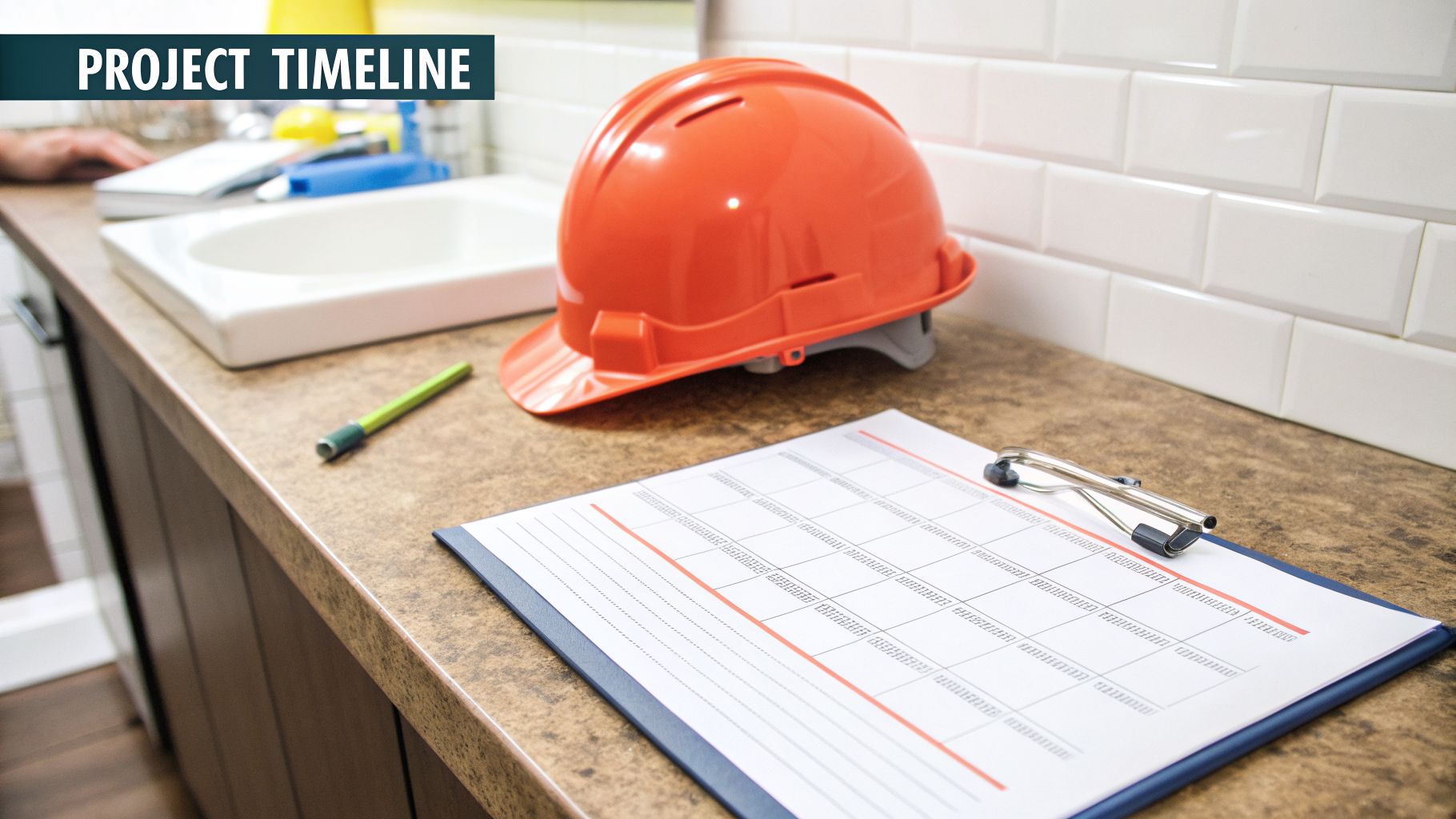
You’ve gotten the seller on board and hired a great designer. Now the real work begins, and your role shifts from visionary to guardian. A renovation that goes off the rails—either with delays or budget blowouts—can destroy the very value you’re working so hard to create and even threaten a timely sale.
Your first move? Get a copy of that designer's contract and read the fine print. I’m not talking about the tile choices; I mean the project management clauses. A good contract ties payments to project milestones, not just dates on a calendar. It also needs a crystal-clear process for handling change orders, because that’s where budgets go to die.
Budgeting for the Unexpected
I’ve never seen a renovation without at least one surprise. The moment a wall comes down, you might find old corroded pipes, a rotted subfloor, or some truly creative wiring from the 70s. This is precisely why a contingency fund isn't a "nice-to-have." It's a deal-saver.
Always, always advise your sellers to budget a 15-20% contingency fund on top of the final quote. This buffer turns a potential five-alarm fire into a minor hiccup, keeping the project moving and everyone’s stress levels manageable.
Building this cushion in from day one shows your client you know what you’re doing. It also gives the designer the room they need to solve problems without grinding everything to a halt to ask for more money.
Monitoring Progress with a Milestone Checklist
You don’t have to be a general contractor to keep a renovation on track. Think of yourself as the executive producer. A simple milestone checklist gives you a bird's-eye view, lets you track forward momentum, and allows you to give confident, accurate updates to your seller. Your oversight keeps the entire team accountable.
This is especially true in today's market. Bathroom renovations are the #1 most popular remodeling project, beating out kitchens. Recent data shows that while 44% of remodel firms were finishing projects and 42% had projects underway, very few were delayed. That tells you this industry moves fast and runs on tight timelines. You can read more about the resilience of the bathroom remodeling industry and its breakneck pace.
Here’s a simple checklist you can adapt to keep tabs on the work:
- Week 1 Demolition & Rough-In: Has the old bathroom been completely gutted? Is the new plumbing and electrical work inside the walls finished?
- Week 2 Inspection & Wall Closure: Are all the permits signed off? Is the new drywall or subfloor up and ready for finishes?
- Week 3 Tile & Flooring: Is the tile work for the floors and shower done? Has it been properly grouted and sealed?
- Week 4 Fixture Installation & Paint: Are the big pieces—vanity, toilet, shower fixtures—in place? Is the final coat of paint on the walls?
- Week 5 Final Touches & Punch List: This is the home stretch. Mirrors, lights, faucets, and cabinet hardware should be installed. Now you and the designer do a final walkthrough to spot any tiny fixes needed for that picture-perfect finish.
Common Questions About Bathroom Renovations for Real Estate
When you suggest a bathroom renovation to a seller, you're not just recommending a project—you're asking for a significant investment of time and money. Expect questions. A lot of them. Having smart, confident answers ready is how you build trust and prove your value. Let's walk through the most common ones you'll get.
Full Renovation or Virtual Staging
This is the big one, and the answer comes down to one thing: function. You should push for a full, physical renovation only when the bathroom has serious, unignorable problems. We're talking active leaks, visible mold, or a layout so bad it's guaranteed to fail an inspection or scare buyers away on the spot.
But for a bathroom that's just cosmetically challenged? Think avocado green tile or a perfectly working but ugly vanity. In these cases, a virtual renovation is your best friend. It’s a faster, more affordable way to show buyers the property's potential without the massive upfront cost, making it the perfect move for sellers on a tight budget or an even tighter timeline.
Top ROI Features for Today's Market
While trends come and go, some upgrades almost always deliver a solid return by appealing to the widest audience. If a seller is going to spend the money, steer them toward these three high-impact features that buyers are looking for right now:
Walk-In Showers: A large, glass-enclosed shower instantly makes a bathroom feel more like a spa. It’s one of the most requested features we see in modern homes.
Double Vanities: For couples, this is often a dealbreaker. Having two sinks adds huge perceived value, and if the space allows for it, it becomes a major selling point.
Quality, Layered Lighting: Never underestimate good lighting. A mix of vanity sconces, a stylish overhead fixture, and even in-shower lighting can make any bathroom feel bigger, cleaner, and more luxurious.
Of course, a designer can also help with the nitty-gritty details, like finding the best flooring for bathrooms that balances style and durability.
How to Convince a Hesitant Seller
Words are rarely enough. You have to show them the money—and the vision. Start by pulling local comps that show the ROI on recent renovations in their specific neighborhood. But the real clincher? Visual proof.
Use an AI tool to generate a stunning "after" version of their actual bathroom. Present a side-by-side comparison showing the incredible transformation from dated to dazzling.
When a seller sees their own bathroom transformed and understands that this exact image can be used in the listing to attract better offers, the conversation changes. Suddenly, the renovation isn't a scary expense. It’s a clear-cut, strategic investment in a faster, more profitable sale. This is how you make the value of hiring a professional designer undeniable.
Transform your listings and win over sellers with instant, AI-powered renovations from Bounti Labs. Generate stunning "after" visuals in minutes to show a property's true potential. Get started at https://www.bounti.ai.