If you’re serious about real estate photography, you’ll want to look at full-frame or APS-C cameras, either mirrorless or DSLR. Paired with a solid wide-angle lens, these cameras give you the image quality, low-light capability, and flexibility you need to shoot properties like a pro.
Why Your Camera Choice Defines Your Listing's Success

In a sea of online listings, your photos are your hook. A buyer’s first impression isn’t made at the curb anymore—it happens on a screen while they’re swiping through dozens of homes. The quality of your images is what makes them stop scrolling or just keep going.
This is why picking the right camera isn’t just a technical detail; it’s a core part of your marketing strategy. It's about creating visuals that make people pause, feel something, and want to see the home for themselves.
The Power of Professional Imagery
Think of your camera as a storytelling tool. Its job is to capture the feeling of a space. A good camera in the right hands can make a small, cozy room feel warm and inviting instead of cramped. It can show off a beautiful view without blowing out the highlights or losing the details in the shadows.
The data backs this up. Properties with professional photos get 47% more online views and rack up 39% more inquiries compared to listings with point-and-shoot snapshots. Research shows that buyers spend a whopping 60% of their time on a listing page just looking at the photos, with only 20% spent reading the description.
The "best" camera isn’t always the most expensive one. It's the one that consistently solves the core challenges of property photography: capturing wide interior spaces, managing tricky lighting, and producing sharp, high-resolution files.
To help you get a quick handle on what to look for, here's a cheat sheet summarizing the most important camera specs for real estate work.
Quick Camera Feature Cheat Sheet for Realtors
Getting these core features right is the foundation of great real estate photography.
Amplify Your Camera's Impact with AI
A great camera is just the starting point. Today, that investment goes much further. A single video walkthrough, for example, can be transformed into a complete marketing package. With AI platforms like Bounti, you can upload a video and instantly generate MLS-ready photos, compelling property descriptions, and even AI-powered virtual staging.
Staging is a game-changer, and you can see just how powerful it is in these house staging before and after transformations. This combination of a quality camera and smart AI tools lets you create incredible marketing materials faster than ever. It all starts with choosing the right gear.
Decoding the Camera Specs That Actually Matter for Property Photos
Getting bogged down in technical specs can feel like trying to read a foreign language. But when you're looking at cameras for real estate photography, you only need to understand a handful of features to make a smart choice. Let's cut through the noise and talk about what really impacts your photos.
Instead of seeing these as complicated specs, think of them as tools to solve the exact problems you’ll run into on every single shoot.
Sensor Size: Your Camera's Window to the World
The camera sensor is basically the digital version of film—it’s the part that captures light and turns it into a picture. The two most common sizes you’ll hear about are Full-Frame and APS-C, and the difference is pretty straightforward.
Imagine your camera's sensor is a window in a dimly lit room.
- A Full-Frame sensor is like a huge picture window. It lets in a ton of light, which means you get brighter, cleaner, and less grainy photos, especially in dark interiors. This is a massive advantage for real estate.
- An APS-C sensor is more like a standard bedroom window. It's still highly effective and produces great images, but it doesn't capture as much light. As a result, you might see more digital "noise" (graininess) when shooting in low-light situations.
For real estate, a bigger sensor almost always means better shots indoors, where good lighting is never a guarantee. It just gives you a cleaner canvas right out of the gate.
Resolution: Why Megapixels Give You More Than Just Detail
Resolution, measured in megapixels (MP), is all about the level of detail your camera can capture. Think of pixels as the individual threads in a high-end sheet; more threads (pixels) create a finer, more detailed fabric (your image).
A camera with more megapixels, say 24MP vs. 12MP, is grabbing more visual information. This gives you some powerful real-world advantages for property photos:
- Freedom to Crop: You can crop in tight on a specific feature, like a beautiful custom backsplash, without the image turning into a blurry, pixelated mess.
- Print-Ready Quality: If you’re creating brochures or print ads, high-resolution photos are a must. They ensure every detail stays tack-sharp on paper.
- Better Digital Zoom: It allows you to "zoom in" on a photo after the fact and still see crisp details, perfect for showing off high-end finishes online.
You don't need the most megapixels money can buy, but a camera in the 20-30MP range hits the sweet spot between incredible detail and file sizes that won’t crash your computer.
Dynamic Range: Seeing into Both the Shadows and the Light
Ever try to take a picture of a room with a bright, sunny window? Your camera usually makes a choice: either the room is dark and cavernous, or the view outside is a completely blown-out white blob. This is a classic dynamic range problem.
Dynamic range is your camera's ability to see detail in the absolute brightest parts of a scene and the darkest shadows—all at the same time.
A camera with great dynamic range can capture the vibrant blue sky outside the window and the rich wood grain of the floors inside, all in a single, balanced shot. This isn't just a nice-to-have; it's non-negotiable for real estate photography. It’s what separates a professional, natural-looking photo from one with ugly, blown-out windows or murky, uninviting corners.
The Wide-Angle Lens: Your Most Important Piece of Gear
Finally, let's talk about the lens. While it’s not part of the camera body, your lens choice is arguably just as critical. For shooting interiors, a wide-angle lens isn't a suggestion—it's a requirement. These lenses have a short focal length (usually between 16mm and 24mm on a full-frame camera) that lets you capture a much wider field of view.
With a wide-angle lens, you can stand in the corner of a room and fit the entire space into one shot, making it feel open and expansive. It’s the only way to help buyers truly understand the layout and flow of a home from a single photo. Without one, you're stuck taking fragmented, confusing pictures that fail to show what it really feels like to be there.
Matching the Camera to Your Real Estate Goals
Let's be clear: there's no single "perfect" camera for real estate photography. The best camera for you is the one that fits your business, the properties you handle, and your budget. Forget hunting for a one-size-fits-all magic bullet. Instead, ask yourself what you need your images to do.
Are you a new agent who just needs clean, professional photos for your first few MLS listings? Or are you a seasoned pro competing in the luxury market where every visual detail gets scrutinized? Your answer points directly to the right camera setup.
This quick visual guide maps out the core decisions you'll make every time you shoot a property.
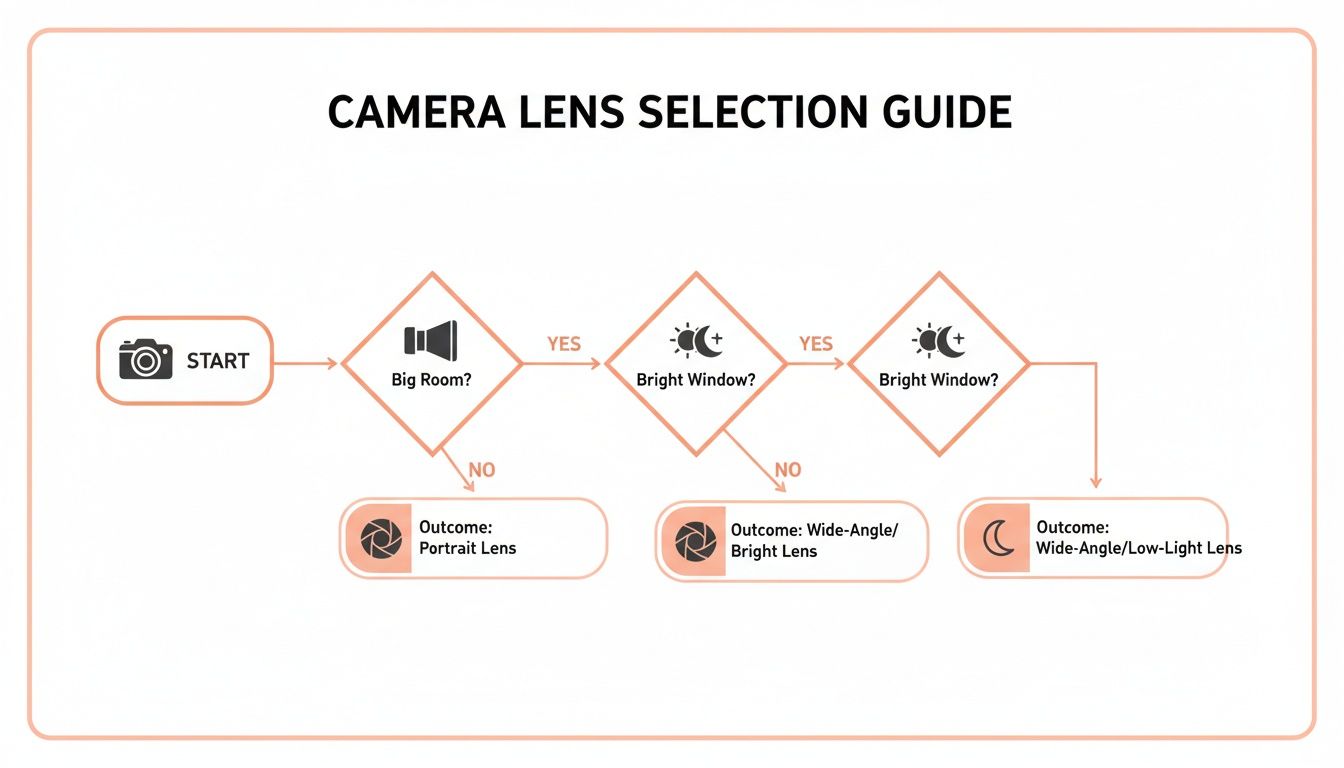
As you can see, the essential tools—like a wide-angle lens and solid dynamic range—are all about solving the classic challenges of shooting indoors. With that in mind, let's look at the specific camera needs for three different kinds of real estate professionals.
The New Agent on a Budget
When you're just starting out, your main job is to create images that are a clear step up from a smartphone. You need a camera that’s reliable, affordable, and delivers sharp, well-lit photos for the MLS that get buyers in the door—all without breaking the bank.
Your focus should be an entry-level mirrorless or DSLR with an APS-C sensor. These cameras offer fantastic image quality for the price and, most importantly, give you access to interchangeable lenses. That’s the real game-changer.
- Top Priority: Interchangeable lenses. The ability to use a true wide-angle lens is the single biggest advantage you'll have over any smartphone, period.
- Key Feature: A sensor size of at least APS-C to ensure you get good results in different lighting scenarios.
- Example Model: The Canon EOS R100 is a great place to start. It’s compact, easy to learn, and when paired with a good wide-angle lens, it produces images that are worlds beyond what a phone can do.
This kind of setup gives you the professional foundation you need to compete without having to overspend right out of the gate.
The Luxury Listing Specialist
When you’re selling high-end properties, your photography can't just be good—it has to be exceptional. Clients in this space expect visuals that showcase premium finishes, architectural details, and sophisticated design. Your camera must deliver uncompromising image quality.
This is where a full-frame camera becomes non-negotiable. Its larger sensor captures more light, producing richer colors, incredible dynamic range, and far better performance in low light. It's what you need for those dramatic twilight shots or interiors with tricky, high-contrast light.
For luxury listings, every pixel matters. A full-frame camera's ability to render fine detail and handle difficult lighting is what separates a good photo from a breathtaking one. It’s an investment in your brand.
- Top Priority: A full-frame sensor for maximum image quality and dynamic range.
- Key Feature: High resolution (30MP+) for large-format prints and the flexibility to crop in on those luxe details without losing quality.
- Example Model: The Sony A7 IV is a true professional workhorse. Its 33MP full-frame sensor and best-in-class autofocus system make it a powerhouse for high-stakes real estate photography.
Gear at this level empowers you to create the magazine-quality images that luxury buyers and sellers have come to expect.
The Video-First Marketer
For agents leaning into video—creating walkthroughs, social media reels, and using AI-powered video tools like Bounti—a hybrid camera is your secret weapon. The goal is to produce both stunning photos and high-quality video efficiently, and you need a camera that excels at both without compromise.
These cameras are built with video as a core function. They feature incredible stabilization, advanced autofocus that tracks you as you move, and high-resolution video modes like 4K. This ensures your walkthroughs are smooth and professional, giving you a crystal-clear source for AI to pull still images from.
Here's what to look for in a video-focused camera:
- In-Body Image Stabilization (IBIS): This is huge. It mechanically stabilizes the sensor itself, giving you much smoother, less shaky footage, even when you’re walking through a property.
- 4K Video Recording: Now the standard for pro-level video, 4K delivers crisp footage that looks fantastic online and gives you way more flexibility in editing.
- Advanced Autofocus: Look for features like eye-tracking and reliable subject detection to keep your shots sharp as you move through a space.
A fantastic choice here is the Sony ZV-E1. It packs a full-frame sensor into a body designed from the ground up for video creators, offering amazing low-light performance and cinematic quality for your property tours.
Mastering Your Camera Setup for Flawless Shots
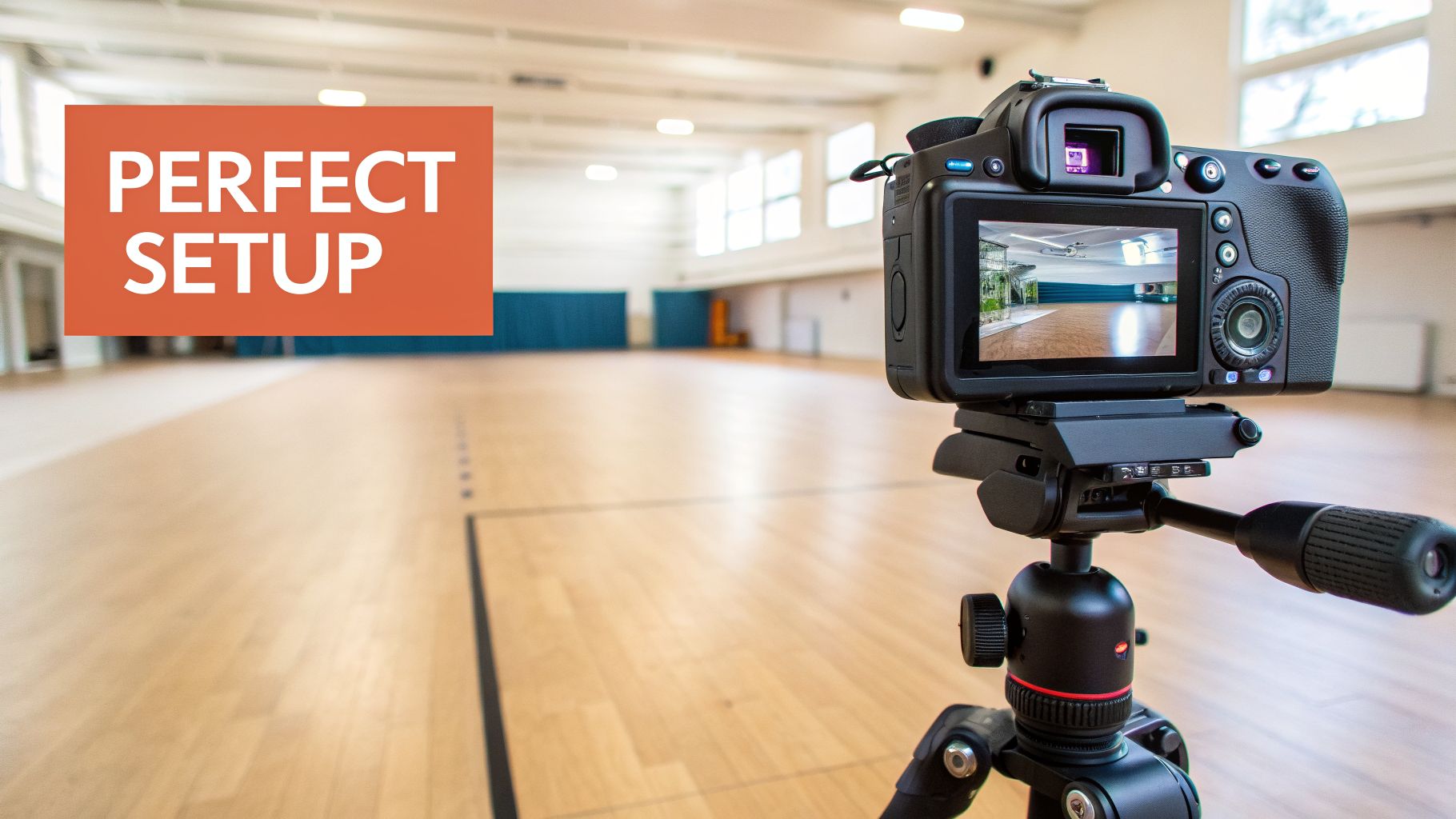
Having a great camera is one thing. Knowing how to set it up to get killer shots every single time? That's the real game-changer. The magic isn’t in the camera; it's in how you control it.
Let's walk through a repeatable, professional setup you can use for every shoot. Think of it as your pre-flight checklist. Once you dial in these settings, you can stop fiddling with the camera and focus all your energy on what matters: finding the perfect angles to make the home shine.
Set Your Foundation with the Right Mode
For real estate photography, the single best mode is Aperture Priority—you’ll see it marked as "A" or "Av" on your camera's dial. It’s the perfect collaboration between you and your camera. You tell it how much of the scene to keep in focus (the aperture), and it automatically figures out the shutter speed for a perfect exposure.
In property photos, you want everything sharp, from the throw pillows on the couch to the trees outside the window. A mid-range aperture like f/8 or f/11 is your sweet spot. It delivers that crisp, front-to-back focus that makes a room feel expansive and detailed.
Using Aperture Priority streamlines your workflow tremendously. You set the most important creative variable—how much of the room is in focus—and let the camera handle the rest, freeing you up to concentrate on composition.
With your mode and aperture locked in, it's time to tweak a couple more settings to guarantee the highest quality and sharpness.
Fine-Tune for Maximum Quality and Sharpness
To squeeze every last drop of quality out of your sensor, you need to get two things right: your file format and your ISO. These settings make a huge difference, especially when you get to the editing stage.
First, always shoot in RAW format. Think of a RAW file as your digital negative; it holds all the original, unprocessed data from the sensor. This gives you incredible flexibility in post-processing to adjust brightness, pull details from shadows, and correct colors without destroying the image. JPEGs, on the other hand, are compressed files where the camera has already made permanent decisions for you.
Next, lock your ISO to its lowest native setting, which is usually 100 or 200. ISO is just the sensor's sensitivity to light. A low ISO gives you the cleanest, most detailed images possible, with zero distracting digital grain or "noise." Since you'll be using a tripod anyway, slow shutter speeds aren't a problem, so you can keep that ISO nice and low.
Now for one final trick that separates the pros from the amateurs. It's a simple step that guarantees tack-sharp photos every single time.
Eliminate Blur with a Simple Trick
Even with the steadiest hands, the simple act of pressing the shutter button can introduce a tiny vibration that blurs your photo. It’s the number one enemy of sharpness. The solution is easy: take your hands off the camera when you take the shot.
You have two main options here:
- Use the 2-second timer: It's built into every modern camera. Press the shutter, the camera counts down for two seconds, and then takes the picture. This gives any vibration from your touch enough time to disappear.
- Use a remote shutter release: A simple wired or wireless remote lets you trigger the camera without touching it at all. It's a must-have gadget for any serious real estate photographer.
This one habit will ensure every shot is as sharp as your lens can possibly make it. Combine this solid setup with a technique like bracketing, and you’ll be creating truly professional images. You can learn more about that in our guide to HDR photography for real estate.
Essential Accessories That Elevate Your Photography

A great camera body is really just the starting point. The accessories you pair it with are what truly carry your images across the finish line and give them that professional polish. These tools don't just make your life easier—they unlock creative possibilities and a level of quality that helps your listings stand out.
Think of it this way: if your camera is the engine, these accessories are the high-performance suspension and racing tires.
Your most crucial piece of gear, hands down, is a sturdy tripod. It is the absolute non-negotiable foundation for sharp, professional real estate photos. By keeping your camera perfectly still, it allows you to use those low ISO settings and slower shutter speeds you need for clean, bright interiors, completely free of motion blur. It also guarantees every shot is perfectly level, saving you from the headache of fixing crooked lines in post-production.
The Lens: Your Most Powerful Tool
While the camera body captures and processes the light, it's the lens that actually shapes what the camera sees. For real estate, a wide-angle zoom lens is your absolute workhorse. A lens in the 16-35mm range on a full-frame body is the key to capturing entire rooms in one shot, making them feel spacious and inviting. It's really the only way to accurately convey a home’s true scale and flow.
Next up is an external flash, often called a speedlight. Natural light is great when you can get it, but it’s rarely perfect. An off-camera flash lets you fill in dark corners, balance the harsh light from a bright window, and create vibrant, evenly lit shots. This is the secret to mastering advanced techniques like "flambient" photography, where you blend a flash-lit shot with an ambient light shot for a flawlessly natural look.
Small Gear That Makes a Big Difference
Beyond the big-ticket items, a few smaller pieces of gear can be absolute shoot-savers. These are the tools that solve those small but infuriating problems that can otherwise ruin a perfect shot.
Circular Polarizing Filter (CPL): This little filter screws right onto your lens and acts like a pair of high-end polarized sunglasses for your camera. It dramatically cuts down on reflections from windows, countertops, and glossy floors, letting the true color and texture of the surface shine through.
Extra Batteries and Memory Cards: There is nothing—and I mean nothing—worse than a dead battery or a full memory card in the middle of a shoot. Always, always carry at least one fully charged backup battery and several high-speed memory cards. It’s a cheap insurance policy against a day-ending disaster.
The goal isn’t to haul around every gadget imaginable. It’s to build a reliable, streamlined kit that solves the most common problems you'll face in real estate photography—camera shake, tricky light, and distracting glare—quickly and effectively.
- Lens Hood: That simple plastic or metal cone that attaches to the end of your lens? Use it. It's designed to block stray light from hitting the lens element, which prevents that washed-out, low-contrast look and ugly lens flare, especially when you're shooting toward bright windows.
Building a complete kit around one of the top cameras for real estate photography is an investment in your own consistency. It means you can walk into any property, no matter the lighting or layout, and feel confident that you have the right tools to produce stunning, professional results every single time.
The Modern Workflow From Shoot to Marketing with AI
Choosing a camera for real estate isn't just about snapping great photos anymore. The old way of doing things—hours on-site shooting brackets, culling thousands of files, editing one by one, then staring at a blank page to write a property description—is dead. It's slow, repetitive, and frankly, a massive time-suck.
There’s a much smarter way to work now. It connects your camera's video capabilities directly to an intelligent marketing engine, completely flipping the old model on its head. This new process saves you an incredible amount of time and produces even better results.
From a Single Video to a Full Campaign
Picture this: you walk through a property just once, capturing a smooth video walkthrough. Instead of that video being a single piece of your marketing puzzle, it becomes the source for everything.
You take that one video file, upload it to an AI platform like Bounti, and the system immediately gets to work. The AI scans the footage and automatically pulls out high-resolution, MLS-ready photos. It finds the best angles, straightens the lines, and delivers crisp, professional stills—all without you ever setting up a tripod for a single photo. This one step can cut your on-site time in half.
The core shift is from manually creating dozens of individual assets to generating them automatically from a single, high-quality source. This makes your video-capable camera an even more powerful investment.
This kind of efficiency is becoming non-negotiable. The real estate photography market was valued at $2.4 billion in 2024 and is projected to explode to $4.5 billion by 2035. As every listing moves online, top-tier visuals are make-or-break, yet agents and photographers are constantly fighting the clock and the budget.
Beyond Photos: The AI Marketing Toolkit
But the magic doesn't stop with still photos. The real power of this modern workflow is how it builds an entire marketing package from that one video.
Once the video is uploaded, the AI also crafts compelling, SEO-friendly property descriptions based on the home's actual features. Then, it unlocks a suite of instant, hyper-realistic virtual edits that used to take days and cost a fortune.
- AI Decluttering: Instantly erase personal items and clutter to present a clean, buyer-ready space.
- Virtual Staging: Drop stylish furniture into empty rooms in seconds, helping buyers see themselves living there.
- Instant Renovations: Show off a home's potential by adding a pool, swapping out kitchen cabinets, or changing the flooring with just a click.
This process directly links your camera choice to your bottom line. When you pair a video-capable camera with a smart platform, you're not just buying a tool to take pictures. You’re investing in the gateway to a fast, cost-effective marketing engine that maximizes your ROI. If you're curious about how AI is changing the game in post-production, check out our guide on the best AI photo editing software.
Frequently Asked Questions About Real Estate Cameras
As you start exploring professional property photography, a few questions always seem to pop up. Let's tackle the most common ones agents ask so you can invest in your gear with confidence.
Is My Smartphone Good Enough for Real Estate Photos?
Look, the cameras on today’s high-end smartphones are incredible. But when it comes to pro-level real estate photography, they hit a wall. Their tiny sensors just can't handle the tricky indoor lighting you’ll face, leading to grainy shots or blown-out windows.
The real killer, though, is the lens. Phones use digital processing to fake a wide-angle view, which often distorts straight lines and makes rooms feel warped. A dedicated camera with a true wide-angle lens captures a space truthfully and professionally. The difference is night and day.
What Matters More The Camera Body or The Lens?
This is a classic debate, but for real estate, the answer is simple: the lens is more important. You can own the most advanced camera body on the market, but if you slap a cheap, narrow lens on it, you'll never capture an entire room properly.
A quality wide-angle lens is the undisputed workhorse of property photography. It’s what creates that feeling of space and flow that buyers need to connect with. A smart move is to buy the best wide-angle lens you can afford first, and then pair it with a solid but more budget-friendly camera body.
Think of it like a sound system. The speakers (the lens) have a much bigger impact on what you actually hear (the final image) than the amplifier (the camera body). Prioritize the glass.
If I Get a Great Camera Do I Still Need to Edit My Photos?
Yes. Absolutely. In fact, shooting with a professional camera doesn't replace editing—it unlocks its true potential. Pro cameras for real estate are built to shoot in RAW format, which is basically a digital negative. It holds all the pure, unprocessed data from the sensor.
This gives you an incredible amount of flexibility later. You can:
- Perfect the White Balance: Get rid of ugly color casts from lightbulbs so walls look clean and white.
- Recover Details: Pull back details from bright, overexposed windows or bring up the shadows in dark corners without making the image look grainy.
- Straighten Lines: Easily fix perspective distortion to make sure walls and doorframes are perfectly straight and vertical.
Editing isn’t about faking a good photo. It's about refining an already great one. It’s the final polish that turns a solid shot into a stunning, professional image that helps sell a home faster.
Ready to skip the manual editing and get straight to stunning marketing materials? With Bounti Labs, you can upload a single video and instantly generate MLS-ready photos, AI-powered descriptions, virtual staging, and even full renovations. Transform your workflow and start creating visuals that win listings at https://www.bounti.ai.