A seller walks you into a home with strong fundamentals and weak presentation. The floor plan works. The natural light is there. The neighborhood sells itself. But the listing photos show crowded countertops, heavy drapes, old finishes, or rooms so empty they feel smaller than they are.
You know what the buyer needs to see. Not the room as it sits today, but the room after a smart update, a cleaner layout, and better visual storytelling. The problem is that many clients can't make that leap on their own.
That gap is where concept art environments become useful. In film and games, artists use them to show what a world could become before anyone builds the final version. In real estate, the same idea helps buyers see a renovation before the contractor starts, a staging direction before furniture arrives, or a better layout before walls move.
For agents, that changes the conversation. You're not stuck defending current condition. You're presenting future value. If you're already using tools like this virtual staging guide, concept-driven visuals are the next step up. They don't just furnish a room. They communicate mood, possibility, and a clear path from "as-is" to "sold."
Selling a Vision Not Just a Property
A dated listing usually creates the same kind of friction.
One buyer says the kitchen feels too old. Another says the living room looks dark. A third can't get past the seller's furniture. None of them are reacting to the square footage alone. They're reacting to the story the space tells.
Why buyers stall
Most buyers aren't trained to read potential from raw space. They don't automatically translate worn carpet into new oak floors, or a blank den into a warm office. They judge what they can see right now.
That makes presentation part of the sales strategy. Not decoration. Strategy.
Buyers rarely reject potential. They reject uncertainty.
A strong visual concept removes that uncertainty. It says, "This is what the room becomes if you modernize the lighting, simplify the palette, and open the layout." That picture is often easier to believe than a verbal explanation.
Where concept art fits
Traditional staging helps when the bones already support the story. Concept art environments help when the story itself needs to change.
Think about a fixer-upper with excellent windows and a dated interior. A standard photo set documents the problem. A concept-driven image reframes it as a design opportunity.
That matters in real estate because decisions happen fast. If a listing doesn't create immediate emotional traction, buyers move on. A good concept image gives the property a second chance to make a first impression.
What Exactly Are Concept Art Environments
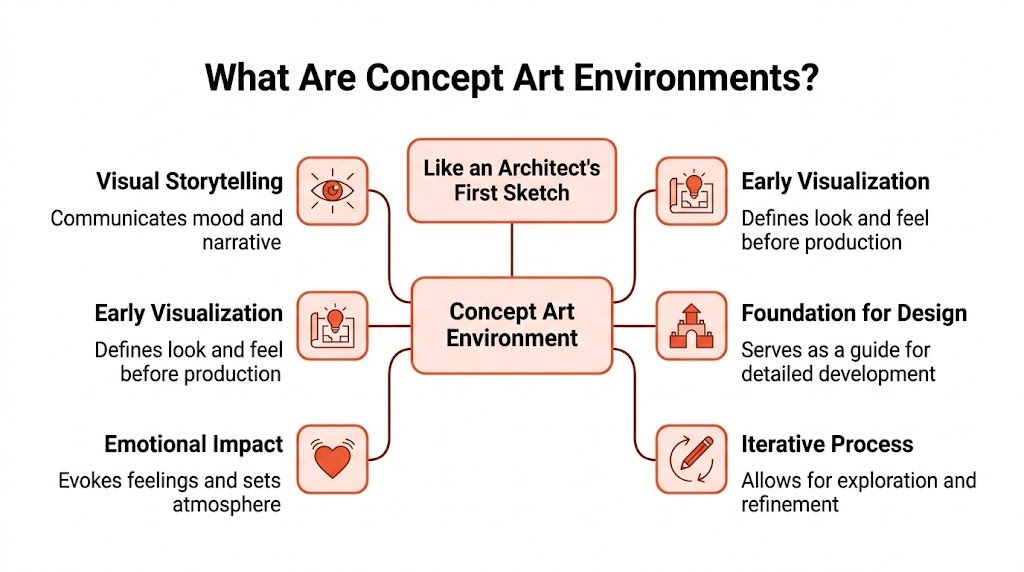
A concept art environment is an early visual that shows the look, mood, and narrative of a space before the final version exists. The easiest way to think about it is this: it's like an architect's first emotional sketch.
It isn't the final blueprint. It isn't the final rendering either. It's the image that helps everyone agree on the direction.
What the artist is really solving
In entertainment, concept artists answer practical questions through visuals.
- What should this place feel like
- Where does the eye go first
- What materials, colors, and shapes define the world
- What story does the environment tell before any character speaks
That discipline sits at the front of a massive industry. The global gaming market, a primary driver for concept art environments, is projected to reach $212.4 billion by 2026 according to concept art industry statistics compiled here. That market relies on concept art to define style, mood, and the core elements of immersive worlds long before production finishes.
Real estate can borrow that same logic. You're not designing a fantasy city. You're helping a buyer emotionally understand a future kitchen, office, lobby, or living room.
Emotional realism versus literal realism
People often get confused at this point.
A listing photo tries to record reality. A concept environment tries to shape perception of a possible reality. Its job is to make the future feel believable enough that someone wants it.
That doesn't mean the image should be misleading. It means it should be intentional.
A concept image can show:
| Use | What it communicates |
|---|---|
| Renovation direction | New finishes, lighting, and spatial mood |
| Style reinvention | Coastal, modern farmhouse, minimal, luxury, industrial |
| Layout possibility | Better furniture flow, clearer zones, stronger function |
| Atmosphere | Warm, airy, dramatic, calm, premium |
How it's different from standard virtual staging
Virtual staging often asks, "What furniture should go here?"
Concept art environments ask broader questions.
For example:
- Could this dark room become bright and contemporary
- Could this outdated kitchen become a premium gathering space
- Could this empty shell become a convincing office, showroom, or lounge
- Could this awkward floorplan feel more coherent with new sightlines and zones
Simple test: If you're only swapping furniture, you're staging. If you're changing the visual story of the space, you're working with concept art thinking.
That's why this technique is so useful for agents. It helps you market not just condition, but direction.
The Core Principles of Environment Design
Good concept art environments don't work because they look fancy. They work because they control attention and emotion.
In real estate, that means making a room feel larger, warmer, cleaner, calmer, or more valuable before a buyer ever visits.

Composition that guides the eye
Composition is the arrangement of visual elements inside the frame.
A strong composition tells the viewer where to look first, where to look second, and what to remember. In a property image, that might mean drawing the eye toward a fireplace, a kitchen island, a window wall, or a beautiful ceiling line.
For agents, this has direct use.
- In a small room, use clean sightlines and fewer visual interruptions so the room reads as open.
- In a long room, use furniture groupings to create order instead of dead space.
- In an awkward room, emphasize the strongest focal point instead of letting the eye drift to the problem area.
Lighting and color that create mood
Lighting does more than brighten a space. It tells the buyer how to feel in it.
Cool lighting can make a home feel sharp and new, but also sterile if overdone. Warm lighting can make an empty room feel lived in and welcoming. Soft contrast makes a bedroom calmer. Stronger contrast can give a lobby or dining room more drama.
Color does the same job. Neutrals calm the frame. Dark accents add weight. Natural wood introduces warmth. Brighter whites create freshness, but only when balanced with texture.
In environment design, lighting is often the fastest way to change the emotional reading of a space without changing the floorplan at all.
Storytelling through use
Every room tells a story about how life happens there.
A concept image should answer practical questions. Where do people gather? Where do they work? Where do they pause? Why does this layout make sense?
That story matters in both residential and commercial settings. A breakfast nook becomes a family ritual. An empty den becomes a focused work zone. A blank office floor becomes a hybrid team space.
Modular thinking for repeatable visuals
Professional environment art also depends on systems. One useful principle is modular asset design with orthographic model sheets, which reduces modeling errors by up to 40% in production workflows, as explained in this environment art process guide.
For real estate, the takeaway is practical. If you build a repeatable library of sofas, tables, lighting schemes, shelving, and décor styles, you can restyle multiple rooms consistently. That matters when you're marketing a whole property, not just one hero image.
A modular approach helps with:
- Consistency across rooms so the listing feels coherent
- Faster revisions when a client wants a different style direction
- Commercial variations when one shell space needs multiple tenant concepts
A Look Inside the Professional Workflow
Professional concept artists don't start with a polished image. They build toward it in layers.
The workflow is part design, part technical planning, and part decision-making under constraints. That's why high-end environment visuals take skill. The final image may look effortless, but the process isn't.
The manual pipeline
A typical environment workflow moves through several stages.
First comes rough ideation. That might be loose thumbnail sketches, paint-overs, or simple value studies to test shape, contrast, and mood.
Then artists create a blockout. In tools like Blender, Maya, or another 3D package, they map the basic architecture and camera angle. This step solves proportion, perspective, and layout before details arrive.
After that comes refinement. Materials, lighting, surface detail, and overpainting in tools like Adobe Photoshop turn the blockout into a believable visual direction.
Here's the key point for real estate professionals. The polished result depends on a lot of hidden labor.
| Stage | What gets solved |
|---|---|
| Sketching | Direction, mood, focal point |
| 3D blockout | Scale, perspective, spatial logic |
| Material pass | Surface identity and realism |
| Paint-over | Atmosphere, polish, storytelling |
Why realism takes technical discipline
The entertainment industry doesn't rely on guesswork when it wants realism that also performs well.
Professionals use PBR texturing with ARM-packed texture sheets, a process that can cut memory usage by 30 to 50 percent while preserving realism in real-time rendering, as described in this environment artist fundamentals breakdown. In simple terms, artists organize texture data efficiently so scenes look convincing without becoming too heavy to render.
Most agents don't need to build those texture sheets by hand. But understanding the standard helps. It explains why quality environment visuals look grounded instead of artificial. Materials behave consistently. Wood looks like wood. Matte paint doesn't shine like marble. Metal catches light differently from fabric.
Why AI matters now
Once you see the traditional workflow, the value of AI becomes obvious.
The old process requires design training, software fluency, time, and revision cycles. A real estate team usually doesn't have an environment artist on call for every listing that needs a renovation concept or alternate style board.
Practical rule: The manual workflow is still the quality benchmark. AI becomes useful when it helps non-artists reach that benchmark faster, with fewer tools and fewer handoffs.
That doesn't make design optional. It makes good design more accessible.
Putting Concept Environments to Work in Real Estate
Real estate teams don't need concept art environments for every listing. They need them when a property's future is easier to sell than its present.
That's common in residential marketing. It's even more common in commercial leasing, where a blank shell can mean anything and therefore means nothing until someone visualizes it.
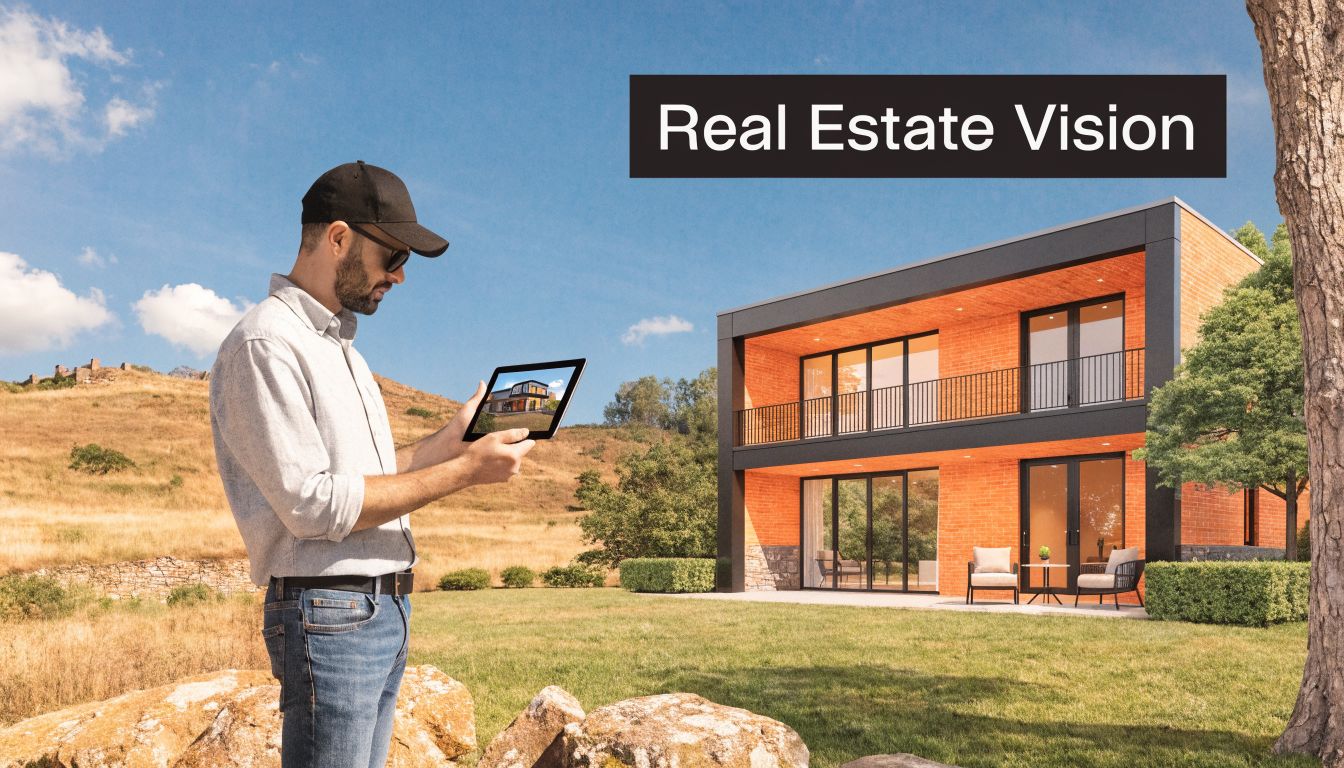
Residential use cases that change the conversation
A listing agent can use a concept image to show what a dated kitchen becomes after a clean renovation. That visual helps justify a price conversation in a way a contractor estimate alone can't.
A buyer's agent can use the same method differently. If the client dislikes the current decor, an alternate concept can separate the house from the seller's taste. That's often enough to keep a buyer engaged.
If you're advising sellers on presentation strategy, this practical piece on virtual staging when selling a home offers a grounded view of how staged visuals shape first impressions and online engagement.
Commercial spaces benefit even more
Commercial brokers face a bigger visualization problem.
An empty office floor, retail shell, or mixed-use unit often needs multiple stories at once. One prospect wants open collaboration. Another wants private offices. Another needs a client-facing showroom.
Top-down planning is especially useful here. In game design, artists use it to map level flow. In commercial real estate, brokers can adapt that same method to generate layout variants from floorplans. That's a notable gap in the market, and the need is reflected in over 1,200 unanswered forum posts from property managers seeking ways to create concept art from floorplans in 2025, as noted in this video discussion on top-down planning and real estate applications.
That means concept environments can do more than decorate. They can pre-sell function.
A simple decision framework
Use concept visuals when the property needs one of these:
- A renovation narrative so buyers can see the post-improvement version
- A style reset when current finishes or furniture distract from the bones
- A layout proof for shell spaces, awkward rooms, or flexible commercial units
- A marketing gallery upgrade when the listing needs stronger visual variety across channels, especially if you're building enhanced property galleries
The strongest concept images don't say, "Look what software can do." They say, "Now I understand the space."
How to Generate Concept Environments with AI
Most real estate professionals don't need to learn digital painting, UV mapping, or advanced rendering. They need a reliable workflow that turns ordinary property photos into clear visual directions.
That's where AI helps. It compresses a process that used to belong almost entirely to entertainment studios. It doesn't remove judgment. It makes iteration faster.
There is also a clear content gap here. Most tutorials still focus on manual entertainment workflows, while Google Trends data from 2025 to 2026 shows a 300% rise in AI-related queries for property concept environments, alongside hundreds of unanswered agent questions about AI home staging concepts, according to this video covering the gap in real estate concept workflows.

Start with the right source image
A clean input makes everything easier.
Use a straight, well-lit photo with a readable room layout. If the room is heavily cluttered, decide whether you want the AI to declutter first or reinterpret the space more broadly. Wide shots work well when the goal is layout and mood. Tighter shots work better for material and finish changes.
Before you generate anything, ask one business question: what objection am I trying to remove?
That answer shapes the image.
- If buyers think the room feels dark, your prompt should focus on light, openness, and reflective materials.
- If the problem is outdated style, focus on finishes, furniture language, and palette.
- If the room feels functionless, focus on use case and zoning.
Write prompts like a creative brief
Good prompts are specific, but they don't need to sound technical.
Include five elements:
- Room type
- Target style
- Material cues
- Lighting direction
- Camera or mood note
Here are examples you can adapt.
Kitchen renovation prompt
Renovate this kitchen into a modern farmhouse style with white oak cabinets, a large center island, warm pendant lighting, matte hardware, brighter natural light, and a clean premium finish.Living room restyling prompt
Restyle this living room in a mid-century modern direction with low-profile furniture, warm ambient lighting, walnut accents, soft neutral textiles, and a welcoming residential feel.Bedroom mood prompt
Transform this bedroom into a calm boutique-hotel style space with layered bedding, soft wall lighting, textured neutrals, subtle contrast, and a serene upscale atmosphere.Commercial office prompt
Reimagine this empty office shell as a hybrid workspace with collaborative tables, glass-front meeting rooms, acoustic panels, warm wood finishes, daylight emphasis, and a polished leasing-ready look.
For broader marketing teams that are experimenting across copy, imagery, and campaign production, this roundup of best AI tools for content creation is useful context because it shows how visual generation now fits into a larger content workflow.
Refine in rounds, not in one shot
The first output is rarely the final one.
Treat the process like direction, not magic. Generate several options. Choose the image that gets the layout, focal point, and mood mostly right. Then refine.
Useful revision instructions include:
- Open the space more by reducing visual clutter and widening circulation
- Make materials more premium by simplifying finishes and improving texture contrast
- Shift the mood warmer through lighting and wood tones
- Keep architecture intact if the image starts inventing features that don't belong
A strong next step is comparing outputs against your source photo in tools discussed in this guide to best AI photo editing software, especially if you need a mix of realism, cleanup, and style control.
A short walkthrough helps make the workflow concrete:
What to watch for
AI-generated concept art environments are persuasive, which means they need guardrails.
Use them to show plausible future states, not fantasy versions that break trust. If you're marketing a potential renovation, keep the architecture believable. If you're creating alternate styles, make sure the room still looks like the room.
Good AI concept work doesn't replace local market knowledge. It packages that knowledge into a form buyers can understand fast.
The practical advantage is simple. Instead of waiting on custom visual production, you can test multiple directions quickly, use the strongest one in your listing strategy, and move the conversation from "I don't like this room" to "I can see what this could become."
The Future of Property Marketing Is Visual
Concept art environments used to live mostly inside game studios, film pipelines, and design departments. Now they're useful to agents, brokers, marketers, and leasing teams who need buyers to see more than current condition.
That's the shift that matters.
A property doesn't always lose interest because it's flawed. Sometimes it loses interest because nobody translated its potential into a visual form the buyer could understand. Concept-driven imagery fixes that. It turns renovation ideas into something concrete, layout options into something persuasive, and empty rooms into places with purpose.
The agents who adopt this approach won't just have prettier marketing. They'll have a sharper sales tool. They'll answer objections earlier, guide client imagination more effectively, and present listings with more control.
Property marketing is becoming more visual, more iterative, and more strategic. Teams that learn to communicate future value clearly will stand out.
Bounti Labs helps real estate teams turn ordinary property visuals into stronger marketing assets without the usual delays. With Bounti Labs, you can start from a simple video walkthrough and generate listing descriptions, still images, MLS-ready photos, decluttered rooms, staged interiors, restyled spaces, and even renovation concepts. If you want a faster way to show buyers what a property could become, it's worth exploring.