
Floor plan sketching is about more than just drawing lines on paper. It's the art of creating a simple, to-scale drawing that tells a property's story. For top agents, this is a foundational skill—transforming basic dimensions into a powerful marketing tool that helps buyers truly see themselves in a space before they ever step inside.
Why Better Floor Plans Win More Listings

In a market this competitive, a high-quality floor plan isn't a "nice-to-have" anymore. It's a non-negotiable advantage. While stunning photos and slick virtual tours set the mood, a detailed sketch gives serious buyers the practical context they crave. It instantly answers their biggest questions about flow, room size, and whether the layout actually works for their life.
That immediate clarity does two things: it builds trust and manages expectations. When a potential buyer can see exactly how the space is laid out, they qualify themselves. That means the people who show up for a viewing are more serious and better informed, which saves you and your seller an incredible amount of time.
It's About Connection, Not Just Dimensions
A great floor plan allows potential buyers to emotionally map their lives into a property. They start mentally placing their sofa, figuring out where the kids will play, and imagining their morning routine. This is where the magic happens. This is the connection that drives decisions.
The industry is catching on. The market for floor plan solutions is booming, projected to hit $2.5 billion by 2026. This isn't just a tech trend; it shows that agents everywhere are recognizing that sophisticated visuals are now a core part of selling real estate. You can see how these shifts are changing the game for real estate agents.
A floor plan is the bridge between seeing a property online and feeling at home in it. It turns a list of features into a tangible future.
The best part? Creating these assets has never been easier. Going from a quick sketch on-site to a polished, professional diagram is simpler and faster than you think. In fact, modern tools now use AI to automate the entire process, turning a simple video of the property into a perfect floor plan.
This guide will walk you through the whole workflow, from taking that first measurement to creating the final marketing asset.
Gathering Your Tools for Accurate Measurements
Great floor plans don’t start with artistic talent. They start with good data. Before you even think about sketching, getting your gear in order is the single most important step you can take to make the process smooth and—most importantly—accurate.
The goal is simple: capture every measurement you need in a single visit. Nothing is more frustrating than getting back to the office only to realize you forgot to measure a hallway or a closet, forcing a return trip. A little prep goes a long way.
The Essential Toolkit
You could try to measure a whole house with a standard tape measure, but a laser distance measurer is the industry standard for a reason. It’s fast, precise, and turns a two-person job into a quick solo task. You’ll get accurate readings in seconds, even across long, open-concept spaces where a tape would sag.
But the laser doesn't do it all. You'll still need a few low-tech essentials to round out your kit. To make your on-site sketching a breeze, you'll need a mix of modern and traditional tools. Here's what the pros carry.
Essential Toolkit For On-Site Floor Plan Sketching
Having these items on hand means you’re prepared for virtually any layout a property can throw at you, from a simple boxy condo to a sprawling, multi-level home.
How to Handle Architectural Quirks
Let's be honest, most homes aren't perfect rectangles. You're going to run into angled walls, bay windows, and split-level layouts. Don't sweat it. A systematic approach makes even the trickiest features easy to map.
The most common mistake in floor plan sketching isn't a bad drawing—it's incomplete data. One forgotten measurement can bring your entire workflow to a halt back at the office.
When you hit an angled wall, think in triangles. Just measure the length of the angled wall, then measure from each end of that wall to a fixed corner. This creates a simple triangle that you can easily reconstruct on paper. For bay windows, treat them as a series of small, connected walls, measuring each segment and noting the angles.
Develop a consistent shorthand for yourself. A simple arc can show which way a door swings. A "W" inside a wall break can mark a window. The point of the on-site sketch isn’t to create a masterpiece; it's to create a clear, readable map for your future self.
Of course, if you'd rather skip the paper and pencil entirely, it's worth seeing how a mobile app can automate floor plan creation right on site. But if you're doing it by hand, a clear system ensures you’re translating solid data, not trying to decipher messy notes hours later.
From Scrappy Notes to a Polished Plan
Alright, you're back from the property with a clipboard full of measurements and a sketch that might look like a treasure map. This is the moment where raw data becomes a real marketing tool—one that helps buyers see themselves living in the space.
Getting from field notes to a final floor plan isn’t about being an artist. It’s all about precision.
Whether you love the old-school feel of graph paper or prefer a slick digital workflow, the goal is the same: create a clean, accurate layout that’s dead simple to read. Let’s look at the two ways to get it done.
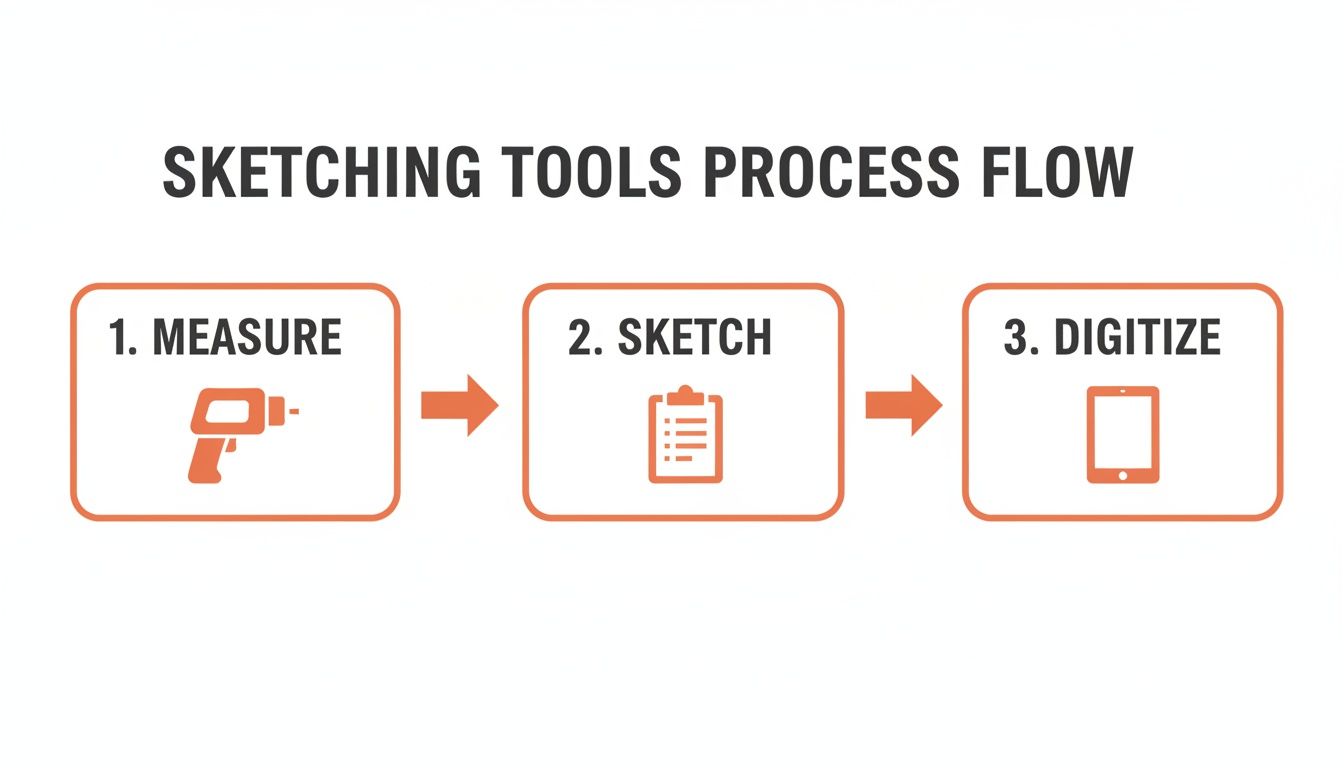
No matter what tools you use, the process is always the same: measure the space, sketch the layout, and digitize it for the final listing.
The Old-School Way: Drafting on Graph Paper
There's a reason people still do this—it just works. Drafting by hand on graph paper gives you an instant, tangible sense of scale and proportion.
First, set your scale. The easiest to work with is 1 square = 1 foot. So if you measured a living room that’s 20 feet long and 15 feet wide, you’d simply draw a rectangle that’s 20 squares by 15 squares. Done.
Using your notes, start adding the walls, doors, and windows to scale. For a standard 32-inch interior door, you’d leave a gap of about three squares, then draw a thin line with an arc showing which way it swings. Windows can be a simple break in the wall or a slightly thicker line.
The key to hand-drafting is being consistent. If you use the same symbols and stick to your scale, you’re creating a readable architectural document, not just a drawing.
If you’re mapping a two-story townhouse, for example, you’ll draw each floor separately. Just make sure the staircases and any shared walls line up perfectly between the two drawings so the connection between floors feels logical.
The Modern Way: Using Digital Tools
If you’d rather skip the paper cuts and eraser dust, plenty of digital tools make this process faster and cleaner. They range from simple tablet apps to full-blown desktop software.
Picture sketching that same townhouse on an iPad. You can draw the exterior walls, and the app will automatically snap the lines into perfect right angles. Then, you can add interior walls and simply type in the exact dimensions from your notes.
This digital approach has some serious advantages:
- Mistakes are painless. Made a wall too long? Just drag it or hit undo. No smudges, no starting over.
- Professional symbols are built-in. Most apps have libraries for doors, windows, stairs, and even furniture. It makes your plan look professionally drafted with zero effort.
- Sharing is instant. When you’re finished, you can export a clean PDF or JPEG and drop it right into your listing.
As you start turning your sketches into final diagrams, it helps to know what you’re creating from a buyer's perspective. Understanding how to read a floor plan like a pro will ensure the layouts and symbols you use are universally understood.
Whether you go manual or digital, the mission is the same: turn your on-site measurements into a polished, scaled plan. A clean floor plan builds buyer confidence and makes the layout instantly clear—making it one of the hardest-working assets in your listing.
How AI Is Changing the Floor Plan Game for Good
Look, mastering the art of the hand-drawn sketch or a basic digital tool gives you a great foundation. But a powerful new approach is here, and it's changing the entire workflow. Artificial intelligence isn't some sci-fi concept anymore; it's a practical tool that’s already eliminating the most tedious, time-sucking parts of creating a floor plan.
And it's not just about making things a little faster. It’s a complete shift in how the work gets done.
Imagine walking through a property, shooting a quick video on your phone, and getting a complete, accurate floor plan spat out automatically. That’s not a dream—it's exactly what AI-driven platforms like Bounti already do. This tech doesn't just help you draw; it handles the entire process for you.
This shift means you get to ditch the laser measure and clipboard. You spend less time measuring and more time actually connecting with your clients. It completely removes the need for manual drafting, delivering a polished, professional result every single time, no matter your technical skill.
It's More Than Just a Floor Plan
Here's where it gets really interesting. The true power of these AI systems is that they double as an all-in-one marketing assistant. The same video you took to generate the floor plan can be mined to produce all your other essential marketing assets at the same time.
From one short walkthrough, you can get:
- A professional, MLS-ready floor plan with precise dimensions and clear room labels.
- Engaging property descriptions that highlight the home’s best features and tell a compelling story.
- High-quality marketing photos pulled directly from your video, showcasing the property from its best angles.
This is what makes AI so powerful. It’s not just a slightly better tool—it’s a whole new, radically efficient way of working. We're seeing it firsthand, and you can learn more about how AI is actively improving the home buying experience in our recent article.
Why This Is Your New Strategic Advantage
This tech couldn't have arrived at a better time. The market for floor plan solutions is blowing up, with a projected 12% CAGR expected to push its value to $7.8 billion by 2033.
For agents, those numbers tell a story: getting on board with these tools isn't just a good idea—it's essential for staying competitive. AI-powered platforms are quickly moving from a "nice-to-have" novelty to a core part of the modern agent's toolkit.
By automating the grunt work of measuring, sketching, and writing, AI frees you up to do what you do best—build relationships and close deals. It turns a massive time-sink into a real strategic advantage.
Instead of blocking out hours to create marketing materials, you can capture everything you need in minutes and get a complete package of assets back almost instantly. For a deeper look at how this is being applied across the industry, check out this guide on AI in interior design for generative layouts and space planning. It's a clear signal of how automated systems are becoming central to how we visualize and market spaces.
From Sketch to Pro: Common Mistakes to Avoid
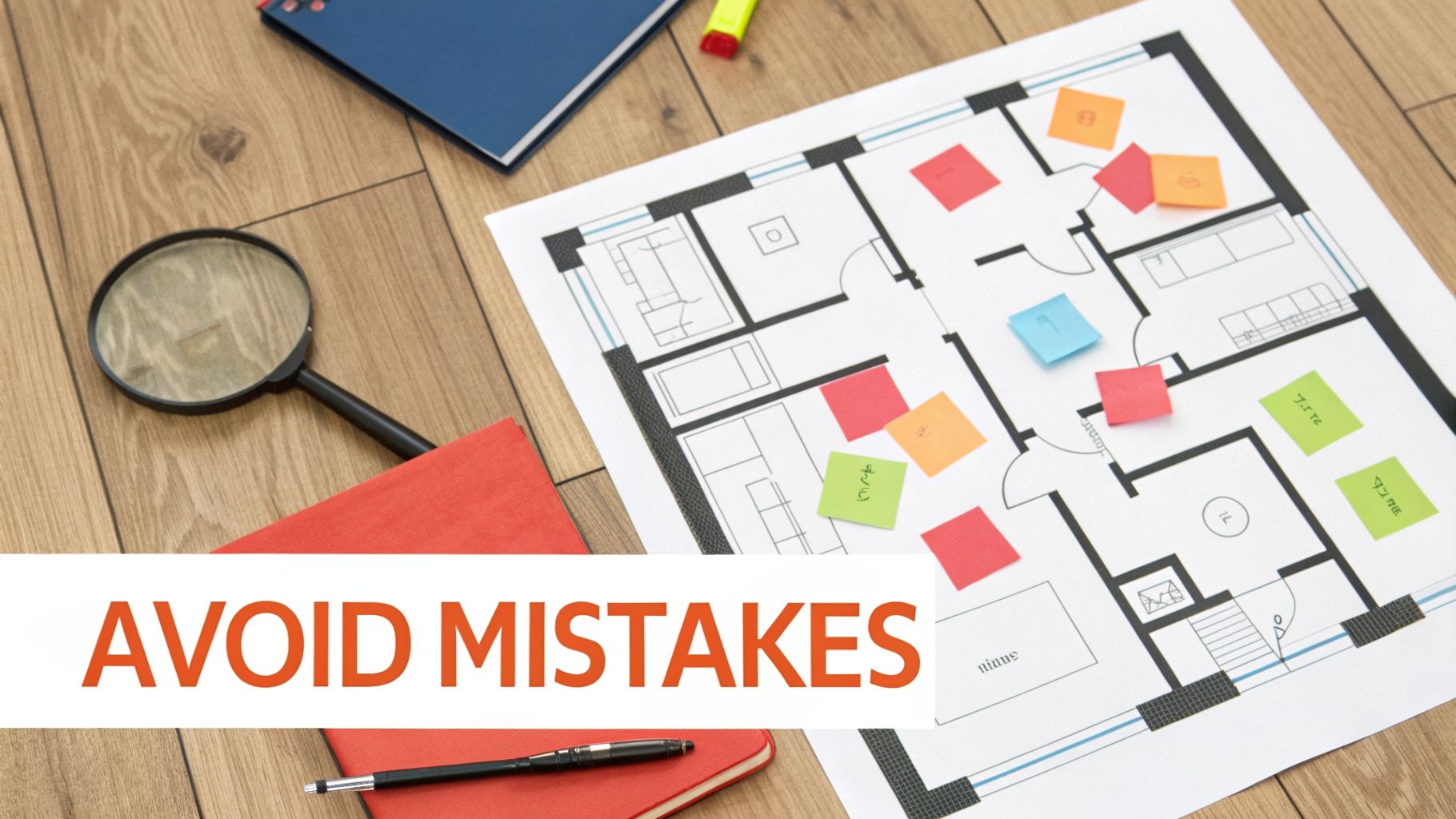
Moving from a basic sketch to a professional floor plan is all about the details. It's the small, pro-level touches that turn a simple drawing into a tool that actually helps buyers see themselves in a home—and it's the common mistakes that confuse them right out the door.
One of the easiest wins? The North arrow. It’s a tiny symbol, but it’s a non-negotiable for any serious floor plan. It instantly tells buyers how the sun will move through the house, which rooms get morning light, and where they can expect afternoon shade. Don’t skip it.
Labeling: Keep It Clean and Clear
Labels are essential, but it’s surprisingly easy to make a cluttered, unreadable mess. The goal is information, not chaos.
- Stay Consistent: Use the same font and size for every room label. Try to place them in the center of each space.
- Add Key Dimensions: For the most important rooms—living room, primary bedroom—add the dimensions (like 15' x 20'). This gives buyers a real sense of scale and helps them visualize their own furniture in the space.
- Use Smart Abbreviations: Save space with common shorthand like "W/D" for the laundry area or "W.I.C." for a walk-in closet.
This level of detail isn't just a "nice to have" anymore. The interior design market is set to hit $204.23 billion by 2031, and that professional polish is exactly what clients now expect. You can see how these standards are rising by checking out the latest industry reports on emerging design trends.
A floor plan doesn't just show where walls are. It communicates the potential of a space. Get the scaling wrong or leave out key details, and you erode a buyer's trust before they even book a showing.
Sidestepping the Most Common Traps
I’ve seen these mistakes derail countless otherwise great listings. Knowing what they are is the first step to avoiding them.
The absolute most common error is inconsistent scaling. This is where one room is drawn out of proportion to another—a small bedroom suddenly looks almost as big as the living room. It's incredibly misleading and sets buyers up for disappointment when they see the property in person.
Another classic pitfall is forgetting the "in-between" spaces. Closets, pantries, and hallways aren't afterthoughts; they're critical to understanding storage and how a home actually flows. Leaving them out gives an incomplete picture and makes it harder for a buyer to imagine their daily routine. Always measure and include them.
Your Floor Plan Questions, Answered
I get it. When you're first adding floor plans to your listing toolkit, a few common worries tend to surface. Let's tackle them head-on so you can start sketching with confidence.
Do I Need to Be an Artist to Create a Good Sketch?
Absolutely not. This is one of the biggest misconceptions out there.
A real estate floor plan is about information, not artistic flair. The goal here isn't fine art; it's clarity. Buyers just need a clean, easy-to-read diagram. Focus on straight lines, basic symbols, and legible notes. Graph paper is your best friend for keeping things in proportion on that first draft.
Remember, your hand-drawn sketch is just a data-capture tool. When you use a digital app or an AI service like Bounti, it does all the polishing for you. No drawing skills required.
How Accurate Do My Measurements Need to Be?
Precision is great, but "representational accuracy" is the industry standard for marketing. This isn’t an architectural blueprint for a builder. Your measurements just need to be close enough for a potential buyer to get a solid feel for the home's scale, flow, and whether their sectional will fit in the living room.
Always add a disclaimer to your finished floor plan. Something simple like, “All dimensions are approximate and for illustrative purposes only,” manages expectations and provides a professional safeguard.
What really matters is avoiding glaring errors that misrepresent the space—like making a spare bedroom look as big as the primary suite. The key is to be consistent and honest.
What Is the Fastest Way to Create a Floor Plan?
If speed is what you're after, nothing beats an AI-powered service. It’s not even close.
The old way—measure by hand, sketch on paper, then redraw on a computer—can eat up hours. With a tool like Bounti, you just walk through the property and record a short video on your phone. That's it. The AI processes the video and kicks back a professional, accurate floor plan in minutes.
It turns a multi-hour task into a few minutes of work on-site.
Should I Include Furniture in My Sketch?
Sometimes. Adding a few key pieces of furniture—a bed, a dining table, a sofa—is a fantastic way to show scale. It gives buyers an instant frame of reference for how they might actually live in the space.
But don't go overboard. A cluttered floor plan is a confusing floor plan. The main purpose is to show the layout, dimensions, and flow. A better strategy is often to provide a clean, unfurnished floor plan and then use separate AI staging tools to create beautifully furnished photos of the rooms themselves.
Ready to skip the tape measure and graph paper for good? With Bounti, a single video walkthrough is all you need to generate a perfect floor plan, stunning photos, and compelling property descriptions instantly. Discover how AI can transform your real estate marketing at https://www.bounti.ai.