Finding the right commercial space is a massive milestone for any business. It's also a process that can feel incredibly complex if you've never done it before. This guide is your roadmap.
We're breaking down the entire journey into clear, practical stages—from figuring out what you actually need to signing on the dotted line. This isn't just a checklist. It's a strategic framework to help you make smart decisions that align your real estate with your business goals for the long haul.
Your Essential Roadmap for Leasing Commercial Space
Every commercial lease, whether it’s for a small retail shop or a massive warehouse, follows the same fundamental path. I’ve seen it hundreds of times. The entire process really boils down to three core phases.
Getting this right means starting with a solid plan before you even think about looking at properties.
The Three Core Phases of the Leasing Journey
Think of the journey in three distinct, connected parts. Each stage builds on the one before it, moving you from a vague idea to a signed lease.
It’s a simple, methodical flow.
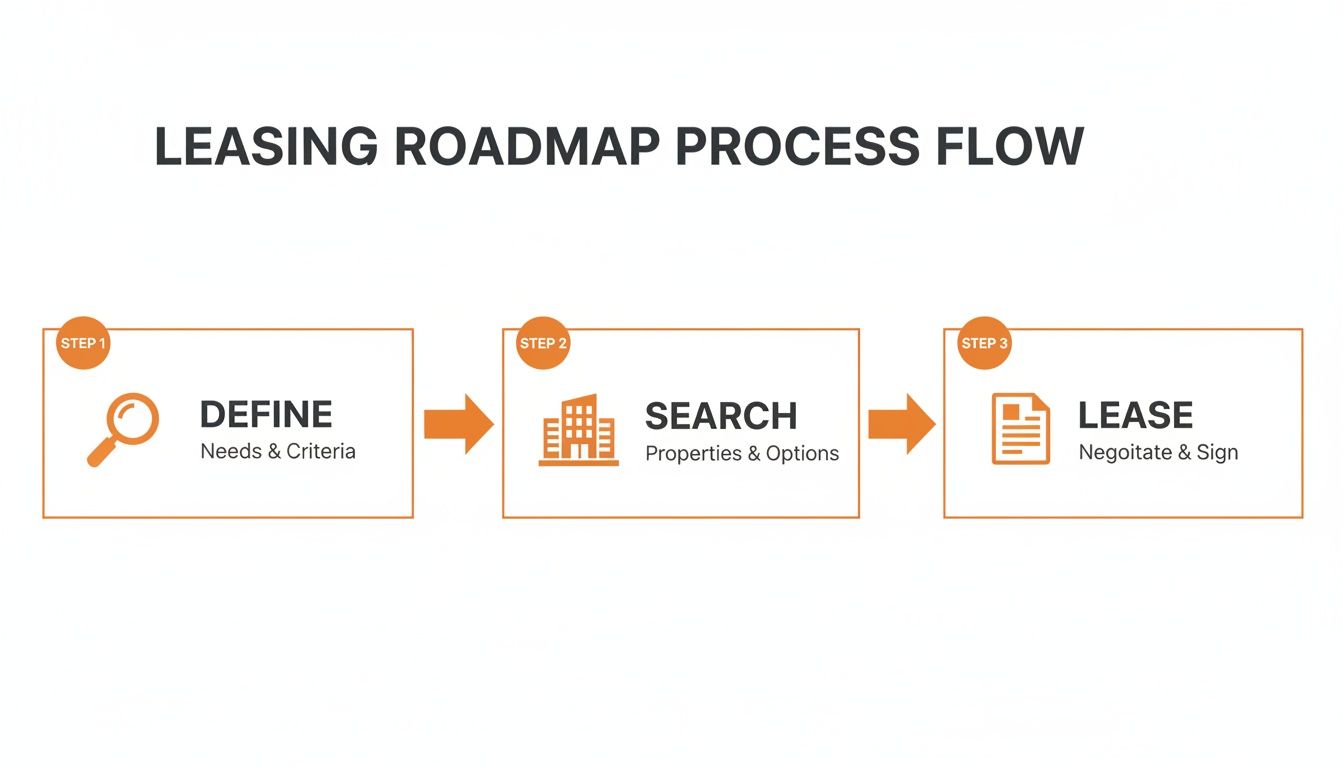
Here's how it breaks down in practice:
Define Your Needs: This is the homework phase. You’ll dig into your budget, project headcount growth for the next few years, and make a list of must-have amenities. Getting crystal clear on location and operational needs here saves you from wasting weeks looking at the wrong spaces.
Search for Properties: With your criteria locked in, the hunt begins. This is where you bring in a broker, start digging through listings, and get out there for site tours. The goal is simple: build a shortlist of real contenders.
Lease and Negotiate: You’ve found the one. Now it's time to make it official. This final leg involves submitting a Letter of Intent (LOI), negotiating the key business and financial terms, conducting your due diligence, and getting the final lease reviewed by an attorney before you sign.
A well-defined plan is your single greatest asset. The most common mistake I see is businesses rushing into the search without a rock-solid understanding of their budget, operational needs, and long-term vision.
By breaking the process into these manageable stages, you can tackle the leasing process with confidence, ensuring the space you choose will be a true asset to your business for years to come.
Get Your Financials and Market Intel Ready Before You Search
Want to know the secret to a great commercial lease? It all happens before you ever look at a single property. The most critical work is the prep—getting your financials airtight and developing a razor-sharp read on the market.
This is how you walk in looking like the exact tenant a landlord wants to sign. I’ve seen too many businesses rush this part, only to end up overpaying or locked into a space that bleeds their cash flow dry. Let’s get you ready to negotiate from a position of real strength.

Calculate Your Real Budget (Not Just the Rent)
That advertised price per square foot? Think of it as the starting point, not the finish line. Overlooking the additional costs is one of the most common—and expensive—mistakes I see. Your "all-in" number is the only one that matters for the health of your business.
To get the real picture, you have to dig into the variable costs that get passed on to you, especially with Net Leases (NNN).
Go beyond the base rent and factor these in:
- Operating Expenses (CAM/NNN): This is your share of the property’s upkeep costs—landscaping, security, management fees, property taxes, and building insurance. Always, always ask for a detailed history of these charges.
- Utilities: Get clarity on what you’re responsible for. It’s common for tenants to pay their own electricity, gas, water, and internet directly.
- Initial One-Time Costs: Don't forget the cash you need on day one. This means the security deposit (often a few months' rent), first month's rent, and the capital for any construction or tenant improvements (TI).
- Business Insurance: The landlord will require you to have your own liability and property insurance policies in place.
As a rule of thumb, I advise clients to budget an additional 15-30% on top of their base rent to cover these variable operating expenses. This buffer prevents unexpected cash flow problems down the road.
To cover major costs like a security deposit, build-out, and initial operating expenses, you need to have your funding lined up. You can explore the Top 10 Sources of Capital for U.S. businesses to see what options might work for you.
Build Your Financial Package
When you make an offer, the landlord is going to do their homework on you, just like you are on the property. Having a professional financial package ready to go shows you’re a serious, credible applicant.
This package is your proof that you can handle the long-term commitment of the lease.
Here’s what you need to have in your folder:
- Business Financials: Have two to three years of Profit & Loss (P&L) statements and Balance Sheets ready. If you're a startup, a detailed business plan with solid financial projections can work instead.
- Tax Returns: It’s standard to ask for two to three years of both business and personal tax returns, especially if the owner's personal credit is part of the deal.
- Bank Statements: Show them the money. Recent statements demonstrating healthy cash reserves can make your application much stronger.
A clean, organized package sends a powerful message: you're competent and reliable. It’s your first impression, so make it a good one.
Read the Market for a Negotiating Edge
The commercial leasing world is constantly in motion. Knowing which way the wind is blowing gives you a massive advantage at the negotiating table. We're talking about a huge market—projected to hit $276.7 billion in 2026—that’s growing despite some bumps like high office vacancy rates.
Right now, the big trend is the "flight to quality." Tenants are moving up, chasing modern, amenity-rich Class A properties. This leaves older Class B and C buildings with landlords who are much more motivated to make a deal.
Understanding this dynamic creates opportunity. If you're targeting a Class B building, you likely have more leverage to ask for a bigger tenant improvement allowance or a few months of free rent. The landlord needs you more than you need them. Knowing the local vacancy rates, average rents, and what deals just closed in your target area will make you a much smarter, tougher negotiator.
Finding Your Ideal Property and Deciphering Lease Types
Okay, you've got your financials lined up and a feel for the market. Now for the fun part—finding the actual space.
But before you step foot in a single property, we need to talk about leases. The type of lease you sign is just as important as the address on the door because it determines your real financial obligations for years to come. An attractive base rent might look great on paper, but if the lease structure sticks you with a ton of operating expenses, you're in for a world of hurt.
Getting this wrong is one of the most common—and costly—mistakes I see business owners make.
The Three Main Commercial Lease Structures
In the commercial world, leases typically boil down to three main flavors: Gross, Triple Net (NNN), and Modified Gross. Each one carves up the responsibility for the property’s big operating expenses—property taxes, insurance, and maintenance—in a different way.
This isn't just fine print; it's a major point of negotiation that directly impacts your bottom line.
I’ve seen countless businesses fixate on the base rent, only to get blindsided by their first CAM (Common Area Maintenance) bill. You have to analyze the total occupancy cost—your base rent plus all the extras—to make a true apples-to-apples comparison between two different spaces.
Commercial Lease Types At a Glance
So, who pays for what? It can get confusing, but here’s a simple breakdown of how these expenses are typically handled under each lease type.
| Expense | Gross Lease | Modified Gross Lease | Triple Net (NNN) Lease |
|---|---|---|---|
| Base Rent | Tenant Pays | Tenant Pays | Tenant Pays |
| Property Taxes | Landlord Pays | Split/Negotiated | Tenant Pays (Pro-rata share) |
| Building Insurance | Landlord Pays | Split/Negotiated | Tenant Pays (Pro-rata share) |
| Common Area Maintenance (CAM) | Landlord Pays | Split/Negotiated | Tenant Pays (Pro-rata share) |
| Utilities (in-suite) | Tenant Pays | Tenant Pays | Tenant Pays |
A Gross Lease is the most straightforward, giving you a predictable, all-in monthly payment that's easy to budget. On the other end of the spectrum, a Triple Net (NNN) Lease usually comes with a lower base rent, but you're on the hook for a share of variable operating costs. A Modified Gross Lease lands somewhere in the middle, creating a hybrid where you and the landlord negotiate who covers which specific costs.
Starting Your Property Search
Now that you know how to read a lease, you’re ready to hit the streets. The best way to find the right property is to combine your own legwork with professional guidance. A sharp commercial real estate broker isn't just helpful; they're essential.
A great broker brings access to off-market deals, an encyclopedic knowledge of local submarkets, and the negotiating muscle to be your advocate. If you're in a niche industry, find an agent who gets it. It’s worth checking out how some real estate agents are using new tools to help clients see a property's true potential.
Your search toolkit should include:
- Commercial Broker: This is your number one asset. They’ll filter properties, line up tours, and manage the back-and-forth with landlords so you can focus on your business.
- Online Listing Platforms: Sites like LoopNet, Crexi, and CommercialCafe are fantastic for getting a lay of the land. Use them to understand inventory and pricing in your target neighborhoods.
- Your Network: Don't underestimate the power of a conversation. Talk to other business owners in your field or area. They can give you the real scoop on buildings, landlords, and management companies.
Evaluating Properties During Site Visits
When you start touring spaces, you need to look past the paint and carpet. The real question is whether the space can support your business operations today and five years from now.
Bring a checklist to every tour to keep your evaluations consistent.
- Accessibility and Parking: How easy is it for your team and your customers to get here? Is parking a nightmare? Is it free or will it be an added cost and hassle?
- Infrastructure: Kick the tires. Check the age and condition of the HVAC, electrical panels, and plumbing. A low rent in an old building might get eaten up by sky-high utility bills or unexpected repair costs.
- Zoning and Use: This is a big one. You have to confirm the property is zoned for your specific business. You can't open a retail shop in a space zoned only for industrial use, no matter how perfect it seems.
- Layout and Flow: Does the floor plan work as-is, or are you looking at a major renovation? Finding a space that’s already close to what you need can save you a fortune in build-out costs.
The Art of Negotiation and Final Due Diligence

You’ve found a space with potential and you understand the lease structure. Now for the make-or-break moment: the negotiation. This is where you go beyond the asking price to shape a deal that actually works for your business—not just for today, but for years to come.
Forget the idea of a confrontation. This is a strategic conversation where you can lock in serious long-term value. It all begins with a document called the Letter of Intent (LOI). While non-binding, this outline of the core terms sets the stage for everything that follows. A sharp LOI can save you thousands.
Negotiating Your Letter of Intent
Your broker will handle the paperwork, but you’re the one driving the business terms. The rental rate is just the starting line. The real wins in commercial leasing are found in the details that protect your flexibility and cash flow.
Here are the key points to focus on:
- Tenant Improvement (TI) Allowance: This is cash from the landlord to help you customize the space. It’s highly negotiable and usually priced per square foot (e.g., $50/sf). A solid business plan and clear vision for the build-out will help you secure a bigger allowance.
- Free Rent Period: Don't be afraid to ask for a few months of "rent abatement." It's a standard and effective tactic that gives you breathing room to finish your build-out and get operational without rent hanging over your head.
- Renewal Options: What happens when the lease is up? A renewal option gives you the right to extend at a pre-agreed rate (or one tied to fair market value). It's invaluable long-term security for your business location.
- Sublease and Assignment Clause: Business needs change. A flexible sublease or assignment clause is your exit strategy, allowing you to transfer the lease to another tenant if you outgrow the space or your plans shift. It prevents you from being locked into a costly obligation.
Never underestimate your leverage, especially when vacancy rates are up. A landlord with an empty space is a motivated landlord. They'd often rather offer concessions like a TI allowance or free rent than just lower the base rent on paper.
Market conditions are your best friend here. For instance, current projections for 2026 show that while new Class A spaces are hot, landlords of older properties are much more willing to negotiate to fill their buildings.
Watch Out for These Red Flag Clauses
While you're pushing for good terms, you also have to play defense. Some "standard" clauses are anything but standard and can cripple your business. Your attorney and broker need to comb through the draft lease for any landmines.
Pay close attention to these potential deal-breakers:
| Clause to Watch | Why It's a Red Flag | What to Do |
|---|---|---|
| Relocation Clause | Gives the landlord the right to move you to a "comparable" space. This is a massive disruption you want to avoid at all costs. | Push to have it removed entirely. If they won't budge, demand strict terms where they cover all moving costs, build-out replication, and any difference in value. |
| Restrictive Use Clause | A narrow "use" clause can box you in. A lease for a "retail clothing store" could prevent you from adding a small coffee bar down the road. | Negotiate for broad language like "general retail use" or something similar. Give your business room to evolve without having to ask for permission. |
| Demolition Clause | This lets the landlord terminate your lease if they decide to tear down or redevelop the property. A business killer. | Fight hard to remove it. If it's non-negotiable, insist on a long notice period (12+ months) and a significant payout to cover your relocation and losses. |
Your Final Due Diligence Checklist
Once the LOI is agreed upon, it's time for the final deep dive before you sign anything legally binding. This is your last chance to spot hidden issues. Do not get lazy here.
This final check-up protects your investment and confirms the property is what it appears to be.
- Professional Physical Inspection: Hire an expert. You need a third-party report on the HVAC, roof, electrical, and plumbing. Any expensive, looming repairs need to be on the table now, not after you've signed.
- Zoning and Permitting Verification: Go to the city yourself. Independently confirm that your specific business use is permitted by the property's zoning. You also need to check for any open permits or code violations tied to the address.
- Thorough Legal Review: This is non-negotiable. An experienced commercial real estate attorney needs to review every word of the final lease. They will spot the ambiguous language and hidden risks that brokers (and you) can miss. This step alone can save you from a five- or ten-year mistake.
Once this final check is complete, you can move toward signing with confidence, ready to tackle property management and start planning your build-out.
See the Future: Using Tech to Visualize and Plan Your Space
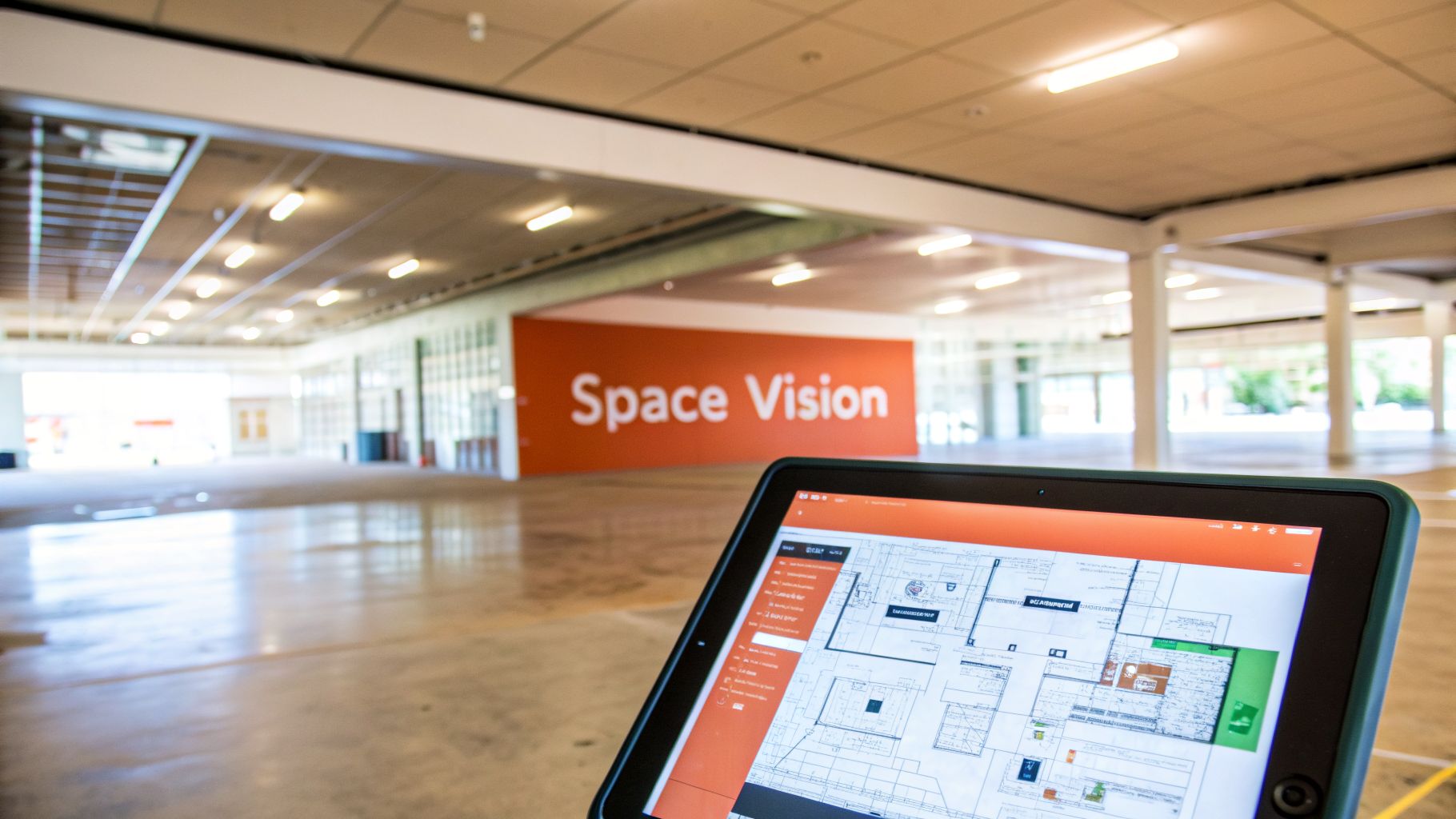
An empty commercial space is a tough sell. For tenants, it's just a box—it’s incredibly difficult to see how their business will actually fit, feel, and function within those four walls. This "imagination gap" is where deals slow down or die completely.
It used to be a game of 2D floor plans and a whole lot of hand-waving. But today, technology lets us show a property's true potential before a single lease is signed or a dollar is spent on a build-out. It’s not about making things look nice; it’s about making decisions faster and with more confidence.
Close the Imagination Gap with AI
Think about that listing you have—the one with good bones but dated finishes and a sea of clutter. What if, instead of describing what it could become, you could just show them? This is exactly where AI tools like Bounti Labs are changing the game.
With just a simple video walkthrough, you can generate a full suite of marketing assets. Show a client exactly how that tired, cluttered office looks after being decluttered and restyled with modern furniture. Better yet, you can show them entirely new possibilities—transforming a traditional cubicle farm into a bright, open-concept workspace in minutes.
The power of visualization is undeniable. One study found that 82% of buyers' agents said staging made it easier for a buyer to picture a property as their future home. This principle is even more critical in commercial real estate, where the layout directly impacts a company's bottom line and brand.
This isn't just a gimmick. It helps your clients answer make-or-break questions on the spot:
- Will our current furniture even fit, or do we need to budget for all new stuff?
- Can this layout handle our team’s projected growth over the next five years?
- Does this space actually support the company culture we're trying to build?
Seeing these options instantly helps tenants zero in on the right space and avoid signing a lease they'll regret. When you can quickly show different design ideas, your negotiations around tenant improvement (TI) allowances become a lot more productive, too. Exploring the best AI photo editing software can give you even more ideas for creating powerful property visuals.
From Big Picture to Brass Tacks
Once you’ve used visualization tech to land on the perfect space, it’s time to get into the details. A thoughtful approach to office space planning and design is what turns a signed lease into a functional, high-performance workplace.
This is more than just deciding where the desks go. It’s about creating a blueprint for how your client's business will operate every single day.
Core Elements of Smart Space Planning
Your layout shouldn't be an afterthought; it should be a strategic asset. A well-planned space improves workflow, encourages collaboration, and can genuinely boost employee morale.
Focus on these key components:
- Workflow and Adjacency: Think about which teams and people actually need to be near each other. Shaving off footsteps between frequently collaborating groups adds up to real productivity gains.
- A Mix of Workspaces: The one-size-fits-all office is dead. A modern layout needs a blend of environments: private offices for deep focus, open areas for collaboration, quiet zones for heads-down tasks, and social hubs like a kitchen or lounge.
- Future-Proofing for Growth: The business you are today isn't the one you'll be in three years. Plan ahead with modular furniture and flexible partitions that let you reconfigure the space as the team grows and its needs evolve.
By pairing AI-powered visualization tools upfront with practical, forward-thinking space planning on the back end, you can make sure the space you lease becomes one of your client’s greatest assets. It’s about removing the guesswork and building a workspace that’s perfectly aligned with their vision for the future.
Your Commercial Leasing Questions, Answered
If you’re new to commercial real estate, you've probably realized the language is different and the stakes are much higher than in residential. The commitments are longer, and the devil is truly in the details. It's only natural to have a long list of questions.
Let's tackle some of the most common ones I hear from clients. My goal is to give you direct, practical answers to sidestep the usual pitfalls and move forward with confidence.
What’s the Real All-In Cost to Lease a Space?
First rule of commercial leasing: the number on the flyer is just the starting point. Your true cost will always be higher than the base rent. To build an accurate budget, you have to factor in several other major expenses.
The big one is operating expenses, usually called Common Area Maintenance (CAM) or NNN charges. These are your share of the property's taxes, insurance, and upkeep for shared spaces.
But don't stop there. You’ll also need to budget for:
- Security Deposit: Plan for one to three months of your total gross rent.
- Utilities: Your direct costs for internet, electricity, gas, and water.
- Business Insurance: Landlords require a liability policy that protects both of you.
- Build-Out Costs: The cash you’ll need to renovate the space so it actually works for your business.
As a solid rule of thumb, I tell clients to add 15-30% on top of the base rent to cover operating expenses. This buffer is critical for real financial planning and prevents a nasty shock when that first CAM reconciliation bill shows up.
What Is a Tenant Improvement Allowance? (And How Do I Get One?)
Think of a Tenant Improvement (TI) allowance as the landlord's investment in your business. It's a negotiated amount of money they provide to help you customize their space for your needs—covering things like new walls, flooring, lighting, or plumbing.
TI is almost always quoted on a per-square-foot basis, like $50 per square foot. If you’re leasing a 2,000-square-foot office, a $50/sf allowance means the landlord is kicking in a $100,000 budget for your build-out.
So, how do you get a good one? You have to prove you’re a great bet. Landlords are much more willing to invest in businesses with strong financials who are ready to sign longer-term leases. Show up to negotiations with a clear, professional build-out plan and a solid business case to get the best possible allowance.
How Long Does This Whole Process Take?
It’s not an overnight thing. The timeline for getting a commercial lease signed and keys in hand varies wildly depending on your needs and the market.
A simple lease for a small, move-in-ready space? You might get it done in 30 to 60 days. But honestly, that's the exception.
For a more typical lease that requires some negotiation and a build-out, you should plan for a 4 to 12-month process. I always recommend starting your search 9 to 12 months before your target move-in date. That gives you enough breathing room for research, tours, negotiating the LOI, legal reviews, and managing construction without being rushed into a bad deal.
Do I Have to Pay Sales Tax on Commercial Rent?
This is a fantastic question, and the answer depends entirely on where you are. State and local laws are all over the map. For years, Florida was the only state that charged sales tax on commercial rent, adding a significant cost for tenants.
Fortunately, that's changing. Thanks to a major legislative update, the sales tax on commercial rent in Florida will be repealed as of October 1, 2025. This is a big win for businesses across the state.
For perspective, a company paying $10,000 a month in rent with a 2% local tax would save $2,400 every year. It’s a perfect example of why you must check your specific state and city tax laws—they can have a real impact on your total occupancy cost.
Can AI Actually Help Me Choose a Space?
Absolutely. While AI won't sit at the negotiating table for you (yet), it’s become an incredibly useful tool for visualization and making smarter decisions early in the process.
Platforms like Bounti Labs are completely changing how we evaluate potential properties. Instead of trying to imagine what a dated or empty shell could become, you can now see it in minutes.
Here’s how brokers and tenants are using it:
- Visualize Potential: Turn a simple video into an AI-powered virtual staging to furnish an empty office or declutter a messy one.
- Explore Renovations: Instantly see how an old space would look with a full modern restyle, helping you spot hidden gems.
- Compare Layouts: Quickly mock up different floor plans to confirm if a space can handle your team's headcount, both now and for future growth.
This kind of tech bridges the "imagination gap." It makes it far easier to compare different properties apples-to-apples and decide with confidence which space is the right long-term fit.
Ready to bring your property's potential to life? With Bounti Labs, you can transform any space with AI-powered virtual staging, restyling, and renovation mockups in minutes. Stop describing what a space could be—and start showing them. Learn more and get started at https://www.bounti.ai.