
You have a listing appointment in two hours. The seller wants a pricing strategy, polished visuals, a plan for social promotion, and confidence that the deal will not fall apart in escrow. Meanwhile, your buyer lead from yesterday expects instant answers, your transaction file needs signatures, and your brokerage wants more consistency across every listing.
This defines the current environment of professionals real estate today. The job is no longer just about knowing comps or opening doors. It is about coordinating specialists, making smart presentation decisions, and using technology well enough that your team looks sharper than the agent down the street.
That pressure is not temporary. It is built into the market. Over 90 percent of U.S. home sales are existing homes, not new construction, which means most agents are selling lived-in properties that need positioning, not just exposure (existing home sales dominate the market). Existing homes come with dated finishes, odd layouts, clutter, deferred maintenance, and photos that can either raise interest or kill it.
The agents winning now do not try to do everything themselves. They build a system around the right professionals and give those professionals better inputs, faster workflows, and stronger marketing assets. That is where the primary advantage lies.
The Modern Real Estate Challenge
A modern listing does not fail because the agent forgot a flyer box. It fails because the presentation was weak, the pricing story was thin, and the team moved too slowly once the client said yes.
Most sellers do not compare you to some abstract industry standard. They compare you to the most polished listing they saw on their phone last night. Buyers do the same. If your photos feel flat, your description reads like boilerplate, and your pre-listing prep lacks a clear strategy, you look replaceable.
Existing homes demand better marketing
Because the market is dominated by resale inventory, the work is not just transactional. It is editorial. You are deciding what to highlight, what to soften, what to restyle, and what to explain.
A new build can lean on fresh finishes. An existing home needs a point of view.
That creates a practical challenge for every role involved:
- Listing agents need faster ways to turn rough conditions into marketable inventory.
- Buyer’s agents need tools that help clients see potential instead of defects.
- Brokers and team leads need repeatable standards across many listings.
- Appraisers and coordinators need clean, accurate files and a process that does not create avoidable friction.
- Marketing staff need assets that can be repurposed across MLS, email, social, and property pages.
The advantage goes to the professional who can combine local judgment with fast execution.
Smarter beats busier
Working harder is not a strategy if every listing still starts from scratch. High-performing teams build operating discipline. They know who should handle what, when to bring them in, and how to keep everyone aligned around the same goal: stronger presentation and fewer preventable mistakes.
That is the shift. The most effective professionals real estate teams are not just staffed. They are coordinated.
Your Deal-Closing Dream Team of Professionals
Every smooth transaction depends on a cluster of people doing distinct jobs well. Problems start when agents blur those roles, delay the handoff, or treat support positions like optional extras.
The core roles that move a deal forward
Here is the quick reference view.
| Professional Role | Primary Responsibility | Key Value Proposition |
|---|---|---|
| Listing Agent | Price, position, market, negotiate | Creates demand and controls listing strategy |
| Buyer’s Agent | Advise buyer, tour, offer, negotiate | Filters options and protects buyer decisions |
| Broker | Supervise, manage risk, support production | Adds oversight, standards, and escalation support |
| Appraiser | Produce independent valuation | Grounds financing and value expectations |
| Transaction Coordinator | Track paperwork, timelines, signatures | Reduces operational mistakes and keeps momentum |
| Home Stager | Improve visual presentation | Makes a property easier to understand and desire |
What each role really contributes
The listing agent owns the commercial strategy of the property. That includes prep, pricing narrative, launch timing, offer management, and communication with the seller when emotions start driving decisions.
The buyer’s agent translates inventory into fit. A good one does not just unlock homes. They narrow noise, spot trade-offs early, and keep the buyer from overreacting to cosmetics or underreacting to serious issues.
The broker matters most when the transaction gets messy. Review, compliance, pricing pushback, disclosure judgment, and conflict management all improve when a broker actively supports the file instead of merely collecting a split.
The transaction coordinator is often undervalued until a deadline gets missed. Clean execution changes client experience more than most agents admit.
The home stager is not decoration. It is sales engineering. A staged room answers the buyer’s silent question: how does this space live?
Why the appraiser deserves more respect
The appraiser is not a side character. They are part of the deal’s structural integrity.
The U.S. appraiser profession is a highly structured field, with the Appraisal Sub-Committee National Registry tracking professionals across all states. A 2022 Appraisal Institute survey with over 2,600 responses provides detailed demographic and professional data and reinforces how central appraisers are to lending and market assessments (Appraisal Institute fact sheet).
That matters because sloppy listing prep has downstream effects. If your file lacks a coherent pricing story, if upgrades are poorly documented, or if the property’s strengths are not clearly presented, you make the valuation conversation harder than it needs to be.
Strong agents do not try to influence an appraiser with hype. They make the property easier to understand with organized facts, accurate condition notes, and credible comparables.
Teams scale when roles are clear
If you are building a more consistent operation, study how high-output groups distribute labor across specialists and support staff: real estate teams.
The pattern is simple. Role clarity beats heroics.
When to Engage Each Real Estate Professional
Timing is where many transactions lose efficiency. People get pulled in too late, or the wrong person leads a stage they should only support.
Before the property hits the market
This phase belongs to the listing agent first. The job is diagnosis. What needs repair, what can stay, what should be removed, and what story the home can credibly tell.
Bring in the home stager at this point, not after the photos disappoint. Even if you are not doing full physical staging, you need decisions on layout, scale, color distractions, and what visual friction will show up in images.
A broker may also need to weigh in early if pricing is aggressive, disclosures are sensitive, or the seller wants a strategy that increases risk.
During launch and buyer activity
Once the listing goes live, the listing agent shifts into campaign mode. Inquiries need qualification. Showing feedback needs interpretation, not just collection. Marketing assets need to stay consistent across channels.
At this stage, many agents often lose ground. They spend all their time reacting instead of refining.
The buyer’s agent becomes central on the other side of the deal. Their role is to help the client compare reality against expectation, identify whether objections are cosmetic or material, and move from interest to a clean offer.
If you want a sharper picture of how productive agents structure this part of the workflow, review how dedicated real estate agents build repeatable systems around lead handling, listing prep, and client communication.
Once the property is under contract
Escrow is where the transaction coordinator earns trust. They manage dates, documents, signatures, and follow-up, so the agent can focus on negotiation and problem solving.
The appraiser typically enters here when financing triggers valuation. By then, the ideal setup is already in place: concise property information, clear access, and no confusion about improvements or condition.
A practical sequence looks like this:
- Consult and diagnose: Listing agent leads.
- Prep and present: Stager supports, broker advises as needed.
- Launch and negotiate: Listing agent leads, buyer’s agent responds.
- Contract to close: Transaction coordinator manages flow.
- Finance verification: Appraiser supplies valuation within the lending process.
- Issue escalation: Broker steps in when risk or conflict rises.
The right person at the right stage makes the whole file feel lighter.
Create a Winning Listing with a Modern Playbook
The best listings do three things well. They justify the price, control the visuals, and make the copy do real work.

Start with pricing that explains itself
Too many agents still price by gut, then use marketing to defend a weak strategy. Stronger operators reverse that. They build a pricing story from attributes, not just nearby sales.
Hedonic pricing models can predict property values with up to 95% accuracy by quantifying the value of attributes such as proximity to a good school, which can carry a 12 to 18% premium, or the presence of a modern kitchen. The same source states that agents using these data-driven insights close up to 25% more deals (hedonic pricing and listing strategy data).
That does not mean you hand a seller a model and call it done. It means you use data to explain why specific features deserve emphasis in pricing and presentation.
Translate value into visuals
Once you know which features carry weight, your media should support that thesis.
If the school access matters, your copy and imagery should frame convenience and lifestyle. If the kitchen is the premium feature, then every visual decision should help buyers notice the layout, finishes, light, and flow instead of the countertop clutter and mismatched stools.
In this area, many listings underperform. The agent identifies value correctly but publishes visuals that bury it.
For practical prep ideas that support stronger presentation before photos, this guide on how to increase home value before selling is useful because it focuses on visible improvements sellers can act on before launch.
A listing earns attention when the price logic, images, and description all point to the same strengths.
Write copy that sells the right details
MLS descriptions should not read like inventory tags. The job is to surface the attributes that explain desirability.
That means:
- Lead with the strongest differentiator: Open on the feature that supports demand.
- Describe benefits, not raw features: “Natural gathering space” often lands better than “open concept.”
- Support the valuation story: Mention improvements or locational advantages that reinforce pricing.
- Avoid generic filler: Empty adjectives waste your first lines.
A short walkthrough on pricing and positioning can help sharpen this part of the listing process:
The playbook is simple. Use data to decide what matters. Use visuals to make it obvious. Use copy to connect the two.
The Commercial Real Estate Professional's Edge
Commercial brokers play a different game. Residential marketing is emotional and household-driven. Commercial marketing is operational, financial, and tenant-specific.

CRE requires analytical fluency
A residential agent can get away with broad consumer language. A commercial professional cannot. Owners, tenants, and investors want someone who understands income durability, lease structure, capex exposure, and how occupancy quality differs from occupancy quantity.
You need to speak in terms such as:
- NOI: The income engine of the asset.
- NNN lease structure: What the tenant reimburses and what ownership still carries.
- CAM recoveries: Whether common area costs are being recaptured.
- Tenant concentration: How dependent the asset is on a small number of occupiers.
- Foot traffic and usage patterns: Whether the physical location supports tenant performance.
Risk modeling changes the conversation
The financial downside of one weak tenant can be severe. In commercial real estate, a single major tenant default can cause a portfolio’s NOI to drop by 15 to 25%, and advanced analytics can predict capex needs with 88% precision by combining traditional metrics with newer inputs such as foot traffic patterns (commercial real estate analytics).
That is why a competent CRE broker does more than market square footage. They help clients evaluate resilience.
A few practical examples:
- Office leasing: Show multiple layout scenarios so a prospect can assess headcount, collaboration zones, and private office mix.
- Retail marketing: Pair location visuals with real discussion about surrounding activity and tenant adjacency.
- Industrial repositioning: Focus on circulation, loading, and operational fit rather than generic branding language.
Commercial clients hire the broker who can reduce uncertainty, not the one who talks the most.
Presentation still matters in CRE
Data does not replace visuals. It raises the standard for them.
A landlord wants to know how quickly a broker can show alternate use cases. A tenant rep wants to test whether a floor plate can support a hybrid model. An investor wants clean presentation that helps a committee understand the asset fast.
That is the edge. In CRE, the professional who can pair analytical depth with clear visual communication wins better assignments.
How AI Amplifies Every Professional's Workflow
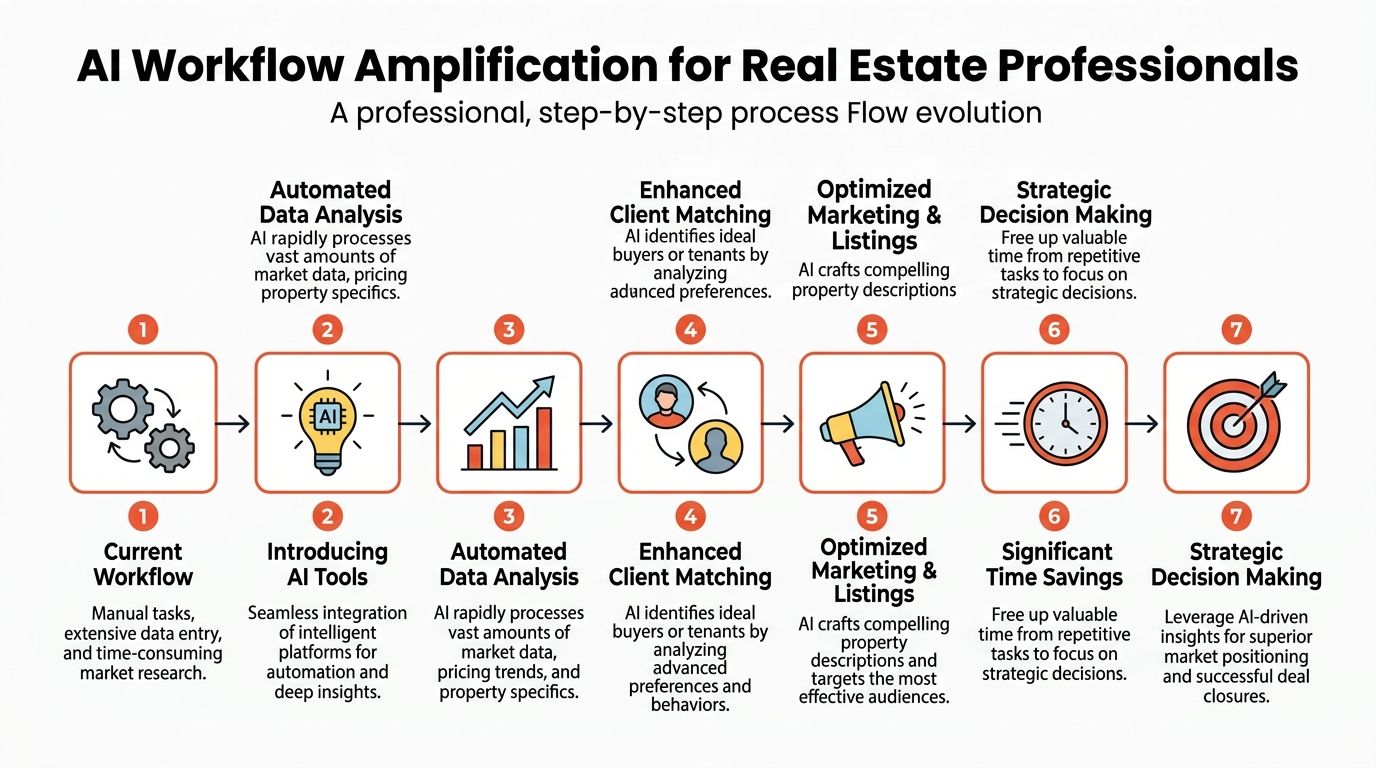
AI is not one more shiny add-on. Used correctly, it removes the slowest parts of real estate production and gives each specialist better material to work with.
A listing agent fixing a stale presentation problem
A seller has a dated living room, crowded shelves, and lighting that makes the home feel smaller than it is. The traditional path involves multiple vendors, revision cycles, and delays.
The AI-first path is tighter. The agent captures a walkthrough, generates cleaner stills, removes visual clutter, tests staging directions, and updates the listing package without waiting on a long manual queue.
That changes two things immediately. The seller sees a more credible marketing plan. The agent launches with stronger assets.
A commercial broker handling layout uncertainty
A prospect tours a raw office suite and struggles to picture how the space would work for their team. That is common. Empty space often reads as risk.
Instead of sending a generic PDF later, the broker can generate alternate visual concepts based on the same walkthrough. One version shows denser seating. Another supports a hybrid configuration. A third leans executive.
The broker is no longer asking the client to imagine. The broker is helping the client evaluate.
A marketing coordinator building a full asset set
Here, AI becomes operational, not just creative.
A marketing coordinator starts with one property video and turns it into MLS-ready photos, listing copy, social assets, and presentation material. That is a significant shift from juggling separate photographers, writers, editors, and turnaround windows for every asset type.
For teams trying to standardize this across many listings, the model is worth studying in an AI operating system for real estate.
Where one tool fits in the stack
One option in this category is Bounti Labs, which uses a single video walkthrough to generate property descriptions, pull stills, create MLS-ready photos, and apply AI staging, decluttering, restyling, or renovation concepts. For agents and marketing teams, that means one capture event can feed several outputs instead of restarting the process for each asset.
That is useful because every role benefits differently:
- Listing agent: Faster launch materials.
- Buyer’s agent: Better visuals to help clients see potential.
- Broker or team lead: More consistency across listings.
- Commercial rep: Quick alternate layout concepts.
- Creative staff: Fewer manual production bottlenecks.
AI works best when it handles repetitive production so professionals can spend more time on pricing judgment, negotiation, and client management.
Debunking Myths About Real Estate and Technology
The resistance usually sounds rational at first. It rarely survives contact with real workflow problems.
Myth one says AI replaces the agent
It does not. It replaces low-value repetition.
An agent still has to interpret comps, manage seller expectations, handle disclosures, negotiate concessions, and keep a transaction together when people get nervous. Software does not take over judgment. It shortens the distance between raw property input and usable marketing output.
Myth two says polished presentation is too slow or too expensive
That was more true when every change required a separate vendor and several rounds of waiting. Today, the bigger mistake is launching with mediocre visuals because the process feels inconvenient.
Myth three says off-market exclusivity is always smarter
That idea ignores fairness and exposure. Off-MLS pocket listings can create significant risks for discrimination and reduce market transparency, disproportionately excluding buyers of color, while professionals who use on-MLS strategies and compliant virtual staging support broader, more ethical exposure (off-MLS transparency and discrimination risks).
The modern professional does not hide behind scarcity when better presentation can make an on-market launch stronger, cleaner, and more defensible.
The Future Belongs to the Agile Professional
The essential shift in professionals real estate is not role replacement. It is role amplification. Listing agents, buyer’s agents, brokers, appraisers, coordinators, stagers, and CRE specialists all create more value when the repetitive production work gets faster and the marketing gets sharper.
The professionals who pull ahead will blend human judgment with AI execution. They will price with more discipline, present properties with more clarity, and run cleaner systems behind the scenes.
That combination is not a trend. It is the new baseline.
If you want to see how Bounti Labs fits into a modern real estate workflow, start with one walkthrough and evaluate how much faster your team can turn it into listing-ready visuals, descriptions, and client-facing marketing assets.