In a competitive market, a compelling property description is the most underrated tool in a real estate professional's arsenal. It's more than a list of features; it's the story that bridges the gap between a casual browser and an interested buyer. A great description can elevate a property, justify its price, and create an emotional connection that photos alone cannot achieve.
Conversely, a weak or generic description can leave a stunning property languishing on the market, failing to capture the attention it deserves. The difference between a quick sale and months of stagnation often comes down to the words you choose. A well-crafted narrative doesn't just describe a house; it sells a home, a business location, or a smart investment opportunity. This skill is akin to mastering a craft; to truly excel, consider consulting guides on how to write a product description that sells effectively, as the core principles of persuasion are universal.
This guide provides a deep dive into eight distinct, field-tested property description examples and frameworks designed for today's real estate landscape. We'll dissect what makes each one work, from feature-focused MLS copy to lifestyle narratives for luxury homes, and show you how to adapt them for any residential, commercial, or investment property.
You will learn the strategic secrets behind crafting copy that not only informs but also persuades. Our goal is to equip you with actionable tactics to:
- Attract qualified buyers who are the perfect fit for the property.
- Generate more inquiries and showing requests.
- Close deals faster and for a better price.
Forget generic templates. We are breaking down the psychology and strategy behind language that converts interest into offers, giving you a replicable system for success.
1. The Feature-Focused Property Description
The feature-focused property description is a direct, fact-first approach that prioritizes clarity and comprehensive detail over storytelling. This method systematically lists a property's specifications, amenities, and upgrades, serving as a reliable data sheet for potential buyers or renters. It's the workhorse of real estate listings, commonly seen on MLS platforms, in investor portfolios, and for bank-owned properties where factual accuracy is paramount.
This style builds trust through transparency. By presenting clear, verifiable details, you empower buyers to make informed decisions quickly. It answers fundamental questions about size, condition, and included features without any fluff, making it an essential tool for many listing scenarios.
Strategic Analysis
The power of this format lies in its efficiency. It strips away subjective language to present a clean, organized inventory of what the property offers.
- Primary Goal: To inform, not persuade. The description acts as a checklist for buyers comparing multiple properties based on concrete attributes like square footage, bedroom count, and specific updates.
- Best Use Cases: Ideal for institutional investors, bank-owned (REO) listings, or any situation where the audience values data over narrative. It's also effective for standard MLS listings where agents need to input data into structured fields.
- Core Components: Key details include square footage, lot size, room dimensions, appliance models, HVAC age, roof condition, and a list of recent upgrades or renovations.
Actionable Takeaways & Tips
Even a straightforward, feature-focused description can be optimized for impact. The goal is to make the facts easy to scan and digest.
- Lead with the Best Features: Start with the most compelling facts. If the home has a brand-new roof and HVAC system, mention those first.
- Organize Logically: Group information by area (e.g., Kitchen, Primary Suite, Exterior) or by system (e.g., Mechanicals, Finishes) to create a logical flow.
- Use Bullet Points: Convert dense sentences into a scannable bulleted or numbered list. This drastically improves readability, especially on mobile devices.
- Integrate Visuals: Complement the text with high-quality images. You can even use Bounti’s AI to generate a clean, decluttered "virtual staging" hook in your description. For instance: "Spacious living room (18'x22') with vaulted ceilings. Visualize this space with your own furniture-our AI-edited photos show a clean slate!" This connects the hard data to a visual possibility. For more on improving your listing photos, explore the best AI photo editing software to make your images stand out.
2. The Lifestyle-Narrative Property Description
The lifestyle-narrative property description is a storytelling approach that sells an experience, not just a structure. Instead of simply listing features, this method paints a vivid picture of what life could be like in the home, focusing on ambiance, emotion, and the daily moments that ownership would offer. It's a style commonly found in luxury real estate marketing, high-end publications, and social media campaigns where creating an aspirational connection is key.
This technique moves beyond the "what" to explore the "why." By describing the feeling of enjoying morning coffee bathed in sunlight or hosting friends in a perfectly designed entertainment space, it helps potential buyers envision themselves in the property. It transforms a list of specifications into a compelling story of a life they could lead.

Strategic Analysis
The power of this format is its ability to forge an emotional bond. It shifts the buyer’s focus from a transactional mindset to an aspirational one, making the property more memorable and desirable.
- Primary Goal: To persuade and inspire. This description helps buyers emotionally invest in the property by showing them how it can improve or align with their desired lifestyle.
- Best Use Cases: Perfect for luxury properties, unique architectural homes, listings in vibrant neighborhoods with strong community ties, and vacation or second homes. It's also highly effective for social media marketing.
- Core Components: Sensory language (e.g., "sun-drenched," "whisper-quiet"), evocative phrases ("the perfect backdrop for entertaining"), and a focus on experiences like weekend relaxation, family gatherings, or neighborhood walkability.
Actionable Takeaways & Tips
A successful lifestyle narrative still requires a foundation of facts, but it weaves them into an engaging story. The goal is to make the dream feel attainable.
- Paint a Scene: Start by describing a specific moment. For instance, "Imagine waking up to views of the tranquil garden from your primary suite..."
- Use Sensory Language: Appeal to sight, sound, and feeling. Words like "warm," "bright," "soothing," and "spacious" help the reader experience the home through your description.
- Connect to the Community: Extend the lifestyle beyond the front door. Mention the nearby farmer’s market, beloved coffee shops, or peaceful walking trails.
- Show, Don't Just Tell: Instead of saying a kitchen is "great for hosting," describe it: "The expansive quartz island becomes the heart of the party, where guests can gather while you craft culinary delights with ease." Bounti's AI can help by generating restyled images that show a furnished patio ready for a summer barbecue, providing a visual to match your narrative.
3. The Investment Property Description
The investment property description is a financial-first approach that speaks the language of returns, cash flow, and market opportunity. Unlike residential descriptions that focus on lifestyle, this method prioritizes the property's performance as an asset. It provides investors with the crucial data needed to evaluate its financial viability, from income potential to operational costs.
This style is common for multi-family complexes, commercial real estate, and vacation rentals where the buyer’s primary motivation is return on investment (ROI). By presenting a clear financial picture, you build credibility and attract serious investors who value data-driven decisions over emotional appeals. It's one of the most effective property description examples for a business-minded audience.
Strategic Analysis
The strength of this format is its direct appeal to an investor's bottom line. It frames the property not just as real estate but as a functioning business with quantifiable performance metrics.
- Primary Goal: To demonstrate profitability and future growth potential. The description acts as a preliminary financial prospectus, highlighting key metrics like Cap Rate, Gross Rent Multiplier (GRM), and Net Operating Income (NOI).
- Best Use Cases: Perfect for multi-family buildings, commercial listings on platforms like LoopNet, vacation rental properties, and any real estate sold primarily for its income-generating potential.
- Core Components: Financial data is paramount. This includes rent rolls, historical operating statements (2-3 years), tenant lease details, pro-forma projections, and neighborhood demographic or economic growth trends.
Actionable Takeaways & Tips
An effective investment description presents complex financial information in a clear, compelling, and easy-to-understand format.
- Lead with the Numbers: Start with the most important financial metric, such as the Cap Rate or annual gross income. This immediately qualifies the property for investors seeking specific returns.
- Separate Current vs. Potential: Clearly distinguish between current, in-place income (actuals) and potential income (pro-forma). For example: "Current NOI of $120,000 with a clear path to $145,000 through rent stabilization and utility bill-backs."
- Use Visuals for Complex Data: Instead of dense text, use Bounti to showcase different unit floor plans or create AI-staged photos for vacant units to illustrate their potential. This helps investors visualize the asset and its revenue-generating spaces.
- Incorporate Market Data: Contextualize the property's value by including neighborhood growth statistics, new local developments, and demographic trends. This supports your pro-forma projections with third-party validation. For more on this, discover how AI-powered tools can support your digital leasing efforts and content strategy.
4. The Problem-Solution Property Description
The problem-solution property description is a strategic approach that frames a listing as the answer to a specific buyer need or challenge. Instead of simply listing features, this method identifies a common pain point in the market and directly positions the property as the perfect solution. It’s an empathetic marketing tactic that connects with buyers on a deeper level, making the property feel like it was made just for them.
This style builds a powerful narrative that resonates with a target audience. By speaking directly to a buyer’s aspirations or frustrations, such as the need for a dedicated home office or a layout suitable for multi-generational living, you create an immediate and compelling connection. This is one of the more advanced property description examples because it requires understanding buyer psychology.
Strategic Analysis
The strength of this format is its ability to cut through the noise by addressing a specific, often unspoken, buyer requirement. It shifts the focus from "what the house has" to "what the house does for you."
- Primary Goal: To persuade by solving a problem. This description appeals to the logical and emotional sides of a buyer’s decision-making process by offering a clear resolution to a real-world issue.
- Best Use Cases: Perfect for properties with unique layouts or features that solve modern challenges, such as homes with in-law suites, dedicated office space, first-time buyer-friendly financing options, or even "fixer-upper" properties positioned as a value-add opportunity.
- Core Components: The description leads with the problem (e.g., "Tired of commuting?"), presents the property as the solution ("This urban oasis puts you minutes from downtown"), and then uses the features to support that claim (e.g., "walk score of 95, secure bike storage, and nearby transit").
Actionable Takeaways & Tips
To be effective, this description must be based on genuine market insights. Research your local buyer demographics to identify their most pressing needs.
- Lead with the Benefit: Start your description with the solution. Instead of "3 bed, 2 bath," try "Finally, a Home Office That Isn't the Kitchen Table."
- Target Different Personas: Create multiple description versions for the same listing. One might target remote workers, while another highlights its suitability for a growing family.
- Use "Before-and-After" Language: For renovation opportunities, frame the current state as the "before" and the potential as the "after." Describe what could be to help buyers see the vision.
- Show, Don't Just Tell: Visuals are critical here. Use Bounti's AI decluttering and virtual staging to show how an empty room can become a functional office or a cozy nursery. Your description can say: "That spare room? See our AI-staged photos showing it as a perfect work-from-home space." This makes the solution tangible and instantly understandable.
5. The Comparative Property Description
The comparative property description is a strategic approach that directly addresses the buyer's core question: "Is this property a good deal?" Instead of just listing features, it frames the property's value by explicitly comparing it to similar homes in the market, recent sales, or competing listings. This method uses market data as a powerful tool for justification, building a logical case for the property's price and competitive advantages.
This style is particularly effective in fast-moving or highly competitive markets where buyers are inundated with options. By providing context, you help potential buyers see not just what the property offers, but why it offers superior value compared to the alternatives. It's a data-driven narrative that guides buyers to a confident decision.
Strategic Analysis
The strength of this format lies in its ability to preemptively answer buyer objections and justify the asking price with hard evidence. It turns a standard listing into a compelling value proposition.
- Primary Goal: To demonstrate and prove value. The description is designed to show that the property is priced correctly and offers distinct advantages over its direct competitors.
- Best Use Cases: Highly effective in competitive markets, for auction and short-sale listings, and for corporate relocation services where clear justification is needed. It's also a powerful tool for institutional investors who rely on comparative data.
- Core Components: Key details include a brief analysis of recently sold comparable properties (comps), a direct comparison of specific features (e.g., "newly renovated kitchen vs. dated kitchens in nearby listings"), and a focus on value differentiators like a larger lot or superior condition.
Actionable Takeaways & Tips
A well-executed comparative description can be the deciding factor for an analytical buyer. The key is to present the comparison clearly and ethically.
- Focus on Value, Not Just Price: Instead of just saying it’s cheaper, explain why it’s a better value. Highlight features the subject property has that the comps lack, such as a newer roof, a finished basement, or more energy-efficient windows.
- Use Recent and Relevant Comps: Stick to properties sold within the last 90 days to ensure the data is current and reflects today's market conditions. Using outdated information can undermine your credibility.
- Highlight Superior Features: If your listing has a newly remodeled primary bathroom, compare it directly to the older, unrenovated bathrooms in competing listings. For example: "While similar homes in the area feature original 1980s bathrooms, this suite offers a fully updated spa-like retreat."
- Stay Dynamic: Real estate markets change quickly. Be prepared to update your comparative analysis if a new, significant comparable property sells or a key competitor goes under contract.
6. The Renovation-Potential Property Description
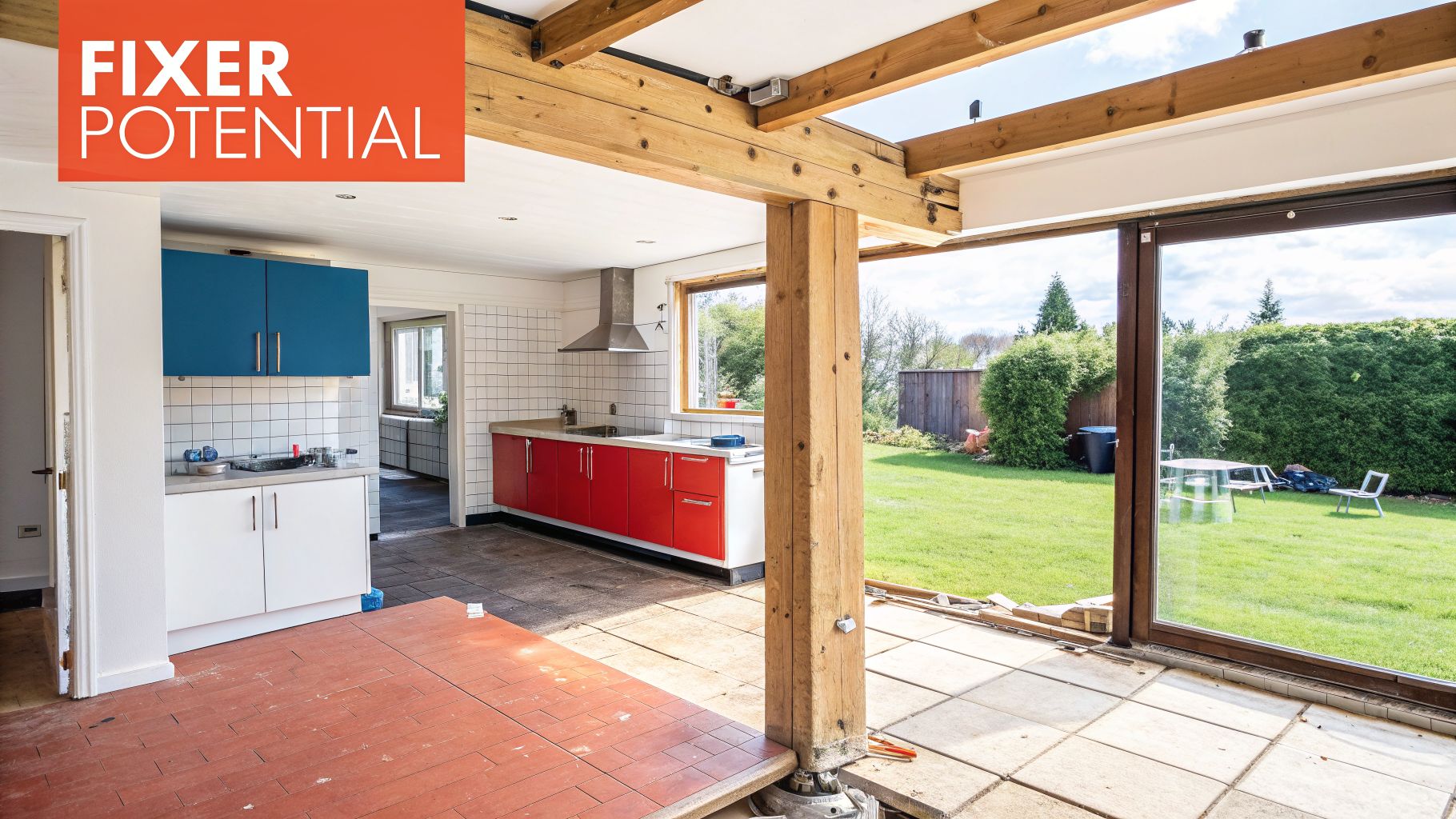
The renovation-potential property description is a specialized approach designed for fixer-uppers, estate sales, or any property where the value lies in its future possibilities rather than its current state. Instead of hiding flaws, this method transparently acknowledges the need for work while strategically highlighting the property's "good bones," desirable location, and architectural charm. It frames the property not as a finished product, but as a blank canvas for investors, contractors, or ambitious homeowners.
This style builds credibility by being upfront and honest. By managing expectations from the start, it attracts serious buyers who are specifically looking for a project and understand the value proposition. It shifts the focus from present imperfections to future equity and customization potential, making it one of the most effective property description examples for as-is sales.
Strategic Analysis
The power of this format is its ability to turn potential negatives into compelling opportunities. It filters out unqualified buyers and speaks directly to a niche audience ready to invest time and resources.
- Primary Goal: To attract visionaries-buyers who can see past cosmetic issues to recognize the underlying value and potential return on investment.
- Best Use Cases: Ideal for distressed properties, historic homes needing restoration, estate sales, and bank-owned (REO) listings where renovation is expected.
- Core Components: Key details include lot size, location benefits, structural integrity (e.g., solid foundation, good roof lines), unique architectural features worth preserving, and clear statements like "sold as-is" or "bring your contractor."
Actionable Takeaways & Tips
Even for a fixer-upper, the description must inspire confidence and paint a picture of what could be. The key is balancing transparency with opportunity.
- Lead with the Aspiration: Start with the end result. For example, "Your chance to restore a classic Victorian in the heart of the historic district" or "Imagine the possibilities in this solid-built blank slate."
- Be Honest but Strategic: Acknowledge the work needed (e.g., "Ready for a full kitchen remodel") but pair it with a positive attribute ("...offering a perfect opportunity to design your dream culinary space").
- Highlight the 'Unchangeables': Emphasize valuable, permanent features like a prime location, a large lot, mature trees, or stunning views. These are assets a renovation can't create.
- Show the 'After' Vision: Use technology to bridge the imagination gap. Bounti's AI can generate virtual renovation renderings to show a space's potential. Add a hook like, "See the potential! Check out our AI-generated images to visualize this kitchen fully renovated." For more inspiration, explore these impactful house staging before and after transformations to understand how visuals can sell a vision.
7. The Hyperlocal-Context Property Description
The hyperlocal-context property description sells more than just a house; it sells a lifestyle embedded within a specific community. This approach shifts the focus from the property's four walls to its surrounding environment, highlighting the unique character, amenities, and culture of the neighborhood. It tells the story of what it's like to live there, connecting the home to local parks, popular cafes, school districts, and community events.
This style builds an emotional connection by painting a vivid picture of daily life. By showcasing the convenience of a nearby farmers market or the charm of a local art festival, you help potential buyers envision themselves as part of the community, not just as owners of a property.
Strategic Analysis
The power of this format is its ability to create a deep sense of place. It answers the question, "What is life really like here?" by providing authentic, on-the-ground details that generic descriptions miss.
- Primary Goal: To attract buyers who are purchasing a lifestyle, not just a structure. It appeals to those who value walkability, community engagement, and local culture.
- Best Use Cases: Ideal for properties in vibrant urban neighborhoods, walkable suburbs, college towns, or up-and-coming areas with a strong local identity. It’s also effective for listings targeting buyers relocating from another city.
- Core Components: Details on nearby schools, parks, and public transit; names of popular local coffee shops, restaurants, and boutiques; mentions of community events like farmers markets or festivals; and insights into the neighborhood's overall vibe.
Actionable Takeaways & Tips
A hyperlocal description needs to be authentic and rich with detail to be effective. The goal is to become the go-to source for what makes the neighborhood special.
- Lead with the Lifestyle: Start with a hook that captures the essence of the neighborhood. Instead of "3-bed, 2-bath," try "Steps from the Saturday farmers market and a short walk to Main Street's best coffee."
- Name-Drop Local Favorites: Mention specific, beloved local businesses by name. "Grab your morning latte at The Daily Grind or enjoy weekend brunch at The Corner Bistro, both just a block away." This adds credibility and color.
- Create a Neighborhood Tour: A short video showcasing the walk from the property to a local park or commercial district can be incredibly powerful. It provides tangible proof of the lifestyle you're describing.
- Incorporate Social Proof: Include relevant Instagram hashtags (e.g., #DowntownLiving, #OakwoodHistoricDistrict) to connect the listing to the online community conversation. This is one of the more modern property description examples that ties directly into social media.
- Primary Goal: To showcase versatility and potential alternative revenue streams. The description should make a buyer think, "This space could be my office now and a rental unit later."
- Best Use Cases: Perfect for properties with ADUs, finished basements with separate entrances, live-work lofts, homes with large bonus rooms, or properties zoned for mixed residential-commercial use.
- Core Components: Clear separation of primary and secondary spaces, details on separate entrances or utilities, zoning information, and conservative income projections based on local rental data. This is a great example of where specific, factual property description examples are needed to build buyer confidence.
- Define Each Space Clearly: Structure your description to address each functional area separately. Use headings like "Main Residence" and "Private Guest Suite/Office" to avoid confusion.
- Paint a Picture of Possibilities: Instead of just saying "bonus room," describe its potential uses. For example: "The lower-level flex space, complete with a full bath and private entry, is an ideal setup for a home-based business, in-law suite, or high-demand short-term rental."
- Provide Practical Proof: Back up your claims. Mention relevant zoning codes ("Zoned C-1 for live/work opportunities") or include conservative rental income estimates ("Similar ADUs in the area rent for $1,500/month").
- Use AI to Visualize Flexibility: Incorporate a call to action that uses technology to show, not just tell. For instance: "This open-concept loft is a blank canvas. Ask for our AI-generated virtual layouts showing three different configurations: a two-bedroom residence, a photography studio, and a co-working office." This makes the property's adaptability tangible.
- Strategy First, Writing Second: Before you type a single word, decide on your primary sales strategy. Are you selling potential (Renovation-Potential), location (Hyperlocal-Context), or a turnkey solution (Feature-Focused)? This initial decision will guide every subsequent choice.
- Know Your Audience: A description aimed at a first-time homebuyer will sound vastly different from one targeting a seasoned commercial real estate investor. Define your buyer persona and write directly to their needs, concerns, and aspirations.
- Bridge the Gap Between Features and Benefits: Don't just state that the kitchen has quartz countertops. Explain how those countertops make meal prep and entertaining effortless. Always answer the buyer’s silent question: "What's in it for me?"
- Select Your Framework: Review the eight examples and identify the one or two that best fit your property. Is it a mixed-use commercial space? The Multi-Use/Flexible-Space framework is your starting point. Is it in a neighborhood with a strong, unique identity? Lean into the Hyperlocal-Context approach.
- Gather Your "Story" Assets: Your description is the narrative, but you need evidence to support it. This includes high-quality photos, floor plans, and video walkthroughs. For maximum impact and detail, especially for high-value listings, consider building a dedicated single property website to house all these assets in one professional, immersive space.
- Refine with Precision: Write your first draft, then edit ruthlessly. Is every sentence working to support your chosen strategy? Have you used powerful, sensory language? Have you eliminated vague adjectives and replaced them with specific, compelling details?
8. The Multi-Use/Flexible-Space Property Description
The multi-use property description is engineered for properties that defy a single label. It focuses on versatility, showcasing how a space can serve multiple functions, from a home office and guest suite to a live-work loft or a property with rental income potential. This approach highlights adaptability as a primary asset, appealing to buyers who need a home that can evolve with their changing lifestyle or financial goals.
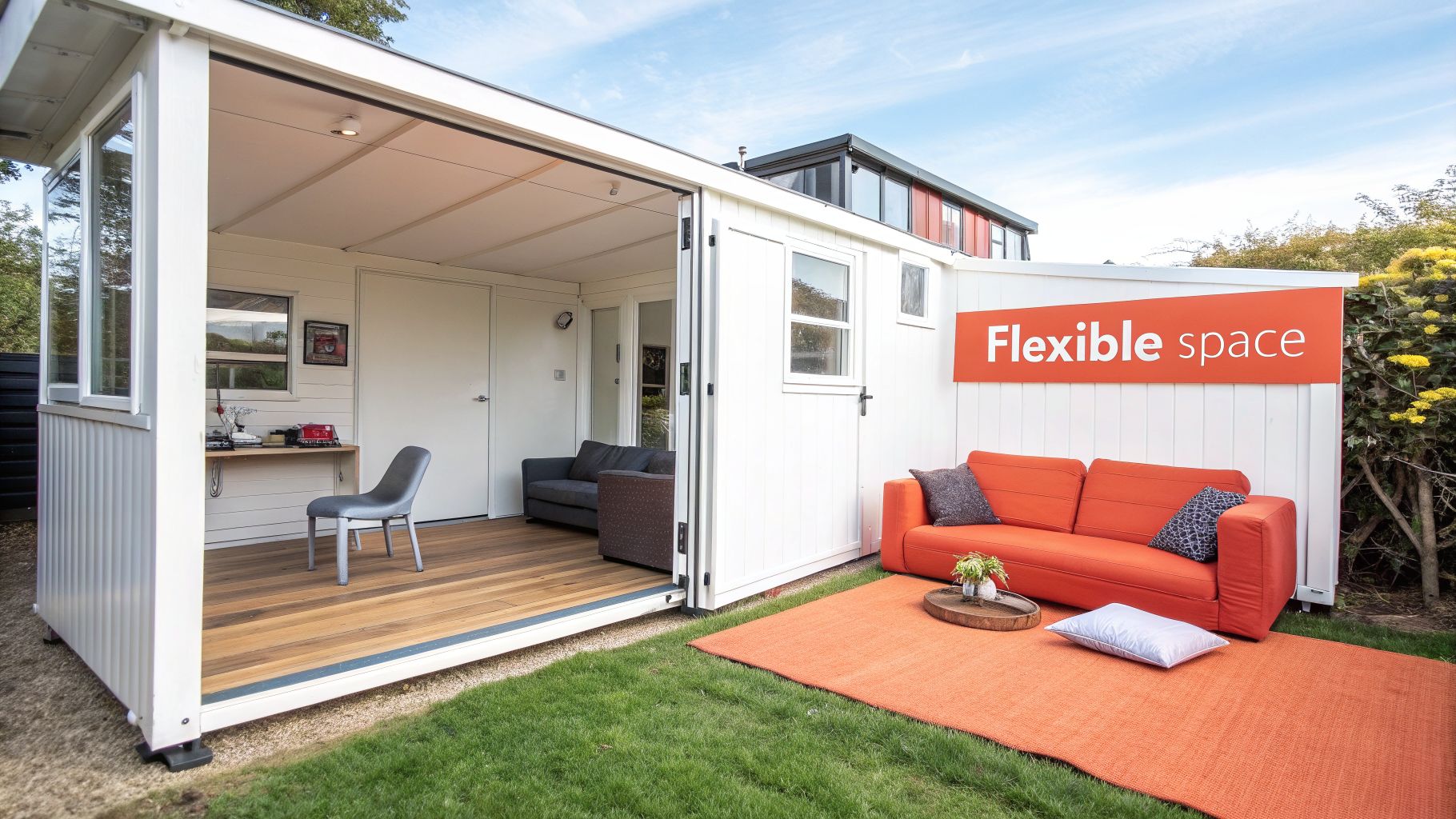
This style moves beyond a simple room count to tell a story of potential. By clearly illustrating how a bonus room, accessory dwelling unit (ADU), or finished basement can be used, you attract a wider audience of buyers who are looking for more than just a place to live; they are looking for a solution to their modern needs.
Strategic Analysis
The strength of this description lies in its ability to spark the buyer's imagination and justify a property's value through its multiple potential uses. It shifts the focus from "what it is" to "what it could be."
Actionable Takeaways & Tips
To effectively sell a flexible space, your description must be both inspiring and practical. The buyer needs to see the vision and trust the data.
8-Style Property Description Comparison
| Template | 🔄 Complexity | ⚡ Resources | 📊 Expected Outcomes | 💡 Ideal Use Cases | ⭐ Key Advantages |
|---|---|---|---|---|---|
| The Feature-Focused Property Description | Low — structured data entry, repeatable | Basic property specs, measurements, standard photos | Clear, scannable listings; fewer follow-up queries | MLS, investor sheets, fast-moving markets | Objective clarity, easy comparison |
| The Lifestyle-Narrative Property Description | Moderate — requires strong copy and tone | High-quality staging photos, creative writing, lifestyle images | Higher engagement, emotional appeal, social traction | Luxury homes, lifestyle-focused listings, social media | Builds emotional connection, differentiates listing |
| The Investment Property Description | High — complex financial compilation | Historical income, expense reports, market analysis, professional photos | Attracts serious investors, speeds due diligence | Multi-family, commercial, vacation rentals, 1031 buyers | Demonstrates income/ROI, builds investor credibility |
| The Problem-Solution Property Description | Moderate — needs buyer segmentation and research | Buyer research, tailored copy, solution visuals/testimonials | Higher conversion among targeted buyers, reduced objections | Niche campaigns, targeted buyer personas, renovation opportunities | Direct relevance to buyer needs, creates urgency |
| The Comparative Property Description | High — requires up-to-date market data and analysis | Recent comparable sales, CMA tools, competitive photos | Justifies price, reduces price objections, builds trust | Competitive markets, price-sensitive listings, auctions | Transparent pricing rationale, highlights competitive edge |
| The Renovation-Potential Property Description | Moderate — accurate condition assessment plus vision | Inspection reports, renovation estimates, before/after renderings | Attracts investors/DIY buyers, emphasizes upside potential | Fixer-uppers, historic restorations, estate sales | Positions challenges as opportunity, honest valuation |
| The Hyperlocal-Context Property Description | Moderate to High — deep local knowledge required | Neighborhood research, local photos, community links and events | Stronger local relevance, better hyperlocal search performance | Urban/walkable areas, relocation markets, emerging neighborhoods | Differentiates by community character, builds local appeal |
| The Multi-Use/Flexible-Space Property Description | Moderate — zoning and multiple scenarios to present | Zoning docs, multiple staging/rendering options, income comps | Broadens buyer pool, highlights versatility and revenue streams | ADU-capable homes, live-work, multi-generational, remote workers | Demonstrates flexibility, supports higher valuation |
From Examples to Execution: Your Next Steps
The journey from a blank page to a compelling property listing can feel daunting, but as we've explored, a strategic framework changes everything. The diverse collection of property description examples in this guide isn't just about providing templates; it’s about illustrating a core principle: the most effective descriptions are built on a deep understanding of both the property’s unique story and the ideal buyer’s deepest motivations. The true power lies not in copying words, but in grasping the strategy behind them.
We've deconstructed eight distinct approaches, from the data-rich Investment Property description designed for analytical minds to the evocative Lifestyle-Narrative that speaks to the heart. The common thread is a deliberate shift away from generic feature-listing. Instead, successful copy connects a property’s tangible assets to the intangible benefits a buyer is truly searching for, whether that's financial security, a sense of community, or the potential for future growth.
Key Insights to Carry Forward
The most critical takeaway is the necessity of alignment. Your marketing angle, your choice of words, and your visual presentation must all work in concert to tell one cohesive story.
Putting Theory into Practice: Your Action Plan
Mastering these concepts requires consistent application. The next time you prepare a listing, challenge yourself to move beyond your default writing style.
Ultimately, a great property description does more than just inform; it persuades. It builds trust, creates an emotional connection, and convinces a potential buyer that this specific property is the solution they’ve been searching for. By moving from simply admiring good property description examples to actively executing the strategies behind them, you position your listings to capture attention, drive higher engagement, and achieve faster, more profitable sales.
Ready to bring these strategies to life without spending hours on copywriting and content creation? Bounti Labs uses AI to instantly generate compelling property descriptions from your listing photos or videos, helping you implement any of these expert frameworks in minutes. See how it works and start creating descriptions that sell at Bounti Labs.