Real estate billboard advertising is one of the oldest tricks in the book for a reason. It’s a high-impact, high-visibility play that puts your face and your brand in front of thousands of potential clients every single day, establishing instant authority in your market.
Why Billboards Still Work in a Digital World
With everyone obsessed with digital ads, it’s fair to ask if a classic like a billboard still has a place. The answer is a hard yes. Billboards have an unskippable physical presence that digital channels just can't match, building the kind of brand recognition that leads to trust and, ultimately, new clients.
Think about it. While your online ads are fighting for a few seconds of attention in a crowded feed, a well-placed billboard becomes part of the local scenery. It’s seen every day by commuters dreaming about a bigger home, parents on the school run, and weekend shoppers. That constant exposure embeds you in the community’s mind, making you the agent they think of first when it's time to sell.
The Unwavering Power of Physical Presence
There's a real psychological power to seeing something that big. Its sheer scale commands attention and projects success and stability. When people see your brand on a massive billboard, it builds instant credibility in a way a social media post can’t. It’s a statement: you are a serious, established professional in this market. This offline authority is the perfect complement to your online efforts, which you can learn more about in our guide to real estate social media marketing.
The numbers don't lie. The outdoor ad market is projected to grow from $48.5 billion in 2025 to $80.1 billion by 2033—a 65% increase. That growth is driven by the simple fact that high-visibility placements work, especially for showcasing premium real estate. For agents, this is a massive opportunity to capture the attention of people stuck in traffic, actively daydreaming about their next move.

A billboard does something a digital ad can't: it makes you a landmark. When clients say, "I see you everywhere," you've moved beyond advertising and become a recognized part of the community fabric.
Integrating Modern Tech with a Classic Medium
Today’s billboards aren’t just static images anymore. Technology has completely revitalized this classic medium, making it more dynamic and effective than ever. This is especially true in North America, which accounts for about 40% of the global outdoor ad market and is seeing a huge boom in digital billboards.
This is where things get really interesting. Tools like Bounti can turn a standard property photo into a show-stopping visual experience. Imagine showcasing a home with AI-powered virtual staging, decluttering, or even a full digital renovation—all on a giant screen on the side of the highway.
It creates an aspirational "wow" factor that literally stops traffic and makes your listings unforgettable. That’s how you set the stage for a campaign that delivers real business results.
Crafting Your Billboard Campaign Blueprint
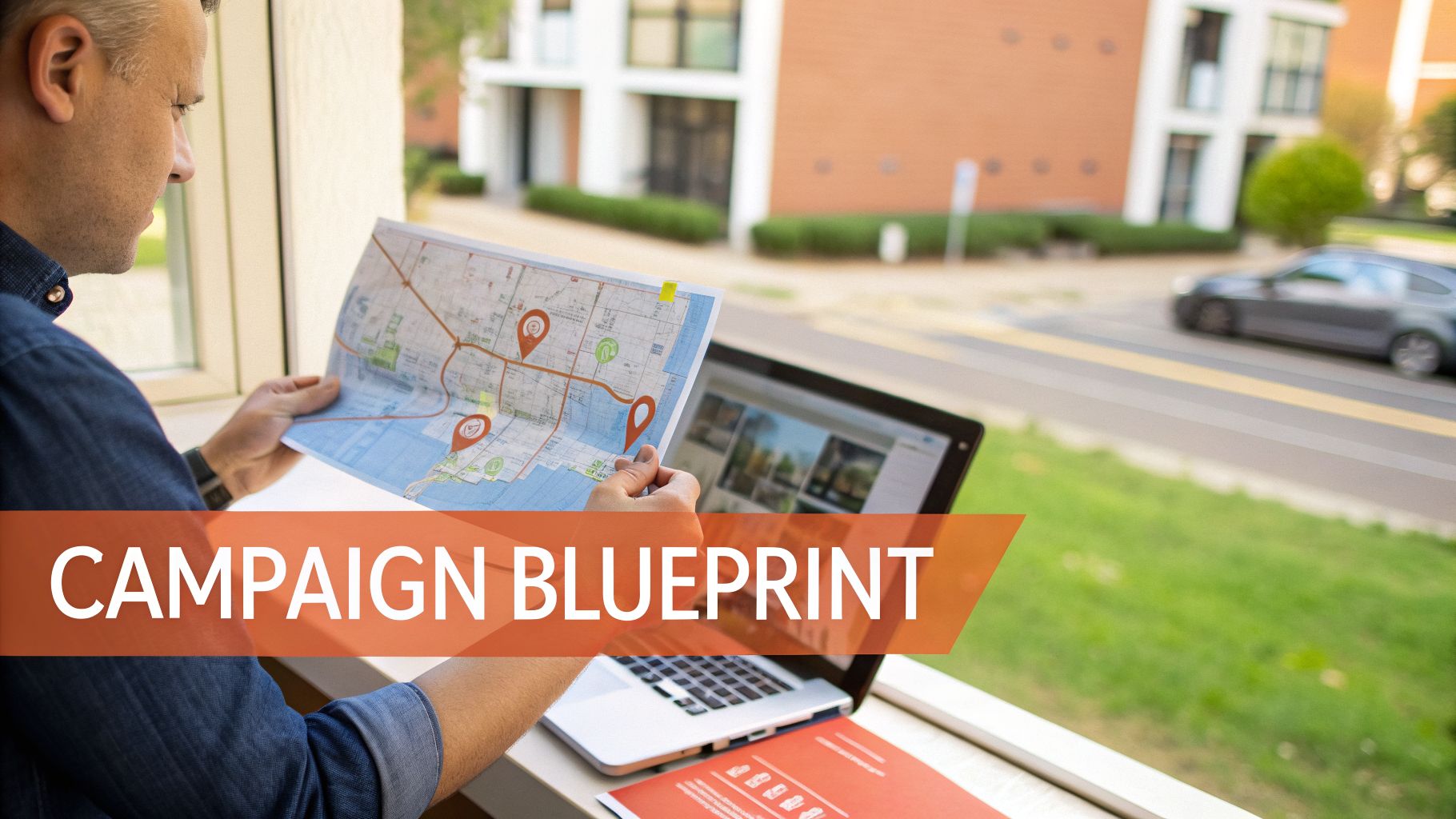
A great billboard isn't just a pretty picture on a big sign. It's the final piece of a carefully laid plan. Before you start playing with colors and fonts, you need a blueprint that ensures your investment in real estate billboard advertising actually works, instead of just becoming expensive roadside art.
A billboard without a clear goal is like a showing without a buyer—it goes nowhere fast. The very first thing you need to do is define what success looks like.
Are you trying to become the go-to agent in a new neighborhood? Promote a single, jaw-dropping luxury property? Or are you a broker trying to recruit top talent? Each of those goals requires a completely different playbook.
Defining Your Core Campaign Objective
Don't just gloss over this part. Your core objective is the north star for every other decision you'll make, from where you place your board to the words you put on it. It keeps you from creating a bland, generic ad that gets ignored by everyone.
Think about what you're really trying to accomplish. Most real estate goals fall into one of these buckets:
- Brand Building: You want to be a household name. This is a long game. The message should be brutally simple, focused on your name, your face, and your core promise (e.g., "The Local Expert").
- Luxury Listing Promotion: The goal here is to create an air of exclusivity to attract a very specific, high-net-worth buyer. Your billboard is a signal of the property's prestige.
- Agent Recruitment: Your audience isn't buyers or sellers; it's other agents. The message needs to hit on their ambitions—think career growth, better splits, or a stronger team culture.
- Lead Generation: This is all about direct response. You need a powerful call to action that pushes people to a specific landing page or phone number to capture their information right then and there.
Pinpointing Your Audience and Prime Locations
Once you know your "why," you can nail down the "who" and the "where." Effective billboard advertising is all about location, location, location. You need to get your message in front of the right eyeballs, over and over again.
Start by sketching out your ideal client. Are they young professionals commuting from downtown apartments? Or established families in the suburbs? Dig into your MLS data, local census reports, and your own CRM to paint a clear picture.
Now, it’s time to become a traffic detective. Don’t just pick a busy road—analyze it. Physically drive the routes your target audience takes to and from work. Pay attention to the traffic flow. Is it a parking lot during the morning commute or the evening rush? You want your billboard facing the direction with the slowest, most congested traffic.
A billboard on the right-hand side of a road with heavy morning commute traffic heading into the city is gold. Drivers are stuck, bored, and your ad has their undivided attention. The same ad on the opposite side, where traffic is flowing freely out of the city, is practically invisible.
Setting a Realistic Billboard Budget
One of the biggest mistakes agents make is underestimating the true cost. Your budget has to cover a lot more than just the monthly rent on the ad space. Getting this right from the start prevents nasty surprises later on.
Your total investment breaks down into three main parts:
- Ad Space Rental: This is your biggest and most variable cost. It can be $1,500 a month in a small town or shoot past $15,000 a month for a prime digital board in a major metro.
- Creative Design: Professional design is non-negotiable. Budget between $300 and $1,000 for a designer to create something impactful that's also formatted correctly for massive printing.
- Production and Installation: For a traditional vinyl billboard, this is the one-time fee for printing and installation. It usually costs between $500 and $1,500, depending on the size and complexity.
Here’s a quick look at a sample budget for a static billboard campaign in a typical mid-sized city.
| Cost Component | Estimated Cost (Low End) | Estimated Cost (High End) | Notes |
|---|---|---|---|
| Monthly Ad Space | $2,000 | $4,500 | Varies by traffic count and location. |
| One-Time Design Fee | $400 | $800 | For a professional graphic designer. |
| One-Time Production Fee | $700 | $1,200 | Includes printing and initial installation. |
| 3-Month Total | $7,100 | $15,500 | A typical minimum campaign length. |
This blueprint—a sharp objective, a strategic location, and a real-world budget—is what turns a billboard idea into a smart business move. With this foundation in place, you’re ready for the fun part: designing an ad that actually stops traffic.
Designing a Billboard That Stops Traffic
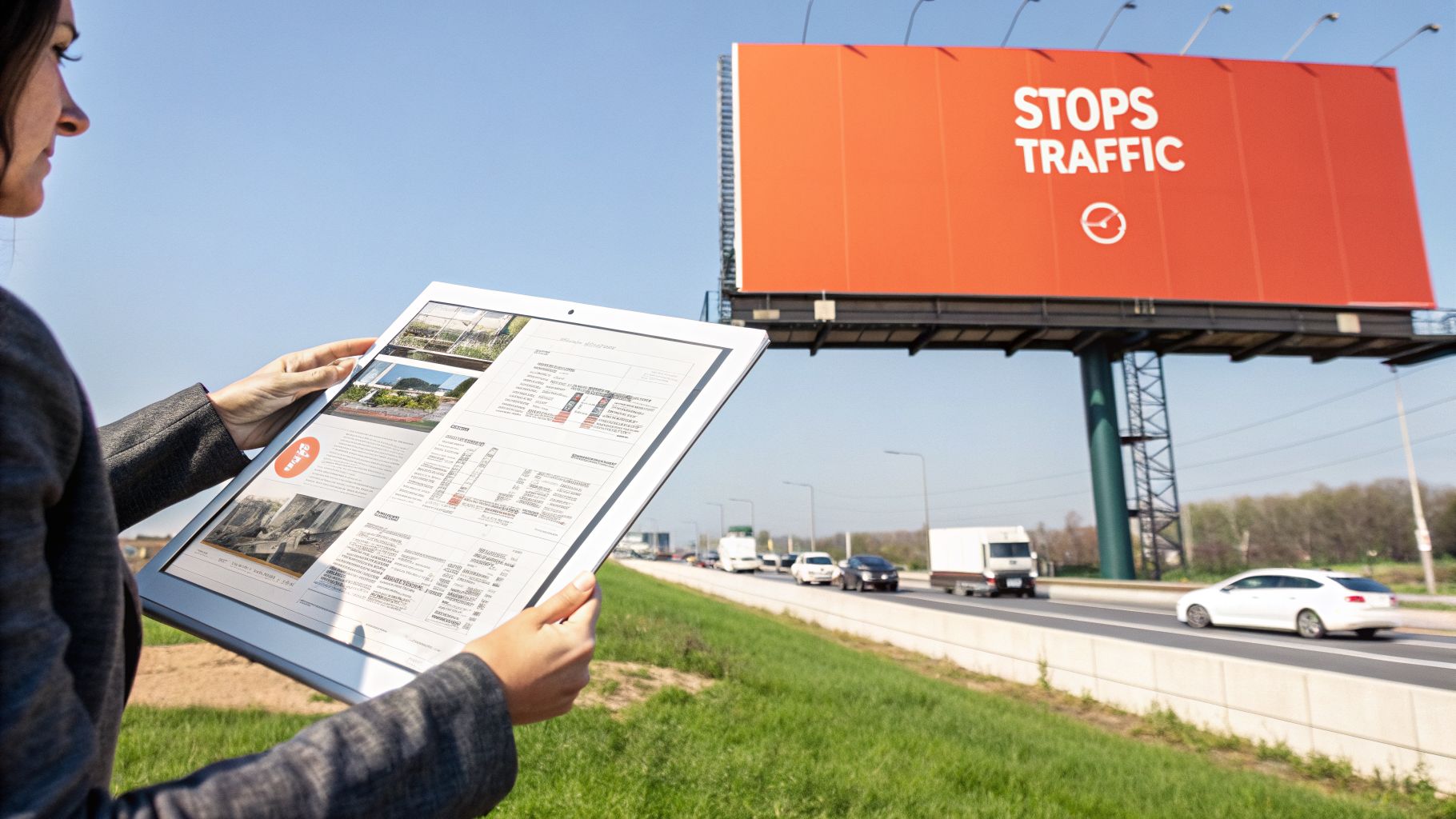
You get three seconds. That's it. In the time it takes a car to whiz past, your billboard has to cut through the noise, make an impression, and be remembered.
This is where so many agents get it wrong. They try to cram their entire value proposition onto a 14x48 foot canvas. The result? A cluttered, unreadable mess that's a waste of money. The best real estate billboard advertising isn't about saying more; it’s about saying the right thing, instantly. Think bold, simple, and unforgettable.
Less Is Everything: The Rules of the Road
The single most important rule is high contrast. This isn't the time for subtle pastels or complex gradients. You need colors that pop. Think bold black on bright yellow, crisp white on a deep blue, or yellow on black. These combinations are scientifically proven to be the most legible from a distance, cutting through glare, rain, or dusk.
Your font choice is just as critical. Forget the fancy script fonts you love for your business cards. On a highway, they become an indecipherable smudge. Stick with thick, clean, sans-serif fonts like Helvetica, Arial Black, or Futura Bold. They are designed for one purpose: to be read quickly at 65 miles per hour.
Which brings us to the message itself.
Your mantra should be the "Seven Word Rule." If you can't get your core idea across in seven words or less, it's too complicated for a billboard. Period. A driver doesn't have time to read a sentence, let alone a paragraph.
The Jaw-Dropping Image That Sells the Dream
Your visual is the hook. It’s what makes someone’s head turn. For most agents, this means one of two things: a great professional headshot for brand building, or an absolutely stunning property photo for a specific listing.
A friendly, trustworthy headshot builds name recognition and personal connection. But when you’re selling a property, you’re not just selling four walls—you’re selling a lifestyle. An empty living room photo is forgettable. But what if you could show its potential?
This is where AI becomes your unfair advantage. Instead of a boring, vacant space, you can instantly create an image of a beautifully staged home. AI-powered tools like Bounti let you declutter a room, add stylish virtual furniture, or even generate a "renovated" look to showcase what a home could be. It creates an emotional pull that a standard photo just can’t replicate.
This visual-first approach is essential, especially when you consider that property promotions made up 28.1% of the entire billboard market in 2025. A jaw-dropping image turns a passing glance into a potential lead.
To make sure your creative is hitting all the right notes, use this checklist before sending anything to the printer.
High-Impact Billboard Design Checklist
| Element | Best Practice | Why It Works |
|---|---|---|
| Color Palette | High-contrast (e.g., black/yellow, white/blue) | Maximum legibility from a distance and in all weather conditions. |
| Font Choice | Thick, bold, sans-serif fonts (e.g., Helvetica Bold) | Ensures readability at high speeds; avoids thin or script fonts that blur. |
| Word Count | 7 words or less | Drivers only have a few seconds to read and comprehend the message. |
| Key Image | One single, powerful hero shot | A single focal point grabs attention more effectively than multiple small images. |
| Branding | Large, clear logo and agent name | Instantly connects the message to your brand for better recall. |
| Call to Action | Simple, memorable URL or phone number | Easy for drivers to remember or for passengers to look up quickly. |
This checklist isn't about limiting creativity—it's about focusing it. By following these guidelines, you ensure your investment pays off with a billboard that actually gets noticed.
The Non-Negotiables
Finally, let's talk about the essential details that tie it all together. Every single billboard must have a clear, concise call to action (CTA). What do you want people to do next?
- Your Name/Brand: Make it huge. Make it unmissable.
- Your Message: The hook that fits the Seven Word Rule (e.g., "Your New Home is Waiting.").
- Your Contact Info: A simple, memorable website or phone number.
That last point is crucial. Don't use a long, clunky URL. A vanity URL like "NorthPhillyHomes.com" is far more effective than "YourBrokerage.com/agent-name/listings/123." If you use a phone number, make it an easy-to-remember sequence. Some agents are experimenting with QR codes, but be sure to place them on the lower-right side where they’re most likely to be scanned in slow traffic.
By combining a simple message with a stunning, AI-enhanced visual, you create an ad that doesn’t just get seen—it gets results. And for agents looking to take their visual marketing even further, you should see how AI can help you create compelling property videos that stop the scroll online, too.
Finding Vendors and Navigating the Fine Print
Alright, you’ve got a killer design and a budget that makes sense. Now comes the part where the digital concept meets the real world. This is where you find the right partners to bring your vision to life and sort through the technical and legal weeds that can trip up a real estate billboard advertising campaign. It might feel like a lot, but asking the right questions makes all the difference.
Your first big decision is picking an outdoor advertising company. You'll run into two main players: the big national providers and the smaller local operators. They each bring something different to the table.
National giants like Lamar or Outfront Media own a massive inventory of prime real estate along major freeways and in busy city centers. They come armed with sophisticated data on traffic patterns and audience demographics. The trade-off? They can be rigid on pricing and often lock you into longer-term contracts.
On the flip side, local or regional vendors can offer a more personal touch and often have exclusive rights to unique neighborhood boards the big guys miss. They're usually more open to negotiating shorter deals, making them a perfect fit for a hyper-local campaign targeting a specific farm area.
Key Questions to Ask Every Vendor
Before you even think about signing a contract, you need to interview these potential partners. Seriously, treat it like a client interview. You're looking for someone who gets what you're trying to do and has the chops to deliver.
Here’s exactly what you need to ask every company you talk to:
- Inventory and Locations: Can I see a map of every available board that fits my target audience and budget? What are the traffic counts (Daily Effective Circulation or DEC) for those specific locations?
- Pricing Models: What are your standard contract lengths? Are there any short-term or seasonal options available? I need a full breakdown: what's in the monthly fee, and what are the separate costs for printing and installation?
- Reporting and Analytics: For digital boards, what kind of performance data will I get? Show me examples of impression counts, play times, and any audience insights you provide.
- Production Process: What are the exact artwork specs—file type, resolution, color profile? Once I approve the art, what’s your timeline for printing and installation?
Having this checklist ready ensures you're making an apples-to-apples comparison. Don't get distracted by a low monthly rate if it’s loaded with hidden fees or comes with zero transparent reporting.
From Artwork to Installation
Once you've picked your vendor, you're officially in production. This is where your design file becomes a massive physical vinyl sheet or a digital ad on a screen. Your vendor will hand you a "spec sheet" with all the technical rules for your artwork. Follow these to the letter. Sending a low-resolution file is an expensive and embarrassing mistake that makes your brand look blurry and amateur.
Your designer needs to export the final creative in the exact format required, which is usually a high-res PDF or AI file using a CMYK color profile for printing. Before it goes to the printer, you’ll get a final proof. Scrutinize it. Check for typos, make sure your phone number is correct, and confirm the colors look right. Once you sign off, that design is locked in.
For static vinyl signs, the material itself is a big deal. You can find helpful advice by reading up on Choosing the Best Material for Outdoor Signs. A quality material means your investment won't fade or fall apart after the first big storm.
Staying Compliant and Avoiding Fines
Finally, do not—I repeat, do not—overlook the legal fine print. Real estate advertising is a minefield of regulations, and billboards are a very public part of that. Getting this wrong can lead to huge fines and a major blow to your professional reputation.
Your campaign has to play by several sets of rules:
- Local Zoning Ordinances: Cities have very specific rules about where billboards can even exist and what they're allowed to show.
- Real Estate Commission Rules: Your state’s licensing board has strict advertising guidelines, including the non-negotiable requirement to clearly display your brokerage's name.
- Fair Housing Act: Every bit of your advertising must be completely free of any language or imagery that could be seen as discriminatory.
Before you give the final "go," sit down with your broker and review the design. A quick check to ensure it meets all brokerage disclosure requirements is a simple step that protects you, your brokerage, and the integrity of your entire campaign.
How to Measure Your Billboard's ROI

Running a real estate billboard advertising campaign without tracking its impact is like holding an open house with no sign-in sheet. Sure, people showed up, but you have no clue who they were or what to do next. To know if your money is well-spent, you have to answer the only question that matters: "Is this billboard actually working?"
Connecting a physical ad to digital results is easier than you think. The trick is to create a clean, measurable path from the highway right into your CRM. Forget just slapping your main website or office number on the ad. You need to use unique tracking tools that are tied exclusively to that one billboard. It's the only way to directly attribute leads and calculate a real return on your investment.
Direct Attribution Tracking Methods
To get hard data, you need to give drivers a unique way to reach you. This isolates the traffic generated by your billboard from all your other marketing channels, leaving you with clean data to analyze.
Here are the most effective ways I've seen agents do this:
- Dedicated Landing Page: Create a simple, memorable URL that only appears on your billboard. Instead of your main brokerage site, think
MiamiCondoExpert.comorEastsideHomeValues.com. Any traffic hitting that specific URL can be credited directly to your campaign. - Unique Phone Number: Use a call-tracking service like CallRail to generate a phone number used just for the billboard. These services don't just forward calls—they give you detailed analytics on call volume, duration, and can even record calls for quality checks.
- QR Code: A well-placed QR code is a direct bridge to your landing page or a digital business card. These work best on billboards in slow-moving, high-congestion areas where passengers actually have time to scan.
By creating these exclusive channels, you build a digital bridge from your physical ad. When a new lead comes in through that specific URL or phone number, you know with 100% certainty that the billboard was the source.
Analyzing the Data and Calculating ROI
Once your campaign is live, the data starts rolling in. Log into your website analytics and check for visits to your dedicated landing page. Open your call tracking dashboard to see the incoming leads. Tally every single inquiry that came through these billboard-specific funnels.
The ROI formula is simple:
(Gross Commission from Billboard Leads - Total Billboard Cost) / Total Billboard Cost
Let's say you spend $10,000 on a three-month campaign. You close one deal from a billboard lead that brings in $25,000 in GCI. Your ROI is a massive 150%.
The power here is undeniable. Billboards still drive 62% of out-of-home ad impressions for housing. These tangible metrics are why the North American outdoor ad market, which holds 40% of the global share, is projected to hit USD 108.08 billion by 2035. This growth is all thanks to digital tools making these ads more relevant and trackable than ever before. You can see more data on the billboard advertising market in this detailed report.
Measuring the Softer Metrics
Not everything that counts can be counted on a spreadsheet. Billboards also generate "softer" returns that build long-term brand equity, and that’s just as important for your business. These are the signals that your campaign is successfully embedding your name into the community fabric.
Keep an ear to the ground for these qualitative wins:
- Increased Direct Website Traffic: Are more people typing your main website URL directly into their browser? That's a classic sign of a lift in brand awareness.
- Anecdotal Feedback: When clients, colleagues, or people at the coffee shop say, "I see your ad everywhere!"—that's gold. It's proof that you're achieving top-of-mind status.
- Social Media Mentions: People love to snap and share memorable billboards. This organic buzz is free marketing that extends your reach.
By tracking both the hard numbers and these softer signals, you get the complete picture of your billboard's performance. This data doesn't just prove its value; it gives you the insights to make your next campaign even better. For more ideas on integrating your marketing, check out our guide on using a mobile app for real estate marketing.
Common Questions About Real Estate Billboards
Even with a perfect plan in hand, you’re bound to have questions when you jump into a real estate billboard advertising campaign. It’s a big move. Let's tackle some of the most common things agents ask, giving you the practical, straight-up answers you need to get your campaign off the ground.
What Is a Realistic Billboard Budget for an Agent?
The honest answer? It's all over the map. Billboard costs depend on location, size, and whether you go with a classic static board or a modern digital one. Your budget isn't just the monthly rent—it's the whole package.
For a traditional static billboard in a medium-sized city, you can expect to pay anywhere from $1,500 to $4,000 a month just for the ad space. Then, you'll need to add a one-time fee of around $500 to $1,000 for a professional designer and the actual printing of the vinyl.
Digital billboards in a busy metro area are a different ballgame, often starting at $5,000 and climbing past $15,000 per month. But that premium buys you serious advantages. You're sharing the space, which means lower per-impression costs, and you can swap out your creative in an instant.
No matter what, your budget needs to cover these three things:
- Ad Space Rental: The recurring fee for that prime piece of real estate.
- Creative Design: The upfront cost of making your ad look amazing.
- Production/Installation: The one-time fee to print and install a static board.
Should I Choose a Digital or a Static Billboard?
This decision should always circle back to your main goal. Each format is a different tool for a different job.
Static billboards are the undisputed champs of long-term brand building. They deliver constant, 24/7 visibility in a single location, which is perfect for cementing yourself as the go-to agent for a particular neighborhood. It’s like planting your flag and letting it fly.
Digital billboards, on the other hand, are masters of timing and agility. They’re the clear winner for time-sensitive messages. Got an open house this weekend? A "Just Sold" you want to celebrate? Want to rotate through several of your current listings? Digital is the answer.
The real magic of digital is the ability to adapt. You can A/B test different headlines, try new pricing, or even drop in AI-enhanced property photos from a tool like Bounti to see what resonates with drivers. That kind of real-time feedback is invaluable for a fast-moving market.
How Do I Make My Headshot Look Good on a Billboard?
Your headshot is your digital handshake, and on a billboard, it’s a handshake with thousands of people a day. It has to be right. Forget about using a selfie from your phone—it will look like a pixelated mess when it’s blown up to the size of a car.
First rule: invest in a high-resolution, professional photo. The file needs to be at least 300 DPI (dots per inch) at its final, massive size. When you're with your photographer, aim for a simple, clean background and wear solid-colored, professional clothes. Your expression should say warm, trustworthy, and approachable.
Tell your designer that your face is the hero of the ad. It needs to be big enough for someone in a moving car to recognize you instantly. The goal isn't just to be seen; it's to create a personal connection at a glance.
What Is the Biggest Mistake Agents Make With Billboards?
I’ve seen this mistake a thousand times: clutter. Agents get anxious about proving their value, so they try to cram every possible piece of information onto the board. They'll squeeze in a long website URL, two phone numbers, a list of awards, and a headshot the size of a postage stamp.
A billboard is a glance medium. Drivers have seconds, not minutes. Trying to make it a resume just creates a noisy, unreadable mess that people tune out. It's the fastest way to waste thousands of dollars.
The billboards that actually work are ruthlessly simple. They stick to a proven formula:
- One killer, high-impact image.
- A clear message of seven words or less.
- Your name and brand, big and bold.
- A single, easy-to-remember call to action.
That’s it. Simplicity is what cuts through the noise and makes people remember you.
Ready to create stunning visuals for your next listing or marketing campaign? With Bounti Labs, you can instantly generate MLS-ready photos, property descriptions, and even AI-powered virtual staging or renovations from a single video. See how easy it is to make every property look its best at https://www.bounti.ai.