
A stucco listing can go one of two ways fast.
The same exterior can read as classic, textured, and high-end in the photos, or it can trigger buyer anxiety before anyone opens the front door. A little cracking, a dirty finish, or an outdated texture often changes the whole conversation. Instead of asking about the lot, layout, or school district, buyers start asking what’s wrong with the walls.
That’s why agents need more than a vague sense that stucco is “common in this area.” You need to know what you’re looking at, how to talk about it, what to flag, and how to market around the weak spots without sounding evasive. Stucco exterior finishes affect curb appeal immediately, and they shape value perception long before inspection day.
Stucco Finishes and a Listing's First Impression
A lot of agents have stood in front of a solid house with one obvious problem. The architecture works. The landscaping is fine. The price point is competitive. But the exterior feels tired because the stucco looks dated, stained, patched, or visually heavy in photos.
That’s the trap. Agents often treat stucco as background material when it is one of the first things buyers judge. On some homes, it communicates permanence and regional character. On others, it telegraphs deferred maintenance, whether that impression is fair or not.
Stucco has earned its staying power. Its history goes back to 1400 BCE in Greece, later used by Romans, and it became especially prominent in the United States during the 1920s with the stucco bungalow, particularly in California, Arizona, and Florida, where it echoed adobe in Spanish Colonial Revival design, as noted by Britannica’s history of stuccowork. That long architectural lineage matters because it gives agents a legitimate story to tell when the finish suits the home.
Why buyers react so quickly
Buyers don’t usually have the vocabulary to identify a finish coat or distinguish traditional stucco from a synthetic system. They react visually.
They notice:
- Texture first: A smooth finish can feel refined and contemporary. A rough or uneven finish can feel dated if the rest of the house doesn’t support it.
- Condition second: Hairline cracking may be cosmetic, but buyers rarely assume that on their own.
- Maintenance cues: Staining, dirt, and patchy paint make buyers think “future expense.”
A stucco exterior rarely gets neutral reactions. It either supports the home’s story or competes with it.
The agent advantage
Agents who understand stucco exterior finishes market these homes differently. They don’t just say “beautiful stucco home.” They connect the finish to style, setting, and upkeep.
That changes listing language, photo direction, prep recommendations, and showing strategy. It also helps you separate a marketable visual issue from a condition issue that needs a contractor’s opinion.
When you know the difference, you stop treating stucco like a problem to apologize for. You start treating it like a feature you can frame correctly.
Understanding Stucco Systems From the Wall Out
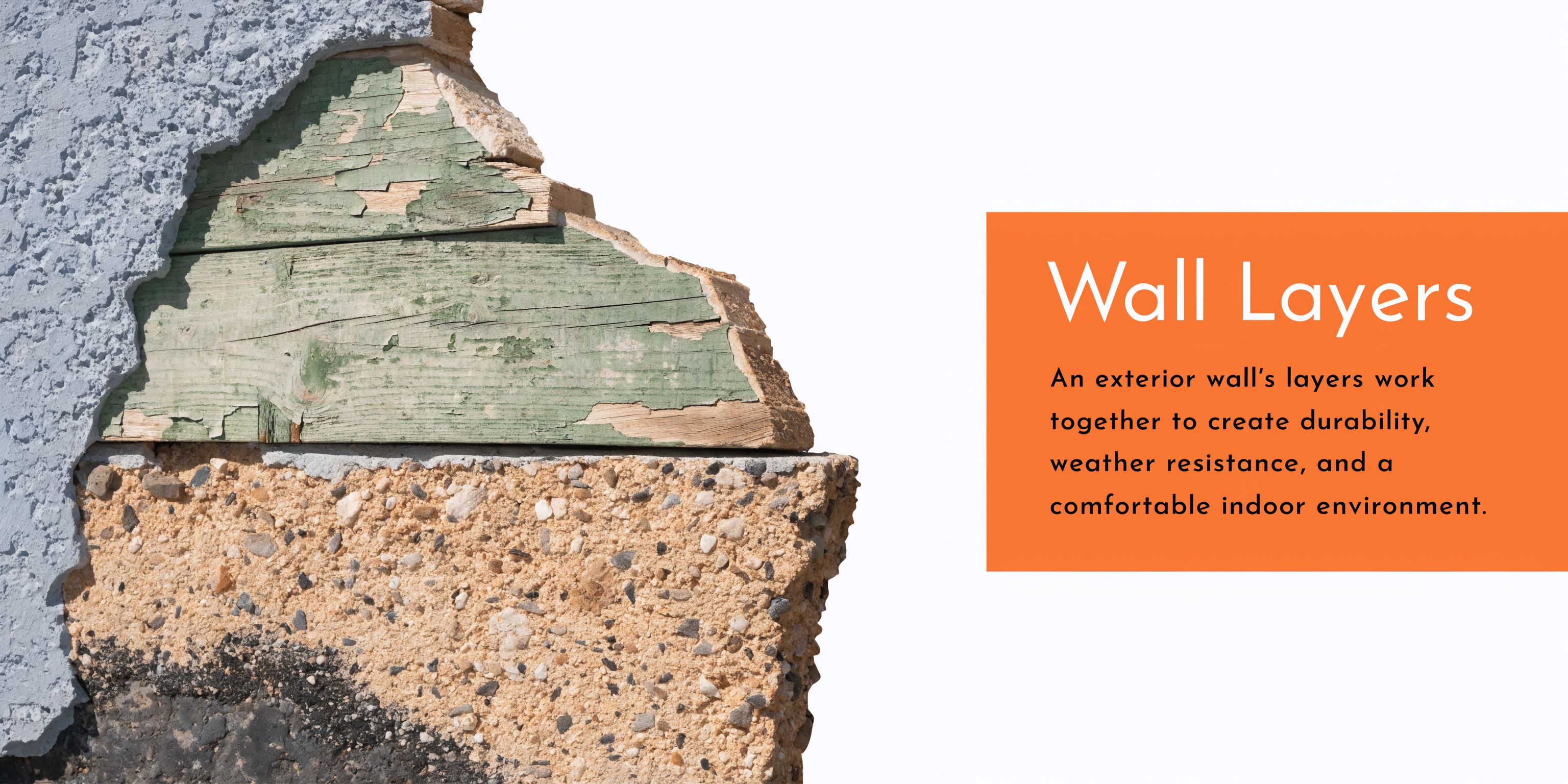
Most agents talk about stucco as if it’s one thing. It isn’t. What buyers see on the outside is only the final layer of a larger wall system, and that system affects durability, repair complexity, and how confidently you can market the exterior.
Stucco as a Layered Finish
Explaining stucco to clients is easiest by comparing it to a layered build rather than a coat of paint. Each layer has a job.
In a conventional setup, you’re dealing with:
- Base support: The substrate or wall assembly underneath
- Lath: The material that helps plaster grip
- Scratch coat: The first rough layer that anchors the system
- Brown coat: The leveling layer that builds body
- Finish coat: The visible texture and color
For agents, this matters because the attractive finish buyers notice may be hiding either a well-built wall or a poorly executed one. You can’t diagnose the assembly by eye alone, but you can understand why some homes age better than others.
Traditional three-coat stucco
Traditional stucco is the system many people mean when they say “real stucco.” It’s typically built in multiple layers over lath and weather protection.
The major historical shift came in the late 1800s, when builders moved from softer lime-based stucco to harder Portland cement systems. By the 1930s, cement stucco had become the standard, improving weather resistance and helping drive stucco’s broad use in American architecture, according to CCA’s summary of stucco evolution.
This is the system that built stucco’s reputation for toughness. It’s also the baseline many buyers and inspectors still have in mind when they hear the word “stucco.”
One-coat systems
A one-coat stucco system isn’t one single pass from wall to finish. In practice, it refers to a faster assembly designed to reduce labor and streamline installation.
From a marketing standpoint, the challenge is simple. Many buyers won’t know the difference unless the home has a known history, visible documentation, or a specialist inspection. Agents shouldn’t guess. If a seller says it’s one-coat, ask for records.
What matters in the field is how the exterior presents and whether there are visible signs of stress, movement, patching, or moisture trouble.
EIFS and synthetic stucco
EIFS stands for Exterior Insulation and Finishing Systems. Buyers often call it “synthetic stucco.”
It can resemble stucco visually, but it’s a different cladding approach. That distinction matters because some buyers, inspectors, and lenders react differently to EIFS than to traditional cement stucco.
A practical way to talk about it is this:
| System | What buyers usually notice | What agents should keep in mind |
|---|---|---|
| Three-coat stucco | Heavier, solid feel, classic texture | Often aligns with expectations of traditional stucco |
| One-coat stucco | Similar visual look from the street | Documentation matters more than assumptions |
| EIFS | Smooth or highly controlled finish | Marketing should be accurate and never vague |
Practical rule: If you don’t know the system, describe the look, not the assembly. Let contractors and inspectors identify the build-up.
What works in agent communication
Good agent language sounds like this: “Textured cement-styled exterior finish,” “smooth stucco appearance,” or “Spanish-influenced exterior with a hand-troweled finish.”
What doesn’t work is casually labeling every textured exterior as “traditional stucco” when you haven’t confirmed it. That can create avoidable friction later in the transaction.
A Visual Catalog of Common Stucco Exterior Finishes
This is the part agents need in the field. Buyers don’t ask what ASTM category a wall falls into. They ask why one stucco home feels clean and current while another feels rough, dated, or harder to maintain.
The answer usually starts with the finish.
Smooth finish
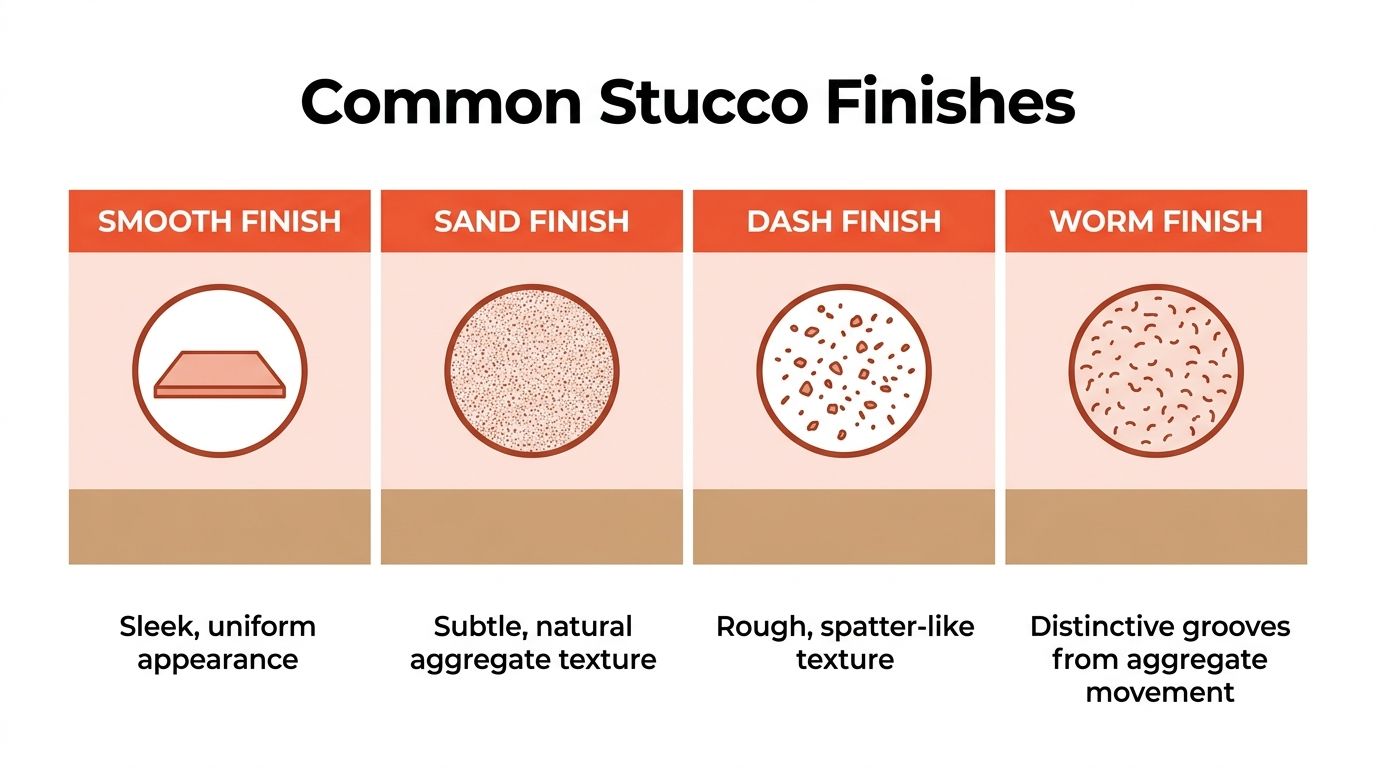
A smooth finish is the most refined-looking option. It presents as flat, controlled, and more contemporary than heavily textured alternatives.
On the right home, smooth stucco looks expensive. It pairs especially well with modern, Mediterranean, and higher-end transitional architecture. It also photographs beautifully in soft light because the planes read clearly.
The catch is that smooth finishes show everything.
Small waves, patch marks, uneven repairs, and cracking stand out fast. If the workmanship isn’t strong, the finish won’t hide it. For listing agents, that means smooth stucco can be a major asset when it’s well maintained and a headache when it isn’t.
Sand or float finish
A sand finish, sometimes called a float finish, has a fine aggregate texture. It feels more forgiving than smooth stucco while still reading as clean and intentional.
This is one of the easiest finishes to market because it fits a wide range of homes. It can support Spanish, ranch, bungalow, and even some updated suburban exteriors without drawing too much attention to itself.
It also tends to mask minor surface inconsistencies better than smooth finishes. The trade-off is visual buildup. Dirt can settle into the texture more easily, especially on lighter exteriors or shaded elevations.
Dash finish
A dash finish is rougher and more visibly irregular. It has a sprayed or spattered look, with a more rugged surface profile than a sand finish.
This finish is practical in some settings because it conceals imperfections well. Patch transitions and small substrate inconsistencies are less obvious. If a home has had minor cosmetic wear over time, dash can be more forgiving in everyday viewing.
Its downside is stylistic. Dash can feel heavy or dated depending on the architecture and neighborhood standard. In listing photos, harsh sunlight can exaggerate the roughness and make the wall look more worn than it does in person.
Skip trowel or lace finish
A skip trowel finish has movement. It’s hand-worked, intentionally uneven, and often associated with Mediterranean, Tuscan, or Southwestern styling.
This is one of the most personality-driven stucco exterior finishes. It can make a plain façade feel custom because the hand-applied texture creates variation across the surface. It often works especially well on arched entries, courtyards, and homes with warm natural materials.
For agents, skip trowel is useful when you want to lean into charm rather than crisp minimalism. It’s less useful when the rest of the property is trying to present as sharply modern.
Skip trowel sells best when the entire exterior supports it. If the doors, lighting, exterior plantings, and paint all feel disconnected, the finish can read older instead of artisanal.
Santa Barbara finish
A Santa Barbara finish is smoother and softer-looking than many textured stucco treatments, but it isn’t perfectly flat. It has a hand-shaped, old-world appearance often associated with upscale California and Spanish-influenced homes.
This finish tends to read warm, custom, and architectural. It’s especially effective when paired with rounded edges, earthy tones, steel or wood accents, and restrained exterior plantings.
Agents should be careful with the label, though. Sellers and contractors sometimes use “Santa Barbara” loosely to describe any soft, elegant stucco look. The safest approach is to describe the appearance if you’re not certain of the exact finish style.
Worm finish
A worm finish includes distinctive grooves created by aggregate movement during application. It’s highly recognizable once you’ve seen it a few times.
Some buyers view it as character-rich. Others see it as dated. That reaction usually depends on regional familiarity and the age of surrounding homes.
In listing copy, it’s rarely the finish you spotlight by name. It’s usually better to focus on the architecture and use the finish as part of the visual composition rather than making it the headline feature.
Quick identification guide for agents
| Finish | Street-level appearance | Best use in marketing | Common risk |
|---|---|---|---|
| Smooth | Flat, crisp, modern | Luxury, contemporary, clean lines | Shows flaws easily |
| Sand | Fine grain, balanced texture | Versatile, broadly appealing | Can hold dirt visually |
| Dash | Rough, spattered texture | Hides wear better | Can photograph harshly |
| Skip trowel | Hand-worked movement | Character, warmth, custom feel | Can feel dated if mismatched |
| Santa Barbara | Soft, sculpted elegance | High-end Spanish or coastal tone | Often mislabeled |
| Worm | Grooved linear texture | Niche architectural character | Polarizing buyer response |
What to say on showings
If you’re standing outside with buyers, skip the contractor vocabulary unless they ask for it. Start with visual impact.
Use language like:
- For smooth finishes: “This gives the home a more current, refined exterior.”
- For sand finishes: “It has enough texture to feel substantial without looking heavy.”
- For skip trowel: “This finish adds depth and fits the architecture instead of flattening it.”
- For rougher finishes: “This texture is more forgiving visually and tends to disguise minor wear better.”
That kind of description helps buyers process what they’re seeing. It also makes you sound like someone who understands materials, not just marketing copy.
Comparing Finishes by Cost Durability and Climate
Agents get pulled into practical questions quickly. Buyers ask which finish holds up best. Sellers ask whether a smoother look will help value. Investors ask whether stucco is worth the upkeep compared with another cladding.
The right answer is rarely “this finish is best.” It’s usually “this finish works best for this house, in this climate, with this maintenance tolerance.”
Cost follows labor and precision
Even without quoting exact installation pricing, the pattern is consistent. Smoother stucco finishes usually demand more labor and more precision. Textured finishes tend to be more forgiving.
That matters when sellers are considering exterior updates before listing. A rougher or more textured finish can conceal minor inconsistencies better. A smooth finish creates a stronger luxury impression, but it leaves less room for error.
Here’s a useful way to frame it for clients:
| Priority | Finish styles that often fit | Why |
|---|---|---|
| Lowest visual risk | Sand, dash | They hide minor irregularities more easily |
| Highest-end appearance | Smooth, Santa Barbara | They create a more polished look |
| Character-driven styling | Skip trowel, worm | They support homes with strong architectural personality |
Durability depends on more than the finish coat
Stucco gets marketed as durable for good reason, but buyers often confuse “durable material” with “maintenance-free exterior.” Those aren’t the same.
Traditional cement stucco is valued for durability, low maintenance, and fire resistance. It also has a 50+ year lifespan in the sustainability discussion cited by Ecohome’s stucco siding guide, even though cement production carries a high embodied carbon footprint. For agents in wildfire-prone markets, that fire resistance is a meaningful talking point because it affects long-term ownership risk, not just aesthetics.
The finish itself influences how wear shows up:
- Smooth finishes reveal cracking, patching, and waviness more clearly.
- Textured finishes often disguise surface flaws better.
- Heavier textures can hold dirt more visibly and may need more cleaning attention to stay sharp.
The best-looking stucco finish on closing day is the one the next owner can realistically maintain.
Climate changes the conversation
Climate matters more than style trends.
In dry, sunny markets, stucco often feels native to the surroundings. In humid or rain-heavy areas, buyers may scrutinize it harder, especially if they already associate stucco with moisture worries. That doesn’t make stucco a bad choice. It means agents need to present condition, drainage, and upkeep more carefully.
A few practical patterns hold up:
- Dry climates: Textured and traditional-looking finishes often feel regionally appropriate.
- Humid climates: Clean condition, visible maintenance, and stain-free presentation matter more than finish style alone.
- Luxury markets: Smooth finishes can help a home feel more architectural, but only if the execution is clean.
If clients want a broader material context, a practical resource is this Brick vs Stucco comparison, which helps frame stucco against another familiar exterior choice without reducing the discussion to appearance alone.
Sustainability and ROI aren’t just green talking points
For some sellers, especially owners in fire-prone regions or long-term holds, stucco’s value story includes resilience. A material with a longer service life can justify a more favorable lifecycle view even if its upfront environmental cost is harder to ignore.
That’s the balanced agent position. Don’t oversell stucco as universally superior. Explain the trade-off clearly. It can offer longevity and fire resistance, but finish choice still needs to match the property, climate, and the owner’s appetite for maintenance.
An Agent's Guide to Stucco Inspections and Maintenance
You don’t need to be a stucco contractor to do a smart first walkaround. You do need to know what deserves a closer look, what’s probably cosmetic, and what should trigger a specialist inspection before the listing goes live.

Start with the obvious visual red flags
Walk the exterior slowly and look across the wall surface at an angle, not just straight on. That makes changes in plane, bulges, and patched areas easier to catch.
Focus on:
- Cracks: Fine hairline cracking may be cosmetic. Wider, longer, or patterned cracking deserves more attention.
- Staining: Discoloration under windows, near roof lines, or at the base of walls can signal water movement.
- Bulging or separation: Areas that look detached or swollen may indicate delamination.
- Efflorescence: A chalky white residue can point to moisture migration through the wall.
Agents shouldn’t diagnose the cause. They should identify the concern and move it into the right professional lane.
Know one technical threshold that matters
One detail is worth remembering because it helps explain why some finish failures happen. Under ASTM C926, the final stucco finish coat must have a minimum thickness of 1/8 inch (3.2 mm), and thinner applications are a known cause of cracking and delamination, as noted in this Euclid Chemical technical reference on stucco finish.
You won’t measure that on every listing. But you can use the idea correctly in conversation. Thin, weak-looking, prematurely failing finishes aren’t just cosmetic annoyances. They can reflect poor application.
Field note: If cracking seems widespread and the exterior also looks thin, brittle, or patchy, don’t minimize it. Recommend a qualified stucco inspection.
What to ask sellers before buyers do
A short seller conversation often reveals whether the exterior is a known issue or just normal wear.
Ask questions like:
Has the stucco been repaired before?
Prior repairs don’t kill a deal, but undocumented repairs create uncertainty.Has the exterior been cleaned or recoated recently?
Fresh paint can improve presentation, but it may also hide recurring trouble.Have there been moisture issues around windows, balconies, or roof transitions?
These areas often draw the most buyer concern.
For surface cleaning, sellers sometimes need a gentler method than aggressive washing. If they’re deciding how to freshen the exterior without rough treatment, this guide to soft washing siding is a useful reference point for discussing lower-impact cleaning approaches.
A broader operational view also helps if you manage multiple units or recurring exterior upkeep across rentals or portfolios. Teams handling those workflows can benefit from tools designed for property management.
Use video to educate your eye
A quick visual refresher can help newer agents distinguish minor wear from more concerning damage patterns. This walkthrough is useful before a listing appointment:
What works and what doesn’t
What works: documenting visible issues early, recommending specialist review when needed, and addressing cosmetic cleanup before photos.
What doesn’t: describing cracks as “normal” without context, assuming stains are only dirt, or waiting for the buyer’s inspector to define the narrative.
The more precise you are upfront, the more control you keep over the listing story.
How to Market and Stage a Home with Stucco
Stucco only hurts a listing when the agent lets the exterior go undefined. If the finish fits the architecture and looks intentional in the photos, it can become one of the strongest visual assets on the property.

Write the finish into the story
Most listing copy wastes the exterior. It says “beautiful stucco home” and moves on.
That’s too generic. Stucco works best in marketing when you tie it to mood and architecture.
Try angles like these:
- For Mediterranean or Spanish-style homes: “Textured stucco exterior complements the home’s arched details and courtyard feel.”
- For cleaner updated homes: “Smooth stucco lines give the façade a refined, modern presence.”
- For warm character homes: “Hand-troweled exterior texture adds depth and a custom architectural feel.”
The point isn’t to romanticize the material. It’s to help buyers see it as part of a design language, not just a wall surface.
Photograph for texture, not glare
Stucco can look excellent in person and flat in photos if the shoot timing is wrong. Harsh midday sun tends to create hard contrast on textured finishes and can make rough areas read more severe than they are.
A few practical rules help:
| Photo objective | Best approach |
|---|---|
| Show depth in texture | Use softer angled light, often earlier or later in the day |
| Avoid overemphasizing cracks or roughness | Skip harsh side light on problem walls |
| Make light-colored stucco look clean | Keep shadows controlled and watch color balance |
| Support a luxury look | Frame entry sequence, exterior plantings, and architectural lines together |
Good stucco photography doesn’t isolate the wall. It shows the wall in relationship to doors, windows, hardscape, and planting.
Stage the exterior to soften objections
Exterior staging matters more with stucco than many agents realize because texture interacts with everything around it.
What usually helps:
- Potted greenery: Plants add softness against rigid wall planes.
- Warm lighting: Wall sconces and exterior lighting can make textured stucco feel rich instead of rough.
- Natural materials: Wood, terracotta, and iron often pair well with stucco surfaces.
- Clean hardscaping: Dirty walkways make stucco look dirtier by association.
What usually hurts:
- Too many competing finishes: Busy stone veneers, overly mixed metals, or clashing paint tones can make the façade feel confused.
- Sparse staging: A bare stucco wall can look stark, especially with smooth finishes.
- Ignoring color temperature: Cool exterior bulbs can make warm stucco look washed out.
Before and after framing matters
Sellers often underestimate how much visual editing happens before a buyer ever visits. If you need examples of how better preparation changes perceived value, these house staging before and after examples are useful for showing why polish matters before photography, not after days on market.
The strongest angle is confidence
Buyers respond well when an agent sounds specific. Not defensive. Not vague.
You don’t need to say the stucco is perfect. You need to show that the exterior has been understood, cleaned, presented correctly, and woven into the home’s overall appeal.
That’s what turns stucco from a possible objection into a curb appeal asset.
The Agent's AI Toolkit for Stucco Imperfections
Stucco creates a modern marketing problem. A house can be structurally fine and still lose buyer interest because the exterior looks stained, cracked, dated, or visually heavy online.
That gap matters because buyers make fast judgments from photos. Traditional advice usually jumps straight to physical repair, repainting, patching, or resurfacing. Sometimes that’s necessary. Sometimes it isn’t realistic before listing.
A more useful approach starts by separating condition issues from presentation issues.
Where AI helps most
The biggest gap in real estate content around stucco is digital problem-solving. Buyer hesitation around visible cracks and moisture staining is real, but most guidance focuses only on manual repairs. The underserved opportunity is using AI to create cleaner, more marketable visuals before the home hits the MLS, which aligns with the need identified in this overview of common stucco problems.
That gives agents several practical uses:
- Virtually reduce cosmetic distractions such as surface staining or dated color
- Restyle an older façade toward a smoother, more current look for marketing concepts
- Test alternate finish directions before sellers spend money on real-world changes
- Create cleaner MLS presentation when the actual issue is visual clutter, not structural failure
What AI should and shouldn’t do
Used well, AI helps buyers imagine potential. Used badly, it creates mistrust.
Good use looks like this:
- Showing a concept version with a cleaner color palette
- Presenting a restyled exterior to help sellers evaluate updates
- Removing purely visual distractions for marketing drafts when disclosures remain accurate
Bad use looks like this:
- Hiding known material defects that should be disclosed
- Presenting a finish as installed when it’s only conceptual
- Creating marketing images that misrepresent actual property condition
AI is strongest when it clarifies possibilities. It shouldn’t replace honest condition conversations.
A practical workflow for agents
For a stucco listing with visible cosmetic issues, a smart workflow is simple. Document the current condition. Decide what needs physical remediation. Then create alternate visual versions for marketing strategy and seller decision-making.
If your team is evaluating tools for that process, this guide to best AI photo editing software is a useful starting point for comparing options that support real estate visuals.
The primary advantage isn’t novelty. It’s speed. When an exterior finish is limiting interest, agents need a way to show what the property could look like without waiting on a full renovation timeline.
That’s especially true with stucco exterior finishes, where a small visual flaw can dominate photos and overshadow the home itself.
Bounti Labs helps agents solve exactly this kind of listing challenge. With Bounti Labs, you can turn a simple property walkthrough into MLS-ready visuals, generate cleaner marketing photos, and create AI-powered restyled versions that help buyers see past dated stucco, cosmetic cracking, or tired exterior color. If you want faster listing prep and stronger presentation without waiting on manual editing vendors, Bounti is built for that workflow.