A listing is sitting in that frustrating middle ground. Buyers don’t hate it, but they don’t feel it either. The rooms are empty, the kitchen is dated, or the commercial shell space looks too abstract for a tenant to picture. You can explain the vision. You can show mood boards. You can stage a few photos. But the client still says, “I just can’t see it.”
That’s where virtual reality rentals become interesting for real estate.
Most of the market talks about VR rentals as event entertainment. That’s the loudest use case, and it’s why the category feels easy to dismiss as a gimmick. But for agents, leasing teams, and commercial marketers, the primary opportunity is different. It’s about helping a buyer, seller, or tenant step into a property’s future before the work is done, or experience a space remotely in a way that static media can’t match.
There’s also a clear gap in guidance. Real estate is mentioned far less often than parties, trade shows, and team-building events, even though agents can use immersive walkthroughs to let buyers tour properties remotely and potentially reduce physical showings by up to 40% according to this overview of virtual reality rentals in event-focused markets. That gap matters because agents don’t need more hype. They need operational advice, presentation strategy, and a realistic way to compare VR with tools they already use, including digital channels such as real estate social media marketing.
The New Competitive Edge in Property Marketing
The strongest listing presentations don’t just promise exposure. They prove that you have better tools for helping buyers make decisions.
That’s why VR deserves attention now. It moves the conversation from “Here’s what this home could become” to “Put this on and walk through it.” For an outdated condo, that can mean showing a renovated kitchen concept in context. For a new development, it can mean letting a buyer experience finishes and layout before completion. For a commercial vacancy, it can mean helping a tenant visualize reception, workstations, or showroom flow inside an otherwise blank box.
Where VR matters most for agents
Virtual reality rentals are not a replacement for your everyday listing media. They’re a high-impact sales tool for moments where belief is the bottleneck.
That usually happens in a few situations:
- Vacant homes with weak emotional pull where buyers struggle to judge scale and furniture fit.
- Properties needing renovation where sellers want proof that updated visuals can drive interest.
- Pre-market or under-construction inventory where there’s no finished product to walk through.
- Commercial leasing and tenant rep work where layout flexibility is central to the decision.
- Remote buyer and renter presentations when travel, timing, or geography slows the process.
Practical rule: Use VR when the challenge is not awareness. Use it when the challenge is imagination.
Why the timing is favorable
The broader conversation around VR is no longer niche. The category has economic momentum, but agents should read that trend as a delivery advantage rather than a headline. The important point is simple: rental access is expanding, and professionals can use immersive hardware without building an in-house VR department.
The market’s entertainment-first identity creates a window for real estate professionals. Most competitors still present with photos, video, floor plans, and standard virtual tours. Those are useful, but they all live on a screen. A headset changes the energy in the room. It slows people down. It focuses attention. It often creates the first strong emotional reaction to a property that otherwise felt theoretical.
The edge is not the gadget
The edge comes from better persuasion.
A seller remembers the agent who can demonstrate a future renovation, not just describe it. A buyer remembers the showing where they felt the scale of the primary suite. A tenant remembers the broker who turned an empty floorplate into a usable office story.
That’s the opportunity. Not novelty for its own sake. A sharper way to win listings, move hesitant prospects, and make a hard-to-picture property easier to buy.
What Exactly Are Virtual Reality Rentals
Virtual reality rentals usually fall into two buckets. You either rent the hardware itself, or you rent a managed experience where a vendor handles delivery, setup, and support.
For real estate, both can work. The right model depends on whether you want a mobile sales tool your team can reuse across appointments, or a polished one-off activation for a launch, broker event, or premium open house.
The two rental models agents use
Hardware-only rentals are the simpler option. A company ships headsets, controllers, and charging accessories. Your team loads the content, manages the appointments, and handles the user flow.
Full-service rentals are closer to event production. The provider may deliver the gear, set up stations, troubleshoot on site, and manage the guest experience. If you’re hosting a development launch, investor preview, or large broker open, that support can be worth it.
A useful benchmark is to look at providers that frame the offer clearly, like Virtual Reality Hire from PSW Events, where the service model is built around supplying hardware and live support for temporary activations.
Standalone versus tethered headsets
This is the first technical fork in the road.
A standalone headset is the easiest comparison to a smartphone. It’s self-contained. The processing happens inside the headset. That means less gear, faster setup, and easier mobility.
A tethered headset is closer to a gaming PC setup. The headset connects to a computer that does the heavy lifting. That usually means more setup work, more cables, and more performance headroom.
Here’s the strategic question: are you trying to impress one client in a conference room, or run a premium visual experience where fidelity matters enough to justify the complexity?
Basic terms worth knowing
A few terms show up in rental conversations and matter in practice.
- 6DoF means six degrees of freedom. In plain English, the user can move naturally through space instead of only turning their head in place.
- Inside-out tracking means the headset tracks movement using its own cameras and sensors, which reduces setup friction.
- Refresh rate affects visual smoothness. Better smoothness usually means a more comfortable experience.
- Latency is the delay between movement and what the user sees. Too much lag makes VR feel wrong fast.
If a prospect is trying VR for the first time, comfort matters more than fancy terminology. Smooth, simple, and guided beats overbuilt every time.
Why rentals keep growing
The appeal is straightforward. Hardware can be expensive to buy outright, and many professionals don’t want to own, maintain, store, and update devices they may only use for select campaigns. That’s one reason the category is growing. The broader VR market is projected to grow from USD 20.83 billion in 2025 to USD 171.33 billion by 2034, while location-based VR is projected to reach USD 10.69 billion by 2031. The same source notes that rentals help users access strong experiences without the upfront cost of headsets that average over USD 300 each, according to Coherent Market Insights on the VR headsets market.
For agents, the takeaway isn’t to chase the trend. It’s to understand the structure. You can test immersive property marketing without committing to permanent hardware, and that makes virtual reality rentals much more practical than they first appear.
How Top Agents Use Immersive VR Experiences
The agents getting the most from virtual reality rentals don’t use them as a gadget at the edge of an event table. They use them to solve a very specific sales problem.
That problem is usually one of translation. The client can’t translate an empty room into a furnished life, a shell space into a workable office, or a construction plan into something emotionally real.
Commercial leasing where the space is too abstract
A tenant rep walks a prospect into a vacant floor. The ceilings are exposed, the lighting is rough, and the prospect starts mentally discounting the space before the conversation gets moving.
A better move is to pair the site visit with a headset session that shows alternate layouts. One scenario presents private offices along the perimeter. Another leans open plan. A third reframes the space for client-facing showroom use.
The value isn’t just visual. It changes the meeting dynamic. The tenant stops asking, “What is this?” and starts asking, “Could we move the team area here?”
That’s a stronger conversation. It leads to design discussion, not confusion.
Luxury listings where future value needs to be felt
High-end residential agents often carry a harder burden than people realize. They’re not only selling what exists. They’re often selling what the property could become after design work, landscaping, or renovation.
That’s where immersive presentation works well. A buyer can stand in the current living room, then put on the headset and see the same volume reworked with different finishes, a new kitchen relationship, or an outdoor entertainment concept. It’s not about replacing in-person showings. It’s about making expensive possibilities feel less speculative.
The best VR moments in real estate happen when a client says, “Now I get it.”
Property management for remote renters
Leasing teams have a different problem. They’re trying to move prospects through the funnel without wasting staff time on low-intent tours.
Virtual reality rentals can help when the prospect is relocating, comparing multiple units, or deciding among communities from out of state. A guided immersive tour at a leasing office, relocation fair, or employer event can pre-qualify interest much better than static brochures.
The important detail is workflow. If the team can’t connect the VR experience to follow-up, application steps, and unit availability, the wow factor evaporates.
That’s why teams often pair immersive presentations with a stronger digital sales layer, such as the kind of property marketing workflow described in the Bounti Studio Experience, where visual assets support the conversation before and after the headset comes off.
New development and launch events
Developers and project marketers can use VR rentals effectively when there’s no finished inventory to walk. In that context, the headset is not a novelty. It’s the closest available substitute for a finished product.
A launch event might use one station for the amenity story and another for individual residence types. A broker preview might focus on key differentiators like views, kitchen packages, or lobby arrival sequences. An investor meeting might use VR to align everyone around the same physical vision.
Later in the event, a short demo can help ground the idea:
What top agents do differently
They curate the experience.
They don’t hand someone a headset and hope for magic. They narrate the tour. They choose one or two moments to emphasize. They prepare a clean transition back into the business conversation, whether that’s pricing, renovation scope, lease terms, or the next showing.
The headset is only the delivery system. The story still has to be sold by the agent.
The Benefits and Limitations of VR for Real Estate
Virtual reality rentals can be excellent for real estate. They can also be a clumsy waste of time when used for the wrong property, the wrong audience, or the wrong stage of the funnel.
That tension matters. The point is not to treat VR as the future of all marketing. The point is to understand where it provides an advantage.
Where VR earns its place
The category itself is expanding quickly. The location-based VR market is forecast to grow by USD 14.58 billion from 2025 to 2029 at a CAGR of 35.1%, according to Technavio’s location-based virtual reality market analysis. For agents, that growth matters because more rental infrastructure usually means more options, more vendor familiarity, and more accessible activations.
The business upside in real estate usually shows up in five ways:
- Memorability: A seller or buyer is far more likely to remember an immersive listing presentation than another slideshow.
- Emotional engagement: VR can create a stronger sense of scale, flow, and possibility than still images alone.
- Differentiation: In competitive pitches, immersive tools can separate your package from a standard media stack.
- Decision support: For renovated or unbuilt spaces, VR helps clients evaluate possibilities with less guesswork.
- Remote persuasion: It gives far-away decision makers a more convincing experience than a link to photos.
What doesn’t work as well
VR also has limits that people skip past too quickly.
It is not scalable. It’s a one-person-at-a-time medium unless you invest heavily in staffing and hardware coordination. It also depends on content quality. If the underlying model, rendering, or navigation feels rough, the experience can weaken confidence instead of building it.
A few common problems show up fast:
- Operational drag: Charging, scheduling, sanitizing, shipping, and troubleshooting can eat time.
- Audience mismatch: Some clients love immersive tech. Others just want three clear options on a screen.
- Content bottlenecks: A headset is useless without strong property content prepared for VR viewing.
- Session management: Open house traffic doesn’t always mix well with a tool that needs orientation and supervision.
Field note: The more people you expect to cycle through in a short window, the less forgiving VR becomes.
The comfort issue is real
Motion discomfort, headset fit, and hygiene are not side issues. They are adoption issues.
If the first user struggles, everyone else in line gets more cautious. If a luxury client worries about cleanliness, your premium experience suddenly feels sloppy. If a tenant has trouble moving, the space itself can seem more confusing than it really is.
That means the practical standard for VR in real estate is higher than the technical standard. The experience has to feel effortless.
Where many teams misjudge ROI
The mistake is using VR for broad marketing when a simpler medium would do the job better.
If your main need is listing coverage, social promotion, email creative, and MLS-ready visuals, VR is often too heavy. If your need is persuasion at a key decision moment, it can be excellent.
That’s the right framing. Virtual reality rentals are a specialty tool. They shine when the sale depends on immersion, not when the job calls for more reach.
Your Pre-Rental Logistics and Cost Checklist
Most VR disappointments in real estate come from planning mistakes, not bad intentions. The headset arrives. The content isn’t formatted correctly. The battery is low. The room is too tight. Nobody has tested the flow with a first-time user. The event starts anyway.
A better approach is to treat virtual reality rentals like any other high-touch marketing activation. You need a checklist, an owner, and a backup plan.
Start with hardware fit, not brand hype
The first decision is whether you need standalone or tethered hardware.
For tethered systems such as Oculus Rift and HTC Vive, the rental setup needs a host PC with at least an Intel i5-4590 CPU, NVIDIA GTX 970 GPU, 8GB RAM, and Windows 10, and the system should maintain 90+ FPS to reduce motion sickness risk, according to this breakdown of the computing power required for virtual reality rentals. That’s why tethered setups are better reserved for environments where you can control the room, the computer, and the support.
Standalone devices are usually easier for agents. The Meta Quest 2 uses an integrated Snapdragon XR2 processor, removes the need for a PC, and offers 2 to 3 hours of battery life, which makes it well suited to mobile presentations and open houses, as noted in the same rental hardware guidance discussed above.
The essential planning table for teams
| Category | Item to Verify | Key Question |
|---|---|---|
| Hardware | Headset type | Do you need portable simplicity or higher-end tethered performance? |
| Hardware | Battery and charging plan | Will the device last through the showing, event, or broker session without interruption? |
| Hardware | Controller availability | Does your content require controllers, or can users move with simple gaze and prompts? |
| Software | Content format | Is the property experience built for the exact headset you’re renting? |
| Software | App loading | Who is responsible for loading and testing the tour before the event? |
| Software | User flow | Can a first-time user understand how to start, move, and exit without confusion? |
| Logistics | Physical space | Is there enough clear area for safe movement and staff supervision? |
| Logistics | Power | If you’re using tethered gear or charging stations, is reliable power available where needed? |
| Logistics | Shipping and timing | Will the equipment arrive early enough for testing, not just on the event date? |
| Client experience | Hygiene supplies | Who handles face covers, cleaning, and turnover between users? |
| Staffing | On-site owner | Who is responsible for setup, resets, coaching, and basic troubleshooting? |
| Budget | Total activation cost | Are you budgeting only for the headset, or also for content prep, staffing, and downtime risk? |
Questions to ask the rental vendor before you book
Don’t lead with price. Lead with failure points.
- Content compatibility: Will this exact headset run the property experience we’ve prepared?
- Delivery timing: Can the gear arrive with enough margin for a full test before the client sees it?
- Support model: If something breaks or won’t load, who solves it and how fast?
- Reset time: How quickly can one user finish and the next begin?
- Sanitation supplies: Are covers, wipes, or replaceable interfaces included?
- Return process: What happens if the event ends late or the shipment misses pickup?
Budgeting beyond the device
Agents often underestimate the non-rental costs.
The visible line item is the headset. The hidden line items are content creation, setup time, staff coordination, client coaching, and the opportunity cost of using a high-friction format for a medium-friction problem. If the asset will only be shown to a handful of serious decision makers, those costs may be justified. If the plan is to impress a broad pool of casual open house traffic, they often aren’t.
Don’t ask whether the headset rental is affordable. Ask whether the full experience is worth producing for this property.
The practical shortlist for real estate teams
If you’re evaluating your first project, keep the decision criteria narrow.
- Choose the property carefully. The best candidates are hard to visualize and financially meaningful.
- Keep the user journey short. A concise, guided experience usually performs better than a long free exploration.
- Assign one operator. Someone must own charging, launching, cleaning, and user transitions.
- Test with a non-technical person. If they struggle, your client will too.
- Have a fallback presentation. If the headset fails, you still need the meeting to work.
Good VR activations feel smooth because the logistics are invisible. That never happens by accident.
The Agent's VR Implementation Workflow
Most real estate teams think the workflow starts when the headset arrives. It starts earlier, with the property story you want the client to experience.
If the underlying visual content is weak, virtual reality rentals only magnify the weakness. If the content is clear, purposeful, and tied to a decision, the headset becomes a strong delivery format.
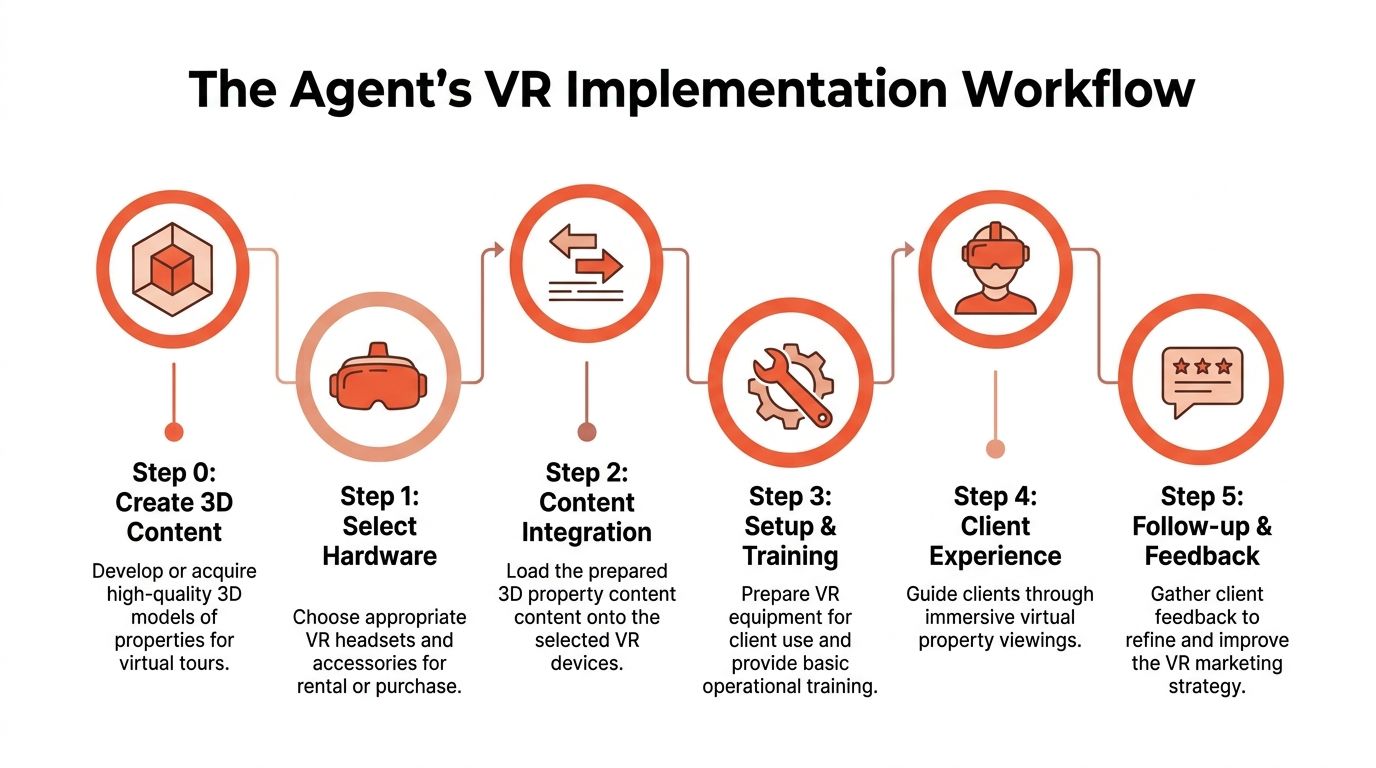
Step 0 begins before the rental
Start by deciding what version of the property needs to exist in virtual form.
Is the goal to show the home as-is for a remote buyer? To present a renovated version during a listing pitch? To help a tenant compare layout options in a commercial shell? Those are different jobs, and each one requires different content decisions.
A useful planning sequence looks like this:
- Define the sales objective. Win the listing, secure the lease discussion, or move a buyer off the fence.
- Choose the property story. Current condition, future renovation, alternate layout, or amenity narrative.
- Prepare the assets. Floor plans, design concepts, source imagery, and any 3D model inputs.
- Approve the final path. Decide what the user will see, in what order, and with what guidance.
Hardware selection only matters after the content goal is clear
Once the content exists, match the device to the use case.
A brokerage conference room demo usually favors a simple, low-friction setup. A polished launch event may justify more support and more controlled staging. The question is not which device is coolest. The question is which device gives the intended user the least confusing route to the intended decision.
Rehearsal separates polished from sloppy
Before the first client session, run a full dry test.
Check the load time. Check the handoff. Check how the user enters and exits the experience. Then test the talk track. The agent should know exactly when to speak and when to let the client absorb the scene.
Give the client one thing to focus on before they put the headset on. Otherwise they’ll spend the first minute just orienting themselves.
Guide the experience in real time
During the appointment or event, stay close to the user experience.
That means helping with fit, framing what they’re about to see, and narrating only where needed. Too much talking interrupts immersion. Too little guidance leaves the user wandering without context.
A strong on-site sequence is simple:
- Introduce the purpose so the client knows what they’re evaluating.
- Help with fit and comfort before launching the content.
- Guide key moments such as layout choices, finish changes, or sightlines.
- Bring the conversation back to business immediately afterward.
Follow-up is where the value gets captured
After the headset comes off, don’t end with “pretty cool, right?”
End with decisions. Ask what version they preferred. Ask what changed in their thinking. Ask what they want next, whether that’s a proposal, a revised layout, another showing, or listing paperwork.
The agent’s job is to convert immersion into movement. The technology can create the moment, but only process turns that moment into a signed client, a stronger offer, or a lease moving forward.
When to Choose AI Staging Instead of VR Rentals
Not every property problem needs a headset.
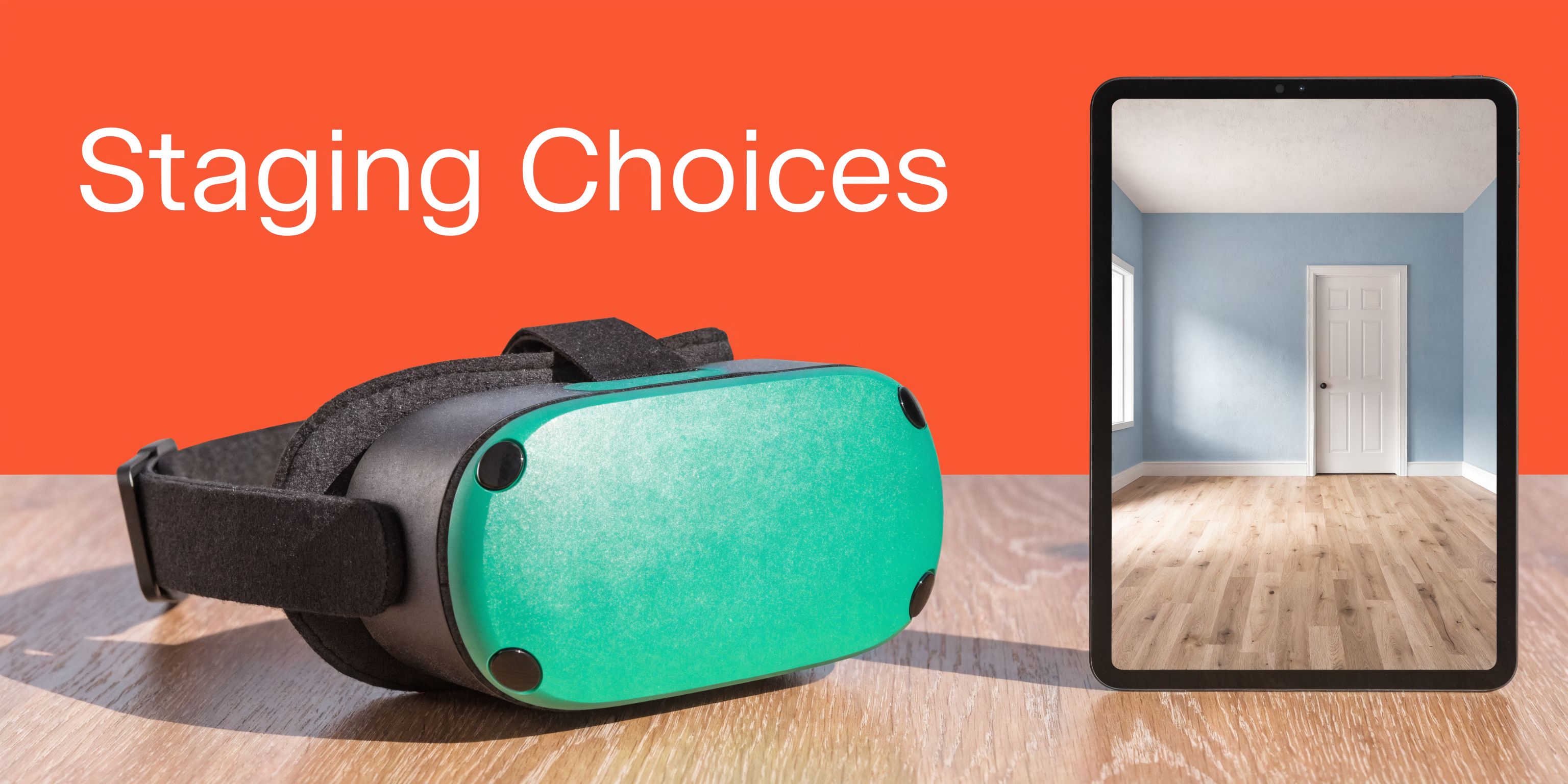
Many teams overspend in this way. They reach for virtual reality rentals when the need is faster visuals, broader distribution, and easier iteration. In practice, VR and AI staging solve different parts of the same marketing challenge.
Use VR for depth, AI for scale
VR is strongest when the audience is small and the outcomes are critical.
AI staging is stronger when you need many variations, fast turnaround, and assets that can live everywhere your listing needs to appear. That includes MLS photos, email campaigns, presentation decks, paid ads, social posts, and listing appointment leave-behinds.
If your main question is “How do I help dozens or hundreds of people understand this property online?” AI usually wins.
If your main question is “How do I help this one decision maker feel the property’s potential right now?” VR often has the edge.
A practical decision framework
Choose VR rentals when:
- The property is hard to visualize in person.
- You’re dealing with a premium listing, launch event, or commercial space decision.
- The audience is limited and qualified.
- The meeting itself is the conversion moment.
- A guided immersive story will materially improve understanding.
Choose AI staging or AI-generated visuals when:
- You need speed.
- You need multiple design directions.
- You want assets that work across every digital channel.
- The property needs help before anyone agrees to an in-person experience.
- You’re marketing at volume across many listings or units.
The cost of friction matters
VR creates friction by design. Someone has to wear something, learn something, and pause for the experience.
AI visuals remove friction. A prospect can scroll, compare, share, and revisit instantly. That doesn’t make them better in every case. It makes them easier to deploy across the whole funnel.
For teams evaluating creative quality across AI tools, this overview of best realistic image generator tools is useful context when comparing realism and output style. In real estate, that matters because weak visuals can hurt trust just as quickly as no visuals at all.
The smartest teams use both, but not at the same stage
A practical stack often looks like this:
- Top of funnel: AI visuals to improve listing appeal and increase click-through interest.
- Mid-funnel: polished marketing assets to support buyer, seller, or tenant discussions.
- Bottom of funnel: VR for the smaller set of prospects who need help crossing the imagination gap.
For agents who want a clearer framework for digital-first visuals, this guide to virtual staging for real estate marketing is a useful reference point.
VR is a presentation tool. AI staging is a production tool. Confusing those roles leads to bad budget decisions.
What to choose for common scenarios
A dated but occupied listing usually needs AI first. You need clean, flexible, listing-ready imagery before you need immersion.
A luxury renovation concept may justify both. AI helps market the possibility broadly. VR helps close the story in person.
A commercial shell space often leans harder toward immersive presentation because layout and movement are central to the decision. A multifamily leasing team with many similar units often benefits more from scalable digital visuals than from trying to operationalize headsets for every prospect.
The right question isn’t which technology is more advanced. It’s which one matches the job in front of you.
Measuring Your Return on Immersion
If you can’t tie the experience back to business movement, it was just an expensive demo.
The cleanest way to measure virtual reality rentals is to track them against a specific sales objective before the event starts. Don’t settle for “people loved it.” Decide what success means for that property.
Metrics that matter more than novelty
Look at outcome signals such as:
- Listing conversion: Did the immersive presentation help win the seller’s signature?
- Prospect progression: Did the buyer, tenant, or investor move to the next concrete step?
- Quality of conversation: Did the meeting shift from abstract objections to specific choices?
- Follow-up velocity: Did VR users respond faster or ask sharper questions afterward?
- Client feedback: What did they understand after the session that they didn’t understand before?
You can also compare VR-assisted presentations against your usual process. Not with invented benchmarks, but with your own before-and-after pattern. Did this tool improve clarity, confidence, or commitment for this kind of property?
The strategic takeaway
Virtual reality rentals are not daily-driver marketing for most real estate teams. They are a specialized persuasion tool. Used in the right context, they can help clients feel the value of a property in a way static media can’t.
For everything else, speed, scale, and repeatability usually matter more.
That’s the main decision. Use immersion where immersion changes the outcome. Use simpler visual tools where reach and efficiency do the heavy lifting.
Bounti Labs helps real estate teams create better property marketing without the delays and complexity of traditional production. With one walkthrough, Bounti Labs can generate property descriptions, pull stills, create MLS-ready photos, and transform spaces with AI decluttering, staging, restyling, or full renovation visuals. If you want faster creative output for listings, presentations, and campaigns, it’s a practical place to start.