
Search demand frames 11 fulton street nyc as a destination. A listing strategy has to frame it as a case study in asset durability.
That distinction matters because the headline tenant can pull attention away from the underwriting story. As noted earlier, the current operator's bankruptcy filing changes how a serious buyer, lender, or replacement tenant will read the address. The stronger listing angle is not celebrity by association. It is optionality in a high-visibility Seaport location with a use story that may need to change.
For an agent, that shifts the job from description to positioning. The question is not whether the address is recognizable. It is whether the marketing makes a clear case for income continuity, replacement-tenant logic, and future use value if the present concept loses traction.
That is why 11 Fulton works better as a marketing case study than a standard property blurb. The asset sits in a historic district, carries consumer recognition, and faces the practical realities of mixed-use leasing in a neighborhood shaped by tourism, office patterns, dining demand, and periodic reinvention. Good listing copy has to connect those forces. Weak copy just repeats the marquee name.
The durable value case sits in four places: the address, the building form, the block's commercial history, and the Seaport's ability to support multiple demand streams at once. That is the story a listing agent has to tell if the goal is to attract buyers who care about more than the current sign on the door.
Beyond the Marquee Understanding 11 Fulton Street
Recognition helps. It does not carry a listing.
11 Fulton Street draws attention because the address already lives in the public mind as an entertainment destination in the Seaport. For a listing agent, that is useful only up to a point. Consumer familiarity can lower the cost of getting attention online, but it can also trap the marketing in a single-tenant story when the actual assignment is broader: sell a mixed-use asset in a historic district where brand identity, use flexibility, and tenant risk all affect value.

That distinction matters more here than it would at a standard retail box. A recognizable operator can create top-of-funnel interest, yet serious buyers still underwrite vacancy exposure, reuse cost, frontage utility, neighborhood demand by time of day, and the path to a replacement concept if the current one falters. Good marketing has to speak to those questions early.
Agents miss the mark when they write this address like a nightlife listing. Terms like historic, prime, and destination do not help unless they connect to a real use case and a real buyer profile.
A stronger approach frames 11 Fulton as a case study in high-visibility repositioning:
- Use the current tenant as context, not the entire thesis. The operating story may change. The location story is what has to hold up.
- Show how visibility converts into income potential. Pedestrian exposure matters only if the space can serve users that fit Seaport traffic patterns.
- Market optionality with discipline. Experiential, food-and-beverage, retail, and specialty commercial users may all see value here, but each one will assess buildout, loading, frontage, and landmark constraints differently.
The practical job is to convert attention into conviction. That means the digital package should do more than show the facade and repeat the tenant name. It should explain why this particular building can support more than one future, and what trade-offs come with each path.
For 11 Fulton, the core value narrative starts with durability. The address sits in a part of Manhattan that keeps reinventing its commercial role without losing relevance. That gives a listing agent a sharper story to tell: not fame, but reusable demand in a neighborhood where history, tourism, office spillover, and destination retail all compete for space.
A 300-Year Story From Colonial Grant to Commercial Hub
The easy mistake with 11 Fulton Street is to treat history as decoration. For a listing agent, history matters only when it sharpens the value story. At this address, it does.
The site sits within a waterfront corridor tied to early Manhattan land grants and centuries of commercial use, as noted earlier. That matters because buyers are not evaluating an isolated storefront. They are evaluating a location with a long record of attracting trade, foot traffic, and reinvestment across different economic cycles.
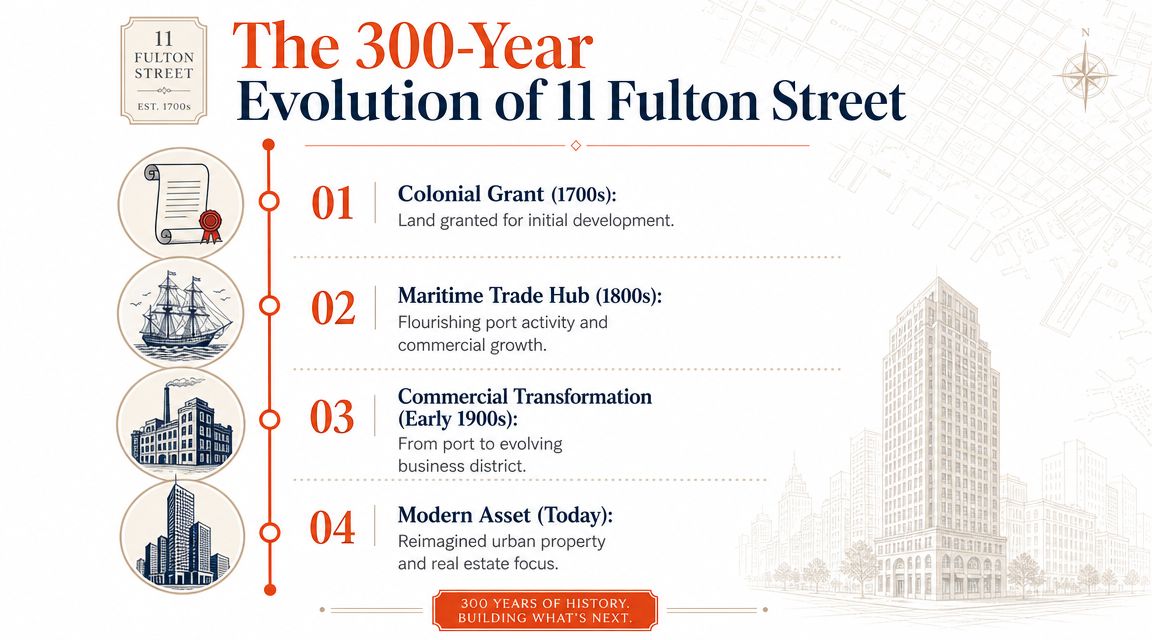
That distinction changes the marketing strategy.
A generic retail asset gets pitched on rent, frontage, and tenant roster. A Seaport asset with layered site history can be marketed as a durable commercial address that has kept finding new uses as the district changed around it. That is the stronger story, especially for investors and operators who care about staying power more than novelty.
How to use the history without sounding ornamental
Agents usually go wrong in one of two ways. They skip the history and reduce the asset to a current operator story, or they bury the listing in nostalgia and lose the business case.
The better route is to translate historical context into present-day commercial meaning:
| Historical layer | Marketing meaning today |
|---|---|
| Colonial-era site origins | The corridor has been commercially relevant for generations, which supports a scarcity and identity narrative. |
| Waterfront trade history | The location has long benefited from movement, visibility, and destination-oriented activity. |
| Seaport reinvention over time | The district has shown an unusual ability to absorb new retail, dining, entertainment, and mixed-use concepts. |
A listing package requires discipline. Historical material should support underwriting logic, tenanting logic, and brand positioning. It should not read like a walking tour.
For agents building that case, a tighter investment property analysis framework for mixed-use assets helps connect neighborhood history to present demand, future use options, and likely buyer objections.
The story that resonates with buyers
When buyers hear “historic Seaport location,” the serious ones are not just hearing charm. They are hearing constrained supply, recognizability, and a location identity that a newer corridor cannot reproduce on command.
That does not mean history adds value by itself. It means history strengthens the marketing narrative when it explains why this corridor keeps attracting commercial attention through changing formats and changing tenants. In practice, that gives a listing agent better raw material for digital marketing. The story is not that 11 Fulton is old. The story is that the address has remained usable, visible, and legible through multiple market eras.
A quick visual history can help anchor that message:
Buyers do not pay more for age alone. They pay more for a location story that supports demand, branding, and reuse potential.
For 11 fulton street nyc, that is the case study. The address has stayed commercially relevant long enough to support more than one future, and that is exactly how the marketing should frame it.
Asset Analysis The Building's Nuts and Bolts
Once you strip away the Seaport glow, the building record tells you what kind of leasing conversation you can realistically have.
Public building data shows the current building at 11 Fulton Street was constructed in 1983, has 3 floors, and is classified as a store building with multi-store occupancy on the building record for 11 Fulton Street. That points to a low-rise commercial asset built around retail logic, not a structure conceived as residential or office-first product.
What the building record implies
That classification matters more than casual readers think. In brokerage practice, “store building” usually signals a set of assumptions about circulation, frontage, tenant turnover, and utility planning. It also hints at the kinds of headaches that can appear when someone tries to force an incompatible use into the shell.
Here's the practical read:
- Ground-floor emphasis: The asset likely derives a lot of its leasing value from street presence and customer ingress rather than from upper-floor exclusivity.
- Operational flexibility: Multi-store occupancy can support varied commercial layouts, but only if demising, services, and life-safety planning line up with the proposed use.
- Repositioning friction: Not every flashy concept fits cleanly into an existing retail-configured shell.
Due diligence before you overpromise
If I were advising an agent on this address, I'd want the marketing team and the leasing team aligned before any polished campaign goes live. “Flexible commercial asset” is credible. “Works for anything” is not.
Check these early:
- Load assumptions by floor. Retail, entertainment, food service, and showroom users don't stress a building in the same way.
- Sprinkler and life-safety zoning. A space that looks easy on paper can become expensive once code-driven upgrades enter the picture.
- Storefront demising and entry conditions. A replacement user may need a different split between frontage, lobby, and back-of-house.
- MEP layout reality. Existing utility routing often decides whether a reuse plan is clever or dead on arrival.
For teams that need a tighter underwriting framework before crafting positioning, this kind of investment property analysis workflow can help organize what the base building supports versus what the story merely suggests.
Underwriting note: Don't market flexibility as a vibe. Market only the flexibility the shell can actually support.
What works and what doesn't
What works is using the building record to support a grounded repositioning narrative. Low-rise. Street-oriented. Commercially legible. Adaptable with verification.
What doesn't work is importing assumptions from trophy mixed-use towers or from purpose-built hospitality assets. This address needs disciplined framing. The shell may be versatile, but versatility only has value when you can map it to realistic user profiles.
The Seaport Micro-Market Location and Transit
A Seaport address can be overrated if the marketing stops at waterfront imagery. For 11 Fulton Street, the primary advantage is how the block converts access into usable demand.
The property sits within the Fulton transit cluster, which gives a listing agent a wider catchment than a typical destination-only venue. That matters because this is not a one-traffic-source location. The audience includes office users coming in from across Lower Manhattan, residents moving through the Financial District, and visitors already oriented to the waterfront and historic core.
Why the block matters more than the headline neighborhood
Agents often flatten the Seaport into a lifestyle label. That misses the operating reality of this corridor. Fulton Street functions as a connector between transit, daytime employment, tourism, and evening activity. For a commercial listing, that is far more useful than generic language about charm or foot traffic.
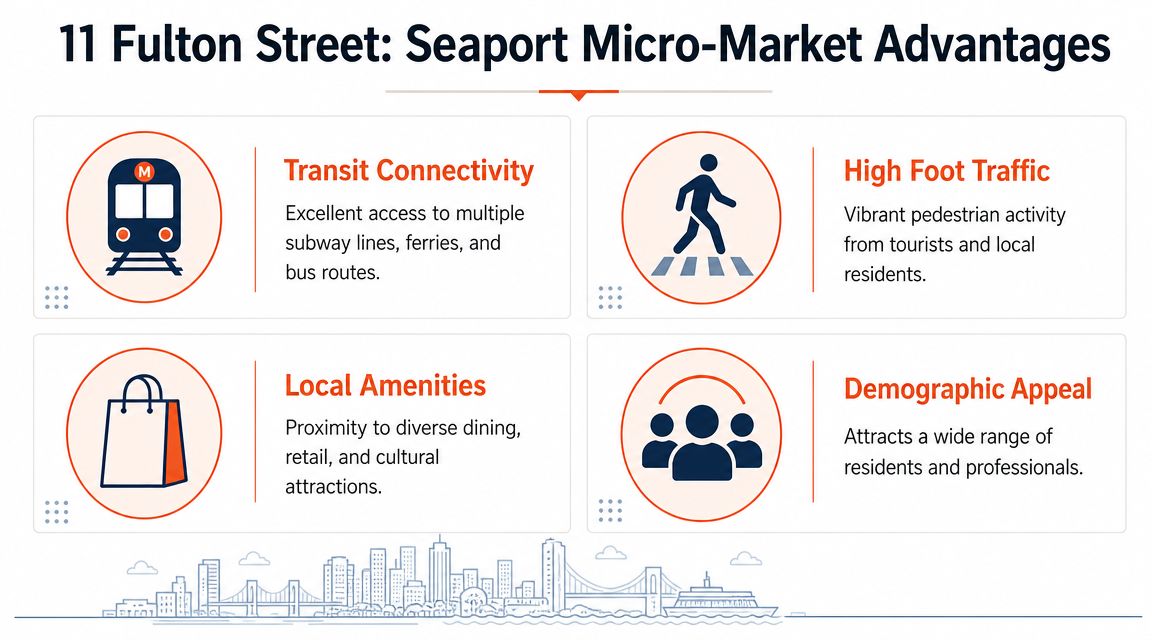
The practical takeaway is simple. Users here can draw from planned visits and incidental visits in the same daypart. That widens the pool for entertainment, food-driven concepts, showroom uses, and other occupiers that need more than convenience buying.
That also changes how the location should be marketed online.
A strong campaign should map transit access, neighboring demand generators, and likely customer paths, then turn that into listing copy, paid audience targeting, and comp-backed positioning. If an agent is building that argument at scale, an AI CMA workflow for MLS-based valuation support can help organize the location story around actual market evidence instead of broad Manhattan averages.
What the micro-market supports
This corridor works best for users who benefit from three conditions at once:
- Multi-source demand: commuters, local residents, and visitors can all reach the site without a car
- Longer dwell patterns: the surrounding environment supports pre-visit and post-visit spending, not just quick transactions
- Brand visibility with context: a tenant gets a recognizable district without relying on Times Square-style volume
There is a trade-off. The same mixed demand that helps an experiential or retail-forward use can make weak positioning more obvious. A generic listing gets lost here because prospects already know the neighborhood has options. The pitch needs to explain why this specific corridor placement improves leasing prospects, customer acquisition, or exit flexibility.
For valuation framing, that means tying location to income potential and replacement-user depth, not just prestige. This guide for real estate asset valuation is a useful reference point for that conversation.
The Seaport story at 11 Fulton Street is not just historic character or Manhattan density. It is a micro-market where transit access, visitor flow, and mixed daily demand can be translated into a sharper commercial narrative if the agent knows how to package it.
Market Position Sales Comps and Value Narrative
Pricing 11 Fulton Street starts with a simple reality. Buyers are not paying for a memorable address alone. They are pricing a mixed-use asset in a part of Lower Manhattan where branding power matters, but only if it converts into rent, demand depth, and future leasing options.
That changes the comp strategy.
A listing agent should build the value narrative around three questions. What uses fit the block today, what kinds of users can realistically replace the current occupant, and how much premium does this frontage command versus less visible space nearby? That is a different exercise from quoting a broad downtown average or pulling residential price-per-foot numbers that have little to do with street-level commercial performance.
The comp set that actually matters
For this asset, the right comparables usually share some mix of these traits:
| Lens | What to look for |
|---|---|
| Use profile | Retail, entertainment, food-and-beverage, or mixed-use commercial assets with customer-facing utility |
| Frontage and visibility | Properties where signage, corner presence, or destination appeal affect tenant demand |
| Re-tenanting potential | Assets that can support more than one operating concept without a full repositioning bet |
Agents either sharpen the story or weaken it. If the comp set includes generic office condos, back-street retail, or properties with completely different customer patterns, the pricing discussion loses credibility fast.
The stronger approach is to treat 11 Fulton as a case study in replacement value for a modern operator. The buyer is not just acquiring current income or a famous address. The buyer is acquiring a location that may support multiple revenue models over time, which matters more in a neighborhood still refining its identity.
If you need a refresher on the mechanics behind income, sales comparison, and cost approaches, this guide for real estate asset valuation is a useful baseline before you tailor the analysis to a special location like this.
What the value narrative should actually say
Clients do not need inflated language about prestige. They need a defendable explanation for why this property should trade above a weaker downtown alternative.
Use points like these:
- The address sits in a corridor where visibility and destination use have more leasing value than they do on a commodity side street.
- The asset has a broader replacement-user pool than a single-purpose box, which can support pricing resilience.
- The value case improves if a future tenant can capture both neighborhood traffic and intentional visits, rather than depending on one narrow customer source.
That last point matters. In this pocket of Manhattan, story only counts if it helps underwriting. Historic identity can support pricing, but only when it lowers vacancy risk, improves tenant quality, or gives a future operator a clearer customer acquisition angle.
For teams building opinion-of-value packages, a structured AI CMA workflow for commercial positioning can help organize the comp logic and narrative evidence in one place.
Where agents overreach
The weak pitch says the property is valuable because the address is known. Discerning buyers will discount that immediately, especially if tenant stability is part of the diligence conversation.
The better pitch is narrower and more credible. 11 Fulton sits in a corridor that has supported reinvention, branded tenancy, and destination use across multiple cycles. That does not make the asset easy to price. It does make the value story more durable if the analysis stays tied to frontage, use flexibility, and realistic replacement demand.
The AI-Powered Marketing Playbook for Listing Agents
At 11 Fulton, the marketing risk is not low awareness. It is lazy framing.
This listing will attract attention on name recognition alone. The job is to control interpretation. In this micro-market, prospects are not just buying square footage or frontage. They are underwriting a story about continuity, replacement demand, and whether the next use can win both online and on the block. That is why I would treat 11 Fulton as a case study in mixed-use positioning, not a standard availability campaign.
The first credibility test is simple. Address the tenant uncertainty in plain English. As noted earlier, the current operator's restructuring history creates diligence questions, and serious buyers will raise them early. Strong marketing materials acknowledge that issue, then shift the conversation to the parts of the asset that survive a tenant change. The building, the corridor, the use flexibility, and the destination behavior matter more than any single logo on the facade.
Five helpful moves

Start with the highest-conviction angle. Then show the trade-offs.
Lead with market fit, not brand residue.
The opening copy should present 11 Fulton as a Seaport mixed-use opportunity with visibility, flexible commercial utility, and a built-in destination setting. That frames the asset around what a future user can do there.Show believable replacement paths.
If prospects sense tenant instability, existing-condition photos alone will not carry the package. Add visual concepts for plausible next uses that fit the shell, the block, and local demand.Write for search intent, not brochure language.
People searching "11 fulton street nyc" usually want context that helps them judge fit. Access patterns, district constraints, visitor behavior, and frontage value outperform generic amenity copy.Handle the tenant question directly.
Do not dodge it, and do not overstate certainty. State what is known, then refocus on durable value drivers such as location identity, visibility, and alternate-user appeal.Build separate paths for separate buyers.
An investor package should not read like an owner-user package, and neither should mirror leasing outreach. Each audience needs its own risk framing, visuals, and call to action.
What the asset package should include
For a listing like this, the digital package needs to do underwriting work, not just branding work.
Include street-level photography that shows frontage, sightlines, neighboring activation, and how the building reads in motion. Add use-case visualizations that stay grounded in the actual envelope and neighborhood economics. Write modular copy blocks for investors, operators, and replacement tenants so the same listing can support different conversations without sounding recycled. Then layer in context slides that explain how Seaport visitation patterns support destination-oriented retail, entertainment, hospitality, or hybrid commercial use.
Agents building that system can borrow from broader workflows outlined in this AI guide for real estate agents. A practical example is Bounti Labs product workflows, which can help generate draft descriptions from a walkthrough, organize visual outputs, and speed up alternate marketing presentations. For a mixed-use asset with repositioning questions, that shortens production time and makes it easier to test more than one credible story.
What to avoid
Complicated assets expose weak marketing fast.
Avoid glossy copy that pretends there is no tenant-risk issue. Avoid overwritten language with no operating detail. Avoid one-size-fits-all outreach that ignores how differently an investor and an occupant read the same building. Avoid visuals that trap the property inside its current use, especially when the sale thesis depends on flexibility.
If the team needs a wider channel and campaign refresher, this digital marketing guide for real estate pros pairs well with a property-specific strategy.
Marketing test: If the package only works under a stay-the-course tenant scenario, it is not sufficient.
Weighing the Pros and Cons A Balanced Verdict
11 Fulton Street is the kind of address that rewards nuanced brokerage. It's easier to misprice, misframe, or oversimplify than a plain retail box. But it also gives a listing agent more story material and more strategic angles than most commercial properties do.
The upside is clear. The address sits in a recognized Seaport corridor with strong identity, layered commercial history, and transit-backed relevance. It has a current entertainment association that reinforces visibility, and the building profile supports the idea of a flexible low-rise commercial asset rather than a one-note format. For the right buyer or user, that combination can be compelling.
The friction is just as real. A tenant stability question changes how buyers underwrite continuity. The current use is high-profile, which helps branding, but high-profile uses can also distract from base-building realities and replacement costs. A historic district setting adds character, yet the surrounding environment can complicate access expectations, operations, and the way prospects interpret the asset.
The fast client-summary version
Pros
- Distinct location identity in the Seaport and Fulton corridor
- Strong narrative depth tied to a long commercial history
- Transit-rich context that supports mixed trip behavior
- Experience-oriented micro-market that fits destination users
- Commercial building typology that suggests practical reuse potential
Cons
- Occupancy risk tied to the primary tenant's bankruptcy filing
- Potential overreliance on one brand story if marketing is careless
- Need for sharper due diligence before pitching broad reuse claims
- Specialized buyer pool compared with simpler commodity assets
- Higher storytelling burden because the value case isn't self-explanatory
The balanced verdict is straightforward. 11 fulton street nyc is not a simple theater listing. It's a repositioning-sensitive, story-driven commercial asset in a rare Lower Manhattan pocket. Agents who present it as a branded venue will undersell it. Agents who present it as a corridor-driven asset with real trade-offs will sound more credible and usually attract better conversations.
Bounti Labs helps agents and property marketers turn complex spaces into clearer listing narratives with AI-generated descriptions, visuals, and alternate presentation concepts from a simple walkthrough. If you're marketing a mixed-use asset where the story matters as much as the shell, Bounti Labs is worth a look.