
You send a new listing email for a downtown luxury condo to your entire database. The photography is polished. The copy is clean. The property is strong.
And the campaign still underperforms.
The problem usually isn't the listing. It's the audience. First-time buyers looking for school districts don't care about rooftop amenities. Downsizers don't want to scroll through content written for investors. Relocation buyers may love the property, but not the assumptions built into the message.
That's why audience segmentation matters so much in real estate. It isn't a marketing buzzword. It's the difference between sending noise and sending something that feels useful to the person receiving it.
Stop Marketing to Everyone and Start Connecting with Someone
Broad marketing feels efficient because it's easy to launch. Pull one list, write one email, boost one ad, post one set of listing photos, and move on. In practice, that approach leaks deals.
The biggest leak is what I think of as the hidden cost of the wrong fit. You had a legitimate buyer in your database, but your message didn't match how that buyer thinks, shops, or imagines living in the property. That lead didn't object. They just disappeared.
A major real estate mistake is assuming all interested buyers respond to the same visuals. They don't. One in 3 real estate leads are lost because agents fail to match listing visuals to specific buyer psychographics, and a 2025 Circana study found that 68% of underserved buyers are overlooked because their niche preferences aren't reflected in broad marketing campaigns (Circana underserved consumer markets analysis).
What this looks like in the field
A property can appeal to several buyer groups at once, but each group needs a different entry point.
- Young family buyers want to see function, storage, safety, and flexibility.
- Remote professionals want to see work zones, lighting, and quiet.
- Investors want clean lines, condition, and rentable appeal.
- Downsizers want simplicity, accessibility, and low-maintenance living.
If you market one version of the home to everyone, you don't broaden appeal. You blur it.
Broad campaigns don't just waste impressions. They hide demand that was already there.
Why this matters more now
Buyers are overloaded. Every portal, feed, inbox, and ad platform is crowded. That means generic messaging gets filtered out fast. The agents who win attention aren't necessarily the loudest. They're the ones who make a listing feel immediately relevant to a very specific person.
That's the operating principle behind effective audience segmentation in real estate. Start with who the property is most likely to convert, then shape the message, visuals, and follow-up around that group first.
Why Segmentation Is a Non-Negotiable for Modern Agents
A lot of agents still treat segmentation like a “nice to have” for larger teams with bigger databases. That's backward. Smaller teams need it even more because they can't afford wasted effort.
If your database gets the same subject line, the same listing set, and the same follow-up cadence, you're not building a pipeline. You're creating avoidable drop-off. Relevance is what turns a contact into a conversation.
Historical campaign data made this clear years ago. Segmented campaigns achieved click-through rates 101% greater than non-segmented campaigns, based on DemandGen reporting cited widely across marketing analysis in that period. In real estate terms, that matters because more relevant clicks usually mean better listing traffic, not just more traffic.
Qualified attention beats broad attention
Every agent says they want more leads. Most, in fact, need better lead quality.
Segmentation helps in three ways:
It filters curiosity from intent
Someone clicking on content relevant to relocation, investment, or move-up buying is telling you more than someone clicking a generic “new listings” email.It sharpens your follow-up
A buyer browsing condos near transit needs a different conversation than a family comparing yard size and school zones.It improves your market positioning
Clients notice when your marketing feels specific. That makes you look less like a listing distributor and more like a strategist.
Where agents usually get this wrong
The common mistake is overvaluing activity and undervaluing fit. More sends, more posts, and more boosted ads can create the illusion of momentum. But if the message is too broad, all that work just produces softer inquiries.
Practical rule: If the same listing ad could reasonably be sent to every contact in your CRM, it's probably too generic to perform well.
There's also a listing-side advantage here. Sellers don't just want exposure. They want a convincing plan for reaching the right buyer. That's where segmentation becomes part of your value proposition, especially when you can explain how targeting buyer subsets changes the marketing itself.
For agents working investor or off-market pipelines, it's useful to uncover this buyer-first strategy because it aligns with the same principle. Start with the likely buyer profile and build backward from demand instead of pushing inventory blindly.
Busy agents stay active. Profitable agents stay relevant
That's the dividing line. Segmentation doesn't create more work when it's done correctly. It strips out wasted work.
You stop promoting every property to every person. You start matching the right listing, angle, and visual story to the subset most likely to respond. That's how a database starts producing closings instead of just impressions.
The 5 Core Types of Real Estate Audience Segments
Most agents start segmentation with demographics because that's the easiest data to see. It's also the weakest place to stop.
Age range, household status, and income band can help you sketch a market. They don't explain active intent. For that, you need behavioral and psychographic signals layered on top. That's where campaigns usually stop sounding generic and start feeling timely.
A useful working rule is simple: demographics tell you who someone may be, while behavior and psychographics tell you why they may act.
Real estate segmentation types compared
| Segmentation Type | What It Tracks | Real Estate Example |
|---|---|---|
| Demographic | Life stage, income band, household profile | First-time buyers, luxury households, retirees |
| Geographic | Location, neighborhood focus, commute pattern | Buyers targeting walkable urban cores or specific school zones |
| Psychographic | Values, lifestyle, taste, priorities | Eco-conscious buyers who care about sustainability, design-led buyers who prefer minimalist interiors |
| Behavioral | Digital actions and engagement patterns | Prospects repeatedly viewing townhomes, saving listings with home offices, clicking price-drop emails |
| Transactional | Prior purchase or inquiry history | Past condo owners, repeat investors, renters who previously inquired on purchase listings |
What each type is good for
Demographic segmentation is the starting point. It's useful for broad fit. A move-up family and a downsizer often won't respond to the same headline. But demographics alone often flatten real demand into rough categories.
Geographic segmentation matters more than many agents realize. Search behavior is local, and so is decision-making. Someone looking inside one school boundary can behave very differently from someone shopping the next town over, even at a similar price point.
Psychographic segmentation is where visual marketing starts getting powerful. Some buyers respond to prestige, others to practicality, others to calm, sustainability, or flexibility. Those are not minor creative choices. They change which rooms you highlight, how you stage them, and what language you use around the home.
Behavioral segmentation is often the strongest signal available to working agents. Saved searches, repeat opens, video watch behavior, clicks on style-specific listings, and return visits all tell you what the buyer is actively moving toward.
Transactional segmentation helps separate general interest from proven patterns. A repeat investor doesn't need the same nurturing sequence as a renter exploring ownership for the first time.
Where conversion lift actually comes from
Many real estate campaigns encounter a common hurdle. Agents build segments using easy fields from the CRM, then wonder why the results are modest.
The stronger lift comes from layering action-based signals with motivation. Dynamic segmentation using behavioral and psychographic data achieves a 20–30% lift in conversion rates, while static demographic segmentation yields only a 3–5% lift, according to the verified McKinsey analysis cited in the brief.
If you want better conversion, stop asking only who the lead is. Ask what the lead has been doing and what kind of life they're trying to build.
A practical way to combine them
Don't create segments like “women age 30 to 45” or “buyers over $800k.” Those are audience descriptions, not marketing strategies.
Build segments that combine at least three layers:
Identity layer
Household type, life stage, or likely budget bandIntent layer
Search behavior, repeat listing views, open patterns, showing requestsPreference layer
Style cues, neighborhood priorities, commute needs, layout preferences
That's how you get a segment like “move-up family buyers viewing larger homes in top school zones and responding to bright, staged family spaces.” That segment gives you direction. It tells you what to say, what to show, and who should receive it.
A Practical Guide to Building Your First Segments
Most agents already have enough data to build workable segments. They just haven't organized it with a clear purpose.
Start small. One or two useful segments will outperform a giant spreadsheet full of labels you never use. The point isn't to create a complex taxonomy. The point is to create audiences you can market to differently.
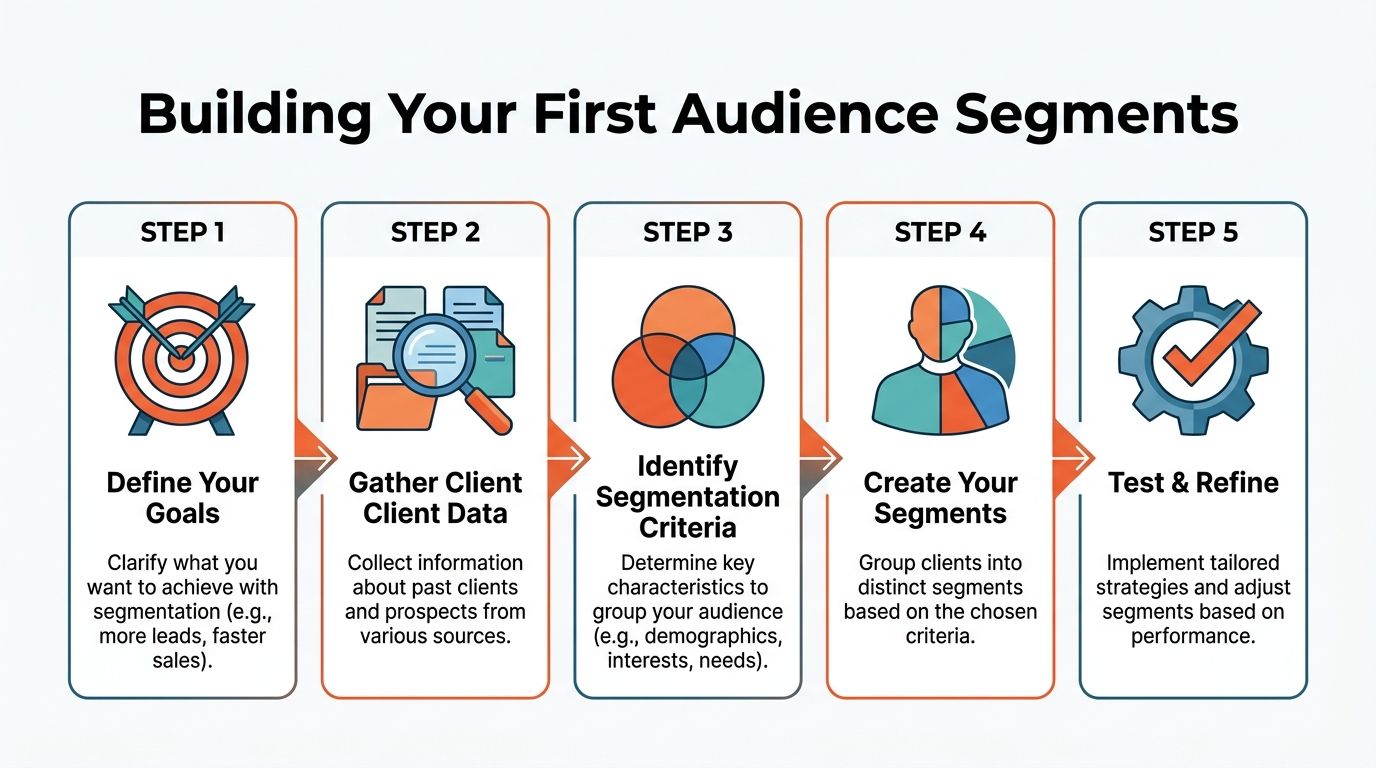
Step 1 and Step 2 start with your existing records
Pull data from the places you already work in every week:
- Your CRM for tags, source notes, inquiry history, saved searches, and email engagement
- MLS records for patterns in past transactions, property types, neighborhoods, and price bands
- Social media interactions for style preferences, content themes, and repeated engagement topics
- Website analytics for listing visits, return behavior, and lead magnet response
If you need a stack that supports this workflow, review these real estate marketing tools for agents and teams and compare them based on whether they help you act on segment data, not just collect it.
Step 3 is where agents usually get too broad
A lot of segmentation fails because the categories are lazy. “Homebuyer” is not a segment. Neither is “seller.”
That weakness shows up in results. 74% of behavioral segmentation failures in real estate stem from using broad homebuyer categories, according to the Matomo reference in the brief. The fix is to build smaller, intent-based groups and validate them before committing budget or creative effort (Matomo audience segmentation guide).
A better segment sounds like this:
- relocation buyers seeking turnkey homes near commuter routes
- move-up families responding to larger kitchens and yard-focused imagery
- investors clicking consistently on low-maintenance multifamily inventory
- downsizers showing interest in single-level living and minimal renovation needs
Step 4 uses a simple validation framework
You don't need a data scientist to validate a segment. You need a repeatable test.
Use a basic three-part check:
Search signal
Use Google Trends to see whether the theme connected to your segment has real local interest. You're not looking for perfection. You're looking for evidence that people are actively exploring the topic.Listing behavior signal
Review MLS photo sets, save behavior, and inquiry patterns. Do certain visual styles, layouts, or neighborhoods repeatedly attract the same type of buyer?Message response signal
Send a small test. One email variation, one landing page variation, or one ad variation aimed at that segment is enough to tell you whether the audience responds differently.
A segment is viable when you can identify it, reach it, and see a distinct response from it.
This walkthrough is useful if you want to see a practical breakdown before building your own workflow:
Step 5 is refinement, not perfection
Your first segment won't be perfect, and that's fine. Real estate segmentation improves through use.
Rename weak segments. Drop categories that don't produce different behavior. Split broad groups when you notice clear preference differences. The agents who get good at audience segmentation don't start with a perfect model. They start with one sharp audience and improve from there.
From Segments to Sales with Tailored Visuals
Most real estate marketing advice stops at messaging. That leaves out the part buyers react to fastest, which is the visual story.
A segmented audience shouldn't just receive different words. It should see a different version of the property's potential. Many agents consequently leave money on the table. They identify a buyer type, then send the same photo set to everyone anyway.
The same room can sell different futures
Take a spare bedroom.
To a move-up family, that room might work best as a nursery or kid's room. To a remote professional, the winning version is a sharp office with clean lighting and a video-call-ready backdrop. To an investor, the better visual may be a neutral, decluttered room that signals flexibility and low turn cost.
None of those audiences are wrong. But they won't all respond to the same image.
That's why segmented visual marketing works so well in real estate. It translates audience insight into something a buyer can grasp instantly.
Match the visual to the motive
Use this framework when deciding how to adapt property visuals:
If the segment values family function
Highlight storage, play areas, breakfast nooks, mudroom utility, and secondary bedrooms with obvious purpose.If the segment values status or design
Focus on finishes, lighting, entertaining spaces, premium appliances, and architectural detail.If the segment values simplicity
Show decluttered rooms, low-maintenance surfaces, accessible layouts, and calm, neutral styling.If the segment values productivity
Emphasize dedicated workspaces, natural light, acoustically calmer rooms, and flexible bonus areas.
This is also where your listing content should support the same angle across channels. If you're building segmented creatives for social distribution, these real estate social media marketing tactics can help you adapt visuals and copy without turning every post into a one-off project.
What works and what doesn't
What works is creating a few distinct visual directions tied to specific audience motivations.
What doesn't work is trying to please everyone in one asset set. You end up with generic staging, bland captions, and listing materials that feel polished but forgettable.
Buyers respond faster when the visual tells them how the home fits their life, not just what the room looks like.
A practical production approach is to create one core asset set from the property, then develop segment-specific variations for the top audience groups you identified earlier. That could mean one version optimized for families, one for remote workers, and one for investors. The listing hasn't changed. The context has.
That's how audience segmentation stops being a CRM exercise and starts driving actual buyer action.
Measuring What Matters KPIs for Segmentation Success
If you can't measure segmentation at the segment level, you're guessing.
Too many agents judge performance by surface metrics. Likes, reach, and even total clicks can be useful directional signals, but they don't prove business impact. The only numbers worth defending are the ones tied to pipeline quality, conversion movement, and client value.
One reason to take this seriously is the revenue upside. Segmented email campaigns can generate a 760% increase in revenue, based on the ANA and Analysis Group benchmark cited in the brief. That's the clearest reminder that personalization is not a cosmetic improvement. It can materially change financial performance.
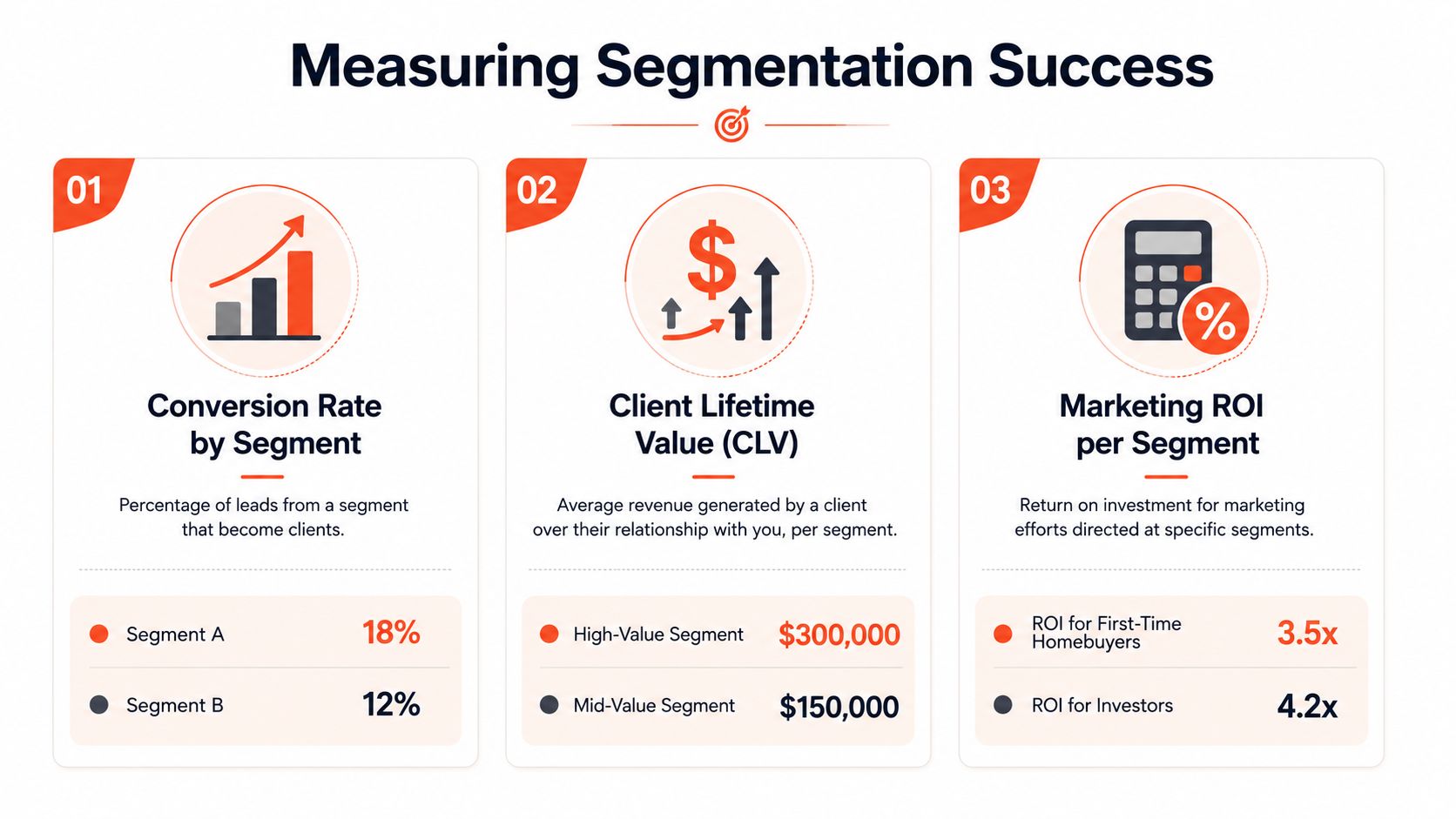
The KPIs that actually help agents
Track these by segment, not just across the whole campaign:
Lead-to-showing ratio
Which audience books the next step after engaging?Showing-to-offer pattern
Which segment moves from interest to action with the least friction?Time on market for segment-led campaigns
Are listings marketed with a sharper audience angle moving faster than similar listings marketed generically?Average inquiry quality
Are you attracting better-fit buyers, fewer tire-kickers, and more serious conversations?Repeat engagement by audience
Which segments keep returning to similar inventory, opening related emails, or interacting with the same property style?
A simple reporting structure for teams
If you're a brokerage leader or marketing coordinator, use a lightweight monthly scorecard.
| KPI | What to compare | Why it matters |
|---|---|---|
| Conversion by segment | Inquiry to showing, showing to offer | Reveals where real buyer intent exists |
| Engagement depth | Repeat opens, listing revisits, content interaction | Shows whether the audience angle is resonating |
| Revenue contribution | Closed deals tied to segment-led campaigns | Connects marketing effort to business outcome |
If you're building a system around follow-up quality, context retention matters too. Tools that support AI client context memory for real estate agents can help teams preserve what each segment cares about between touchpoints.
What to stop measuring first
Stop leading with vanity metrics in seller updates.
Sellers care about movement toward a buyer, not whether a carousel post collected reactions. If segmentation is working, you should be able to explain that a specific buyer cohort engaged, booked, returned, or offered at a higher rate than a broad campaign usually produces.
That makes your reporting more credible, and it makes your marketing easier to justify.
Put Your Segmentation Plan into Action Today
You don't need a massive database or a marketing department to make audience segmentation work. You need one property, one audience, and one clear angle.
Pick a segment that already exists in your market. Move-up families. Remote professionals. Downsizers. Investors. Then build one version of your marketing around how that group buys. Change the visuals. Change the copy. Change the follow-up. Keep the test tight enough that you can learn from it quickly.
If local paid traffic is part of your mix, studying focused local Google Ads strategies can help you align search intent with the same segmented messaging you're using in email, listing pages, and social campaigns.
Start there. Don't wait for perfect data.
The agents who gain the edge aren't the ones sending the most marketing. They're the ones making each listing feel more relevant to the right buyer. That's what gets attention, appointments, and closings.
Bounti Labs helps agents turn segmentation into usable marketing assets fast. With Bounti Labs, you can start from a single video walkthrough and generate listing descriptions, stills, MLS-ready photos, and AI-enhanced visuals that fit different buyer angles without slow manual production. If you want your marketing to feel more relevant without adding more busywork, it's a practical place to start.