Highly walkable neighborhoods don't just feel attractive. In housing-market research summarized by the University of Florida, they commanded an average sales-price premium of 23.5%, or about $77,668 more than comparable car-dependent areas, according to the EPA's National Walkability Index methodology guide.
That number changes the conversation. Walkability scores aren't decorative listing details. They're market evidence. For agents, that makes them useful in three places that matter: pricing, positioning, and persuasion.
Most agents still treat location language too loosely. They say “close to everything,” “great neighborhood,” or “convenient access.” Buyers hear marketing copy. A walkability score gives you a standardized way to translate convenience into something more defensible, more specific, and easier to compare across listings.
Why Walkability Scores Are Your New Secret Weapon
The strongest use of walkability scores isn't as a badge. It's as a negotiation tool.
When a seller wants to push price, you need evidence that extends beyond finishes and square footage. When a buyer questions value, you need a way to explain why one block trades differently from another. Walkability gives you a language for that. It connects a property to nearby daily-use amenities, mobility patterns, and neighborhood form in a way that feels tangible to clients.
Walkability turns “location” into a measurable asset
Agents talk about location constantly, but location often gets presented as intuition. Walkability scores narrow that fuzziness. They let you show that convenience isn't just aesthetic. It has structure.
That matters because buyers don't purchase a home in isolation. They buy access. Access to coffee, groceries, parks, restaurants, errands, transit, and a street network that makes those trips practical. A score packages that access into a format clients can grasp quickly.
Practical rule: If a feature changes daily life, it can influence value. Walkability changes daily life more often than a quartz countertop.
Why top agents use it differently
Average agents mention walkability when the score is high. Stronger agents use it no matter what the score says.
A high score can support a premium narrative. A middle score can support a balanced lifestyle narrative. A lower score can sharpen a different value proposition around privacy, space, and destination access by car. The strategic edge isn't having a perfect number. It's knowing how to frame the number the property has.
Walkability scores also help in comparative market analysis. If two homes look similar on paper but one sits in a more amenity-rich, connected area, that difference needs to show up somewhere in your pricing logic and showing script. Without that context, you risk under-explaining the premium or overpromising on a weaker location.
The competitive advantage is credibility
Clients are overloaded with opinion. They respond to agents who can interpret data without sounding robotic. Walkability scores work well because they're easy to understand and naturally tied to lifestyle.
Used correctly, they do three jobs at once:
- Support pricing conversations by tying a listing to an attribute that buyers already recognize.
- Improve listing copy because “short walk to daily essentials” lands better when it's backed by a known metric.
- Clarify fit for buyers whose routines depend on convenience, flexibility, or reduced driving.
Many agents leave value on the table. They mention the number, but they don't explain what the number means for the buyer's actual week. That interpretation is where commissions are won.
How Walkability Scores Are Calculated
Walkability scores compress a messy location question into a single number from 0 to 100: how efficiently can someone handle daily errands on foot from this address? The best-known version, Walk Score, calculates that number by measuring walking routes to nearby amenities, weighting destinations by category and distance, and giving the strongest credit to places within roughly a quarter-mile, with declining value out to about 1.5 miles, according to the Walk Score methodology.
For agents, the important point is methodological, not philosophical. A walkability score measures functional access. It does not measure architectural charm, curb appeal, or whether a block feels lively at 7 p.m.
The score is mostly about access, not aesthetics
That distinction prevents bad pricing arguments.
A pretty street can score poorly if daily necessities are spread out. An ordinary-looking corridor can score well if groceries, coffee, parks, pharmacies, and schools sit within short walking distance on connected streets. Buyers often blur those ideas together. Agents should not. The score is strongest when you present it as a location-efficiency metric tied to routine behavior.
What goes into the calculation
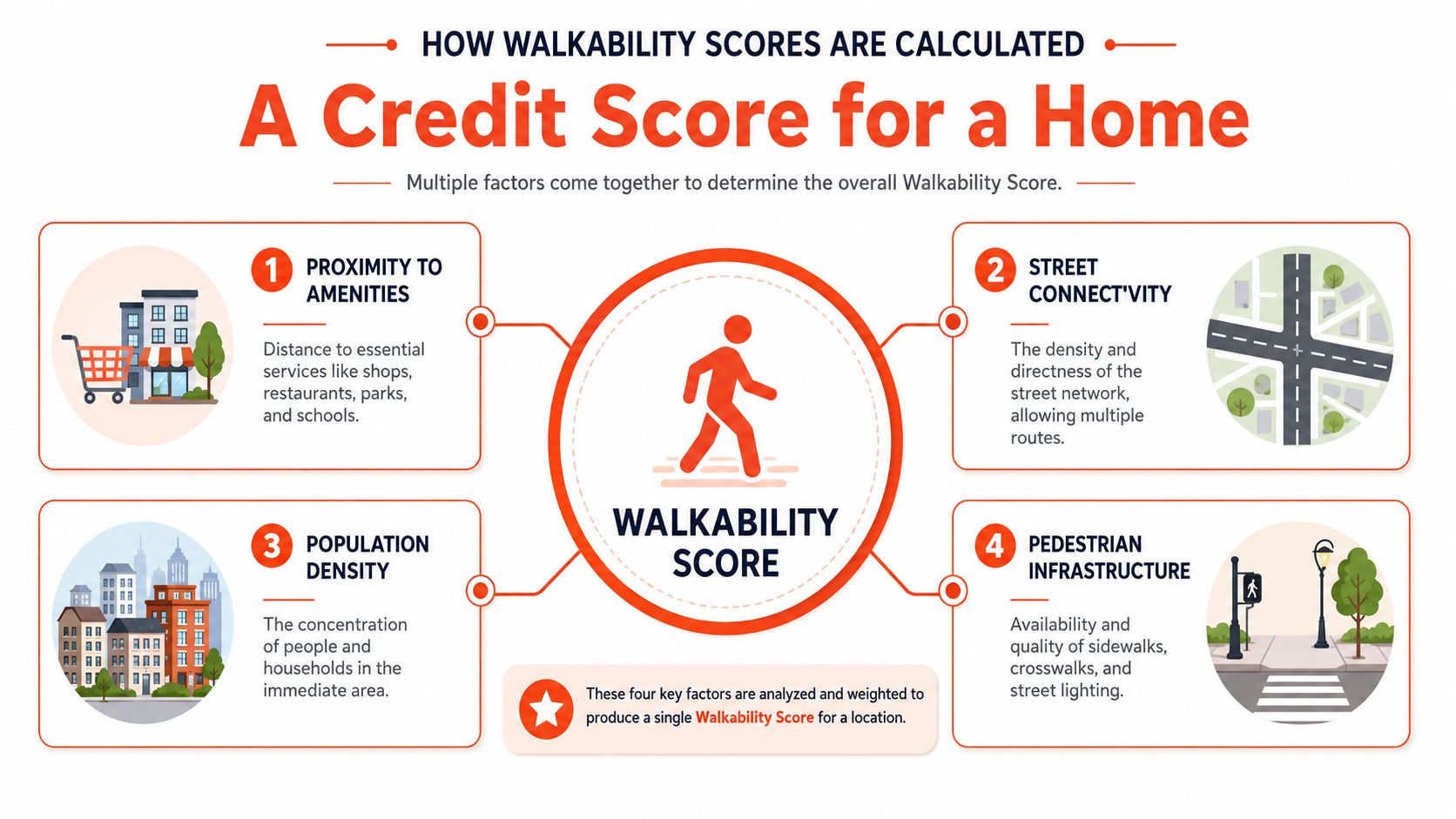
Most walkability systems use the same basic ingredients, even if the exact formula differs:
- Amenity mix: Nearby grocery stores, restaurants, parks, schools, and similar destinations matter because they support recurring trips, not one-off outings.
- Distance decay: Closer destinations carry more weight. A market three blocks away affects behavior differently than one a mile away.
- Route efficiency: Street networks with shorter blocks and more intersections usually produce more direct walking paths than loops, cul-de-sacs, and barriers do.
- Pedestrian conditions: Some scoring systems also adjust for built-form traits such as block length and intersection patterns, which shape how practical the walk is.
That last point matters in valuation work. Two homes can sit the same straight-line distance from a grocery store, but the one with a connected street grid often functions better in real life. That is one reason location analysis should sit alongside any AI-powered CMA workflow for comparative market analysis, rather than being treated as a throwaway listing detail.
Why methodology matters in client conversations
You do not need to quote formulas in a listing presentation. You do need to explain the number accurately enough that buyers and sellers trust your interpretation.
A walkability score is narrow by design. It captures convenience and connectivity. It does not cover school quality, noise, safety perceptions, lot privacy, or street character. That limitation is useful because it lets you isolate one part of location value instead of stuffing every neighborhood trait into one vague claim.
That also makes the score easier to pair with broader pricing logic. If you are building a value case, use the score as one input inside a larger framework such as PropLab's valuation methods guide, not as a substitute for full market analysis.
How to explain the scale without overselling it
Keep the script tight. Higher scores generally mean more daily destinations can be reached on foot, with less effort and fewer car trips. Lower scores usually mean buyers will rely more on driving, trip planning, or destination clustering.
The practical advice is simple. Treat the score as directional, not surgical. A 78 tells a buyer something useful about routine convenience. It does not guarantee every route feels pleasant, safe, shaded, or stroller-friendly. Strong agents translate the metric into likely weekly behavior, then verify it against the buyer's actual needs and the streets around the property.
Connecting Walkability to Property Value and Buyer Demand
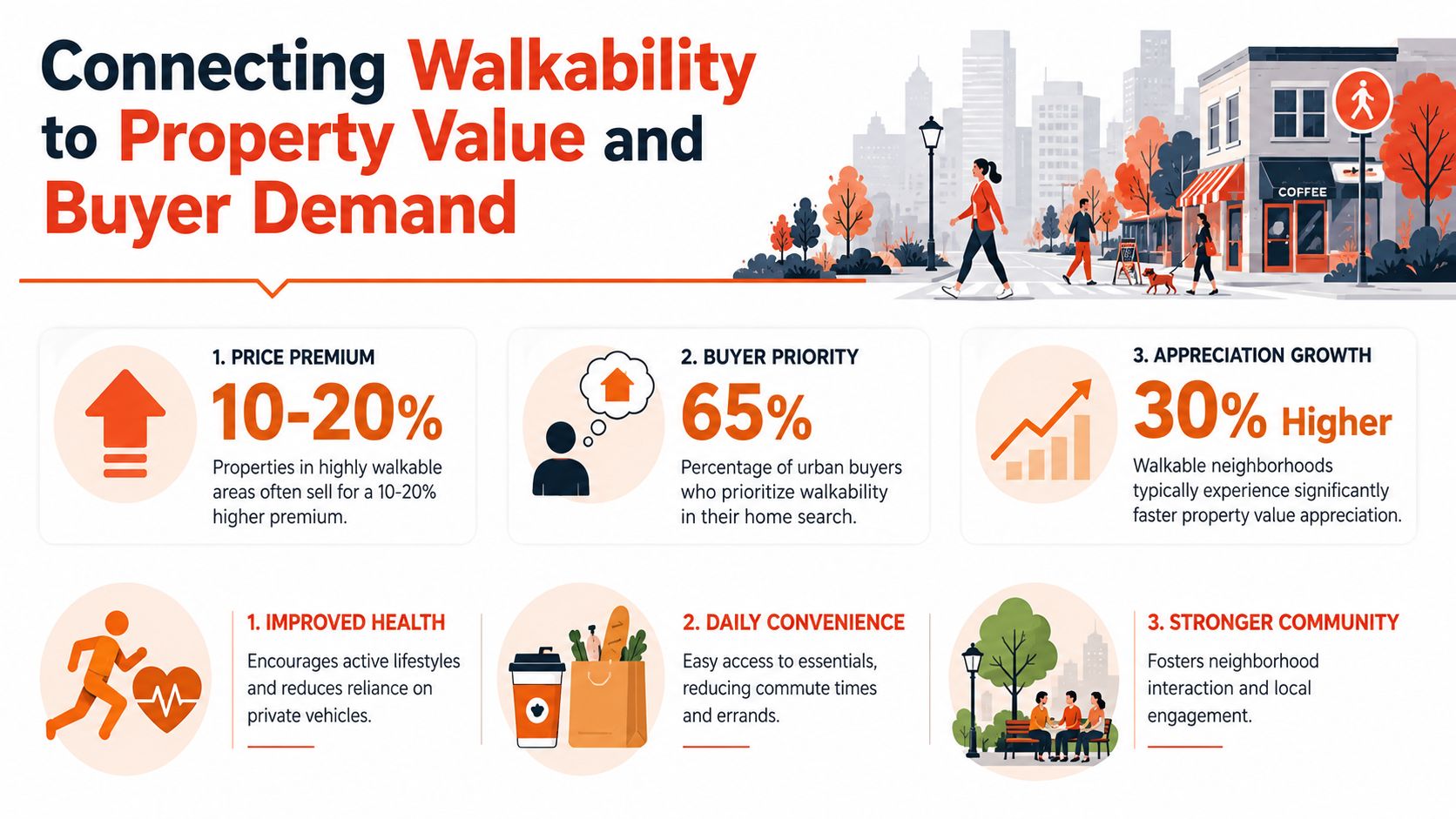
A useful walkability score does more than summarize nearby errands. It acts as a proxy for a broader urban pattern that many buyers find desirable.
Academic research found that Walk Score correlated strongly with objective built-environment measures, including intersection density (0.81), street density (0.74), residential density (0.76), and transit access (0.52), according to a published validation study in the NIH archive. That's why the score tends to align with places that feel connected, active, and efficient to live in.
Why buyers pay for it
Most buyers aren't shopping for a score. They're shopping for a routine that feels easier.
Walkability often signals fewer friction points in everyday life. It can mean grabbing essentials without planning a car trip, meeting friends nearby, combining errands into one outing, or having more than one route through the neighborhood. Those benefits are practical, but they're also emotional. Buyers read them as flexibility, energy, and independence.
That helps explain why walkability can support price. The premium isn't just for nearby storefronts. It's for a style of living that many people consider efficient and desirable.
How to connect the score to valuation work
Agents should treat walkability as one layer in a broader pricing framework, not a standalone answer. If you're building out your valuation logic, PropLab's valuation methods guide is a useful reference for how professionals weigh multiple approaches rather than relying on a single metric.
In practice, the score becomes more powerful when paired with your CMA process. If you're refining comps, adjusting for location nuance, or trying to explain why superficially similar listings diverge, tools that systematize analysis can help. That's where AI CMA automation for comparative market analysis becomes relevant. It can help agents structure the pricing conversation around evidence instead of instinct.
Demand isn't uniform, and that's the opportunity
The best agents don't present walkability as universally good in the same way for every client. They match it to motives.
A buyer who wants a car-light weekday values one thing. A household that wants quick access to neighborhood amenities plus a manageable commute values another. An investor may care more about how a connected urban form supports sustained demand than about lifestyle language itself.
Here's the strategic point: walkability is often a shorthand for functional urban quality. When you present it that way, you stop treating the score as a gimmick and start using it as evidence for buyer fit and price resilience.
Don't pitch the number first. Pitch the routine the number makes possible.
The Agent Playbook Finding and Presenting Walkability Data
Buyers rarely pay more for a number they do not understand. They pay more for a routine they can picture and defend.
That is why the agent workflow matters more than the score itself. If walkability data sits in your notes, it has no pricing power. If it shows up in your CMA narrative, listing copy, showing script, and follow-up, it becomes usable evidence.
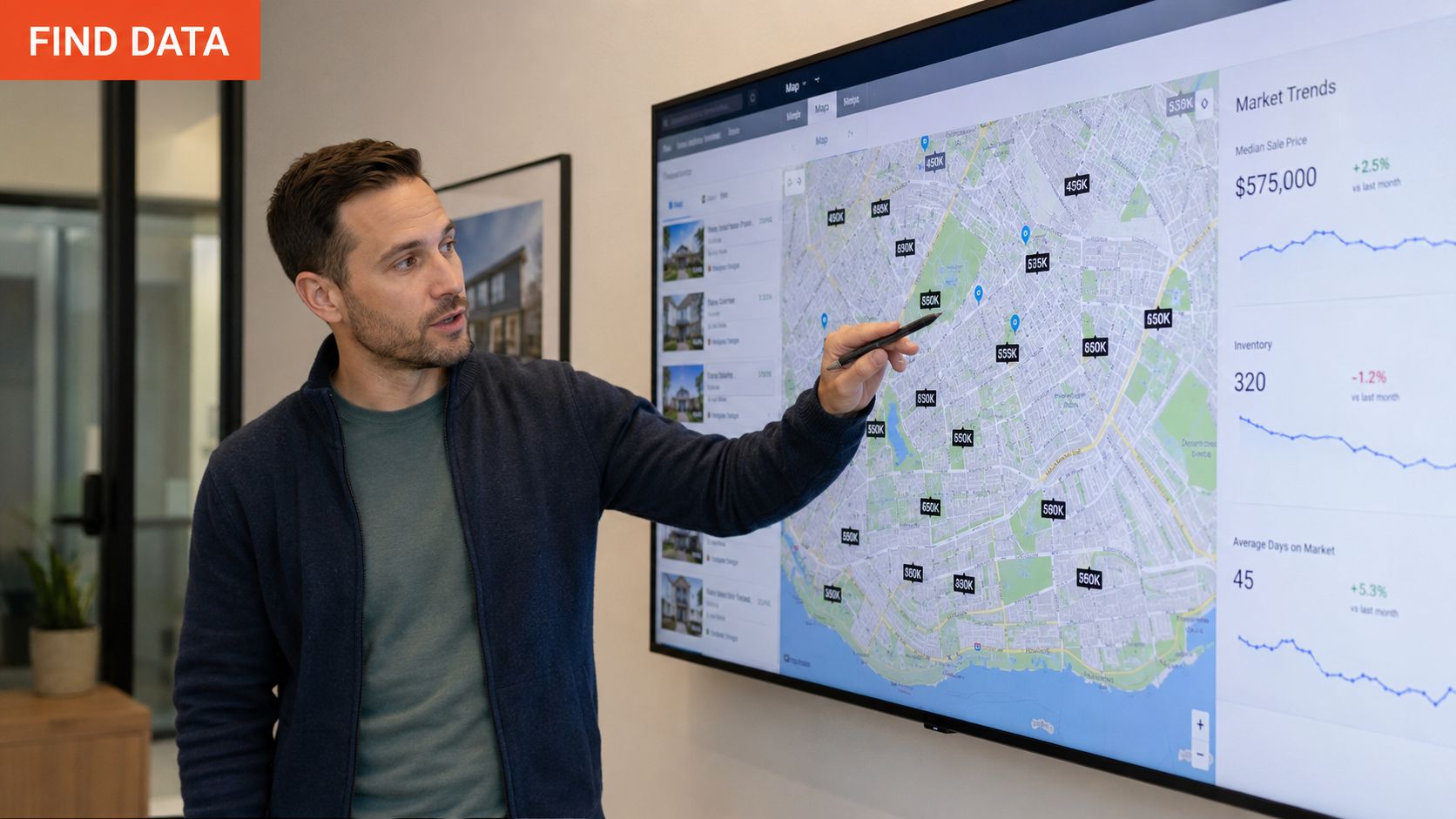
Start with a repeatable collection process
Treat walkability like any other location input you would verify before pricing. Pull it early, log it the same way for every listing, and pair it with the amenities that matter to the likely buyer pool.
A practical intake routine looks like this:
- Pull the address-level score before writing remarks. Positioning should follow the location pattern, not the other way around.
- Check how major portals display location context. If buyers will see walkability-related data on third-party sites, your description should explain what that number means for this specific home.
- Map the actual amenity set within walking distance. Buyers respond to named destinations and realistic routes, not abstract claims about convenience.
- Note the property type and buyer profile. A condo for a first-time buyer, a townhouse for a downsizer, and a suburban single-family listing need different walkability narratives even at the same score.
Agents often stop at step one. That leaves value on the table.
Turn the number into listing language buyers can use
Strong listing copy translates the metric into decisions, time savings, and lifestyle fit.
Use the score to frame daily patterns:
- High score: focus on errands, dining, parks, and a car-light routine.
- Mid-range score: highlight selected conveniences nearby and the tradeoff between access and quieter residential feel.
- Lower score: be direct about limited walk access, then shift to the location strengths that matter more, such as privacy, school pickup efficiency, lot size, or road connectivity.
If you want those location advantages to show up clearly in the public remarks and feature hierarchy, use MLS listing optimization tactics to tighten the headline, summary, and amenity wording.
Specificity wins here. “Coffee shop, pharmacy, and neighborhood park within reach” is more persuasive than “great location.”
Build a one-page lifestyle sheet
A short handout gives agents a cleaner way to present location value without drifting into vague neighborhood hype. It also helps during listing appointments, where sellers need proof that your marketing plan is more disciplined than a standard portal upload.
Keep the sheet visual and practical. Include the score, a simple map, and a short list of destinations grouped by use case:
- Daily essentials: grocery, pharmacy, coffee, bank, daycare
- Weekend patterns: parks, trails, dining clusters, retail streets
- Mobility context: realistic walking use for many trips, some trips, or occasional trips only
This format does two jobs at once. It sharpens the buyer story, and it gives sellers a clearer explanation for why your pricing and marketing angle differs from the house down the street.
Bring walkability into the showing conversation
Walkability has the most influence when tied to the buyer's existing habits. Ask questions that reveal whether the score supports the way they already live.
Do they want to walk to coffee on weekends? Would they use nearby grocery access midweek? Are they relocating from a denser area and likely to feel the difference immediately? Those answers tell you whether walkability should be a lead selling point, a secondary benefit, or a non-factor.
Use that information in follow-up. A short note that connects the home to the buyer's routine feels analytical and personalized, which is exactly what builds trust in pricing conversations later.
Here's a practical explainer you can use in training or client education:
Where agents lose the advantage
The common failure is not bad data collection. It is weak presentation. Agents gather the score, then bury it in the footer of a brochure or mention it once in passing.
A better operating model is to place walkability where it can influence perception:
| Placement | What to do |
|---|---|
| MLS remarks | Tie the score to specific routines and named nearby destinations. |
| Brochure or feature sheet | Pair the metric with a map and practical walking context. |
| Social posts | Use location convenience to tell a neighborhood story that supports demand. |
| Showing script | Match the location profile to the buyer's transportation habits and priorities. |
| Seller presentation | Explain how walkability supports positioning, buyer targeting, and possible price premium arguments. |
That last row matters. Sellers often assume location sells itself. The sharper strategy is to show them how you convert location data into a stronger value story than competing listings.
Marketing Walkability From Paradise to Car-Dependent
A weak strategy says only high-scoring homes deserve a walkability story. A strong strategy recognizes that every location needs a coherent narrative.
In New York City, a city-level walkability analysis found significant borough-level variation, showing that “walkable” is not a single universal condition even within one major market, as discussed in this Planetizen opinion analysis on walkability variation and interpretation. That's the deeper lesson for agents everywhere. Walkability is local, contextual, and relative to the buyer's routine.
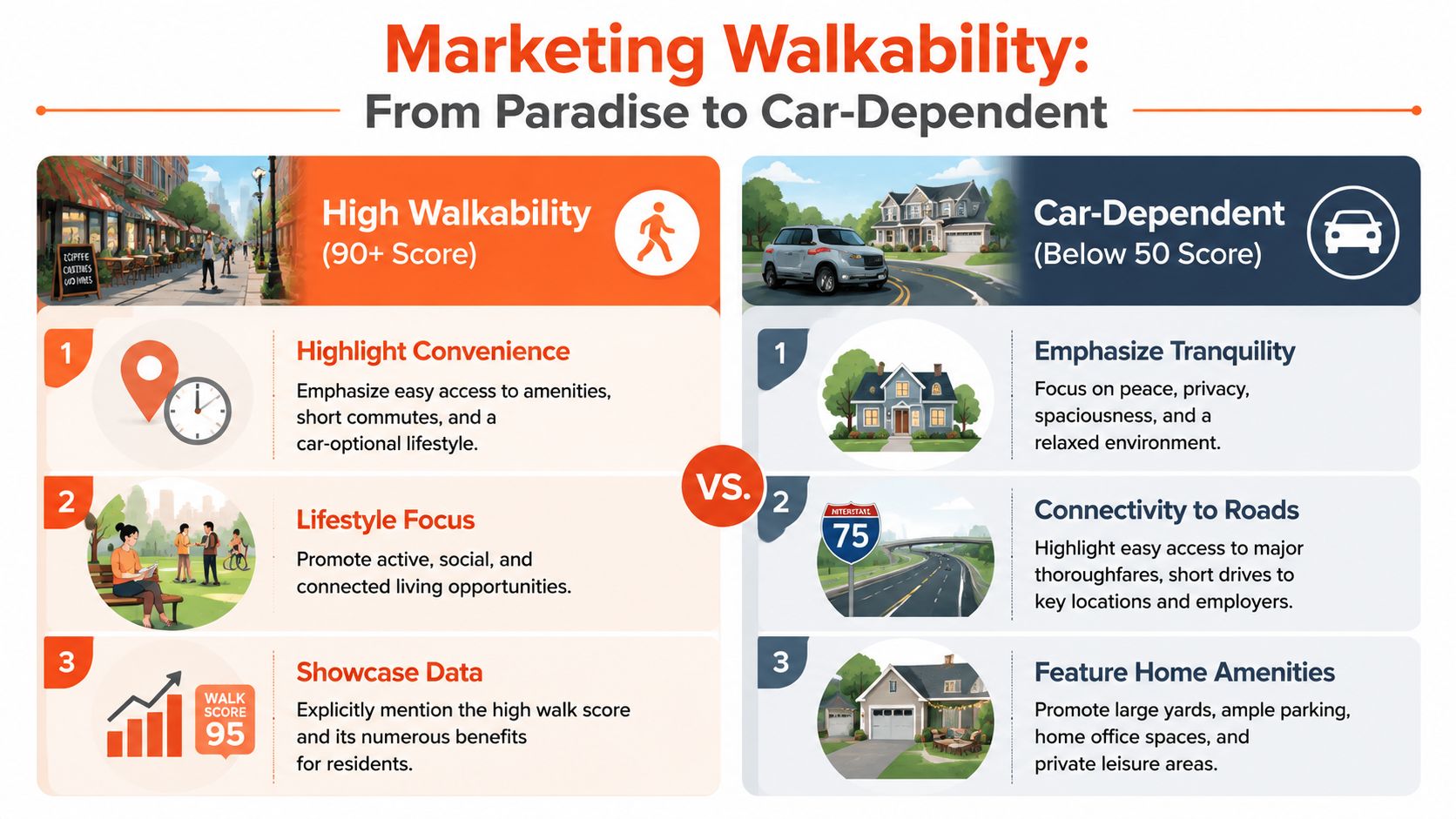
High score listings need sensory copy plus proof
If the score is strong, don't waste it on a throwaway line. Build the listing around rhythm and access.
Try language like this:
“Live within easy reach of dining, parks, and daily essentials, with a location that supports a more flexible, car-optional routine.”
That works because it blends measurable convenience with identity. Buyers don't just hear “many amenities.” They hear a way of living that feels current and efficient.
Middle score listings need specificity
Mid-range locations often get marketed poorly because agents either undersell them or pretend they're ultra-walkable. Neither works.
Instead, define the pattern accurately. Maybe the home offers a short stroll to a few regular stops, with broader retail and dining a quick drive away. That's a valid position. It appeals to buyers who want some convenience without full urban intensity.
A good social caption strategy helps here. If you're looking to translate neighborhood strengths into channel-ready content, these real estate social media marketing ideas can help you turn a location story into posts that feel concrete instead of generic.
Lower score listings need a different value frame
Don't fight the score. Reframe the strengths.
For a car-dependent property, the pitch usually shifts toward what the location gives the buyer in exchange for reduced walkability:
- More privacy: Less foot traffic, quieter streets, or more separation from commercial activity.
- More space: Larger lots, bigger garages, dedicated home offices, or stronger indoor-outdoor living.
- Targeted access: Straightforward drives to employers, retail hubs, schools, or recreation.
This isn't spin if it's true. It's segmentation. Some buyers want to walk to brunch. Others want a backyard, storage, and a smoother drive pattern. Good agents know those are different products.
The score doesn't decide the story. It tells you which story has the highest credibility.
Match the copy to the market, not the metric alone
A high score in one city doesn't mean the same thing as a high score in another. Even within a single metro, expectations differ by submarket. That's why generic walkability language underperforms.
Your copy should answer three questions:
- What can a resident realistically do on foot here?
- What tradeoff comes with that location?
- Which buyer is most likely to value that balance?
When you answer those well, walkability stops being a static data point and becomes a positioning asset.
The Future of Location Value Is on Foot
Walkability scores matter because they compress a messy concept into something agents can use. Not perfectly, but usefully. They give structure to location value, and that makes them more practical than broad claims about convenience or neighborhood feel.
The advantage isn't just knowing the score exists. It's knowing how to interpret it without oversimplifying it. A strong score can support premium pricing and a lifestyle-forward narrative. A middling score can clarify balance. A low score can sharpen a different pitch built around space, calm, and destination access by car.
Agents who use walkability well tend to do one thing better than everyone else. They connect data to the buyer's actual routine. That's why the metric works in listing presentations, pricing conversations, social content, showings, and follow-up.
Pull the walkability score for your current listing. Then ask a harder question than “Is this good?” Ask what that number says about the buyer's week, what tradeoffs it signals, and how it should change your pricing language. That's where the edge is.
Bounti Labs helps agents turn listing assets into sharper marketing, faster. With a single video walkthrough, Bounti Labs can generate property descriptions, pull stills, create MLS-ready photos, and transform rooms with AI-powered decluttering, staging, restyling, or renovation concepts. If you want stronger visuals and more persuasive marketing materials without slow manual production, it's worth a look.