Nearly every home search now starts online. That should settle your media plan fast. If your ad for real estate agent growth still relies on postcard logic, generic listing copy, and one polished exterior photo, you are paying for attention you do not convert.
The agents winning in 2026 build ads for the way buyers browse on phones. Fast visuals. Clear positioning. Immediate next steps. They make the property easy to understand and the agent easy to trust in seconds, not minutes.
This guide is not a swipe file. It is a working playbook. Each ad format below explains why it works, where it fits, what to say, how to target it, and how to produce it faster with AI tools such as Bounti. The goal is simple: give you repeatable ad systems you can run this week, then improve with real response data.
1. Property Showcase Video Ad with AI-Generated Description
Video earns attention faster than any static listing asset. Buyers can judge layout, light, room flow, and finish quality in seconds. That speed matters because weak first impressions kill response before your copy ever gets read.
A property showcase video ad should do two jobs at once. It should sell the home and generate the raw material for every other channel you use. Record one clean walkthrough, then use that footage to produce the ad, pull still frames, and draft the property description. Bounti helps agents turn a single video into usable listing copy and creative assets, which cuts production time and keeps the message consistent across MLS remarks, paid social, and email.
What this ad looks like
Keep the edit short. Fifteen to thirty seconds is enough for a paid social cut. Start with the strongest visual proof that the home deserves attention, then move through the rooms that drive decisions, and finish with the feature that gets the inquiry.
The sequence matters more than fancy editing. Use this order:
- Hook fast: Open with curb appeal, the entry, or the best interior reveal in the first two seconds.
- Show decision-driving spaces: Prioritize the kitchen, main living area, primary bedroom, and any standout upgrade.
- End with a reason to act: Close on the yard, view, office, pool, renovated bath, or another differentiator tied to buyer intent.
Your copy should sound like it came from someone who walked the property. AI can draft that faster than a blank screen can, but you still need to tighten it. Add the specific details the camera can confirm. Remove vague filler. Match every claim to what appears on screen.
Practical rule: If your video highlights open-concept living but your description spends half its time on “charm” and “potential,” your ad looks sloppy.
Here is the repeatable workflow that works. Film one uninterrupted walkthrough on a phone gimbal. Upload it. Review the AI-generated description. Fix accuracy, Fair Housing compliance, and local phrasing. Then publish adapted versions of the same core message to Instagram Reels, Facebook, YouTube, the property page, and your email list. That gives you one source of truth instead of five rushed rewrites.
Why it works
This format reduces a common failure point in real estate ads. The visuals say one thing, the copy says another, and the landing page introduces a third version. Buyers notice. So do sellers.
A video-first workflow fixes that. It gives you consistent positioning, faster launch speed, and fewer production bottlenecks. It also helps agents who are strong on camera but weak on copy. The footage does the heavy lifting, and AI handles the first draft.
Best platform fit and setup
Use vertical video for Instagram Reels, Facebook Stories, and Shorts. Use square or vertical for Facebook feed placements. Use a slightly longer cut for YouTube pre-roll or retargeting audiences already familiar with the listing.
Targeting should match the objective. For a new listing, start with radius targeting, in-market interest signals, and lookalikes based on past lead converters if you have enough data. For retargeting, serve the video to people who viewed the listing page, saved a post, or watched at least half of a prior ad. That second touch usually performs better because the property no longer needs a full introduction. It needs a sharper reason to inquire.
If you build only one repeatable ad system first, build this one. It produces the asset, the copy foundation, and the message discipline that the rest of your campaign depends on.
2. Before and After Staging Decluttering Ad
Some listings don't need more reach. They need a clearer visual argument. A cluttered room, a vacant living area, or an oddly configured bedroom can reduce response even when the price is competitive.
That's why before-and-after ads work so well. They remove friction. The buyer stops wondering what the space could become and starts reacting to a finished vision.
A split-screen treatment works best for social. Put the original frame on the left and the improved version on the right. Keep the changes believable. Declutter, restyle, brighten, and furnish with restraint.
Here's the visual format that tends to stop the scroll:

How to make it credible
Transparency matters more than polish here. Label the improved frame clearly as virtually staged, AI-enhanced, or decluttered. Buyers don't mind edited presentation. They mind feeling misled.
This format is also useful beyond residential resale. Commercial brokers can show multiple potential layouts from the same shell space. Leasing teams can turn an empty unit into several lifestyle directions without waiting on a physical install.
- Disclose the edit: Add “virtually staged image” directly on the visual or in the caption.
- Keep the original visible: The contrast creates the hook and protects trust.
- Match the buyer profile: Family-style staging, investor-clean staging, or premium-modern staging should reflect who you're targeting.
A practical example: a listing agent has a dated, occupied condo with too much furniture and poor room definition. They pull clean frames from a walkthrough, generate decluttered and staged variants in Bounti, and run a retargeting ad to previous website visitors. The ad doesn't promise a remodeled unit. It helps buyers understand the room.
Buyers don't need fantasy. They need help seeing usable space.
Use this ad when the listing's challenge is presentation, not awareness. It's one of the fastest ways to improve perceived value without touching the actual property.
3. Social Media Carousel Ad with Multiple Property Views
A carousel is the best answer when one image can't carry the listing. That's common. Most homes need sequence, not a hero shot.
This format also aligns with how agents already sell in conversation. You don't pitch a property by saying one thing. You walk someone through the story. Exterior. Kitchen. Living area. Primary suite. Outdoor space. CTA.
The targeting logic matters here. In one property advertising case study, an agency reviewed campaign performance and found the most engaged viewers were females ages 35 to 44. They rewrote the ad around family-friendly features like spacious kitchens and nearby schools, then used targeted social media and retargeting. The result was described as “phone ringing off the hook” in the EAC case study on data-led property advertising.
A simple carousel sequence
Build the cards in a deliberate order. Don't dump five random photos into Meta and hope the algorithm saves you.
- Card one: Best exterior or entry shot
- Card two: Kitchen or main living area
- Card three: Primary bedroom or standout secondary space
- Card four: Virtually staged, renovated, or alternate-use view
- Card five: Clear CTA with agent branding
That sequence works because it mirrors buyer curiosity. The viewer first confirms the home is attractive, then starts testing fit.
Where AI speeds this up
One walkthrough can become several clean stills plus alternate variants. That means you can test card order, ad copy, and audience segment without arranging multiple shoots or waiting on separate vendors.
- Use directional text: “Swipe to see the layout” gives viewers a reason to keep going.
- Adapt the copy to the audience: Families respond to function and nearby amenities. Investors respond to flexibility and condition.
- End with one action: Schedule a tour, request details, or view full listing. Pick one.
This is the ad for real estate agent campaigns that need more storytelling but still have to perform on mobile in a few seconds.
4. Virtual Home Tour Ad with CTAs at Key Points
Property video gets attention. Timed CTAs get action.
That distinction matters. A walkthrough ad should not wait until the last frame to ask for the click. Put the CTA immediately after the moment that raises intent. If the kitchen sells the home, the next on-screen prompt should be “Book a private tour.” If the backyard closes the gap for a family buyer, offer “See full lot details.” If the home office is the hook, use “Request floor plan.”
Watch the format in action here:
CTA timing that works
Keep the edit tight. For Meta, Instagram, and YouTube pre-roll, 20 to 30 seconds is usually enough if each scene earns its place. The job is simple. Create interest, answer the obvious next question, then present the right action before attention drops.
A practical residential sequence looks like this:
- 0 to 3 seconds: Exterior or entry with price range or location cue
- 4 to 10 seconds: Kitchen, living room, or the strongest shared space
- 11 to 15 seconds: First CTA on screen, such as Schedule a private tour
- 16 to 24 seconds: Bedroom, bath, backyard, or bonus room
- Final frame: Agent name, phone number, and listing destination
Commercial tours need stricter qualification. Use prompts like Request floor plan, Ask about permitted uses, or Book a site visit. Those CTAs filter casual clicks and move serious prospects into conversation faster.
Field note: Match the CTA to the room. Each scene should answer the buyer's next likely question.
This format also gives you a better testing framework than a standard listing video. You can swap CTA timing, change the hook room, and cut separate versions by audience. Families may respond after the yard or storage reveal. Investors may respond after layout efficiency or condition cues. That is the strategic value. You are not just posting a tour. You are building a repeatable platform-specific ad system.
Bounti-style workflows help you produce those variants fast. One walkthrough can become a short vertical ad, a square retargeting cut, several stills, and AI-assisted copy matched to buyer intent. That speed matters when you are running multiple listings and need consistent creative without rebuilding every asset by hand.
Use this ad format for homes with strong flow, a standout feature worth sequencing, or any listing where the layout does the selling.
5. Neighborhood and Lifestyle Context Ad with Property Comparison
Location drives the click as much as the listing photo. Buyers and tenants judge a property against the life or business activity around it, then compare that package with the next option in the feed.
That is why this format works. It gives people a fast answer to the question behind the search: Why this property, in this area, instead of the other one?
Use the ad to frame a decision, not just show an address. Start with the property, then add two or three context signals that change perceived value. For a home, that could be school proximity, park access, walkable retail, or commute time. For a commercial listing, it is usually access roads, parking, surrounding businesses, zoning fit, delivery flow, or customer visibility. Commercial buyers need that use-case clarity, a gap highlighted in Inman's coverage of NAR's campaign and commercial marketing blind spots.
The comparison piece matters.
Do not build this ad like a generic neighborhood postcard. Build it like a controlled contrast. Show the subject property, then anchor it against a real buyer alternative: a smaller home with a longer commute, a similarly priced listing with no yard, a retail unit with weaker frontage, or an office suite with less parking. You do not need to name the competitor. You need to make the advantage obvious.
A simple structure works well:
- Frame 1: Strong property image with price or headline benefit
- Frame 2: One neighborhood proof point, such as walkability, commuter access, or nearby demand drivers
- Frame 3: One comparison cue, such as more outdoor space, better parking, newer finishes, or stronger visibility at the same price band
- Frame 4: CTA tied to the buyer's intent, such as Compare this home in person or Ask for nearby listing comps
That last CTA is what turns this from a pretty ad into a lead filter. People who ask for comps are evaluating, not casually browsing.
Audience targeting should shift with the context you highlight:
- Families: schools, parks, storage, safer-feeling streets, errand convenience
- Relocation buyers: commute logic, local landmarks, neighborhood identity, daily routine
- Commercial prospects: ingress and egress, parking count, frontage, nearby tenants, layout fit
Here is the playbook I recommend. Build one base creative, then produce three audience-specific variants with different overlays and copy. Bounti-style workflows help you do that fast. Feed the listing photos, neighborhood notes, and agent positioning into your system, then generate versions for Meta, Instagram Stories, and retargeting display. The asset stays the same. The angle changes.
Example. A relocation agent runs an ad with the front exterior, a shot of the main street, and copy focused on a shorter commute plus walkable coffee and groceries. A second variant uses the same home but shifts the message to school pickup, park access, and weekend convenience for family buyers. A commercial broker can use the same framework with sharper criteria: parking ratio, arterial access, and signage visibility.
One warning. Keep your face small or leave it out. Imagine.art's breakdown of real estate ad creative makes the point clearly: “Agent headshots in property advertising are almost universally bad”. Buyers clicked for the property and the context. Give them that. Brand yourself in the footer, landing page, or follow-up sequence, not in the center of the ad.
That is the strategic value of this format. It does more than show a neighborhood. It gives buyers a reason to choose, gives you cleaner segmentation, and gives your team a repeatable ad system you can deploy across listings without rebuilding the playbook every time.
6. AI Renovation Visualization Ad with Cost and ROI Information
This format sells possibility. It works best on dated homes, value-add listings, mixed-use opportunities, and commercial spaces that need interpretation.
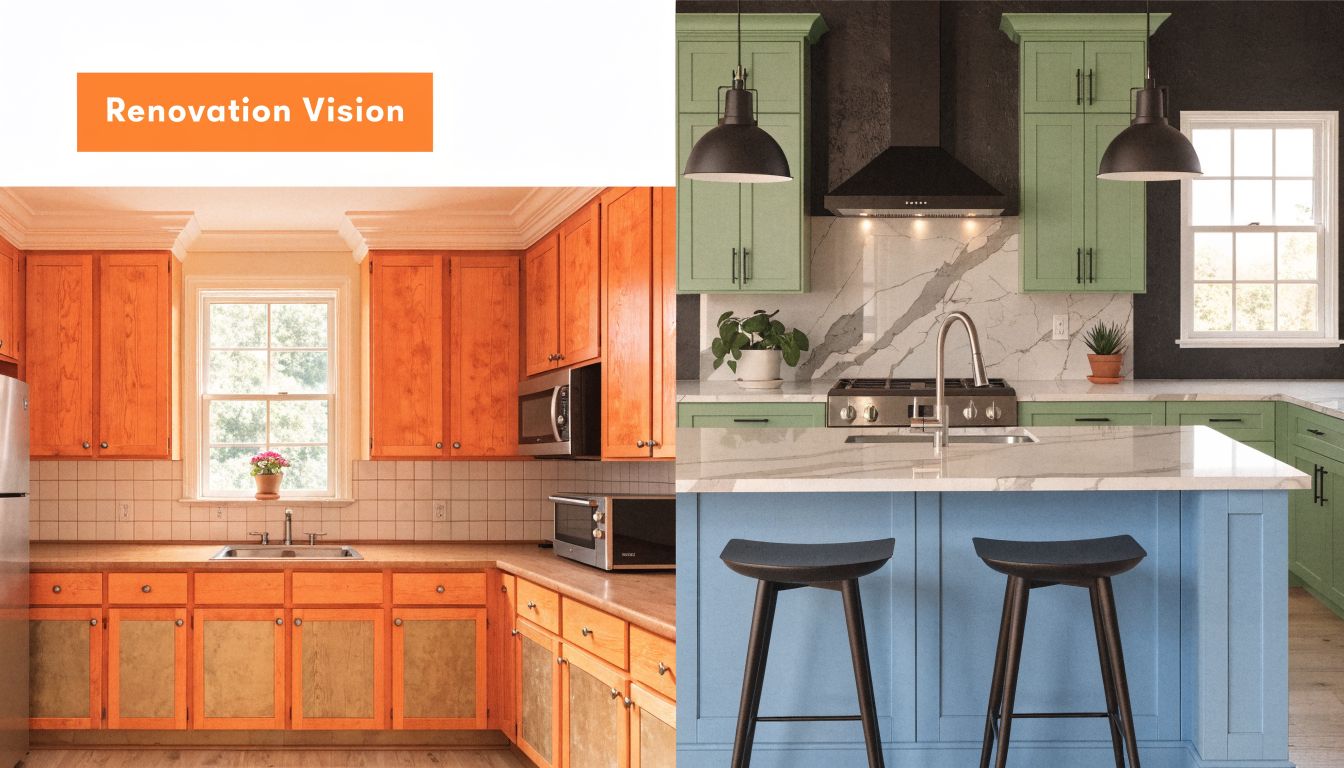
The key is discipline. Don't create fantasy architecture. Show a realistic improved version that helps the buyer understand what could happen next. AI-generated renovation visuals are useful because they collapse the gap between “I can't see it” and “I know what this could become.”
Here's the kind of visual pairing that works well:
Where paid search fits
This ad often performs well when paired with intent-driven search. In a Google Ads case study for two Pune property listings, a total spend of ₹1,00,000 over six months produced conversion rates of 3.00% and 3.50%, with ROIs of 20.0% and 22.0% after optimization, according to the Slideshare real estate lead generation Google Ads case study. The specifics won't transfer one-to-one to every market, but the lesson does. Renovation-focused buyers often search with strong intent.
Your ad should therefore connect visual potential to a concrete next step. Request contractor packet. Ask for renovation-ready floor plan. Get investor details. Book a walkthrough.
- Label every generated image clearly: Use “AI visualization” or “virtually renovated.”
- Keep estimates contextual: If you mention cost or upside, verify locally and present it as an estimate.
- Build audience-specific copy: Investors want opportunity and speed. Owner-occupants want clarity and inspiration.
Reality check: Renovation ads work when they reduce uncertainty, not when they oversell upside.
A practical use case: a listing agent markets an outdated kitchen with an original frame, an AI-updated version, and a short caption inviting buyers to see both current condition and design potential. A commercial rep can use the same structure to show open-plan versus private-office layouts for the same space.
7. Team and Brokerage Branding Ad Featuring Agent with Property Portfolio
Referral-driven business still wins this category, which is exactly why your branding ad needs proof, not polish. One strong brand unit can do three jobs at once. It can reassure past clients, warm up seller leads, and filter in agents who want better systems.

Build a credibility ad that shows operating quality
A headshot and tagline do not carry enough weight. Your audience wants fast pattern recognition. They should see your market, your inventory quality, and your level of organization within a few seconds.
That is why the agent should appear next to a real property portfolio, not isolated from it. The ad works best when the portfolio signals range. Mix entry-level, mid-market, and premium listings if you serve all three. If you specialize, show depth in one lane and make that obvious.
Use this framework:
- Agent image with local context: Put the agent at a recognizable neighborhood spot, listing, or streetscape
- Portfolio grid with consistency: Use 4 to 9 property images with matched color treatment, framing, and text hierarchy
- One proof line: Years in market, homes sold, team support model, or client satisfaction signal
- One audience-specific CTA: List your home, meet the team, apply to join, or book a strategy call
This format matters even more for teams and brokerages with multiple agents. Inconsistent visuals make the business look fragmented. Standardized creative fixes that. AI tools help you keep every ad on-brand, especially when different agents submit different photo quality, listing angles, and caption styles. A workflow tool like Bounti can help teams turn raw listing inputs into repeatable ad variations faster, with tighter copy and cleaner production.
Platform execution matters. On Meta, this ad should run as a square or vertical static image with minimal copy on the creative and stronger proof in the primary text. On LinkedIn, recruiting-focused versions should emphasize training, lead flow, and operational support. On Google display, keep the message simpler and use the portfolio itself as the proof layer.
Use targeting that matches the objective. Seller campaigns should hit homeowners in your core ZIP codes, recent website visitors, and past lead lists. Recruiting campaigns should target licensed agents, agents with recent job-change signals, or people engaging with team growth content.
A replicable version looks like this. The left side shows the lead agent in a recognizable local setting. The right side shows six recent listings with clean labels by neighborhood or price band. The headline states the market served. The CTA offers one next step only. That structure is easy to rebuild across offices, teams, and farm areas.
Keep the message tight. Brand ads perform when they reduce uncertainty and make your operation look dependable at scale.
7-Point Comparison: Real Estate Agent Ads
| Ad Format | Implementation Complexity 🔄 | Resource Requirements ⚡ | Expected Outcomes 📊 | Ideal Use Cases 💡 | Key Advantages ⭐ |
|---|---|---|---|---|---|
| Property Showcase Video Ad with AI-Generated Description | Low, immediate video input; minimal setup | Moderate, good walkthrough video and AI processing | High, consistent MLS-ready copy; saves ~30–45 min/listing | Listing agents, high-volume brokerages, new agents | Time-saving, consistent, MLS-compliant copy |
| Before & After Staging/Decluttering Ad | Moderate, AI staging workflow and image prep | Moderate–High, quality images, staging models, disclosure needs | High, boosts perceived value and engagement (5–15%) | Vacant or cluttered homes; social media engagement campaigns | Dramatic visual impact; easy style testing |
| Social Media Carousel Ad with Multiple Property Views | Moderate, sequencing and design planning | Moderate, multiple AI images, platform optimization | High, 30–40% higher engagement; longer interaction time | Storytelling listings, renovations, platform ads (IG/FB) | Strong storytelling, higher CTR and A/B testing potential |
| Virtual Home Tour Ad with CTAs at Key Points | High, interactive video setup and planning | High, video production, interactive platform, CRM integration | High, 2–3x video engagement; 8–15% CTA click rates | Conversion-focused campaigns, luxury or lead-gen listings | Direct lead capture, feature-level analytics and qualification |
| Neighborhood & Lifestyle Context Ad with Property Comparison | Moderate–High, data integration and careful design | Moderate, local data feeds, design assets, periodic updates | Medium–High, improves buyer context and pricing justification | Relocations, families, investors researching neighborhoods | Differentiates via context; broadens buyer appeal and trust |
| AI Renovation Visualization Ad with Cost/ROI Information | High, visualization + cost estimation + legal review | High, accurate cost data, contractor rates, expert validation | High, attracts investors; 35–50% higher engagement for transformations | Investors, fix-and-flip, dated properties needing repositioning | Shows potential value and ROI; justifies pricing strategy |
| Team/Brokerage Branding Ad Featuring Agent with Portfolio | Low–Moderate, portfolio curation and branding design | Moderate, professional headshot, consistent property images, stats | Medium–High, boosts brand credibility; higher recruitment/lead volume | Team recruitment, high-volume agents, brand-building campaigns | Builds credibility, demonstrates market activity and consistency |
Your Next Ad Campaign Starts Here
Nearly every agent can publish an ad. Far fewer run a campaign system that turns one listing into multiple assets, targeted variants, and fast follow-up.
That gap is where results are won.
The strongest real estate ads follow a simple rule. Match the format to the sales problem. Use video for flow and scale. Use carousels for comparison. Use staging and decluttering creative when presentation is blocking interest. Use neighborhood context when the home sells better as a lifestyle decision than a feature list. Use renovation visuals when buyers need help seeing value after the close. For agent and team branding, lead with proof of work, market coverage, and consistency.
Treat each listing like a content engine, not a one-off task. One walkthrough should give you short-form video, still images, listing copy, paid social variants, retargeting creative, and follow-up email assets. That is how productive teams reduce production time and keep campaigns live across Meta, Google, email, and listing portals without rebuilding everything from scratch.
Speed matters after the click. If a prospect watches the tour, taps the carousel, or requests details, respond fast with a clean landing page, one clear CTA, and a short nurture sequence. Slow follow-up wastes paid traffic. Fast follow-up turns curiosity into conversations, showings, and signed clients.
Standardization matters at the team level. Set one visual system, one copy framework, one approval path, and one compliance review process. Agents who skip this end up with inconsistent branding, slow launch cycles, and ads that look disconnected from the brokerage. Tools built for real estate AI workflows help fix that. Bounti Labs can turn a single walkthrough into listing descriptions, polished stills, MLS-ready photos, and AI-generated variations for staging, decluttering, restyling, or renovation concepts.
Start with one format this week. Pick the bottleneck you already have, weak presentation, low engagement, poor context, or slow lead conversion, then build the ad around that problem. Test one audience, one offer, and one follow-up path. Measure response. Keep the winner. Cut the rest.
If you want to turn one property walkthrough into listing copy, polished stills, virtually staged images, and ad-ready creative faster, take a look at Bounti Labs. It's built for real estate teams that need practical AI marketing assets without the usual manual production delays.