Properties marketed with video receive 403% more inquiries than those without. That single stat changes the conversation about ads for real estate agents in 2026.
The old playbook was simple. Boost a listing post, run a few just-listed graphics, hope the phone rings. That still creates activity, but it rarely creates a durable pipeline. Buyers search digitally, sellers compare agents online, and every serious market now punishes lazy creative and vague targeting.
What wins now is sharper than that. Agents who combine intent-based media buying, disciplined follow-up, and fast visual production have an edge. The biggest shift is creative speed. The agent who can turn a raw walkthrough into polished ad assets quickly will usually beat the agent waiting on a photographer, editor, stager, and designer to finish the queue.
Beyond Boosted Posts The Modern Ad Strategy for Agents
Most agents already know they need to advertise online. The primary issue is how they do it.
Real estate agents using social media in their marketing generate four times more revenue than non-users, 95% of agents use social media, and 90% of home buyers start their search online, according to real estate marketing statistics. That doesn't mean every social ad works. It means online visibility is now the minimum standard.
Boosting posts isn't a strategy
A boosted post is usually the fastest way to spend money without learning much. You get reach, maybe some engagement, and very little control over audience structure, message sequencing, lead quality, or what happens after the click.
Agents need a system built around three things:
- Targeting with intent: Separate cold local awareness from high-intent search traffic.
- Creative built for action: Use visuals and copy that make someone stop, click, and inquire.
- Measurement that ties to pipeline: Track lead source, response speed, appointment set, and closed business.
If you want a good primer on search-side execution, this guide to effective real estate PPC advertising is worth reading because it reinforces the difference between casual promotion and structured campaign management.
Boosted posts help platforms spend your money. Campaign architecture helps agents build business.
The new battleground is creative speed
In 2026, targeting tools are available to everyone. The key differentiator is who can produce better listing creative faster and test more variations without slowing down operations.
That matters on every platform, especially when your campaign depends on fresh visuals, short-form video, and retargeting assets that don't look recycled. Agents who want to scale video production without adding friction should look closely at tools built for listing content, including an AI video creator for real estate.
The practical takeaway is simple. If your ad workflow still depends on manual handoffs for every visual update, you're already behind.
The Foundation Defining Your Audience and Goals
Most wasted ad spend starts before the campaign goes live. It starts with a fuzzy audience and a goal that sounds like "get more leads."
That isn't specific enough to guide targeting, creative, or follow-up. Good ads for real estate agents begin with a clear person and a clear action.

Build one buyer audience and one seller audience
Start with a buyer profile that is narrow enough to influence the ad itself.
Example buyer segment: first-time millennial buyer in the suburbs. The message isn't "beautiful homes available." It's affordability, layout, commute, monthly payment sensitivity, and confidence. The creative should show livable spaces, not just curb appeal. The offer might be a list of homes, a tour invite, or a financing-oriented landing page.
Now contrast that with a seller profile.
Example seller segment: empty-nester homeowner in an established neighborhood. That message should focus on timing, prep, downsizing, convenience, and the financial upside of a cleaner presentation. The ad should feel like expertise, not urgency. A valuation request, seller guide, or staging-focused consultation fits better than a generic "call now."
Match goals to the audience's next step
Once the audience is clear, define the campaign goal by behavior, not by vanity metrics.
A practical way to do that:
| Audience | Strong goal | Weak goal |
|---|---|---|
| First-time buyers | Drive sign-ups for a curated home list or open house RSVP | Get traffic |
| Move-up buyers | Generate private showing requests | Increase awareness |
| Local sellers | Capture valuation requests or listing consults | Get engagement |
| Farm area homeowners | Build a retargeting audience from seller content views | Get clicks |
The point is to choose a result your team can act on. A lead form submission, scheduled call, open house registration, or saved-home alert all create follow-up opportunities. "Awareness" only matters if it supports a later conversion step.
Field rule: If your ISA or agent can't tell what to say when the lead comes in, the campaign goal is too vague.
Use message-market fit before platform tactics
Agents often obsess over platform settings before fixing the offer. That's backwards.
Write down these four planning decisions before you launch anything:
- Who exactly is this for
- What problem are they trying to solve right now
- What action do I want next
- What visual proof will make that action feel easy
If you're selling to first-time buyers, your proof may be clarity and guidance. If you're targeting sellers, your proof may be presentation quality and local knowledge. Different audience, different promise.
The agents who stay efficient don't create one campaign and force everyone into it. They create focused campaigns with a single audience, a single promise, and a single next step.
Choosing Your Ad Platforms Wisely
Every ad platform has a job. Most campaigns fail because agents ask one platform to do all of them.
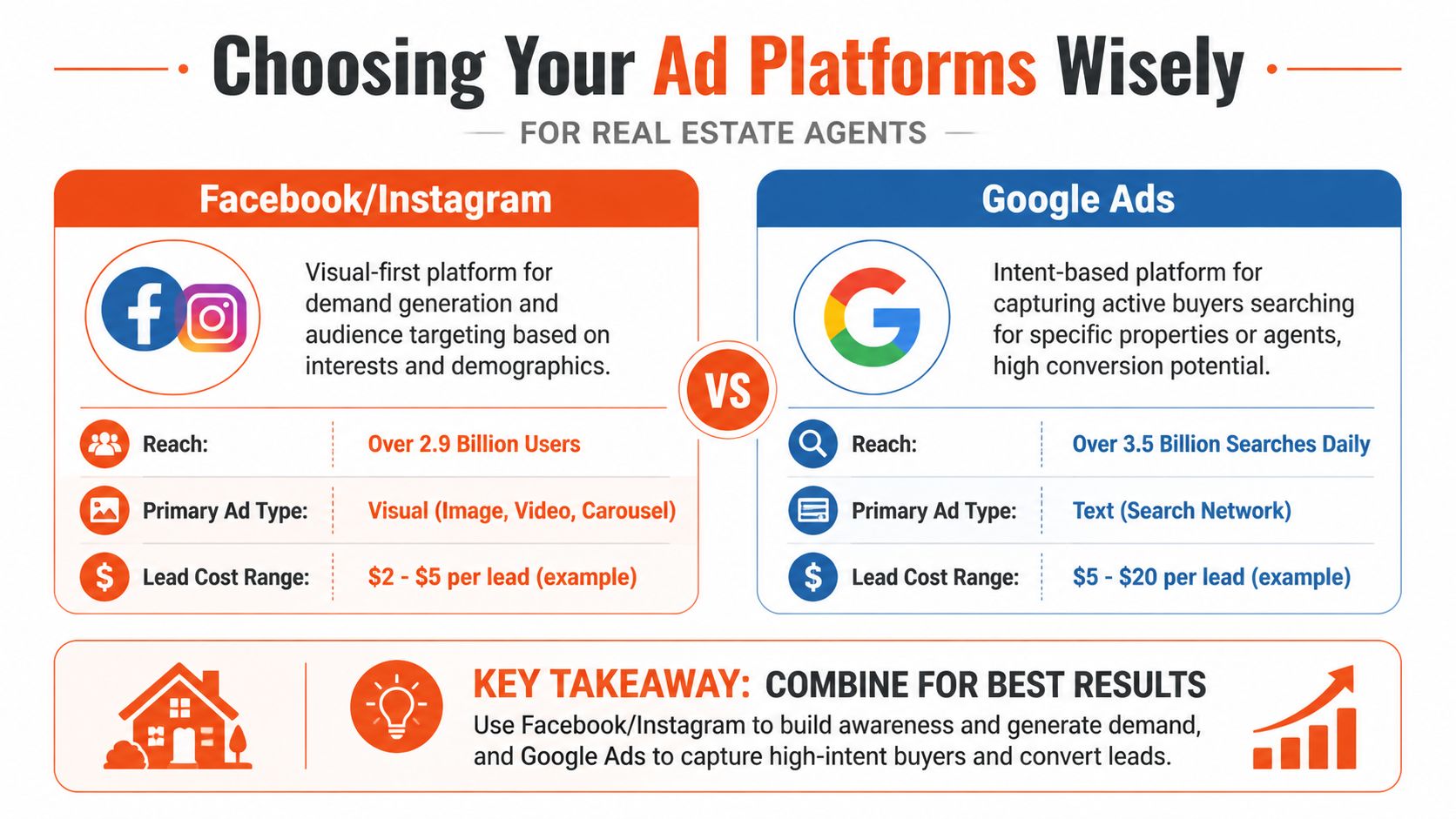
Google captures intent. Facebook and Instagram create and shape demand. YouTube extends time with your listing. Display can support visibility, but it usually isn't where the best leads begin.
Use Google when the prospect already wants something
Google is where buyers and sellers tell you what they want in their own words. That's why it remains the strongest channel for high-intent traffic.
For real estate, Google Search ads deliver a 6.19% CTR and a 4.50% conversion rate, compared with 0.59% CTR for Display ads and a 2.70% general industry conversion average, according to the earlier-cited source in this article. If you're going after people searching for homes, valuations, or agents in a specific market, search should be in the mix.
Google is usually the right fit for:
- Seller intent campaigns: terms tied to listing, valuation, or agent selection
- Buyer intent campaigns: homes for sale queries in a target geography
- Brand defense: protecting your name when local competitors bid on it
- Retargeted search behavior: matching ad copy to specific listing or neighborhood interest
Use Facebook and Instagram when your job is demand generation
Meta platforms are better at putting the right message in front of people before they search. That's useful when you're launching a listing, warming up a farm area, promoting a lifestyle move, or creating a retargeting pool for later conversion.
The best ads here are visual, local, and specific. Carousels, short videos, before-and-after presentation, neighborhood clips, and agent-led walkthroughs all work better than static "just listed" cards with too much text.
If you want a useful tactical read on setup and testing, these actionable strategies for Facebook ads are a solid companion to the planning work agents often skip.
For teams already using Meta in a serious way, it's also worth connecting ad workflows and assets cleanly through Facebook integrations for real estate marketing.
A simple platform decision filter
Ask one question first. Is the prospect already looking, or do I need to create interest?
Use this quick framework:
| Situation | Better channel | Why |
|---|---|---|
| Homeowner wants to know what their home is worth | Google Search | Existing intent |
| New listing needs broad local attention | Facebook or Instagram | Visual discovery |
| Luxury property needs story-led presentation | Instagram and YouTube | Better visual immersion |
| Site visitors didn't convert | Retargeting on Meta or Google | Follow-up visibility |
The mistake isn't choosing Google or Meta. It's running the same message on both and expecting the same behavior.
Don't overvalue cheap clicks
Cheap traffic can still be expensive if it produces weak leads. Search clicks may cost more, but they often come with clearer intent. Social clicks may be cheaper, but they need better creative and a tighter funnel to produce quality.
That's why channel choice should follow the job-to-be-done. If your listing has broad lifestyle appeal, social can open the door. If someone is actively typing a real estate problem into Google, search should answer it immediately.
Crafting Ad Creative That Stops the Scroll
Video listings generate far more engagement than static posts, and buyers still spend a disproportionate share of their attention on photos. The agents winning paid traffic in 2026 treat creative production as an operating advantage, not a design task.

The feed is crowded. Clean listing photos are still required, but they are no longer enough to earn attention on their own. Paid social now rewards agents who can produce multiple strong angles fast, test them quickly, and replace weak creative before spend gets wasted.
That is the advantage of AI-assisted visual production. Tools like Bounti help agents turn one property asset set into staged variants, short-form social cuts, polished stills, and ad-ready creative in hours instead of waiting on separate edits from multiple vendors. Traditional digital ads are table stakes now. Faster creative iteration is where the edge shows up.
Build creative around buyer decisions
Many agents have an opportunity to improve here because they advertise the property, but not the decision a buyer is trying to make.
A stronger ad answers one question fast:
- Can I picture myself living here?
- Does this solve a problem I have right now?
- Is this worth clicking before someone else gets there first?
Creative that performs usually does one of these jobs well:
- Decluttered visuals make room size and layout easier to process
- Virtual staging gives empty space context and purpose
- Restyled interiors help dated homes feel current without hiding the home's condition
- Short walkthrough clips create movement and hold attention longer in-feed
- Asset variations from one shoot let you test hooks without paying for another production day
There is a trade-off. More creative variants can improve performance, but only if each version highlights a distinct buyer angle. Five near-identical photos are not a testing strategy.
Write the first line like it has a job
A common mistake is wasting the first line on generic listing language. "Just listed" rarely creates enough curiosity by itself unless the property already has strong local demand.
Lead with the benefit, tension, or use case:
- Lifestyle hook: Morning sun, covered patio, walkable restaurants
- Problem-solution hook: Need one-level living, extra office space, shorter commute
- Access hook: See it before the weekend open house
- Transformation hook: Compare the empty room with two staged layouts
A few copy formats I keep coming back to:
Ad copy angle: "Hard to picture an empty room? Here it is set up as a home office and guest room."
"Three bedrooms, a real workspace, and a backyard that actually gets used."
Short copy usually wins in-feed. Specific copy usually beats clever copy. One ad should ask for one next step.
For agents who want a better organic and paid content mix, this guide to real estate social media marketing shows how to match visuals to platform behavior instead of posting the same asset everywhere.
Use one walkthrough to produce an entire campaign
A single walkthrough video can supply a week or two of ad creative if you build the campaign correctly. Cut vertical teasers for Instagram and Facebook. Pull still frames for carousel ads. Isolate the kitchen, primary suite, backyard, or neighborhood angle for retargeting. Use the same property to speak to different buyer motivations.
That production model matters because speed matters. Agents still relying on a photographer, then a separate editor, then a separate designer are often too slow to test what converts. Agents using AI image and video workflows can launch faster and refresh creative while the listing is still hot.
Here's a good example format to study:
Creative performance should also connect back to business outcomes, not vanity metrics. A practical social media ROI framework is useful for judging whether better visuals are producing better leads.
The standard in 2026 is simple. Run a visual system, not a single hero image. Agents who create, test, and refresh stronger creative faster usually get lower acquisition costs and more qualified inquiries than agents still treating ad production like a one-off task.
Managing Your Budget and Measuring Real ROI
Most agents don't need a bigger ad budget first. They need cleaner measurement.
If you can't tell which ad produced the inquiry, which inquiry turned into a conversation, and which conversation turned into an appointment, your reporting is decoration. Reach, impressions, and likes have a place, but they don't answer the only question that matters. Did the campaign create profitable business?
Start small, but track like a pro
A small budget is enough to learn if the campaign is structured correctly. The common low-budget question is whether AI-enhanced creative outperforms a standard boosted post. A 2025 Inman report found that listings with AI enhancements get 2.5x more inquiries, which supports the idea that even a $10/day AI-enhanced ad can outperform a boosted static image when the creative is stronger, as summarized in this discussion of AI-enhanced real estate ad ROI.
That doesn't mean every cheap campaign works. It means low-budget testing is valid if the offer, audience, and tracking are tight.
Watch these metrics in order
Don't treat every metric equally. Use a hierarchy.
Lead quality first
Are the inquiries relevant to the listing, price point, and geography?Cost per lead second
Use the simple formula from the verified guidance: CPL = total ad spend / leads.Return on ad spend third
ROAS = revenue / ad spend. For agents, this only becomes meaningful when attribution is honest.Platform metrics last
CTR and cost per click help diagnose creative and targeting, but they don't prove profit.
A practical way to think about it is this:
| Metric | What it tells you | What it doesn't tell you |
|---|---|---|
| CTR | Whether the ad got attention | Whether the lead was worth having |
| CPL | What each lead cost | Whether the lead became business |
| ROAS | Whether the campaign paid off | Why one ad outperformed another |
If you optimize only for cheap leads, platforms will gladly send you more cheap leads.
Run simple A B tests
Most agents overcomplicate testing. You don't need a lab. You need controlled variation.
Test one variable at a time:
- Headline test: lifestyle promise vs urgency promise
- Visual test: empty room vs staged room
- Format test: image vs short video
- Audience test: broad local radius vs segmented homeowner or buyer set
Leave the rest alone while that test runs. If you change audience, copy, and landing page at once, you won't know what moved performance.
For a cleaner way to think about attribution beyond vanity metrics, this practical social media ROI framework is useful because it keeps the focus on business outcomes, not platform applause.
Build the handoff before you scale
An ad is only part of the system. The lead handoff matters just as much. Every campaign should route inquiries into a CRM, trigger an alert, and assign follow-up clearly. If your team responds slowly or inconsistently, better media buying won't fix it.
The agents who win on budget aren't always the ones spending the most. They're the ones who know what happened after the click.
Answering Your Top Real Estate Ad Questions
How are commercial real estate ads different from residential ones
Commercial campaigns need a different visual argument. Residential ads sell aspiration and emotional fit. Commercial ads need to communicate function, layout flexibility, and business use.
That's where AI-enhanced visuals have a real advantage. In commercial real estate, AI-powered visuals such as decluttering and virtual restyling have boosted engagement by 40% in pilot tests and can help close deals up to 30% faster by showing layout options quickly, according to this commercial real estate advertising discussion.
For tenant reps and leasing teams, that matters because prospects often need help visualizing office, retail, or mixed-use potential before they schedule the next conversation.
What's a realistic benchmark for ad performance
There isn't one universal benchmark that fits every market, price point, and lead source. A seller campaign in a mature suburb behaves differently from a downtown condo campaign or a commercial leasing push.
Use platform benchmarks as directional, not definitive. The better benchmark is your own funnel. Track which campaigns produce qualified inquiries, which leads answer the phone, and which ones move to an appointment. That's the number your business can improve.
How long should I let an ad run before making changes
Don't edit a campaign every time you get nervous. Most agents kill decent campaigns before they generate enough signal.
A better rule is to wait until you have enough evidence to diagnose the problem. If the ad isn't getting clicks, the issue is usually creative or audience fit. If it gets clicks but no inquiries, the landing experience or offer is probably weak. If you get inquiries but no appointments, the handoff or follow-up needs work.
Good optimization is diagnosis. Bad optimization is random tinkering.
Should I choose Google or social first
If you're trying to capture active demand, start with search. If you're trying to build awareness around a listing, a neighborhood, or your brand, start with social. If you can support both, use each for its actual job instead of forcing one platform to carry the whole funnel.
The best ads for real estate agents don't come from one magic channel. They come from matching platform, creative, and follow-up to the way people make decisions.
Bounti Labs gives agents and brokers a faster way to turn one property walkthrough into marketing that gets used. With Bounti Labs, you can generate MLS-ready photos, property descriptions, decluttered images, virtual staging, restyling, and renovation visuals without waiting on slow manual workflows. If you want better creative for your ads without adding production bottlenecks, it's worth a look.