
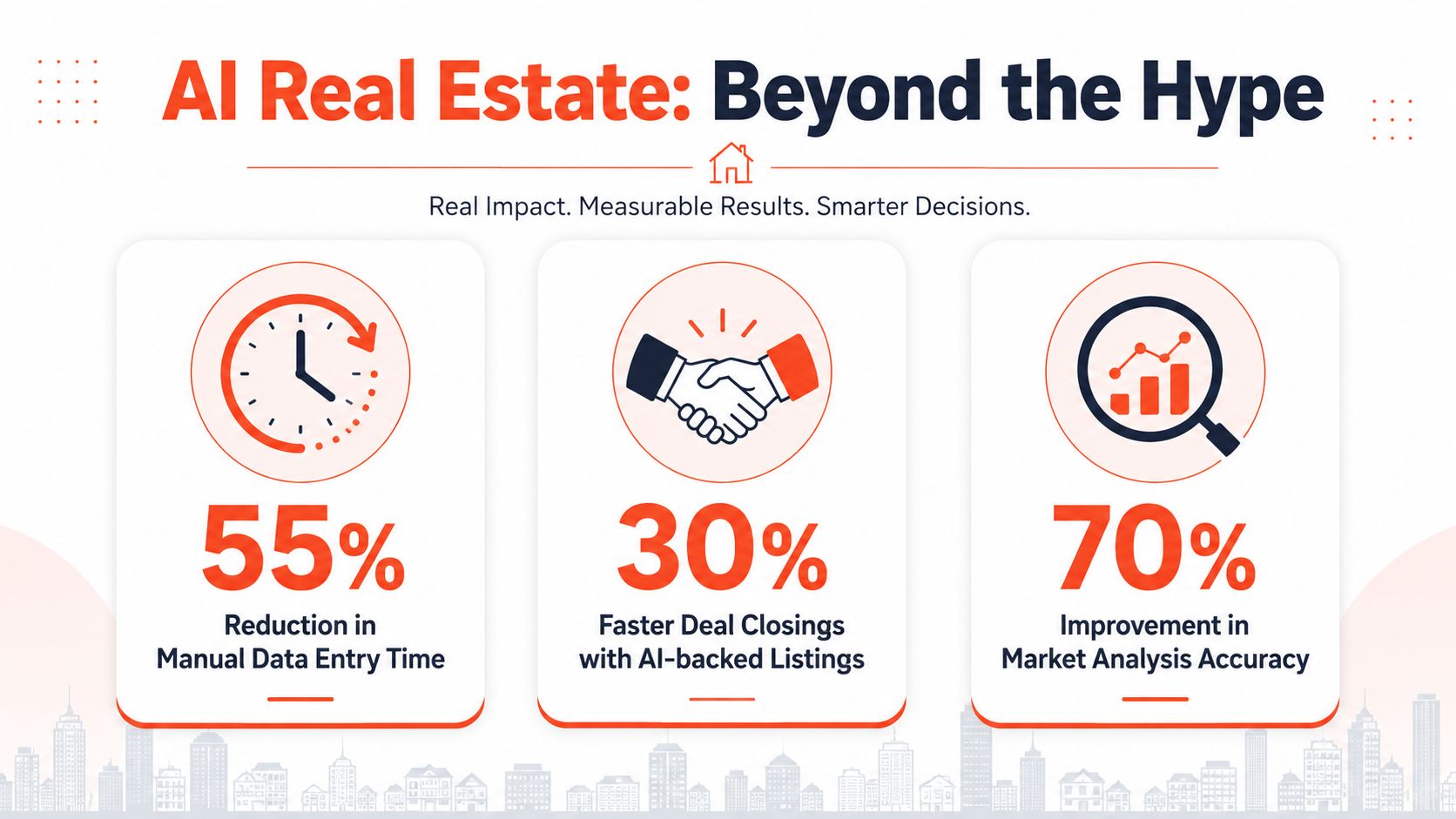
Most real estate teams still talk about AI as if it's a writing assistant. That's already outdated. The primary shift is toward software that handles specific pieces of work, and the market size tells you this isn't a side trend: the global AI in real estate market was valued at USD 2.9 billion in 2023 and is projected to reach USD 41.5 billion by 2033, a 30.5% CAGR, with North America holding 38.5% of the market according to Market.us research on AI in real estate.
That matters because buyers, sellers, brokers, leasing teams, and property managers aren't paying for “AI.” They're paying for faster turn times, cleaner listings, fewer manual handoffs, better underwriting, and fewer avoidable mistakes. In practice, the winning tools aren't the ones that talk the most. They're the ones that remove repetitive steps from listing production, document review, reporting, and reconciliation without creating a new mess for staff to clean up later.
Beyond the Hype What AI Real Estate Software Actually Is
The old version of AI in real estate was “ask a chatbot for some copy.” The current version is workflow software with AI inside it. That distinction matters.
AI real estate software discussions often lump together everything from virtual staging apps to valuation models to leasing assistants. This obscures the core buying question: does the software aid a human in drafting something, or does it complete part of the workflow with enough structure that a human can review and approve it?
Assistance is not automation
An assistant can suggest a listing description, summarize a lease, or brainstorm social copy. Useful, but limited.
Automation starts when the system can:
- Ingest real inputs like photos, PDFs, rent rolls, or ledgers
- Produce structured outputs such as listing-ready media, extracted lease fields, or reconciled accounting entries
- Route exceptions for review instead of pretending every edge case is clean
- Fit the existing process so agents, brokers, and ops teams don't have to rebuild the whole stack
That's why the category is moving away from generic chat interfaces and toward narrower tools with better operating context. A residential listing team needs something very different from a multifamily accounting department or an acquisitions team reviewing tenant risk.
What counts as real value
The most useful real estate AI products usually do one of four things well:
| Workflow type | What useful software actually does |
|---|---|
| Listing creation | Generates visuals, description drafts, and presentation assets from property media |
| Deal analysis | Extracts and normalizes information from leases, spreadsheets, and investor materials |
| Operations | Handles repetitive admin tasks with governed data and approvals |
| Compliance review | Checks whether claims, visuals, and documents line up |
If a tool only gives clever text back, it's still in the assistant bucket. If it transforms messy source material into something operationally usable, it's closer to a digital coworker.
Practical rule: Buy AI for a recurring bottleneck, not for a category label.
Teams evaluating AI real estate tools for listing workflows should think less about “which platform has the most features” and more about “which product removes the most rework from one high-frequency task.” That's where the greatest advantage lies.
The Two Core Jobs of Modern Real Estate AI
The easiest way to understand the market is to split it into two core jobs. Almost every product fits into one of them.
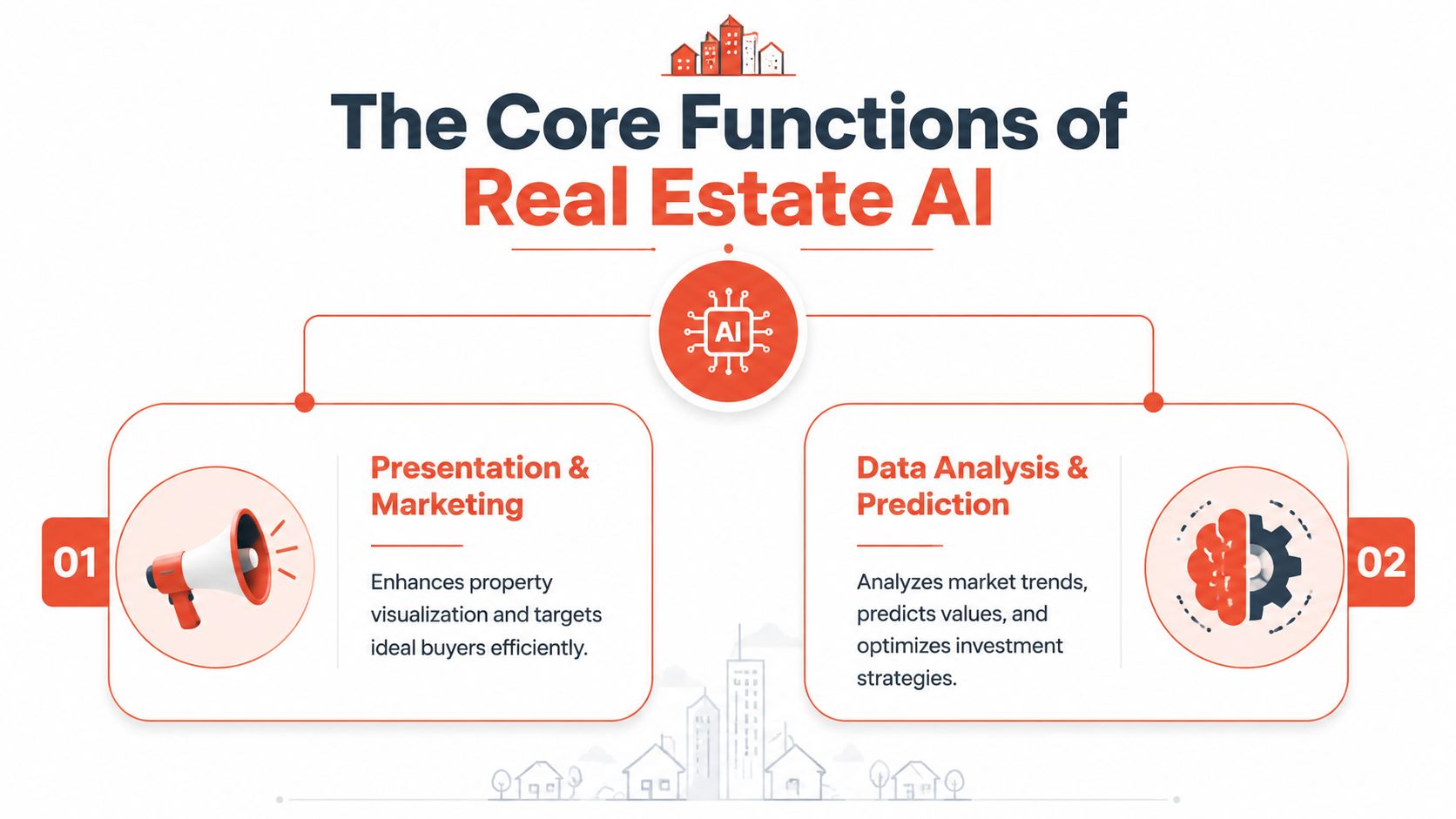
Presentation and marketing
This side of AI real estate software helps properties look clearer, stronger, and easier to understand.
For residential teams, that usually means:
- Photo enhancement so images feel clean and listing-ready
- Virtual staging or restyling so empty or dated rooms become easier to market
- Description generation to turn raw listing facts into usable MLS copy
- Multi-format content production for flyers, webpages, and social assets
Many agents first encounter AI here, and for good reason. The output is visible. Sellers can see it. Buyers react to it. Listing appointments become easier when a team can show what the property could look like before they spend days coordinating vendors.
But this category has a trap. It's easy to mistake visual polish for operational maturity. Plenty of tools can generate attractive images. Fewer can do it consistently, quickly, and in a way that doesn't create compliance headaches.
Analysis and operations
This is the less flashy side, and often the more valuable one.
In commercial real estate and property operations, AI earns its keep by processing messy information that people would otherwise review by hand. That includes lease abstraction, rent roll normalization, underwriting support, investor reporting, and back-office accounting tasks.
The practical difference is that these systems don't just produce content. They turn unstructured data into structured fields that someone can use in a model, report, or decision.
The best operations tools don't feel magical. They feel reliable.
That's the standard buyers should use. If the software can't show where a number came from, where a clause was extracted from, or why an exception was flagged, it isn't ready for high-stakes work.
Compliance and accuracy matter more than most buyers expect
One of the most overlooked uses of AI in real estate is quality control. Independent coverage from V7 Labs on AI in real estate points out that computer vision can flag when a listing description mentions a shower but the photos show only a bathtub, and it can also identify copyrighted or unauthorized images.
That use case deserves more attention than it gets.
A practical framework looks like this:
- Presentation tools make a property easier to market
- Analysis tools make a deal easier to evaluate
- Compliance layers make both safer to publish and use
Teams often need all three. They just don't need them from the same vendor.
AI in Action for Listings and Commercial Deals
The difference between hype and value becomes obvious when you watch where the minutes disappear in a real workflow.
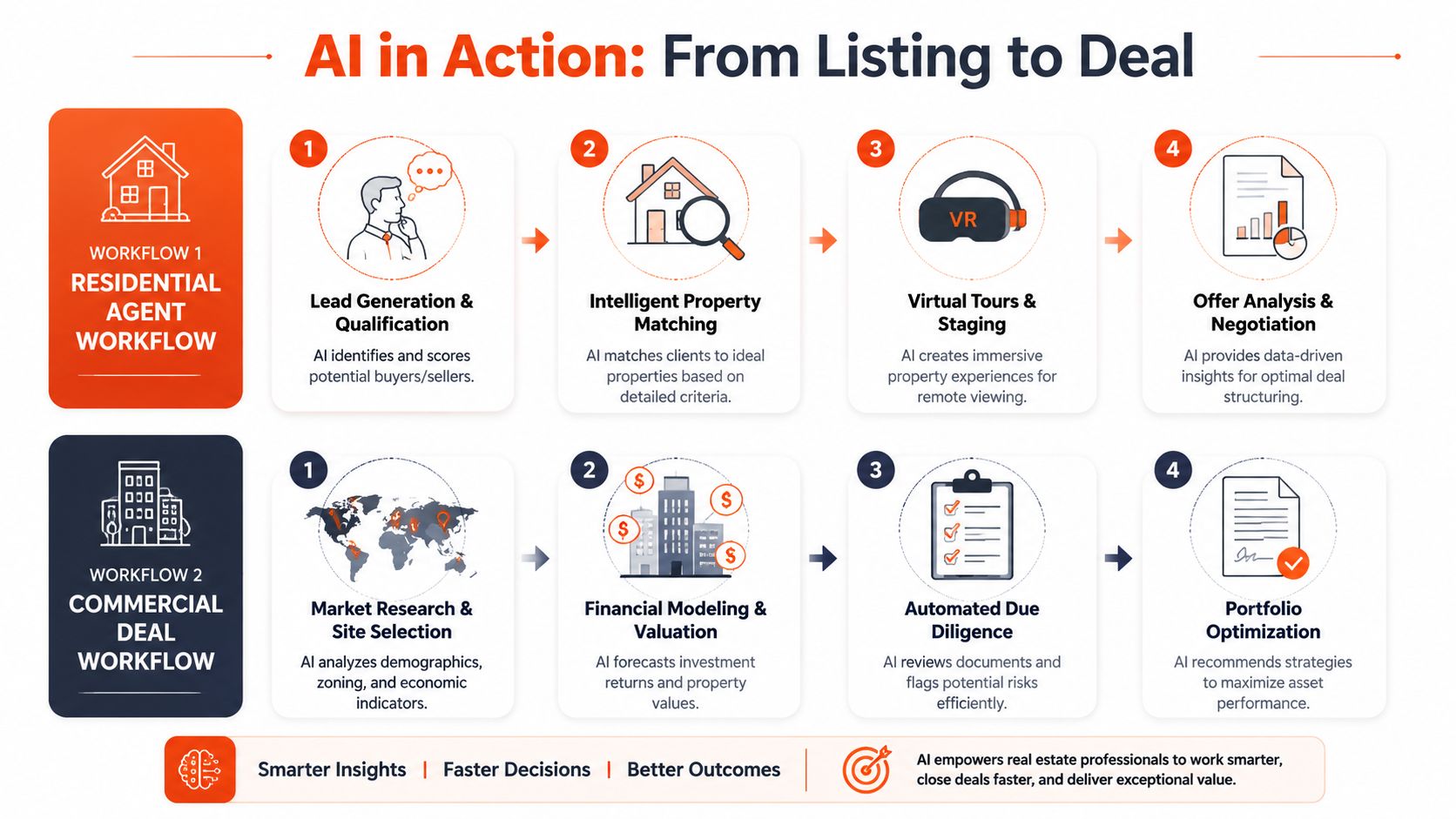
A residential listing workflow
A listing agent walks a property once and captures a video tour. From that raw media, the team wants stills, cleaned-up visuals, optional staging concepts, and copy that's usable for the MLS and marketing package.
That's a strong use case for visual AI because the source material already exists. The software doesn't need to invent the property. It needs to convert the walkthrough into assets that help buyers understand the space quickly.
One option in that category is Bounti Labs, which uses a single video walkthrough to generate property descriptions, stills, MLS-ready photos, and visual variants such as decluttering, staging, restyling, or renovation concepts. In practice, that's most useful when an agent needs to compress the time between media capture and a listing going live.
There's also a broader marketing layer around this. If you want examples of how agents boost real estate listings with AI, it's worth studying how listing presentation now blends visual enhancement, showcase-style merchandising, and distribution strategy rather than treating photography as a standalone task.
A commercial deal workflow
A commercial broker or acquisitions team gets a package that includes leases, operating statements, spreadsheets, and investor materials. The bottleneck isn't writing. It's extraction.
Someone has to identify critical dates, rent escalations, termination rights, expense obligations, extension options, and unusual clauses. Then the team has to normalize those details into a format underwriting can use.
That's where purpose-built document AI matters. According to CREx Software's CRE AI strategy overview, AI in commercial real estate delivers 30 to 40% time savings on data analytics and a 60 to 85% reduction in manual data processing for workflows like lease abstraction, tenant analysis, valuation reviews, and investor reporting.
Those gains come from one core capability: transforming unstructured PDFs, spreadsheets, and emails into structured data.
If the input is messy, the AI's first job is normalization. Everything else comes after that.
That's the right mental model for commercial buyers. Fancy summaries aren't enough. The system has to create fields, surface exceptions, and keep source traceability intact.
For teams working on valuations and broker opinions, AI can also help accelerate comp packaging and presentation. A focused example is AI CMA generation from MLS workflows, where the value comes from reducing repetitive prep work around comparable analysis rather than replacing judgment.
A quick video example helps make the category concrete:
What works and what usually fails
The strongest AI implementations in real estate share a few traits:
- They start with source material already in the workflow. Video tours, leases, rent rolls, and ledgers are better inputs than vague prompts.
- They narrow the task. “Abstract this lease” is a workable product problem. “Do my acquisitions job” is not.
- They preserve review points. Human approval remains part of the process where financial, legal, or reputation risk is involved.
What fails is also predictable. General chat tools often break down when teams ask them to manage transaction detail, maintain formatting discipline, or handle edge cases across many documents.
Measuring the Business Impact and ROI of AI
AI budgets get approved when buyers can connect them to labor, cycle time, output capacity, or win rate. Anything softer than that becomes a nice-to-have.

The macro case is already clear
Morgan Stanley Research found that AI could automate 37% of tasks across real estate firms, translating to about USD 34 billion in potential efficiency gains by 2030, based on analysis of 162 REIT and commercial real estate firms representing USD 92 billion in labor costs and 525,000 employees, as detailed in Morgan Stanley's AI in real estate analysis.
That's not a promise that every brokerage or operator will suddenly cut labor. It's a signal that a large portion of real estate work is repetitive enough to be redesigned.
Hard ROI shows up first in bottlenecks
For many teams, ROI appears in very ordinary places:
| ROI type | What to measure |
|---|---|
| Time | How long it takes to produce a listing package, abstract a lease, or finish a monthly reconciliation |
| Labor allocation | Whether staff are still doing repetitive formatting, extraction, and follow-up work by hand |
| Throughput | How many listings, reports, or reviews a team can handle without adding headcount |
| Rework | How often someone has to fix missing fields, bad formatting, or inconsistent outputs |
The best operators measure before and after. Not in theory. In actual task runs.
If a brokerage adopts visual AI for listing production, one useful question is whether agents and coordinators can move from capture to publish-ready assets with fewer vendor handoffs. If an asset management team adopts document AI, the useful question is whether analysts spend less time cleaning source files and more time interpreting them.
Soft ROI matters too
Not every return shows up cleanly in a spreadsheet.
AI also changes how a firm is perceived:
- Listing presentation improves when teams can show alternate layouts, staged rooms, or decluttered spaces quickly
- Client confidence rises when deliverables arrive faster and look consistent
- Brokerage operations scale better when fewer tasks depend on one person manually stitching together assets
- Teams modernize their brand when the operating experience feels current rather than improvised
Better output quality isn't just marketing polish. It changes how clients judge responsiveness and competence.
The common mistake is overvaluing novelty and undervaluing repeatability. A one-off impressive demo doesn't create ROI. A workflow that staff use every day does.
The right ROI lens
A practical buying lens is simple:
- Identify one task performed constantly.
- Check whether it's rules-based enough for software to handle part of it.
- Verify that the output is reviewable.
- Measure savings in time, rework, or capacity.
That's how AI real estate software earns a line item. Not by sounding advanced, but by removing friction from work that happens every week.
How to Choose the Right AI Real Estate Platform
Most buyers ask the wrong first question. They ask, “Which platform has the most AI?” The better question is, “Which product solves a painful task thoroughly enough that my team will truly use it?”
Start with a narrow workflow
The strongest products usually enter an organization through a single bottleneck:
- For listing teams, that might be media transformation and content generation
- For property management, it may be reconciliation, resident communications, or maintenance routing
- For commercial teams, it's often lease abstraction, rent roll parsing, or underwriting prep
If a vendor pitches twenty workflows at once, ask which one they handle end to end. Broad claims often hide shallow execution.
MRI Software offers a useful benchmark here. In property management, its AI capabilities in Property Management X help firms complete tenant-ledger-to-general-ledger reconciliation in one-third of the time required for manual reconciliation, with human oversight retained, according to MRI Software's product announcement. That's a concrete example of software built for a transaction-aware job rather than a generic assistant layer.
Separate assistants from agents
This distinction changes implementation risk.
An assistant suggests. An agent executes steps in a workflow, accesses data, and hands exceptions back to a person.
Use this checklist when comparing tools:
| Question | Why it matters |
|---|---|
| Does it solve one repeated task well? | Narrow scope usually beats broad promises |
| Does it use your actual source data? | Good outputs depend on real documents, photos, or records |
| Does it require human approval? | Critical for financial and client-facing work |
| Does it fit the current stack? | Adoption drops when staff have to duplicate work |
| Can it show its work? | Trust depends on traceability and reviewability |
Watch for workflow fit, not demo quality
A polished demo can hide operational gaps. Ask what happens when the input is incomplete, inconsistent, or poorly formatted. Real estate data is messy. A product that performs only on ideal examples won't survive contact with production.
This is also where adjacent tools matter. For example, if your team's pain point is distribution after content creation, a guide on AI tools for content scheduling can help map the social publishing side of the workflow. That's useful context, but it shouldn't distract from the core buying principle: solve the internal bottleneck first.
Compare by operating model
When reviewing vendors, it helps to compare categories, not just brands.
- Point solutions work well when one task is expensive or slow.
- Platform layers make sense when a team wants AI embedded across multiple workflows.
- General chat tools are fine for drafting and ideation, but they're weak substitutes for governed workflow products.
For buyers comparing product categories and fit, a side-by-side view like real estate AI platform comparisons is often more useful than a generic “top tools” list because implementation details matter more than feature count.
The shortest path to value is usually a purpose-built product that removes one recurring headache without forcing a full stack replacement.
Your First Move Making AI Work for You Today
The smartest way to adopt AI in real estate isn't to map every possible use case at once. It's to choose one workflow that happens constantly, costs attention every time, and already has clear inputs.
For some firms, that's lease abstraction. For property managers, it may be reconciliation or reporting. For many residential agents and brokerages, the fastest first win is listing production because the before-and-after is immediate and the operational drag is obvious.
That's the broader lesson across this market. Specificity beats generality. A narrow product that reliably handles one recurring task is usually more valuable than a broad AI suite that sounds impressive but still leaves staff doing essential work by hand.
A good first deployment usually has four traits:
- The workflow is frequent
- The source material already exists
- The output can be reviewed quickly
- The team feels the pain today
If you're still deciding where to start, avoid abstract pilots. Pick a live workflow. Run it on real properties, real documents, or real operations data. Then judge the software by whether your team keeps using it without being pushed.
That's how AI real estate software becomes an operational advantage instead of another tab in the browser.
Bounti Labs fits that practical first-step model for teams that want to improve listing output without adding more manual production work. Bounti Labs focuses on a concrete job: turning property walkthroughs and photos into listing-ready visuals and marketing materials, with tools for decluttering, staging, restyling, still extraction, and description generation. For agents and brokerages, that makes it a straightforward entry point into AI that's tied to visible client deliverables rather than vague experimentation.