You're probably dealing with one of these situations right now. A seller says the addition was “done to plan,” a buyer wants to know whether a wall can move, or a contractor asks for existing dimensions before pricing a renovation. The listing is live, questions are coming in, and the only documents anyone can find are the original plans from years ago.
That's where as built documentation stops being a construction archive and starts becoming a real estate advantage.
For years, agents treated as-builts as something builders, architects, and facility teams cared about after closing. That's outdated. In 2026, accurate post-construction records help agents market renovation potential, answer buyer objections with confidence, coordinate faster with vendors, and avoid expensive guesswork. The shift matters even more now because the workflow has changed. Capturing usable building data no longer requires a specialist crew for every property.
What Is As-Built Documentation Really
The simplest way to explain as built documentation is this. It's not the property's birth certificate. It's the property's official biography after real life happened.
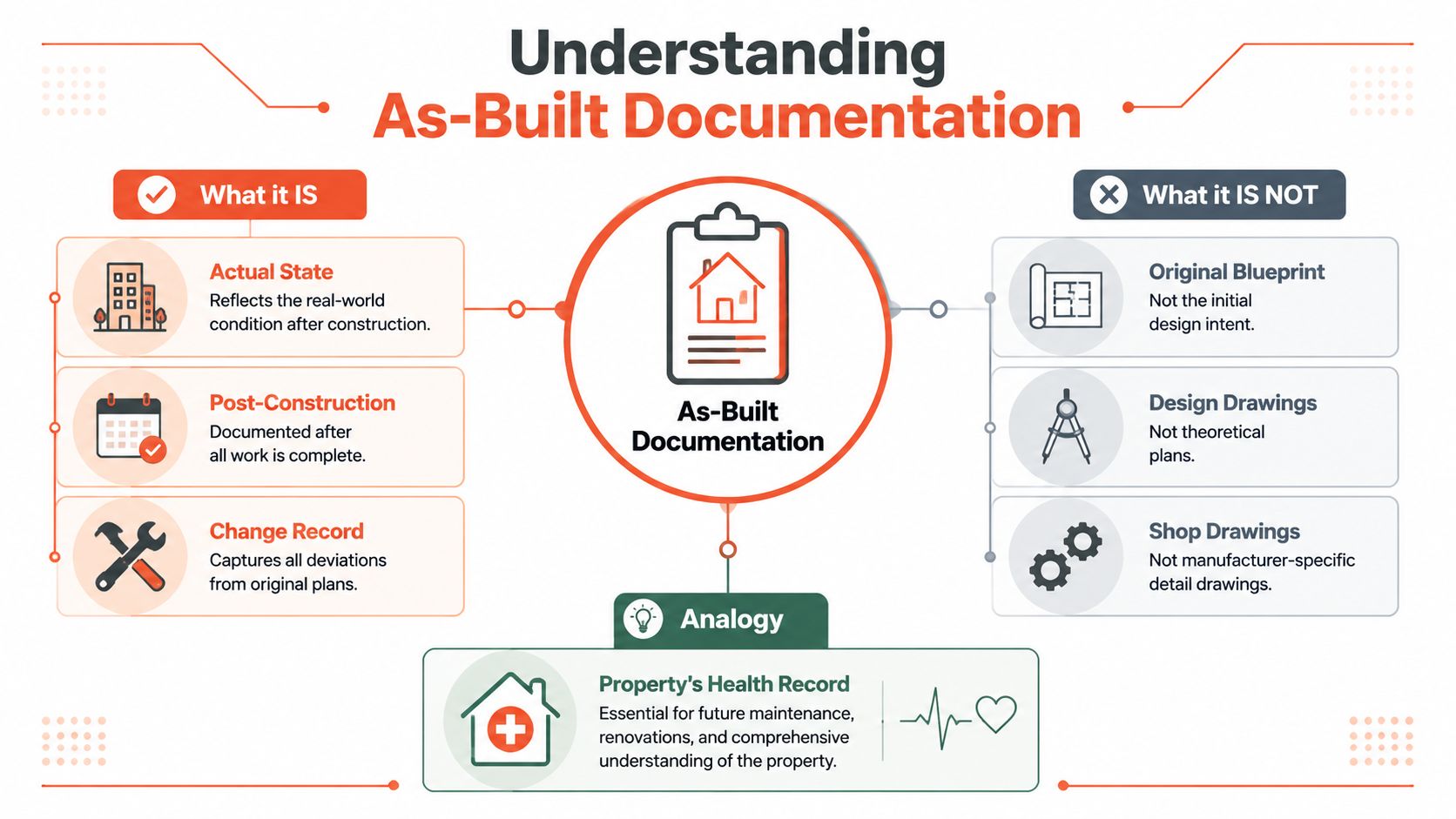
Original design drawings show intent. As-built records show reality. That distinction matters because, as Existing Conditions explains in its overview of as-built documentation, very few buildings are perfect manifestations of their original construction documents, and as-builts serve as the bridge between designed intent and constructed reality by capturing field changes, design modifications, and extra works.
What agents often confuse with as-builts
Agents regularly get handed a PDF set and assume it's good enough. Often it isn't. Three documents can look similar and serve completely different purposes:
- Original plans show what the architect intended to be built.
- Shop drawings show fabrication or installation details for specific components.
- As-built records show what ended up in place after adjustments on site.
That difference is why a listing package built from old plans can create problems. A room dimension may have shifted. A duct run may have changed. A window or door may have moved. Those aren't drafting trivia. They affect remodel feasibility, furniture layout, permitting conversations, and how confidently you describe the home.
Practical rule: If the question is “what's there now,” the original blueprint is only a starting point.
Why the distinction matters in the field
As-builts become the single source of truth for future work. Renovation teams use them to plan around real constraints. Inspectors and facility stakeholders rely on them to verify compliance and coordinate maintenance. For agents, they support accurate marketing, cleaner handoffs to contractors, and better conversations with buyers who want to understand what can change and what can't.
A solid record usually includes the structural layout, system locations, room dimensions, openings, utilities, and finish information. If you want a useful primer on how to capture building data accurately, Survey Merchant's measured building survey guide is worth reviewing because it helps clarify what “accurate existing conditions” means in practice.
The practical test
Ask one question. If a buyer closes tomorrow and hires a contractor next week, would the documents you have help that contractor work from the building as it exists today?
If the answer is no, you don't have reliable as built documentation. You have reference material.
Why As-Builts Are a Realtor's Secret Weapon
Most agents still think of as-builts as technical paperwork. That's too narrow. In the field, they're a risk control tool, a marketing asset, and a decision aid for everyone involved in the deal.

They reduce uncertainty that kills momentum
Renovation-driven buyers don't just want inspiration. They want a realistic starting point. If they can't tell where utilities run, what dimensions are usable, or whether openings align with the current structure, the conversation slows down fast.
That's one reason as-builts matter beyond the build team. Alterpex notes that as-built documentation records exact final positions of MEP systems, doors, and windows with surveyed dimensions, and that discrepancies between plans and reality account for 25-30% of hold-ups in renovations. For an agent, that's not just a construction issue. It's the hidden drag on every buyer who asks, “Can we open this kitchen?” or “Can we convert this space?”
They strengthen how you position value
A property's story gets sharper when you can point to specifics instead of generalities. High-end HVAC, updated electrical, unusual ceiling conditions, utility placements, and actual room dimensions all help shape a more credible listing narrative.
That doesn't mean dumping technical files on buyers. It means using better source material to make better claims.
A few examples:
- For renovated homes: You can describe completed work with more confidence because the final configuration is documented.
- For fixer opportunities: You can frame renovation potential from a real base plan rather than a rough guess.
- For commercial listings: Tenant reps and leasing teams can discuss layout feasibility with fewer assumptions.
A floor plan helps people imagine. An as-built package helps them believe the plan is workable.
They make you easier to work with
The agent who can hand off organized property information becomes more valuable to clients, contractors, and internal marketing teams. That's especially true when you're building repeatable listing systems with tools that support fast content creation and property packaging, including platforms built for real estate agents working with AI-assisted listing workflows.
Here's the bigger point. Buyers are more skeptical, sellers want stronger positioning, and renovation-minded clients expect clearer answers. Agents who can work from the property's actual built condition aren't just better informed. They're faster, more credible, and less exposed to avoidable misstatements.
Key Components of Modern As-Built Packages
A modern as-built package is much more than a floor plan PDF. If that's all you receive, assume the record is incomplete until proven otherwise.
According to Datumate's overview of digital as-built documentation, modern digital as-builts capture precise dimensions, spatial relationships, and exact component positioning, including building layout, structure, design features, mechanical systems, utilities, interior finishes, and material specifications, all organized in centralized digital platforms for real-time access.
What should be in the package
When I review an as-built set for listing or redevelopment use, I look for these categories first:
Base geometry
This includes floor plans, room dimensions, ceiling relationships, and the overall building layout. Without this layer, everything else becomes harder to trust.Openings and circulation
Door and window locations matter for staging, traffic flow, and renovation options. They also affect how accurately you present light, access, and room usability.MEP information
Mechanical, electrical, and plumbing locations are where many listing questions turn from visual to practical. Buyers may never ask for “MEP data,” but they will ask whether a bathroom can move or whether the retail suite can support a new layout.Utility and service locations
Panels, shutoffs, lines, and system access points matter for owners, managers, and contractors.
What turns a basic file set into a useful asset
The difference is usually organization. A complete package should make it easy to understand not just what exists, but where to find that information quickly.
| Component | Why an agent cares |
|---|---|
| Room dimensions | Supports accurate marketing and layout conversations |
| System locations | Helps answer renovation and maintenance questions |
| Finish and material info | Improves property descriptions and upgrade narratives |
| Centralized digital access | Makes sharing with clients and vendors much easier |
What to ask sellers, builders, or property managers
Don't ask, “Do you have plans?” Ask for the actual post-construction record.
Use questions like these:
- Do you have final as-built drawings or digital as-built files?
- Are MEP locations included, or only architectural floor plans?
- Were later renovations incorporated into the record set?
- Can the files be shared in a format a contractor or designer can use?
If your team builds listing systems around standardized collateral, it helps to pair these records with a broader listing kit workflow so the technical data doesn't get buried in email attachments and forgotten.
A strong as-built package makes you more than the person who opens doors and writes remarks. It makes you the person who knows what is there.
How As-Builts Are Traditionally Created
The traditional methods for creating as built documentation were built for construction teams, not for busy agents. That's why most agents either ignored the process or assumed it was too expensive and too specialized to matter.
Manual red-lines and paper workflows
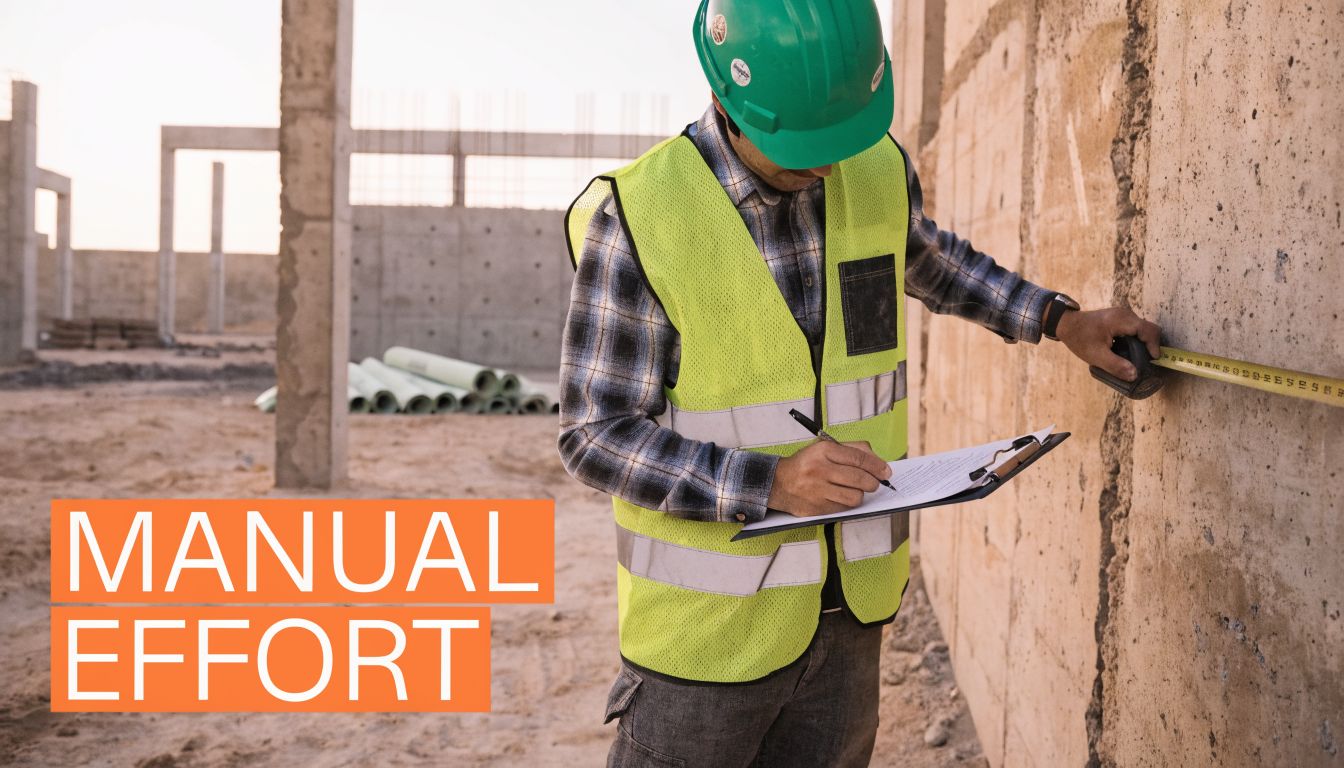
For a long time, the standard approach was simple in theory and messy in practice. Someone marked up plan sets during construction, tracked field changes by hand, and updated the final drawing set later. If the record keeping was disciplined, you got something usable. If it wasn't, the final package often missed important changes.
This method still exists, and in some projects it's adequate. But it depends heavily on people recording updates consistently in real time. That's exactly where things tend to break down.
A common failure pattern looks like this:
- Changes happen fast on site and don't always make it back into the record set.
- Paper markups get fragmented across trades, subcontractors, and revisions.
- Final updates happen late, after memory has filled the gaps instead of measurement.
Laser scanning raised the quality bar, but not the accessibility
High-definition laser scanning changed the quality side of the equation. The precision is exceptional when the workflow is handled well. But the process also introduced cost, scheduling, and specialist dependencies that kept it out of reach for many everyday listing scenarios.
The military as-built documentation specification referenced here notes that high-definition laser scanning can achieve sub-millimeter accuracy, and also warns that inaccurate documentation creates real risk because a 1 cm MEP misalignment can lead to over $10,000 in retrofit expenses during renovation.
Precision has value. The question for agents isn't whether precision matters. It's whether the workflow required to get it fits the listing.
Where traditional methods work and where they don't
Traditional methods still make sense for complex properties, large capital projects, and situations where engineering-grade verification is essential. They're harder to justify when the need is speed, broad accessibility, and practical listing support.
In day-to-day brokerage work, the old model usually fails for three reasons:
- Turnaround is slow compared with the pace of listing prep.
- The workflow depends on specialists most agents don't have on call.
- The cost structure is hard to justify for every property, especially smaller listings.
That gap is what opened the door for newer AI-based capture methods.
The New Workflow with AI and Video Capture
The biggest shift in as built documentation isn't philosophical. It's operational. You can now get useful property records from a workflow that looks a lot more like listing prep than construction surveying.

What the new workflow looks like
At a practical level, the new model is straightforward. Instead of scheduling a specialized scan crew for every job, an agent or team member captures a video walkthrough on a smartphone. AI then processes that footage into structured outputs such as floor plans, dimensions, and visual assets that support marketing and planning.
This matters because it aligns with how agents already work. You're already walking the property. You're already capturing visuals. The newer workflow turns that effort into a deeper data asset instead of just another gallery folder.
Matterport's as-built documentation page states that emerging AI apps can process single video walkthroughs into as-builts 80% faster and at 1/10th the cost of professional laser scanning, and that a Q1 2026 survey found 62% of US residential agents use mobile AI tools for this purpose, up from 18% in 2024.
That adoption trend matters because it shows this is no longer an edge case. It's becoming normal operating procedure.
Why this is the competitive edge for 2026
The advantage isn't just lower cost. It's the combination of speed, convenience, and repeatability.
Here's where the modern workflow stands out:
It fits listing timelines
Agents don't have weeks to coordinate technical capture before going live.It lowers the expertise barrier
You don't need surveying experience to begin collecting usable visual and spatial data.It expands what one walkthrough can produce
The same capture session can support floor plans, layout discussions, renovation visuals, and listing content.
That last point gets missed. Once video becomes the starting asset, the rest of the marketing pipeline gets more efficient too. Teams already looking to speed up video post-production with AI will recognize the pattern. One capture, multiple downstream outputs.
What works and what doesn't
This newer workflow works best when the property is captured cleanly and consistently. Slow movement, complete room coverage, and clear visibility around walls, openings, and circulation paths all help.
It doesn't work well when people rush the walkthrough, skip difficult spaces, or treat the capture like a casual social media clip. AI improves the processing, not the discipline of the operator.
Field note: The fastest workflow still rewards methodical capture. Bad input doesn't become premium documentation because the software is new.
For teams building modern listing operations, it also helps to connect capture to delivery. A property walkthrough can feed broader marketing outputs, including AI-assisted video creator workflows for listing content, instead of living in a silo as a one-off technical file.
That represents a significant shift. As-built generation used to be a separate specialist process. Now it can start inside the same media workflow agents already use to win attention and explain potential.
Best Practices for Using As-Built Data
Obtaining the file is only half the task. The actual value comes from how you validate it, store it, and translate it into decisions other people can use.
Validate before you circulate
AI-generated records are useful, but you still need a quality check before sharing them with clients, contractors, or appraisers. That doesn't require turning every listing into an engineering exercise. It means checking whether the outputs are directionally and practically sound.
Use a short validation routine:
- Spot-check dimensions against a few obvious real-world references such as major room widths, door openings, or corridor lengths.
- Review the layout for omissions so utility spaces, alcoves, and additions aren't missing from the record.
- Flag high-risk areas where remodel decisions depend on exact system or structural positions.
If a seller plans to market major renovation potential, involve the appropriate design or construction professional before anyone treats the as-built set as permit-ready documentation.
Store the files like they matter
Many organizations lose value here. The documents exist, but nobody can find the current version when a buyer, contractor, or manager needs it.
A workable folder structure should separate:
- Raw capture files
- Processed floor plans and visuals
- Final client-facing versions
- Notes on version date and property address
Keep naming consistent. “Final-final-revised-2” is how confusion starts.
Turn technical detail into buyer-facing language
An as-built package is not marketing copy. But it gives you better raw material for marketing copy.
Translate the file into benefits buyers understand:
| As-built detail | Better listing or sales use |
|---|---|
| Exact room dimensions | More credible layout descriptions |
| Utility and system locations | Better renovation and maintenance conversations |
| Door and window placement | Stronger staging and natural light framing |
| Material and finish info | More specific upgrade narratives |
Share selectively and with context
Not every recipient needs the full package. Buyers may need a simplified floor plan and a few annotated notes. Contractors may need the deeper file set. Appraisers and property managers may care about different layers entirely.
Add brief context whenever you send files:
- What the document represents
- When it was generated or updated
- Whether it should be used for planning, marketing, or technical review
Send the right version to the right person. Oversharing creates confusion almost as fast as having no file at all.
The agents who get the most value from as built documentation don't treat it as a static attachment. They treat it as working property intelligence.
Making As-Builts Your Competitive Edge
As built documentation used to live at the end of a construction job. For agents in 2026, it belongs much earlier in the property workflow.
That's the shift. What was once a technical record for builders is now a practical sales and marketing asset for brokers, listing teams, leasing groups, and property marketers. It sharpens listing accuracy, improves renovation conversations, reduces avoidable uncertainty, and gives clients a stronger basis for decision-making.
The old barriers were real. Traditional documentation methods were often too slow, too specialized, or too expensive for everyday listing use. AI and video capture changed that. The workflow now fits the way agents already move through properties, build marketing packages, and respond to buyer questions.
The agents who adopt this early will stand out for a simple reason. They'll know more about the property than the agents working from old PDFs, rough sketches, and seller memory.
That's not a minor operational upgrade. It's a service advantage clients can feel.
Bounti Labs helps real estate teams turn a single property walkthrough into far more than a video file. With Bounti Labs, agents can generate listing-ready visuals, marketing assets, and AI-enhanced property presentations from one capture workflow, making it easier to present spaces clearly, market possibilities faster, and move from walkthrough to polished listing materials without the usual manual delays.