
For years, agents were told to keep the living room pale, pleasant, and forgettable. That advice still works if your only goal is to avoid mistakes. It doesn't work if you need a listing to stand out in a crowded 2026 feed where buyers scroll fast, compare faster, and remember almost nothing that looks “nice enough.”
A black decor living room changes that equation. Used well, black reads expensive on camera, sharpens architectural lines, and gives the room a point of view. It also solves a problem many listings have: broad neutrality often photographs flat. A controlled dose of contrast gives photos shape, depth, and a premium feel that lighter rooms sometimes lack.
The pushback is predictable. Black will make the room feel small. Black will kill the light. Black will hurt resale. Sometimes that's true. Most of the time, it's true because the room was styled badly, lit badly, or taken too far. Black isn't the problem. Indiscriminate black is.
If you're already looking at other upgrades that increase home value before selling, treat black decor as a marketing move, not just a design choice. The right move isn't painting everything charcoal and hoping for drama. It's choosing the right black surface, in the right place, with the right balance, so the listing feels refined instead of heavy.
1. Black Accent Walls with Contrasting Trim
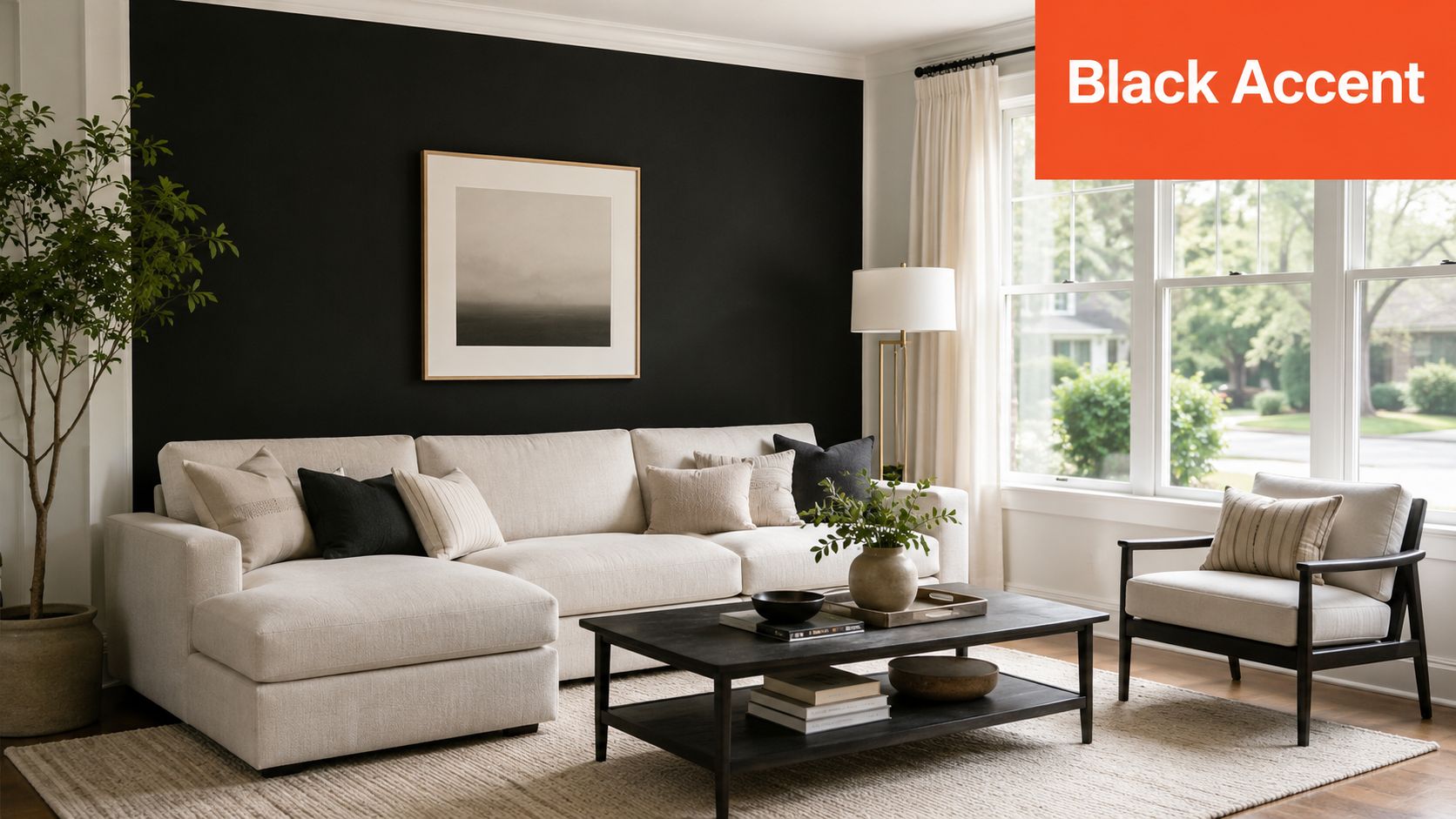
A black accent wall is still the fastest way to give a living room authority. Not because it's trendy, but because it tells the camera where to look. In listing photos, that matters. A focal wall behind built-ins, art, or a fireplace creates depth that plain beige drywall never will.
The mistake is obvious once you've seen it a few times. Agents or sellers paint all four walls dark, leave builder-grade lighting in place, and wonder why the room feels compressed. One black wall is usually enough. Sometimes a recessed alcove or media wall works even better than the room's main long wall.
Where This Sells Best
Rooms with good natural light, taller ceilings, or strong trim detail handle black best. White or cream trim does the heavy lifting here because it draws a clean edge around the dark plane and keeps the room legible in photos. I've also seen black work well behind floating shelves because the shelves and decor read crisper against the darker background.
Decor guidance around black interiors consistently points to repetition and balance. Black works best when it's repeated in at least three elements and paired with warm wood, crisp white, cognac leather, or green accents. That's what keeps the room from looking like a one-off paint experiment. The same source also notes that black-painted shiplap and mantles gained wider traction in the late 2010s, helped by Joanna Gaines's black shiplap moment.
Practical rule: If the black wall is the only dark thing in the room, it can look accidental. Repeat black in the frame, lighting, hardware, or textiles so it reads intentional.
A good real-world setup is simple: black wall, pale sofa, walnut coffee table, oversized art, and one reflective piece like a mirror or metal lamp. That's a black decor living room buyers remember after five similar listings blur together.
2. Black Furniture and Statement Pieces
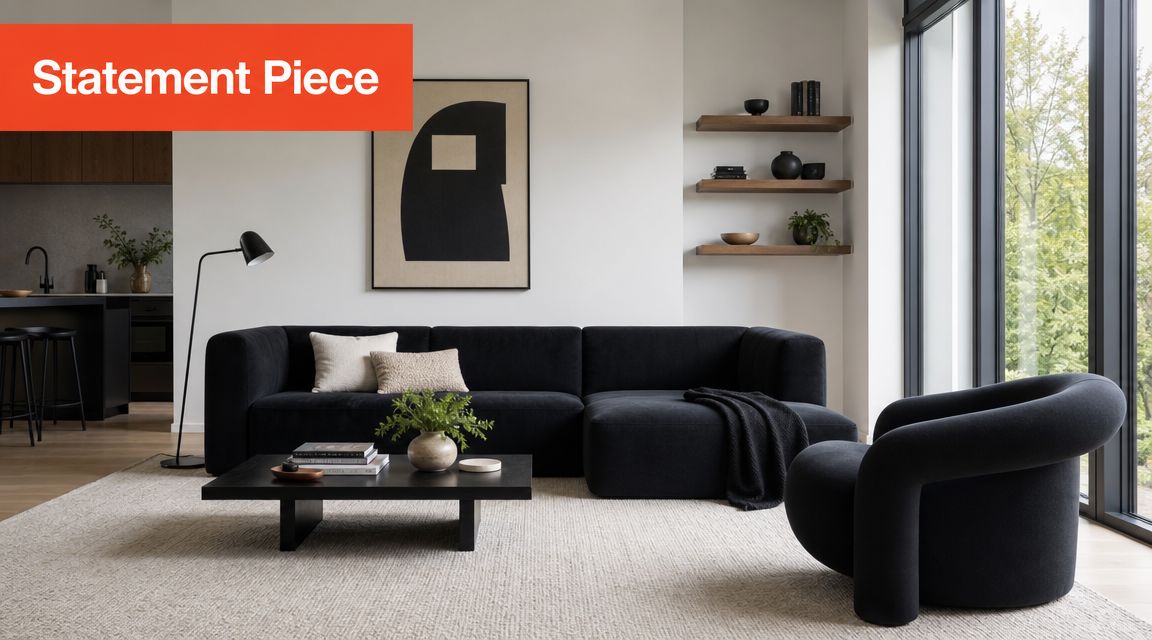
If painting feels too risky for the seller, black furniture is the cleaner play. A black sofa, pair of lounge chairs, console, or media cabinet anchors the room without forcing a permanent finish decision. It gives the listing a modern edge while leaving walls light and buyer-friendly.
This approach is especially effective in homes that need flexibility. A downtown condo, newer townhouse, or rental listing often benefits more from black furniture than from black walls because the furniture can create contrast without making the room feel darker overall.
What to Buy and What to Avoid
A black linen sofa photographs differently than a black leather one. Black bouclé can look rich in person but muddy in low light. Matte wood or powder-coated metal tables usually read sharper than glossy bargain pieces, which tend to reflect clutter and flash.
Use this filter before you stage:
- Choose shape first: A black piece with clean lines reads upscale faster than an overstuffed dark sectional.
- Layer light around it: Cream rugs, oat throws, and pale pillows keep the furniture from turning into a visual block.
- Protect sightlines: Don't let a bulky black sofa cut the room in half in your hero shot.
- Prioritize texture: Ribbed fabric, subtle weave, leather, and wood grain all separate premium black furniture from flat black mass.
For agents who want to show the contrast visually before making changes, a strong reference point is comparing house staging before and after transformations. The lesson is consistent: the room sells when the anchor piece gives the eye structure, not when every furnishing competes.
Dark furniture can make a room feel more expensive. Too much dark furniture makes it feel underlit and overfurnished.
In practice, one statement sofa and one secondary black piece is often enough. After that, pull the rest of the room lighter.
3. Black and White Geometric Patterns and Rugs
If you want black decor in the living room without committing to paint or major furniture, start from the floor. Rugs and patterned textiles do two things at once. They introduce contrast, and they organize the room for the camera.
That matters because soft furnishings are not a minor category in home styling. A 2025 estimate for the U.S. home décor market places it at USD 215.20 billion, projected to reach USD 263.21 billion by 2030 at a 4.11% CAGR, with carpets and rugs accounting for 52.1% of total market share in 2024 and generating USD 18.45 billion. For staging, that tracks with what works in the field. Rugs often do more to fix a black decor living room than another accessory ever will.
Use Pattern to Define, Not Distract
A black and white geometric rug gives you architectural energy without adding visual clutter to the walls. In open-concept homes, it can also define the living area in a way that reads instantly in listing photos. Buyers don't have to guess where the room begins and ends.
The trap is mixing too many patterns at equal strength. If the rug is graphic, let the upholstery stay quieter. If the pillows go bold, keep the art restrained.
A strong setup usually looks like this:
- One dominant pattern: A large rug with a clear motif anchors the room.
- One supporting echo: Repeat the geometry in a pillow, frame, or small object.
- Solid upholstery: Let the sofa and chairs calm the composition.
- Clean perimeter: Don't crowd the rug edges with baskets, poufs, and side pieces.
I've had the best results with large-scale geometry rather than tiny busy patterns. Small motifs can shimmer or blur in listing photos. Bigger shapes hold their form and make the room look more deliberate.
For smaller apartments, this is often the safest path into black decor. The rug gives contrast, but the walls still bounce light.
4. Black Matte and Gloss Finishes with Metallics
Not all black reads the same. Matte black absorbs light and adds discipline. Gloss black kicks light back and feels more dressed. Metallics break up both. When you combine those three intentionally, the room starts to feel layered instead of flat.
Many “luxury” living rooms fall short when they choose black, then keep every finish dead matte. The result can feel stylish in person but dull online. Buyers don't just need drama. They need dimension.
To see finish contrast in action, start with this design reference video:
How Finish Contrast Changes the Photo
Think in surfaces. A matte wall, glossy ceramic lamp, aged brass floor lamp, and smoked glass coffee table all handle light differently. That's exactly why the room looks expensive. You aren't relying on color alone. You're using reflectivity to create separation.
This matters in a category that's already large and growing. The global living and dining room market was valued at USD 183.09 billion in 2025 and is projected to reach USD 241.61 billion by 2033 at a 3.6% CAGR, with Asia Pacific holding 49.7% share in 2025. For agents, that means buyers are already conditioned by polished showroom imagery. Your listing has to hold up against that standard.
A few finish pairings I trust:
- Matte wall plus brass lighting: Warm and editorial.
- Black lacquer side table plus linen sofa: Sharp but not cold.
- Powder-coated metal plus antique mirror: Modern with some softness.
- Gloss ceramics plus textured rug: Adds bounce without glare overload.
When photos still feel flat, test edits before reshooting. Tools that compare AI photo editing options for real estate images can help you see whether the issue is finish placement, brightness, or a weak contrast hierarchy.
The best black rooms don't look dark. They look edited.
5. Black Living Room with Natural Materials and Textures
This is the version of black decor most agents should use first. Black plus natural material is easier to sell than black plus chrome minimalism, especially in family homes and suburban listings. Wood, stone, leather, linen, wool, and greenery keep black from feeling severe.
It also aligns with what buyers already respond to in the broader decor market. Fortune Business Insights estimates the global home decor market at USD 802.26 billion in 2025, projected to reach USD 1,299.88 billion by 2034, with growth tied to online retail channels, home renovation trends, and rising demand for modern furniture and flooring, while Asia Pacific holds 45.75% share in 2025. The takeaway is practical. Contemporary looks with tactile, natural balance are highly discoverable and highly marketable.
The Warmth Layer Most Dark Rooms Need
If a black decor living room feels too cold, the fix usually isn't less black. It's more texture. Warm oak shelving, walnut tables, a cognac leather chair, woven baskets, or a chunky wool rug can reset the room fast.
I've seen this work particularly well in listings with black-framed windows or a black fireplace. Once the architecture goes dark, the room needs something organic to absorb the edge.
Try this mix:
- Warm wood first: Walnut and white oak are easy wins.
- Soft textile second: Bouclé, linen, wool, or a substantial woven throw.
- Natural floor layer: Jute, sisal, or wool helps the room breathe.
- Green accent: One plant often does more than five decorative objects.
If you need to test the balance before moving furniture or buying accessories, a virtual staging guide for real estate marketing is useful for trying wood tones, rug styles, and softer layers digitally.
For a quick luxury signal, I also like draping luxury faux fur throws over a chair or sofa arm in the right listing. Used lightly, they soften the edges and photograph well against black upholstery or trim.
6. Black Fireplace as Focal Point
A black fireplace solves one of the most common staging problems. It gives the room a center of gravity. In open-concept homes where the furniture tends to float, that matters more than people think.
Painted black brick, black tile, dark stone, or a black mantel surround can all work. The exact material matters less than the discipline around it. Keep the mantel simple. Keep the hearth spotless. Keep the styling restrained enough that the fireplace stays architectural.
When It Works and When It Doesn't
A black fireplace works best when the rest of the room isn't trying to steal the show. If you've got a graphic rug, loud art, patterned drapery, and a heavy media wall all competing, the fireplace loses its force. It becomes one more dark object instead of the focal point.
The stronger setup is quieter:
- Minimal mantel: One framed piece, one sculptural object, or nothing at all.
- Furniture orientation: Angle the seating toward the fireplace in at least one photo.
- Warm light nearby: Lamps or sconces soften the dark surround.
- Clean firebox: No ash, no random tools scattered around, no visual noise.
A real-world example is the dated red-brick fireplace in a 1990s suburban living room. Left alone, it reads tired. Painted black and paired with lighter walls and toned-down mantel decor, it suddenly looks deliberate and current. Buyers don't need to love the original brick. They just need to feel the room has a point of view.
If the fireplace is black, the room doesn't need another competing hero wall.
For twilight-style listing photos, the black fireplace can be especially strong. It creates contrast even when the rest of the room is softly lit.
7. Black Window Frames and Doors Against Light Interiors
Black window frames and doors are one of the cleanest ways to introduce black decor without darkening the whole living room. They sharpen the architecture. They also make the room look more custom, even when the rest of the palette stays restrained.
This look took off in the late 2010s alongside the wider spread of black-painted architectural features. That's part of why it still feels current. It has enough familiarity to be safe, but enough edge to stand out.
Use Black to Outline the Room
Frames, mullions, and interior doors act like linework in a drawing. They define the room's edges, frame views, and create contrast where buyers already look. In listing photos, that means windows stop disappearing into white walls.
This is also the safer answer to a real concern in black decor. Practical design discussion has pointed out a major gap in black living room advice: many examples ignore how dark finishes can reduce the sense of daylight and hurt appeal in smaller or dimmer rooms, where black usually works better as an accent rather than the dominant finish (discussion reference on balancing black with lighter, warmer interiors). That's exactly why black window frames work so well. They deliver contrast without covering large light-reflecting surfaces.
Use them strategically:
- Keep walls light: White, warm off-white, or light greige lets the frames stand out.
- Clean the glass thoroughly: Dirty panes kill the crisp look.
- Coordinate nearby black elements: A lamp, side table, or art frame ties it together.
- Don't mix frame colors: Inconsistency reads like a renovation in progress.
One of my favorite uses is a living room with garden-facing windows. The black trim makes the exterior greenery look richer and more framed. Buyers read the view as part of the design, not just something beyond the glass.
8. Black Lighting Fixtures and Sculptural Elements
If you only get one shot at introducing black decor into a bland living room, make it overhead. Black lighting fixtures draw the eye up, give the room silhouette, and show up in photos even when the furniture is neutral.
This works because fixtures are both functional and sculptural. A black pendant, chandelier, floor lamp, or pair of sconces can carry the black decor story without asking the seller to repaint, reupholster, or replace half the room.
The Fastest Upgrade With the Least Disruption
Ceiling fixtures are often the most dated element in a listing. Swapping an old brushed-nickel fan or builder dome for a black fixture instantly changes the room's posture. It feels edited. It feels intentional. Buyers may not know why the room looks better, but they can see it.
Use warm bulbs so the black fixture doesn't read harsh. Then layer with a lamp or sconce so the room has ambient light at eye level. A single overhead source almost never flatters a dark-accent room.
A few fixture types that consistently work:
- Linear chandelier: Great over combined living and dining sightlines.
- Black dome pendant: Clean in modern and transitional spaces.
- Articulating floor lamp: Adds shape next to a lounge chair.
- Slim sconces: Useful around built-ins or fireplaces.
For sellers who already have decent overhead lighting but weak atmosphere, add one sculptural black table lamp and one floor lamp before the shoot. The room will feel more complete with almost no renovation work. If you're updating a listing where the lighting is part of the home's value story, it can also help to enhance your Bellefontaine home lighting with a fixture that contributes both style and usable illumination.
Black Living Room: 8-Point Design Comparison
| Design Approach | 🔄 Implementation Complexity | ⚡ Resources & Cost | ⭐ Expected Outcomes | 📊 Ideal Use Cases | 💡 Quick Tip |
|---|---|---|---|---|---|
| Black Accent Walls with Contrasting Trim | Medium, single-wall prep and precise trim work | Low–Medium, paint, trim materials, lighting upgrades | ⭐⭐⭐⭐, dramatic focal point; adds depth and sophistication | Living rooms, gallery/backdrop walls, MLS photos | Use one wall, crisp light trim and strong lighting |
| Black Furniture and Statement Pieces | Low, purchase and arrange; styling required | Medium–High, quality furniture investment | ⭐⭐⭐⭐, anchors space; elevates perceived value | Open-plan spaces, minimalist/contemporary staging | Balance with light textiles and good natural light |
| Black and White Geometric Patterns and Rugs | Low, textiles/art placement | Low–Medium, rugs, pillows, art pieces | ⭐⭐⭐, adds movement and designer feel without heavy cost | Small-to-medium rooms, zone definition, contemporary listings | Use one dominant pattern; layer solids to avoid chaos |
| Black Matte and Gloss Finishes with Metallics | High, finish work and coordinated lighting | High, specialty finishes, metal accents, professional labor | ⭐⭐⭐⭐⭐, luxurious, high-impact, gallery-like results | Luxury listings, kitchens, bathrooms, showroom spaces | Balance matte/gloss, highlight with professional lighting |
| Black with Natural Materials and Textures | Medium, sourcing and layering materials | Medium–High, quality wood, stone, leather, textiles | ⭐⭐⭐⭐, warm, inviting sophistication with broad appeal | Biophilic, transitional/rustic-modern, high-appeal listings | Layer warm woods and natural fibers; add greenery |
| Black Fireplace as Focal Point | Medium, painting or material application; upkeep | Low–Medium to High, paint or premium surround materials | ⭐⭐⭐⭐, strong visual anchor; emotional buyer appeal | Living rooms, open-plan entertainment areas, staging photos | Keep fireplace clean; photograph with and without flame |
| Black Window Frames and Doors Against Light Interiors | Medium–High, consistent finish or replacement | Medium–High, paint or custom frames; ongoing maintenance | ⭐⭐⭐⭐, crisp architectural definition; perceived quality boost | Modern farmhouse, contemporary homes, framed views | Maintain immaculate frames; ensure consistency throughout |
| Black Lighting Fixtures and Sculptural Elements | Medium, selection and often professional installation | Medium–High, designer fixtures can be costly | ⭐⭐⭐⭐, creates sculptural focal points and improved ambiance | High-ceiling rooms, dining/living areas, design-forward listings | Choose proper scale, warm bulbs, and layered lighting |
From Plan to Listing Your Black Decor Action Plan
Most agents don't need a full black living room makeover. They need one decisive move that changes how the listing reads online. That's the difference between design for living and design for selling. A seller may need a comfortable room. You need a room that stops the scroll, survives the camera, and gives buyers a reason to remember the property.
Start with the architecture, not the accessories. If the room has a fireplace, built-ins, strong windows, or detailed trim, black can sharpen those features fast. If the room has weak bones, use black in movable pieces first, especially furniture, rugs, and lighting. Permanent dark finishes in a mediocre room can expose flaws. Portable dark accents usually hide them better.
Keep the balance disciplined. The strongest black decor living room isn't all black. It's black plus relief. Relief can come from white walls, warm wood, natural fibers, reflective metals, glass, greenery, or daylight. If everything in the room is dark, buyers feel the weight before they notice the style. If black is framed by lighter and warmer elements, they read the room as expensive.
This is also where many listings go wrong operationally. Agents choose a black direction, but they don't support it with the right photography. Dark styling needs clean windows, layered lamps, thoughtful exposure, and enough negative space to let contrast register. Clutter kills black rooms faster than light rooms because every object interrupts the composition. Before the shoot, strip surfaces down, remove fussy decor, and make every black element earn its place in the frame.
Treat each room according to its light level. In bright living rooms, black can carry a wall, fireplace, or major furniture piece. In dim rooms, keep black tighter and more architectural. Window frames, doors, a rug, or a fixture may be all you need. That's not playing it safe. That's making the room marketable.
If you want to move faster, visualize before you commit. Bounti can help you test a black accent wall, restyle furniture, simplify clutter, and generate polished listing visuals from a single walkthrough. That matters when a seller isn't sure, a budget is tight, or you need to prove the concept before anyone lifts a brush.
The practical formula is simple. Pick one high-impact black feature. Balance it with warmth and light. Photograph it with intention. A black decor living room done well doesn't just look stylish. It gives the listing an identity, and identity is what helps buyers remember, revisit, and make offers.
Bounti Labs gives agents a faster way to turn bold design ideas into listing-ready marketing. With one walkthrough, Bounti can generate MLS-ready photos, property descriptions, and AI-powered staging or restyling so you can test black decor, declutter a room, or visualize a full upgrade without the usual delays. If you want living rooms that look sharper, richer, and easier to sell, Bounti helps you get there fast.