Trying to sell a vacant home is like trying to sell a story with blank pages. It just doesn't work. An empty room is a missed opportunity, a place where potential buyers get stuck trying to imagine their life instead of actually feeling it. This is exactly where virtual staging comes in, a technique that companies like BoxBrownie have helped bring to the forefront of real estate marketing.
What Is Virtual Staging and Why Does It Matter?
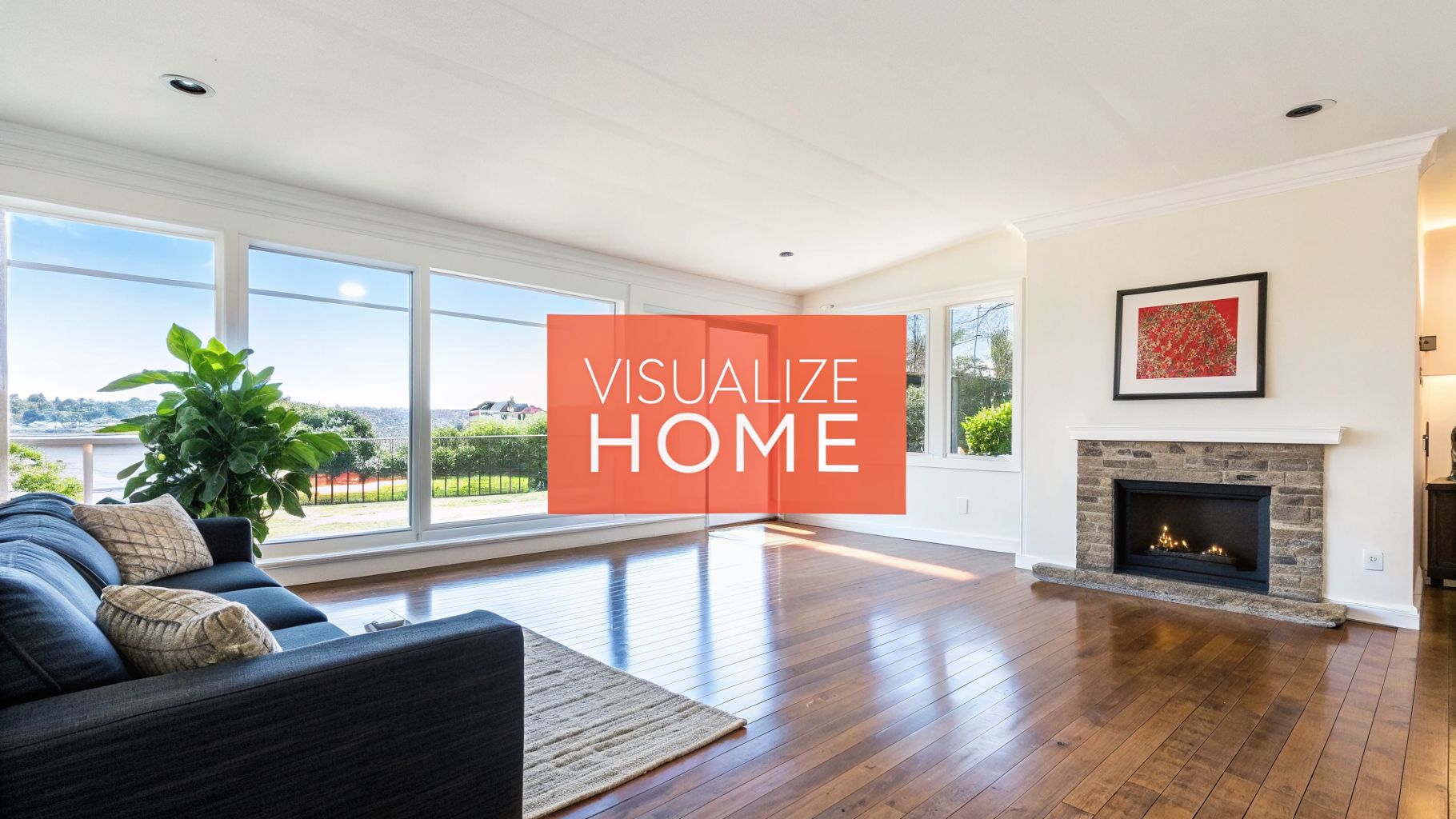
Let's be honest. When a buyer is swiping through dozens of listings, a sea of empty, beige rooms starts to look the same. They're cold, impersonal, and—surprisingly for us pros—really hard for most people to connect with. An empty space doesn't just lack furniture; it lacks emotion.
Virtual staging fixes this by digitally adding stylish furniture, art, and decor into your listing photos. Instead of seeing four blank walls, buyers see a living room ready for movie night, a home office where they can close their next deal, or a serene bedroom to unwind in. It’s a simple edit with a massive psychological payoff.
Bridging the Imagination Gap
Most people can't walk into an empty room and see its potential. They can’t accurately judge scale, figure out if their sectional will fit, or feel any sort of spark. We call this the "imagination gap," and it’s a deal killer.
Virtual staging bridges that gap by handing them a finished vision on a silver platter.
It’s about showing a property as a potential home, not just a house. This helps buyers get past the mental hurdles of an empty space and start picturing their own future there.
Once a buyer can see themselves hosting Thanksgiving in that dining room, they're not just looking anymore. They're emotionally invested. And that's the first real step toward an offer.
The Undeniable Impact on Sales
The numbers don't lie—staging works. Whether it's physical or virtual, a staged home grabs attention and holds it.
The performance gap between staged and unstaged properties isn't just a talking point; it's a clear, bottom-line advantage for agents who know how to use it. The data shows exactly how presentation drives results.
Quick Answer: How Staging Impacts Home Sales
| Metric | Staged Homes | Unstaged Homes |
|---|---|---|
| Time on Market | Sell 73% faster (avg. 24 days) | Avg. 90 days |
| Sale Price | 85% sell for 5-23% over list | Often sell at or below list |
These figures tell a powerful story. Staging isn't an expense; it's an investment that accelerates the sale and boosts the final price.
Digging deeper into the core principles of how to stage a home for selling, it's all about making that crucial connection with buyers.
In a market where the first showing happens on a phone screen, your listing photos are everything. They determine if you even get a chance for an in-person tour. Virtual staging makes sure your property delivers a knockout first impression.
Ready to make this technique your own? Our complete virtual staging guide will show you everything you need to know.
How The Box Brownie Virtual Staging Process Actually Works

Think of using BoxBrownie.com less like a self-serve app and more like commissioning a team of digital artists. Their whole model is built on a human-powered workflow, which is the most important thing to understand when you're thinking about turnaround times and results. It’s a hands-on service for agents who want to delegate the creative work.
Everything starts inside your dashboard after you create an account. This is where you’ll place new orders, track progress, and talk to their team. The platform is built to handle anything from a single photo for a new listing to an entire portfolio.
Kicking Off Your First Order
Placing an order is pretty simple. You start by uploading the high-resolution photos of the empty rooms you need staged. Remember: garbage in, garbage out. The higher the quality of your original photo, the more realistic the final staged image will look.
Once your photos are in, you get to play creative director. This is your chance to guide the designers and make sure the final image speaks to the right kind of buyer for that specific property.
The core of the Box Brownie virtual staging process is choosing a furniture style from their library. You’ll find everything from modern and contemporary to farmhouse and coastal, so you can match the staging to the home's vibe.
You can also add specific instructions for the design team, like "add a small desk in the corner to show a home office" or "stick to neutral colors." This back-and-forth ensures you get a custom marketing asset, not just a generic staged photo. After you submit, the job gets assigned to their global team of editors.
The Human Touch: Turnaround and Revisions
Unlike instant AI tools, BoxBrownie uses skilled photo editors to manually place 3D furniture models into your photos. This human element is their key selling point, promising a high degree of realism. But it also means you won't get your images back in minutes.
A typical turnaround time for Box Brownie virtual staging is 24 to 48 hours. This can change depending on how complex the request is and how busy they are. When the job is done, you’ll get an email and can review the staged images in your dashboard.
What if it’s not quite right? BoxBrownie offers free revisions, which is a huge part of their service. If you don't like the couch or want to swap out a rug, you can send it back with notes. The revision process usually takes another 24 hours.
The workflow really boils down to these steps:
- Photo Upload: You provide the empty room photos.
- Style Selection: You pick a design style from their catalog.
- Designer Assignment: The job is sent to a human photo editor.
- Staging and Rendering: The editor manually adds and perfects the furniture.
- Review and Revision: You check the work and ask for changes if you need them.
- Final Delivery: You download the finished, high-res photo.
This manual process gives you a direct line to a professional who can fine-tune the final image. To really grasp the power of this, checking out some powerful house staging before and after examples shows just how much a great staging job can transform a space. The trade-off is clear: you exchange speed for a curated, hands-on approach.
Understanding BoxBrownie Pricing: What's the Real Cost?
It’s easy to glance at the per-image price for BoxBrownie virtual staging and think you’ve got the full picture. But that sticker price is just the beginning. The real cost of using their service isn’t a single number—it’s a tally of every little edit your listing needs.
BoxBrownie operates on an à la carte model, not a subscription. That means every single task is a separate line item. The base price gets you a staged photo, sure. But what if the room isn't empty? Removing the seller's old furniture is a separate charge. Want to showcase a kitchen with updated cabinets? That’s a virtual renovation—another, more expensive service.
This pay-as-you-go approach gives you flexibility, but it also means costs can balloon quickly. For a high-end listing where you only need to stage the empty living room, it works. But for a typical family home, you'll likely want to stage multiple rooms, and that's where the math gets interesting.
A Practical Cost Analysis
Let's run the numbers on a standard three-bedroom house. To really connect with buyers, you’ll want to stage the most important spaces.
Here’s a pretty common scenario:
- Living Room: Needs virtual staging.
- Master Bedroom: Also needs staging.
- Spare Bedroom: You want to show its potential as a home office.
- Cluttered Family Room: The owner's furniture has to go before you can stage it.
Right there, you're not paying for three staged photos. You're paying for three virtual staging jobs plus one item removal job. That one extra step significantly bumps up the total bill for a single listing.
The true cost of using BoxBrownie isn't the price of one photo. It's the cumulative expense of all the edits needed to get a single property ready for the market. For a full home, that can easily climb into the hundreds of dollars.
This model forces you to be strategic. You can't afford to stage every empty room in a large house without a serious budget. Instead, you have to pinpoint which one or two images will deliver the biggest impact and highest return.
Looking Beyond the Initial Price
There’s more to the final bill than just the edits. BoxBrownie's pricing does include a certain number of free revisions, but these are for minor tweaks. If you change your mind about the design style or ask for something that deviates too far from your original request, it might be classified as a "re-do" and come with another fee.
The lesson here? Be incredibly specific with your instructions from the get-go. The more detail you provide upfront, the better your odds of getting the perfect shot on the first try, saving you both time and money on back-and-forth edits.
Key Financial Considerations with BoxBrownie:
- Cost Per Image: The starting point for a single staged photo.
- Add-On Services: Expect to pay extra for item removal, virtual renovations, and day-to-dusk edits.
- Volume of Photos: The bill grows with every photo you decide to edit.
- Revision Limits: Know what’s included and what will cost you more if you need major changes.
So, is BoxBrownie virtual staging worth it? It all comes down to your specific situation. If you have a one-off luxury listing that just needs a couple of perfectly staged shots, the pay-per-image model is a great way to get professional results without a subscription. But if you’re an agent juggling multiple listings or need to stage several rooms per property, those costs add up fast. You have to do the math before you commit.
The Next Wave: AI-Powered Virtual Staging
For years, the manual, hands-on approach of services like Box Brownie has been a go-to for virtual staging. But the ground is shifting. The industry is moving from commissioning individual digital artists to using generative AI, and it’s changing how agents market properties from the ground up.
Think about it like this: traditional services are like ordering a custom-built car. You give your specs to the workshop, wait a few days, and hope the final product matches what you pictured. AI-powered virtual staging, on the other hand, is like having a car configurator that creates and shows you a dozen different models, colors, and trims in a matter of seconds.
The real difference is what’s under the hood. Instead of a human editor manually dragging and dropping furniture into a photo, sophisticated AI algorithms are analyzing the room and generating complete, context-aware designs on the spot. This isn't just a service anymore; it's a platform built for speed, creativity, and incredible cost savings.
The AI Advantage: Speed and Scale
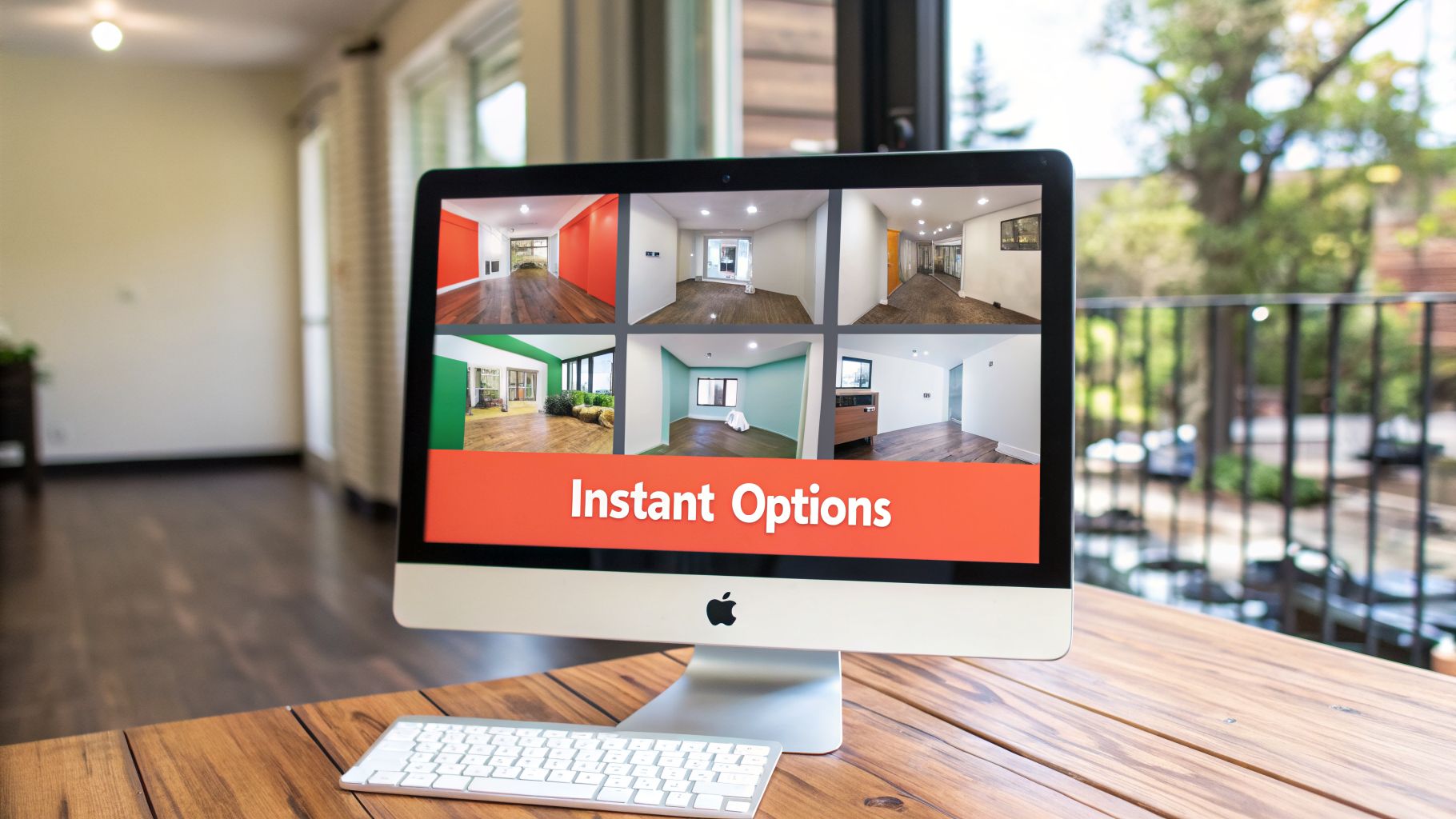
The most obvious win with AI staging is that the waiting game is over. That standard 24-to-48-hour turnaround for a manual job? It’s basically obsolete. With AI platforms like Bounti Labs, you upload a photo of an empty room and get back multiple, fully-staged versions in seconds.
This instant feedback loop is a game-changer for agents. You’re no longer stuck committing to a single style and crossing your fingers. You can generate options in Modern, Scandinavian, Farmhouse, and more, all at once, and pick the one that works best.
For agents juggling multiple listings, this isn't just about convenience—it's about scalability. An AI subscription lets you stage every room of every listing without worrying about per-image fees, which is a massive ROI.
This shift is happening as the virtual staging market explodes, projected to grow from about $454 million in 2025 to a staggering $1.33 billion by 2026, a surge driven almost entirely by AI.
Unlimited Revisions at No Extra Cost
Another massive advantage is the end of the dreaded revision request. With manual services, asking for changes means more waiting and, often, more money. With AI, a "revision" is just the click of a button.
Don't love the couch? Generate another version. Want to see a different rug? Get a new option instantly. This gives you the creative freedom to experiment and dial in your marketing visuals without any friction or financial penalty.
This flexibility means you can cater to specific buyer tastes or even A/B test different designs on social media to see what gets the most engagement—something that’s just not practical with a pay-per-image, human-powered workflow. For a deeper look at how AI is changing real estate visuals, check out our guide on the best AI photo editing software.
Box Brownie Versus AI Staging: A Head-To-Head Comparison
So, what does this all mean in practice? Let's put the traditional service model and the new AI-powered platform approach side-by-side to see how they really stack up.
| Feature | Box Brownie (Traditional) | Bounti Labs (AI-Powered) |
|---|---|---|
| Turnaround Time | 24-48 hours per image | Instant results (seconds) |
| Revision Process | 24-hour wait, manual requests | Unlimited, instant regeneration |
| Pricing Model | Pay-per-image, à la carte | Flat-rate subscription |
| Creative Control | Limited to pre-set styles | Generate endless style variations |
| Scalability | Costly for multiple listings | Cost-effective for volume |
This table makes it pretty clear. The decision is no longer just about getting a room staged; it's about choosing a workflow that matches the speed and scale of your business.
For agents who need to move fast, maintain creative control, and manage costs effectively, AI-powered solutions aren't just an alternative—they're the future of property marketing.
Using Virtual Staging Ethically and Effectively
Virtual staging is a seriously powerful marketing tool. But with that power comes real responsibility. Get it wrong, and you can obliterate buyer trust and even walk straight into legal trouble.
The goal is to show a property’s potential, not to create a fantasy. Think of it less like a mask and more like a great makeup job—it highlights the best features, it doesn't hide the truth.
So, when you use a service like Box Brownie virtual staging, you’re also signing up for total transparency. If a photo has been digitally furnished, you have to say so. This isn't just about being a good person; it's about building the trust your entire career depends on.
The Non-Negotiables of Ethical Staging
There’s a bright, unmissable line between ethical enhancement and outright deception. Your job is to paint a picture of what’s possible while staying grounded in the reality of the property. Nail this, and you protect your reputation and your client.
A few rules are absolutely non-negotiable:
- Disclose, Disclose, Disclose: Every single virtually staged image needs to be clearly marked. A simple watermark or text overlay saying "Virtually Staged" is non-negotiable. It manages expectations from the very first glance.
- Keep the Scale Real: The digital furniture has to match the room's actual proportions. We've all seen it: a tiny, doll-sized sofa placed in a small room to make it look palatial. It’s a classic mistake that only leads to disappointment when buyers show up for the tour.
- Never, Ever Touch the Bones: This is the biggest red line. You cannot digitally knock down a structural pillar, paint over a huge crack in the wall, hide water damage, or swap out the flooring. Virtual staging is for adding furniture and decor—not for digital demolition or cover-ups.
Following these rules isn’t just about dodging complaints. It’s about upholding the professional standards set by organizations like the National Association of REALTORS® (NAR) and staying compliant with local MLS regulations, many of which now have very specific policies about photo alterations.
Protecting Your Reputation and Your Clients
The fallout from misleading buyers is no joke. It can range from a trashed reputation to formal ethics complaints and even lawsuits. An agent known for deceptive photos will never build the long-term trust needed for a sustainable career.
Remember, even when you hire a service like Box Brownie virtual staging, you are the one on the hook for how those images are used. Always—and I mean always—review the final photos to make sure they're an honest representation of the property's actual condition, just without the stuff in it.
Stick to these best practices, and you can use virtual staging with confidence. You get to sell a compelling vision that captures serious buyer interest, all without compromising your integrity. You help people see the incredible potential in a space while ensuring that what they see online is what they’ll get in person.
Deciding Which Virtual Staging Service Is Right For You
With so many virtual staging options out there, picking the right one can feel like a chore. Should you go with the hands-on, human touch of a traditional service, or the sheer speed of an AI platform? The answer really comes down to your business, your budget, and how you get listings to market.
Let's think about it like coffee. Sometimes you want to go to a cafe, chat with the barista, and get a perfect, handcrafted latte made just for you. Other times, you just need a great cup of coffee right now, and the espresso machine on your counter is the only thing that makes sense. Neither is "better"—they just solve different problems for different moments.
A traditional service like Box Brownie virtual staging is your personal barista. It’s perfect for an agent with one high-end listing who needs a specific, bespoke look and doesn't mind waiting a day or two for that polished result.
An AI-powered platform, on the other hand, is your home espresso machine. It’s built for the agent, team, or brokerage juggling multiple properties. When you need to stage five homes before the weekend, speed, volume, and cost-efficiency are what matter most. Waiting on individual edits just isn't in the cards.
Tailoring Your Choice to Your Business Model
The right move depends on a few key factors. Are you a solo agent staging a couple of hero shots for each listing? Or are you a brokerage trying to market dozens of properties every month?
Ask yourself these questions:
- Listing Volume: How many properties do you actually stage each month?
- Budget: Do you prefer a predictable flat-rate subscription or a pay-per-image model where costs can fluctuate?
- Turnaround Time: Do you need images back in minutes, or is a 24-48 hour wait acceptable?
- Creative Control: Do you want to generate tons of style options yourself or hand off the design decisions to an editor?
Your workflow dictates your best choice. If your business is built on volume and speed, a subscription to an AI platform like Bounti Labs will almost always deliver a better ROI. If your model is built around a few high-touch, luxury listings, a manual service could be the way to go.
A Decision Framework for Agents
Let’s break it down into simple terms.
You should choose a traditional service like Box Brownie if:
- You have a healthy marketing budget for a single, important listing.
- You only need to stage one or two key photos, like the living room and primary bedroom.
- You’re not in a rush and can wait up to two days for the finished images.
- You’d rather delegate the entire creative process and let someone else handle it.
You should choose an AI-powered platform like Bounti Labs if:
- You manage multiple listings and need to stage rooms without breaking the bank.
- You need instant results to get properties on the market today, not tomorrow.
- You want the freedom to experiment and generate different styles on the fly.
- You prefer a predictable, flat-rate monthly cost for unlimited staging.
To make this even clearer, this ethical staging checklist outlines the core principles you must follow, regardless of which service you choose.
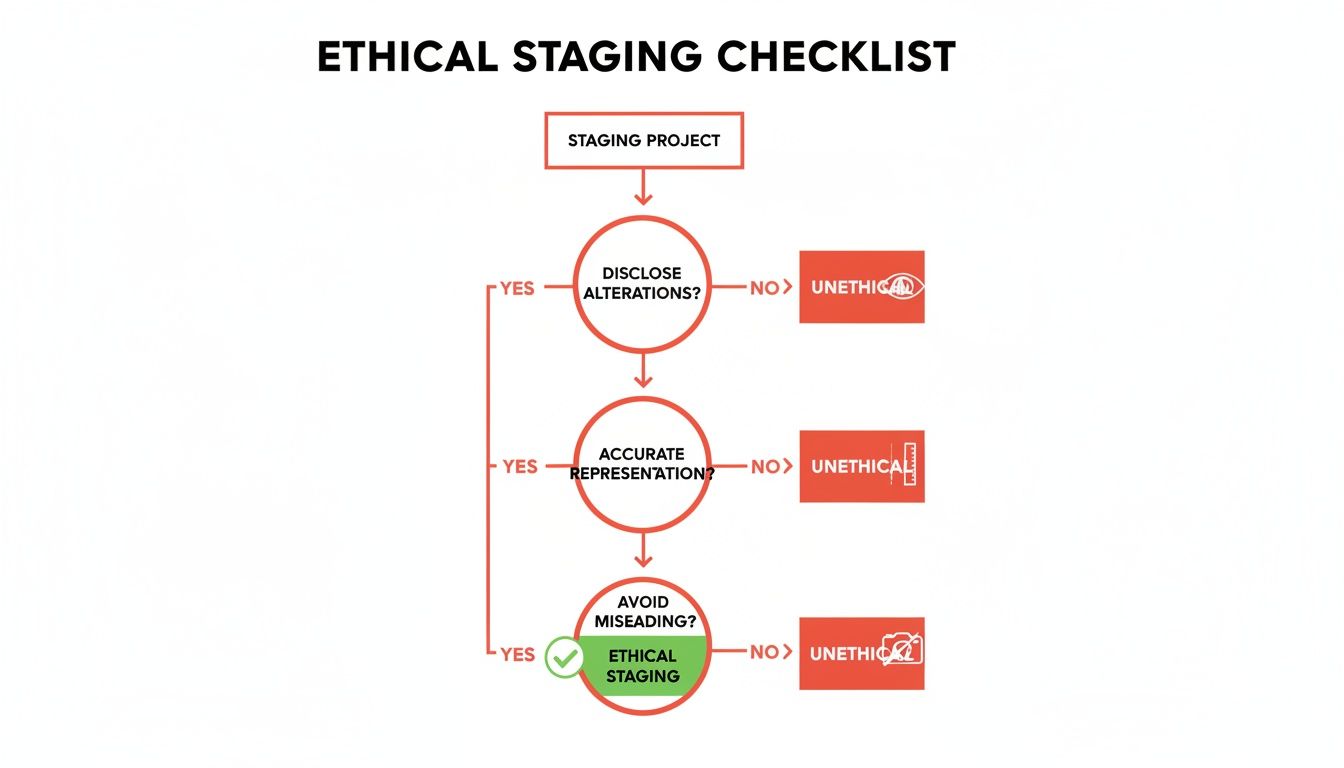
At the end of the day, disclosure, accurate scale, and honesty are the foundations of marketing that people trust. Your choice of tool should help you create beautiful images while making it easy to uphold these critical standards on every single listing.
Answering the Tough Questions About Virtual Staging
Even seasoned agents have questions before spending money on virtual staging. And that's smart. When you're paying per photo for a service like Box Brownie virtual staging, you need to know it’s going to work. Let’s get into the most common questions we hear from agents on the ground.
One of the biggest hang-ups is whether staging is worth it for a mid-range or starter home. The answer isn't just yes—it's absolutely. The point isn't to make a $400k house look like a Beverly Hills mansion. It's to close the "imagination gap" so a buyer can see themselves living there.
An empty room feels cold and sterile, no matter the price tag. Staging is what makes a starter house feel like a cozy first home, or a mid-range property feel like a solid place to raise a family. It’s about creating an emotional connection that speeds up the sale.
ROI isn't just for luxury listings. Selling faster and for a better price works in every market segment.
What About Homes That Are Occupied or Just… Messy?
This is where things get interesting. What do you do with a home that's full of a seller's dated furniture, personal clutter, or just stuff you wish wasn't there? This is a job for item removal, a service that most providers, including Box Brownie, offer as an add-on.
Their team will digitally erase all the existing furniture and clutter from your photos first. Only then do they stage the now-empty room. This remove-then-stage workflow is a game-changer for occupied listings. You get to present a clean, modern vision of the home without asking your clients to haul a single sofa out the door.
How Do I Choose the Right Furniture Style?
Okay, the room is empty. Now what? The biggest mistake agents make is choosing furniture based on their own taste. Your style isn't what's for sale. You need to think like a set designer and choose a look that speaks directly to your target buyer.
- Young Professionals: Go for Modern or Scandinavian. Think clean lines, uncluttered spaces, and a minimalist vibe.
- Growing Families: Try Farmhouse or Transitional styles. These feel warm, durable, and instantly welcoming.
- Luxury Buyers: Contemporary or glam styles are your friend. Focus on high-end textures, sophisticated palettes, and statement pieces.
Whether you're using Box Brownie virtual staging or another tool, the goal is the same: tell a story. You're helping someone see more than just a property; you're helping them picture their future.
Ready to stop waiting and start creating? Bounti Labs offers AI-powered virtual staging that delivers unlimited designs in seconds, giving you the speed and creative freedom to market every listing effectively. Explore what's possible at https://www.bounti.ai.