
Most advice on a brown and black bedroom is wrong for listings.
Agents get told to “lighten everything up,” avoid dark palettes, and play it safe with beige. That advice produces forgettable photos and bedrooms that buyers scroll past. Safe doesn't win attention. Safe blends in with every other listing in the feed.
A well-staged brown and black bedroom does the opposite. It gives the home a point of view. It feels expensive, calm, and deliberate. It turns a basic bedroom into a retreat, which is exactly how buyers want to experience private spaces when they're deciding whether a home feels luxurious or ordinary.
The key is control. If you let black and brown fight for dominance, the room looks heavy. If you stage it with hierarchy, texture, and the right lighting, it reads like a boutique hotel suite instead of a dark cave. That distinction is where better marketing lives.
Why a Brown and Black Bedroom Sells in 2026
The old objection is simple. Brown looks dated. Black feels harsh. Together, they'll scare buyers.
I disagree.
Brown and black were historically treated as safe neutrals before becoming a more deliberate style move in the 21st century. Brown's comeback is especially relevant because Pantone named Mocha Mousse its 2025 Color of the Year, signaling a broader shift toward warm, grounded palettes that align with emotionally calming interiors, as noted by Feather & Black's coverage of brown bedroom design.
That matters for agents because bedrooms sell emotion before they sell square footage. Buyers don't walk into a bedroom and think about color theory. They ask themselves one question: would I want to shut the door and exhale here?
Why this palette works for listings
A brown and black bedroom creates a stronger emotional impression than another gray-and-white setup. Brown adds softness and depth. Black gives the room edge and structure. Together, they photograph with more contrast and more character than washed-out neutrals.
You're not staging for design approval from other agents. You're staging for buyer memory.
Practical rule: If a bedroom can be described as “nice,” it's too weak. If it can be described as “calm, rich, and polished,” you've built something marketable.
What buyers see in the photos
Dark neutrals can look current, not dated, when you pair them with texture, wood, and warm light. This is the key shift. The palette no longer reads as old-fashioned when it's styled with restraint and modern materials.
Use that to your advantage:
- Create contrast buyers remember: Black framing on lamps, artwork, or nightstands gives listing photos clean visual anchors.
- Build warmth fast: Brown upholstery, wood tones, and bedding keep the room from feeling cold.
- Make the room feel intentional: Strong palettes signal that the home was styled, not just cleaned.
Agents who understand this stop trying to “fix” a dark bedroom and start packaging it.
Mastering the Palette for Buyer Appeal
The biggest staging mistake is the equal split. If the room is half black and half brown, it looks undecided. Buyers don't read that as refined. They read it as dark.
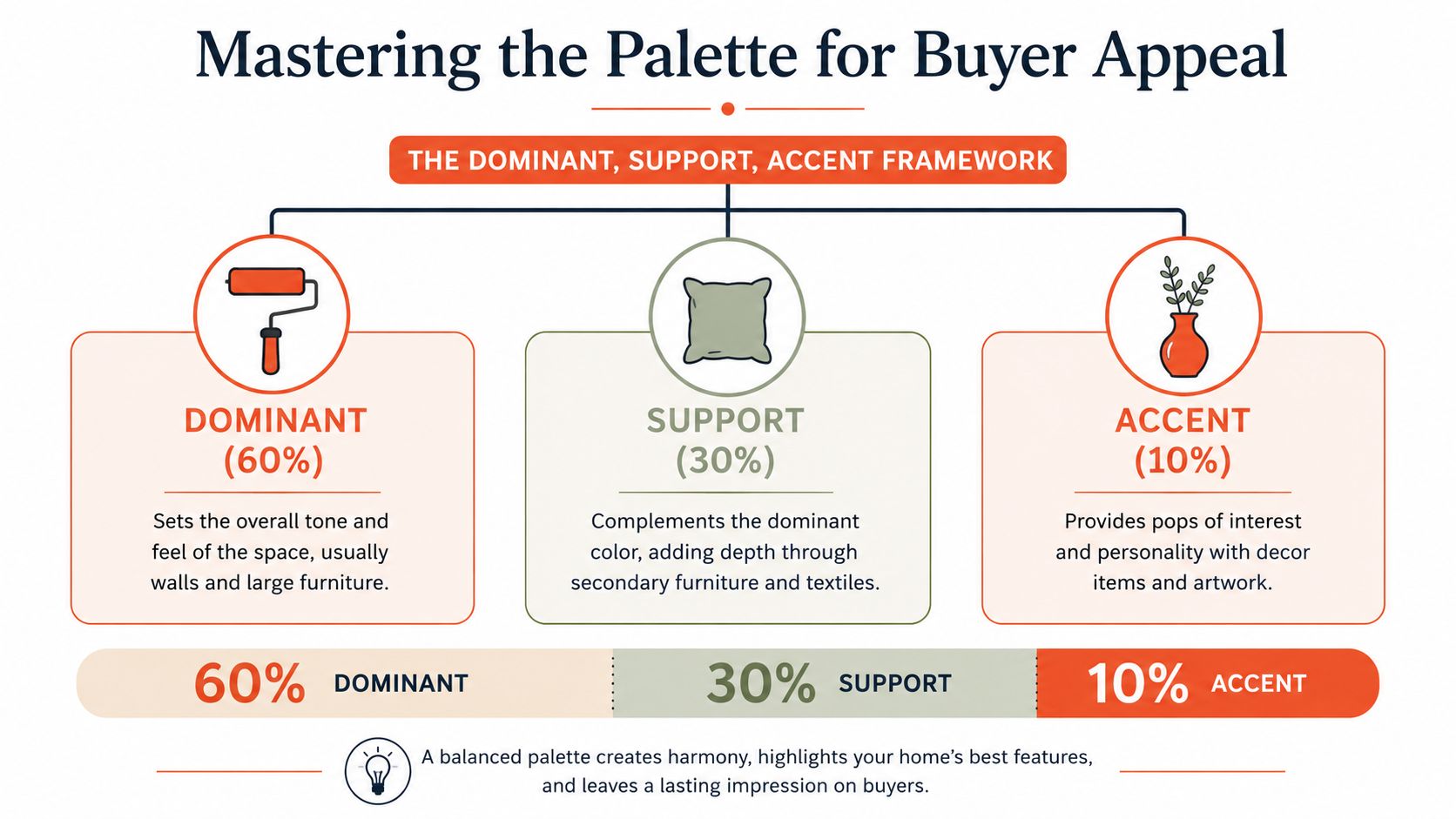
Run a simple framework instead. Dominant, support, accent.
Use one color as the lead
In most listings, brown should dominate. It's warmer, more forgiving, and easier to scale across bedding, wood furniture, and textiles. Black should support the look, not swallow the room.
That means brown carries the comfort story. Black sharpens the edges.
A useful working ratio is 60-30-10. Treat it as a staging discipline, not a decorating law. Brown should handle the largest visual surfaces, black should anchor secondary elements, and the final layer should come from a lighter counterpoint such as cream or off-white.
Texture is what makes dark neutrals sell
Flat dark rooms die in photos.
What rescues a brown and black bedroom is material contrast. You need visible texture so the camera can separate surfaces and buyers can read the room as layered rather than muddy.
Use a mix like this:
- Wood for warmth: Walnut, oak, or medium-toned wood keeps the room grounded.
- Linen or cotton for softness: Bedding needs visible folds and tonal variation.
- Metal for definition: Black metal or bronze details create crisp edges.
- Leather or faux leather in small doses: A bench, chair, or accent pillow can add polish without making the room feel masculine or stiff.
Brown and black don't need more color to work. They need more surface variation.
The three elements that reliably work
Design guidance on this palette consistently points to 3 key elements: textured bedding in chocolate or coffee shades, natural wood furniture, and warm-toned lighting, because black anchors the room while brown introduces warmth, as shown in this brown-and-black bedroom inspiration guide.
That's the formula. Don't improvise your way out of it.
| Layer | What to use | What it does |
|---|---|---|
| Dominant | Brown bedding, wood bed frame, brown rug | Sets warmth and comfort |
| Support | Black lamps, black nightstands, black frames | Adds structure and contrast |
| Accent | Cream throw, off-white pillows, light art mat | Prevents heaviness |
What to avoid
Skip these if you want the room to convert:
- Equal black and brown distribution: It makes the room feel dense.
- All-matte everything: Without sheen or reflection, photos lose depth.
- Too many unrelated wood tones: Pick one main wood direction and stay disciplined.
- Cold lighting: It kills the cocooning effect and makes brown look muddy.
The Staging Playbook Furniture Textiles and Decor
Most agents overthink this room. You don't need a designer showroom. You need a staging kit that creates hierarchy, softness, and one strong visual story.
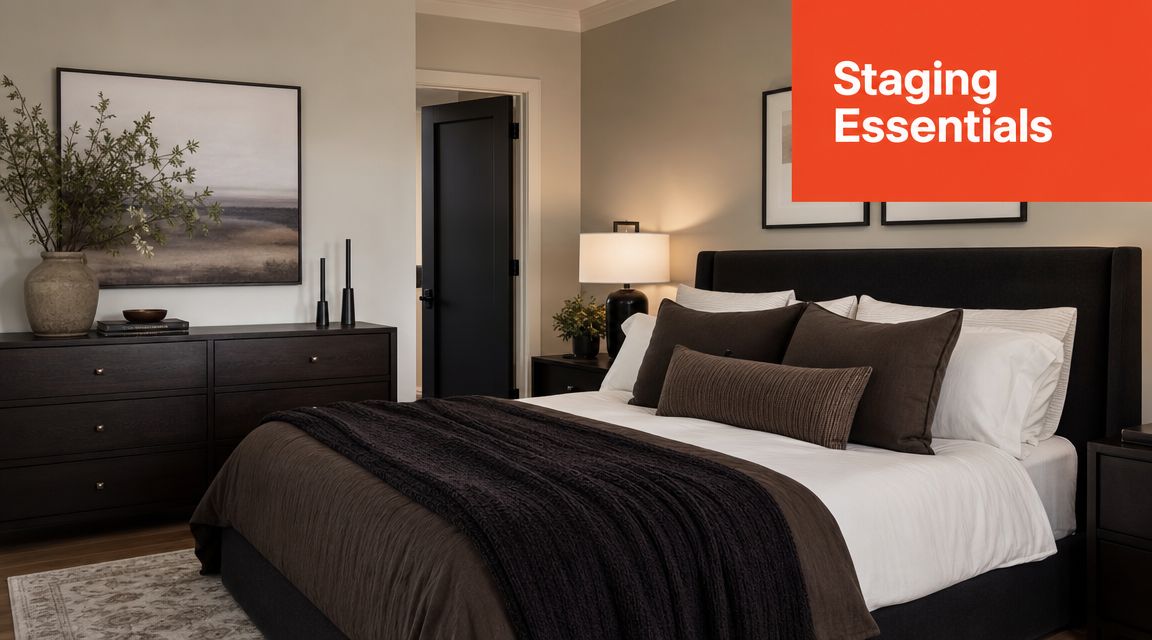
Start with the bed. It's the hero shot.
Furniture choices that photograph well
The strongest setup is usually a wood bed paired with black accents. A walnut or medium-dark wood frame gives you warmth immediately. Then bring in black through slimmer pieces such as nightstands, sconces, curtain rods, or a bench base.
Don't choose bulky black furniture unless the room is large and bright. In average bedrooms, black works best when it outlines the space instead of filling it.
Use this decision filter:
- If the room has decent natural light: You can push black further into nightstands or a dresser.
- If the room is tighter or dimmer: Keep black to lamps, frames, and hardware.
- If the existing furniture is mismatched: Unify with bedding and lighting before replacing large pieces.
For agents working with occupied homes, restraint pays off. You don't need to swap every item. You need to remove the pieces that break the story.
A practical reference for furniture flow is this guide on how to create a serene bedroom sanctuary. It's useful when the room layout is fighting the mood you're trying to stage.
Textiles that make the room feel expensive
Bedding does most of the heavy lifting in a brown and black bedroom. If you cheap out here, the room will look flat even with good furniture.
The bed should have visible layering. That means a chocolate, coffee, or mocha duvet or quilt, lighter sheets peeking through, and at least one tactile top layer such as a knit throw, quilted coverlet, or lumbar pillow in a contrasting fabric.
Use a simple stack:
- Base layer in cream, oatmeal, or off-white
- Main layer in brown
- Contrast layer in black or charcoal
- Texture layer through a throw or accent pillow
This is also where agents can lean on virtual planning before spending on physical pieces. A smart prep step is reviewing a virtual staging guide for real estate marketers so you can test the look before sourcing inventory.
Decor that fixes the room without cluttering it
Decor should correct weak points, not just fill surfaces.
If the room lacks light, add a mirror. If the furniture feels cold, bring in brass or bronze hardware. If the walls feel blank, use art with warm undertones, soft contrast, and simple frames. Don't hang loud abstract pieces that hijack the mood.
The best decor in a staged bedroom solves a problem the buyer never notices.
The room should also have one organic element. That can be a wood tray, a branch arrangement, or a muted plant in a simple pot. Skip glossy fake greenery that screams staging kit.
A short visual reference helps here if you're briefing a seller, assistant, or junior stager on the look you want:
The fastest shopping list for agents
If you need to assemble the room quickly, buy or borrow these first:
- A brown duvet or quilt: This sets the room's mood faster than paint.
- Two matching black lamps: Symmetry always improves listing photos.
- One wood bench or stool: It introduces natural texture at the foot of the bed.
- Cream pillows or sheets: They break up dark bedding and improve legibility.
- A mirror with a warm metal or dark frame: It reflects light and adds polish.
That's enough to change the room from generic to market-ready.
Essential Lighting and Photography Techniques
A brown and black bedroom can look premium in person and terrible online if you light it badly. Poor lighting means a lot of agents lose the sale before the showing even starts.
Dark palettes need layered illumination. One ceiling light won't carry the room.

Build three layers of light
Guidance for darker rooms is clear. Use multiple light sources instead of relying on a single overhead fixture, and add at least one reflective or lighter element such as off-white bedding, mirrors, or brass hardware so the room stays comfortable and legible, according to Kevin Francis Design's advice on dark brown bedrooms.
That translates into a simple listing setup:
- Ambient light: Warm overhead fixture or flush mount that fills the room.
- Task light: Matching bedside lamps that give the bed structure and balance.
- Accent light: A floor lamp, wall sconce, or light hitting art or a mirror.
If you only turn on the ceiling fixture, the corners collapse and black surfaces go dead.
What your photographer needs to know
Don't treat this bedroom like a white box. The goal isn't maximum brightness. The goal is controlled warmth and visible depth.
Brief your photographer with these priorities:
| Priority | What to ask for | Why it matters |
|---|---|---|
| Window timing | Shoot when natural light is strongest | Keeps dark finishes readable |
| Exposure control | Protect details in shadows and bedding folds | Prevents muddy images |
| Color accuracy | Keep brown warm and black neutral | Avoids orange or blue casts |
| Angle selection | Shoot from a height that flatters the bed | Makes the room feel grounded, not cramped |
A good companion reference is this house staging before and after guide, especially if you need to show sellers why styling and lighting decisions materially change the final marketing package.
Buyers forgive a small bedroom. They don't forgive a bedroom photo they can't read.
Fast fixes before the shoot
Agents can improve the result in minutes:
- Open every window treatment fully before the photographer arrives.
- Turn on every bulb in the room and make sure the color temperature is consistent.
- Pull the bed slightly away from the wall if the room allows it. That creates cleaner edge definition.
- Remove dark clutter from nightstands so the lamps, bedding, and bed shape stay dominant.
If the room still reads too heavy, add one lighter throw at the foot of the bed or swap in lighter pillowcases. Small contrast changes often do more than another decor item.
The Instant Makeover with AI Staging
Physical staging is powerful, but it isn't always practical. Some bedrooms are vacant. Some are packed with oversized furniture. Some have sellers with highly personal taste that sabotages the listing.
That's where AI staging becomes a tactical advantage.

When AI staging makes the most sense
Use it when the room has good bones but poor presentation. An empty rectangle doesn't help buyers understand scale or mood. A cluttered seller bedroom can be even worse because buyers focus on the owner's life instead of the property's potential.
A brown and black bedroom concept is especially well suited to AI staging because the look depends on coordinated materials, tonal control, and visual restraint. That's hard to pull off quickly with whatever inventory happens to be available locally.
Best-use scenarios include:
- Vacant listings that need warmth and identity
- Occupied homes where the existing decor is distracting
- Remote or budget-sensitive listings where physical staging isn't efficient
- Pre-listing presentations when you want to show the seller a sharper vision before they spend money
The workflow that actually works
Keep the process simple.
Start with a clean photo of the bedroom. Remove obvious clutter if possible. Then create a prompt that specifies the exact staging direction: warm brown bedding, black accent furniture, natural wood textures, layered lighting, boutique-hotel feel, minimal decor, and one lighter balancing element.
If the original image isn't sharp enough, it helps to learn MyImageUpscaler photo upscaling before running staging variations. Better input images usually produce cleaner marketing assets.
Then pressure-test the output like an agent, not like a designer:
- Does the bed wall read immediately?
- Can buyers see circulation space?
- Does the room feel calm rather than dark?
- Do the materials look believable for the price point?
For teams also refining final imagery, this walkthrough on HDR photography for real estate pairs well with AI staging because the best visual package usually combines style direction with disciplined image finishing.
What to avoid with AI visuals
Don't generate fantasy rooms that the house can't support. If the bedroom is compact, don't stage it with oversized furniture. If the windows are tiny, don't create a sun-drenched look that buyers won't experience in person.
Use AI to clarify potential, not falsify it.
That's the strategic edge. You can present a polished brown and black bedroom concept fast, align it to the listing's likely buyer, and avoid the delay and friction of full physical setup.
FAQ Solving Common Brown and Black Bedroom Challenges
How do you use this palette in a small or north-facing room?
Most advice says to add metallics and hope for the best. That's lazy guidance.
For bedrooms under 120 sq ft, keep black limited to smaller accent pieces and leave the ceiling plus one primary wall lighter to preserve the sense of space, based on Living Spaces guidance for compact bedrooms. In plain terms, don't turn every surface dark.
Use brown as the main mood-setter through bedding, wood tones, and one upholstered element. Then add black in controlled amounts through lamps, frames, or a bench base. If the room faces north or gets weak daylight, prioritize reflective finishes and layered lighting over more decor.
Should the walls be light or dark?
There isn't one answer. There is a right answer for the room you have.
If the bedroom has decent daylight and architectural interest, dark walls can work. They create a cocooning effect and can make the room feel more immersive. If the room is small, dim, or visually flat, keep the walls lighter and let the brown and black come through furnishings and textiles instead.
A simple rule:
- Use darker walls when the room already feels open and you want drama.
- Use lighter walls when you need flexibility, brightness, and broader buyer appeal.
- Never let every large surface go dark at once unless the room has exceptional light.
In a challenging bedroom, paint should support the staging story, not carry the entire story alone.
How do you mix different brown and black furniture pieces without clashing?
Stop trying to match everything perfectly. Match the intent.
You can mix woods and black finishes if you control three things:
- One dominant wood tone: Let one brown family lead. Walnut with walnut-adjacent tones is easier to sell than a jumble of espresso, red cherry, and gray oak.
- Repeated black accents: If black appears only once, it looks random. Repeat it in at least a few visible spots such as lamps, frame lines, and hardware.
- Consistent undertone direction: Warm woods pair better with warm metals and warm whites than with icy grays.
If the seller has inherited furniture chaos, simplify the read. Remove the noisiest piece, unify with bedding, and repeat one finish enough times that the room feels deliberate.
What if the room feels too masculine?
That usually means the staging lacks softness, not that the colors are wrong.
Add linen, boucle, cream accents, curved shapes, and warmer art. Brown and black can feel refined without feeling severe. The fix is almost always textile-driven.
What if the listing photos still look heavy?
Then the issue isn't the palette. It's contrast management.
Lighten one surface. Add a mirror. Swap one dark throw pillow for a cream one. Turn the bedside lamps on. Edit the styling until the bed reads first, the floor reads second, and the corners don't disappear.
Bounti Labs helps agents turn rooms with potential into marketing assets that win attention. If you want faster listing visuals, cleaner staging concepts, and AI-powered transformations from a single walkthrough, explore Bounti Labs.