You've narrowed the search. A building looks right. The rent seems within budget. Then the lease arrives and the easy part is over.
What looked like a simple space decision turns into a business risk decision. The document is dense. Operating expenses are vague. The work letter looks thin. Renewal language favors the owner. Assignment rights are narrow. If you're handling that alone, you're negotiating against a party that does this every day and has representation built for one job: protecting the landlord's economics.
That's where commercial tenant representation stops being a nice extra and becomes part of basic deal discipline. A good tenant rep doesn't just open doors and schedule tours. They strengthen their client's position, control information flow, compare the actual cost of different options, and keep bad lease language from becoming an expensive lesson later.
Your Advocate in a Complex Real Estate Market
A lot of tenants call a broker too late.
They've already picked a building, already talked themselves into the layout, and already started reacting to the landlord's paper. At that point, the landlord's side has a major advantage. They know the asset, the ownership objectives, the pressure points, and the lease form. The tenant is still trying to figure out which clauses matter.
Commercial tenant representation exists to fix that imbalance.
A tenant representative is a licensed broker aligned only with the tenant's interests in site selection, lease negotiation, and risk management. That model became mainstream as the brokerage industry professionalized around the tenant and landlord split in the late 20th century, and it matters because the landlord's broker is aligned to maximize the owner's economics while the tenant rep is aligned to reduce occupancy cost and preserve flexibility, as described in TenantBase's overview of tenant representation in 2026.
In practice, that changes the whole conversation.
A business owner may focus on whether the storefront feels right or whether the office has enough glass. A tenant rep asks better first questions. What will this lease cost over time? How exposed are you to expense pass-throughs? Is the expansion option usable or cosmetic? If your business changes, can you assign or sublease without getting trapped?
Practical rule: The most expensive part of a lease usually isn't the asking rent. It's the clause you didn't understand when you signed.
That's why good representation starts before tours, not after the draft lease lands. The rep's job is to protect business flexibility from day one, not rescue the deal at the end.
What a Commercial Tenant Rep Really Does
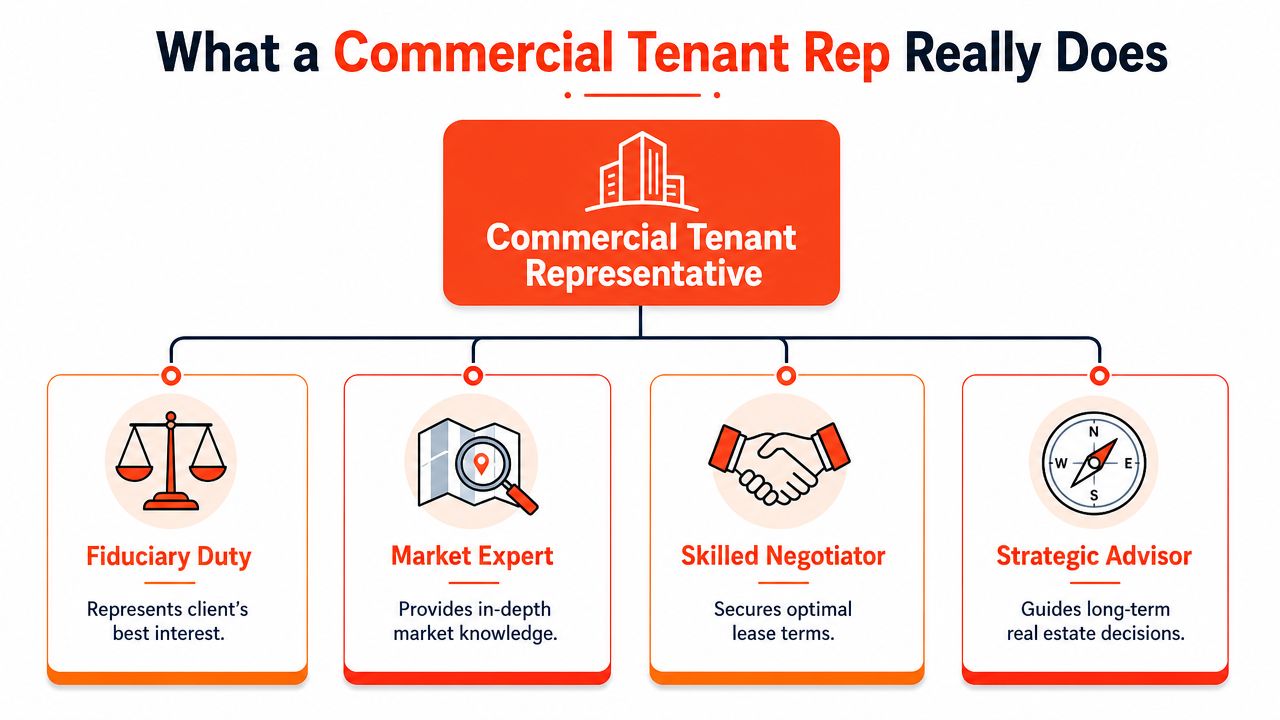
A tenant rep earns their keep long before a lease draft shows up. The job is to turn a business requirement into negotiating power, then carry that advantage through the deal.
The closest practical comparison is early legal and financial strategy, applied before either side starts marking up documents. A good rep defines the tenant's position, tests the market, and builds alternatives the landlord has to take seriously.
The strategist
Before the search, a serious rep translates operating needs into real estate criteria that can survive contact with the market.
That work includes headcount, customer access, parking ratios, loading requirements, brand visibility, timing, expansion plans, and whether the core decision is renewal or relocation. It also includes the less glamorous issues that swing cost later. Approval timelines, capex constraints, IT needs, and how much disruption the business can absorb during a move.
This is also where modern tools matter. AI-assisted market analysis, stacking plans, map-based commute reviews, and visual comparisons help tenants rule out weak options early instead of wasting tours on spaces that never fit. If a rep is still running the assignment from static brochures and memory alone, the client is giving up speed and clarity for no reason.
The market operator
A strong rep does more than collect listings. They pressure-test availability, compare real occupancy cost, and keep the search anchored to usable options.
That means calling landlord brokers, checking pass-through assumptions, flagging stale listings, and separating spaces that photograph well from spaces that work. In tougher searches, the rep also creates competition by keeping multiple paths alive at once. Lose that competitive tension and the landlord feels it immediately.
Good market coverage is part information, part judgment. Two spaces can quote similar rent and produce very different outcomes once parking, HVAC responsibility, delivery condition, tenant improvements, and expense structure are on the table.
The negotiator
At this juncture, tenants either save money or give it back.
A capable rep negotiates the full occupancy package, not just the headline rate. That includes economics, free rent, tenant improvement dollars, work-letter language, commencement timing, expansion rights, renewal structure, assignment and sublease flexibility, restoration exposure, and the clauses that shift operating risk back to the tenant.
Landlords expect a counter on rent. They are often more protective of terms that affect control, future value, or precedent in the building. Junior brokers miss that. Experienced reps know which asks are expensive for the landlord, which asks only look expensive, and which trade-offs can buy better flexibility without blowing up the deal.
The landlord is pricing a lease. The tenant rep is pricing a business commitment.
The coordinator who keeps the deal moving
Commercial deals stall when nobody owns the process.
A good rep keeps attorneys, contractors, architects, finance leads, and decision-makers working from the same version of the deal. They track open items, document proposal changes, and keep deadlines from slipping while the business is still trying to operate. For multi-location users or teams signing remotely, tools that speed review and execution matter too, including DocuSign integrations for commercial deal workflows.
That discipline has real value. A delayed approval can cost a tenant the space, the concession package, or the delivery date they were counting on.
The advisor after the deal
Good tenant representation does not stop at signature.
Critical dates, renewal windows, expansion options, notice requirements, and operating changes all need attention while the lease is live. The best reps stay close enough to help the tenant act early, with current market context and updated visuals that show what comparable options look like before a deadline becomes urgent.
That is the core job. Protect the tenant's economics, preserve room to maneuver, and use better market intelligence than the other side expects.
The Tenant Representation Process from Search to Signature
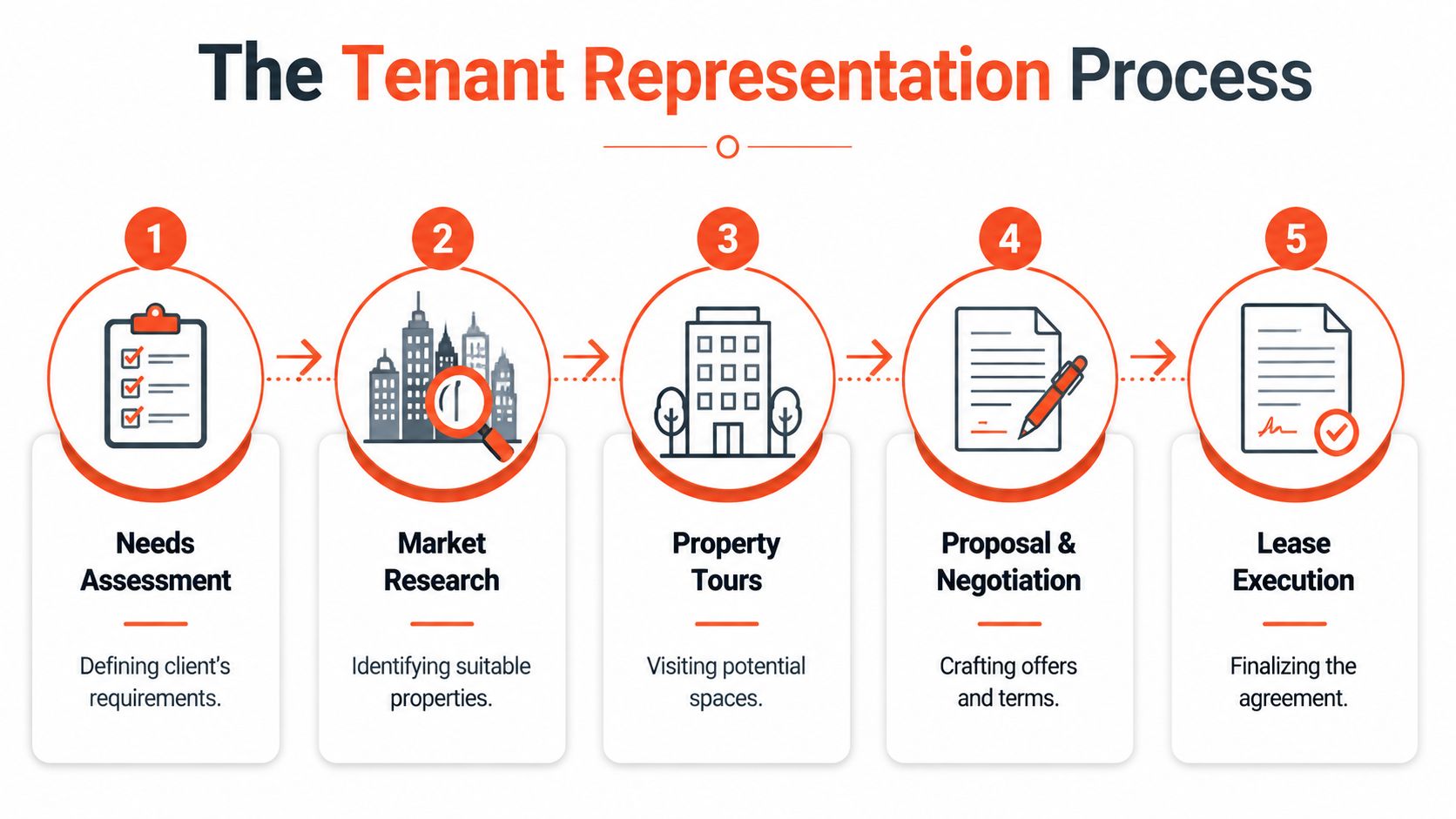
The best tenant-rep assignments follow a disciplined sequence. When the process is loose, tenants get emotionally attached to one option too early, compare deals poorly, and give up their negotiating advantage without realizing it.
A structured process keeps the decision financial, operational, and strategic.
Discovery and planning
The work starts with a requirements brief, not a property tour.
That brief should cover current use, future use, timing, budget range, deal-breakers, location logic, and internal approval dynamics. For an office tenant, that may mean hybrid work assumptions and growth flexibility. For industrial, it may mean truck flow, clear height, loading, labor access, and yard constraints. For retail, it may mean frontage, co-tenancy, signage, and customer behavior.
If this phase is rushed, everything downstream gets noisy.
Market survey and site selection
Once the brief is clear, the rep surveys the market, filters options, and lines up tours that are worth the client's time.
The point isn't to see as many buildings as possible. The point is to compare the right buildings against the operating plan. Some spaces fail on visibility. Some fail on ownership posture. Some fail because the lease structure will never get where it needs to go, even if the space itself works.
A good rep also keeps parallel options alive. That matters because landlords negotiate harder when they believe you've mentally committed to their building.
Here's a useful explainer on how digital execution can support deal workflow once documents start moving: DocuSign integrations for real estate teams.
Later in the process, clients often benefit from seeing the mechanics in action. This walkthrough is a solid visual primer:
Financial analysis and offer strategy
A clear distinction arises between experienced tenant reps and tour coordinators.
Professional tenant representatives commonly model lease decisions over 3, 5, or 10-year horizons to compare total occupancy cost, not just headline rent, because concessions, operating expenses, and renewal rights can materially change effective rent and risk over a long-term commitment, as outlined in Renaud Consulting's guide to tenant representation in commercial real estate.
That is the correct way to evaluate a lease.
A lower asking rent can still be the worse deal. A higher asking rent with better concessions, cleaner expense treatment, stronger options, and a better work letter may produce the stronger business outcome. Tenants who focus only on face rent usually miss where the underlying economics sit.
Negotiation and due diligence
Once a target group is selected, the rep pushes proposals in parallel and tightens the business points before legal papering starts.
This phase usually includes:
- LOI shaping with economics, options, delivery terms, and use rights
- Comp testing against current market alternatives
- Lease issue spotting before attorney review becomes expensive
- Business diligence on ownership, building condition, and timing risk
The best negotiations happen before the lease draft. Once bad assumptions get embedded in paper, every fix costs time and leverage.
Execution and post-signature support
After the business terms are settled, legal review, approvals, and signature move the deal across the line.
A strong rep still has work to do. They track milestones, delivery conditions, notice windows, and expansion or renewal dates. Good process at this stage protects the value you negotiated earlier.
Tenant Rep vs Landlord Rep An Essential Distinction
A lot of confusion in commercial leasing comes from one basic mistake. Tenants assume every broker in the deal is there to help them.
They're not.
The distinction is simple. A tenant representative is aligned to the occupier. A landlord representative is aligned to the owner. Both may be professional, informed, and responsive. But alignment drives behavior, and behavior drives outcomes.
Alignment decides the advice you get
If a landlord rep suggests a rent structure, concession package, or lease clause, they're doing their job through the owner's lens. That doesn't make them dishonest. It means you should understand who benefits when choices are framed a certain way.
The tenant rep's job is to challenge that framing.
A landlord rep wants to preserve economics, reduce owner risk, and keep flexibility with the building. A tenant rep wants to lower occupancy cost, widen the tenant's options, and limit future constraints on the business.
| Criterion | Tenant Representative | Landlord Representative |
|---|---|---|
| Primary loyalty | Represents the tenant's interests | Represents the property owner's interests |
| Core objective | Reduce occupancy cost and preserve flexibility | Maximize owner economics and protect lease value |
| Search approach | Compares multiple options for tenant fit | Markets available space in the owner's asset |
| Negotiation posture | Pushes for concessions and risk protections | Pushes for stronger rent and owner-favorable terms |
| Lease review focus | Flags tenant exposure and operational limits | Preserves owner protections and income structure |
| Long-term concern | Renewal leverage, assignment rights, expansion flexibility | Rent roll strength, control of space, owner optionality |
Where tenants get tripped up
The biggest mistake is confusing friendliness with representation.
A responsive listing broker can still be the wrong advisor for a tenant. They may answer questions quickly, know the building well, and seem helpful in tours. None of that changes who they work for.
Another mistake is assuming conflict can be managed casually. It can't. If your broker is balancing both sides of the same transaction, you need to look very closely at how advice is being shaped and whether your bargaining power is being diluted.
If you want someone to tell you whether the landlord's terms are actually good for your business, that person can't be judged on how well they protected the landlord.
Commercial tenant representation starts with that clarity. Once you understand alignment, a lot of the industry's mixed signals make more sense.
The Modern Advantage How AI and Visuals Win Negotiations
Older tenant-rep playbooks treated market knowledge as a relationship business with spreadsheets attached. That's no longer enough.
Today, the best reps combine brokerage judgment with data handling, lease analysis tools, and visual workflow. If they don't, they're slower than the market and weaker at the table.
Modern commercial tenant representation is increasingly a data-engineering exercise. Brokers use AI to analyze live market availability, pricing, and demographic indicators to score properties by fit, and lease-analysis tooling can extract key clauses and risks from large documents in seconds, reducing the chance of missed optionality or hidden costs, according to Hokanson's analysis of AI shaping tenant representation.

Where AI helps before negotiation
AI is most useful early when the market is noisy.
It helps reps screen inventory faster, compare location variables, and identify which spaces fit the client's actual operating pattern instead of just matching size and rent range. That matters because many weak options look acceptable in a listing feed and fall apart under real scrutiny.
Used properly, AI also helps with clause review. Large leases hide risk in repetitive language, buried deadlines, and non-standard exceptions. A rep with extraction tools can move through those issues much faster and raise cleaner questions for legal counsel.
Why visuals change the deal
This is the part many traditional guides miss. Visuals aren't cosmetic. They are an advantage.
When a tenant can show stakeholders, landlords, and project partners how a space could function, the conversation improves immediately. Layout questions get resolved earlier. Build-out assumptions get less vague. Tenant improvement requests become easier to justify because they're tied to a visible use plan instead of abstract wish lists.
That's especially powerful when internal decision-makers aren't real estate people. Finance, operations, leadership, and franchise teams often approve deals faster when they can react to a concrete visual scenario instead of a bare floor plan. Teams looking at AI-assisted presentation workflows can review visual collaboration tools for client studio workflows to understand how that side of the process is evolving.
What works and what doesn't
What works:
- Live market scoring: Comparing options by operational fit, not just by rent
- Lease abstraction tools: Catching renewal windows, escalations, and odd clauses early
- Visual build-out concepts: Giving landlords a clearer basis for TI discussions
- Stakeholder-ready materials: Helping non-brokers make faster, better decisions
What doesn't:
- Using AI as a substitute for judgment: Tools can rank options, but they can't negotiate nuance
- Pretty visuals without budget discipline: If the design can't be priced or supported by the work letter, it's decoration
- Static market reports: They age fast and often miss active movement in live inventory
Good technology doesn't replace brokerage skill. It sharpens it. Bad brokers with new tools are still bad brokers.
Hiring the Right Tenant Rep A Practical Checklist
A tenant often reaches out after the mistake has already been made. The CEO toured a space, got attached, and told the landlord they want to move fast. At that point, the broker's job gets harder. Bargaining position is weaker, internal expectations are ahead of the facts, and every issue in the lease feels urgent.
The right tenant rep prevents that sequence. They control timing, protect negotiating position, and keep site selection tied to operating reality instead of momentum.
What to look for
Start with the assignment, not the personality. A polished broker can still run a sloppy process.
A good tenant rep should be able to explain, in plain terms, how they make decisions when the facts are incomplete. Ask how they screen bad options out early, how they compare concessions against occupancy cost, and how they keep a client from getting emotionally committed before the market has been tested. That tells you more than a list of past deals.
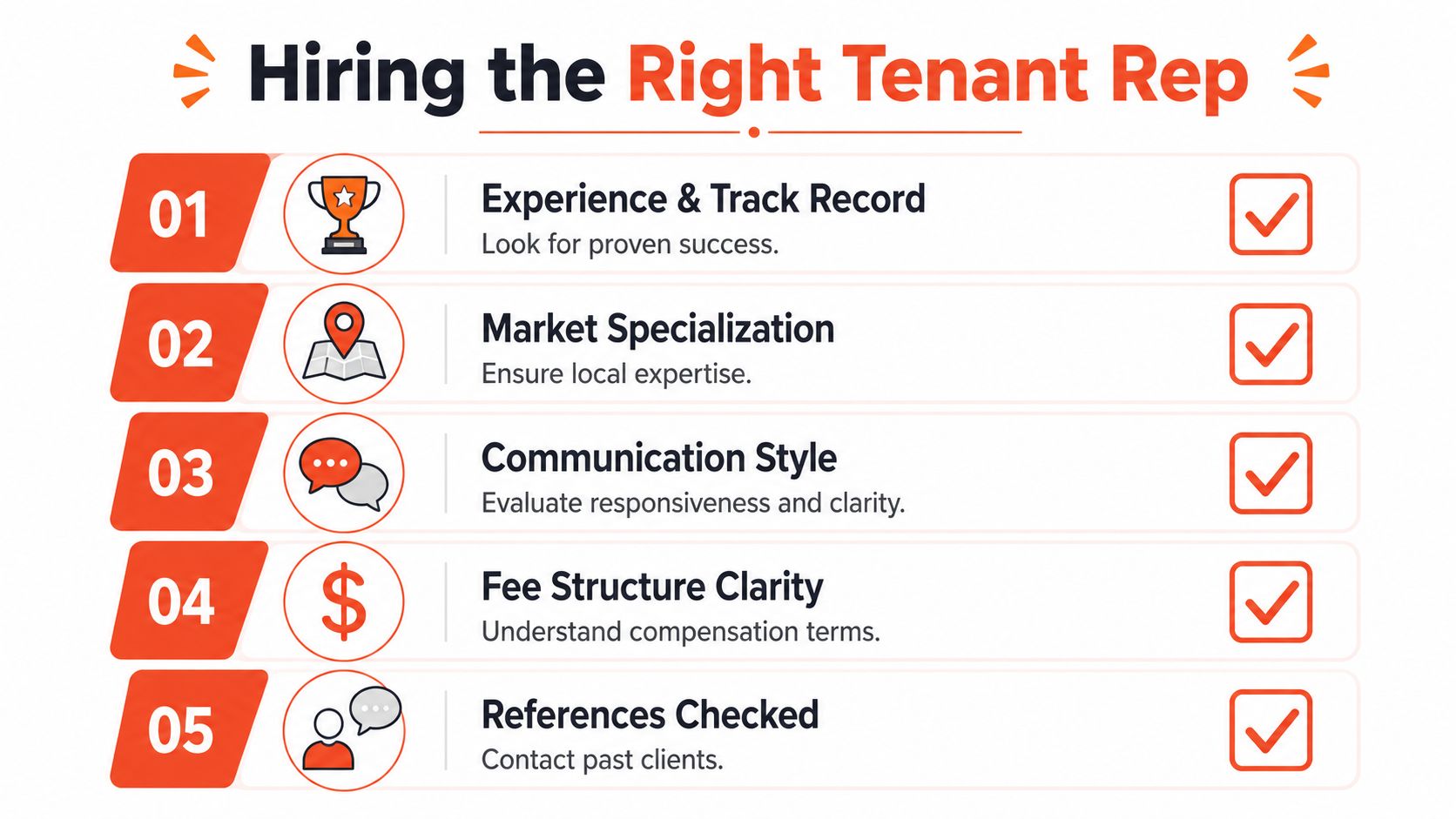
Use a practical checklist:
- Relevant market depth: They know the submarket, recent landlord behavior, and which listings are stale, mispriced, or likely to trade
- Asset-type fluency: Retail, office, medical, and industrial searches fail for different reasons. Your rep should know which details affect the deal
- Negotiation discipline: They should be able to explain how they preserve alternatives long enough to create pressure on the final landlord
- Financial competence: They should compare rent, operating expenses, free rent, TI, relocation costs, term risk, and renewal exposure. Not just quote asking rent
- Tech fluency: AI-assisted search, lease abstraction, mapping, and visual scenario tools should be part of the workflow, not an afterthought
- Communication under pressure: If they ramble in an interview, expect muddy updates when the deal gets tense
I pay close attention to whether a broker uses technology with judgment. Good reps use AI to sort options faster, surface lease issues earlier, and present choices clearly to finance and operations. They still do the hard part themselves. They ask better questions, pressure-test assumptions, and negotiate.
If you want a sense of the tools serious brokers are adopting, this roundup of best AI real estate agents and tools for 2026 is a useful reference point.
Questions worth asking in the interview
Experience matters. Process matters more.
Ask questions that force specific answers:
- How do you keep a client from showing their hand too early with a landlord?
- How do you compare one attractive deal against a second-best option that gives you more negotiating room?
- What is your method for reviewing operating expense history and unusual pass-throughs?
- How do you handle a conflict or dual-agency scenario?
- What do you do when internal stakeholders disagree on location, budget, or timing?
- What tools do you use for market analysis, lease review, and visual presentations to decision-makers?
- How do you support renewal planning, expansion rights, or contraction options after the initial transaction?
Listen for specificity. Vague answers usually mean the broker is relying on instinct, reputation, or landlord relationships to carry the assignment.
Red flags
Some problems show up before the search even starts.
A broker who talks about access but not analysis is a risk. A broker who cannot explain how they read an expense stop, relocation clause, or restoration language is a risk. A broker who treats AI and visual presentation tools as optional is behind the market, and that gap shows up in slower decisions, weaker comparisons, and less persuasive negotiation support.
One more warning sign. If a broker makes every answer about finding space, they are underselling the job. Tenant representation is part market work, part financial analysis, part process control, and part negotiation strategy.
Hire the rep who can explain their method, defend their assumptions, and keep your options open until the lease is ready to sign.
Understanding Fees and Representation Agreements
Most tenants ask the fee question early, and they should.
In many commercial leasing situations, the tenant rep is compensated through the brokerage commission structure in the deal rather than by a separate direct fee from the tenant. Even so, don't treat compensation as background noise. It affects incentives, scope, and expectations, and it should be discussed in plain English before the search starts.
What the representation agreement should cover
The representation agreement is the document that formalizes who the broker represents and what the engagement includes.
At a minimum, it should clarify:
- Scope: Which markets, asset types, or locations are covered
- Term: How long the engagement lasts
- Exclusivity: Whether the rep is your sole broker for the assignment
- Compensation terms: How the rep is paid and what happens in unusual deal structures
- Conflict language: How potential conflicts are disclosed and managed
That agreement matters because it puts alignment in writing. If a broker is representing the tenant, the paper should make that relationship unmistakable.
What tenants should pay attention to
Read the exclusivity language carefully. Most of the time, exclusivity is reasonable because it lets the broker invest real time without worrying that the assignment will scatter across multiple intermediaries. But the scope should be clear and practical.
Also ask how renewals are handled, how off-market opportunities are covered, and what happens if your requirement changes during the engagement. Good brokers won't dodge those questions. They'll answer them cleanly.
A tenant rep relationship works best when roles, incentives, and decision rights are all clear before the first tour is scheduled.
Bounti Labs helps real estate teams turn raw spaces into persuasive visuals fast. With Bounti Labs, a single walkthrough can become polished images, layout-ready visuals, decluttered scenes, staged concepts, and renovation-style alternatives that help clients picture what a property can become. For commercial tenant reps, that means stronger presentations, clearer build-out conversations, and better support for site selection and negotiation.