You've got the photos, the walkthrough, the feature sheet, and a listing deadline that keeps moving closer. The blank description field is still staring back at you. That's where a property description generator earns its place, but only if you use it like an operator, not like a gambler.
Most agents don't need more words. They need a workflow that turns verified property facts into clean listing copy, catches compliance problems before publish, and adapts the same approved narrative across MLS, portals, email, and social. That's the difference between dabbling with AI and building a repeatable listing engine.
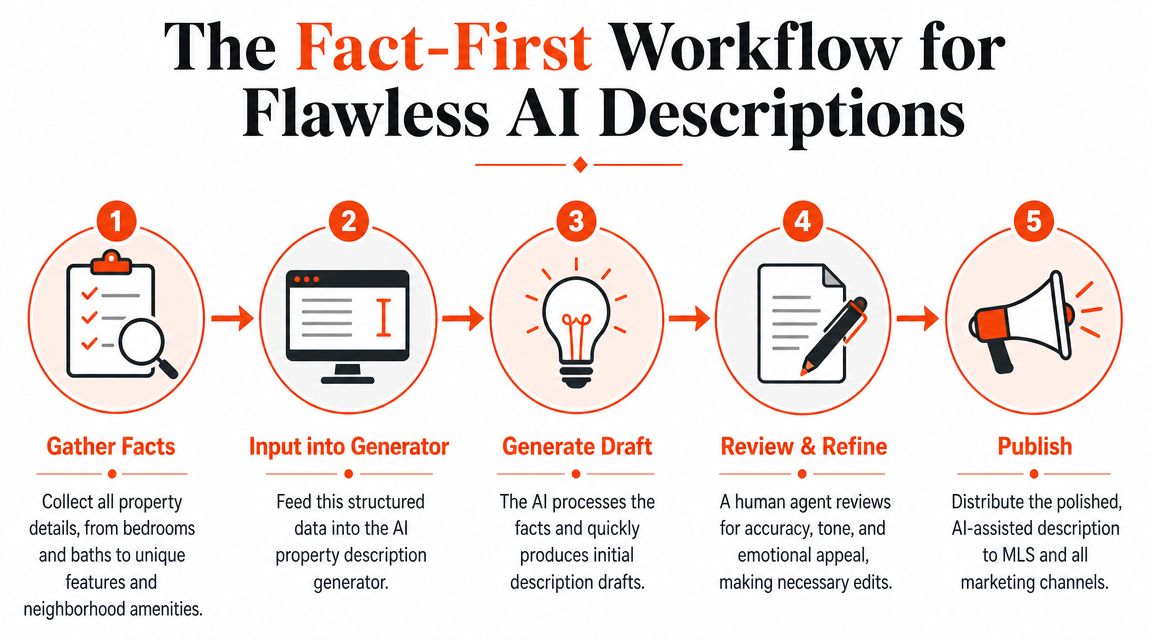
The Fact-First Workflow for Flawless AI Descriptions
The old way was familiar and slow. Pull the tax record, open the MLS sheet, scroll through your notes, then try to write something fresh about another kitchen, another primary suite, another fenced yard. You'd spend more time organizing information than selling the property.
Modern property description generators changed that by using a fact-first workflow. Instead of starting with clever phrasing, you start with structured inputs like beds, baths, square footage, highlights, and location context. The tool asks for core data before it drafts copy, a design meant to reduce inaccuracies and turn verified property data into compliant, persuasive narratives in minutes, as described by LogicBalls' overview of AI property description generators.
Start with records, not prompts
A good property description generator should feel more like a checklist than a chatbot. Before you ask for any draft, gather the essential details:
- Core property facts: beds, baths, square footage, lot details, property type, and condition.
- Listing-specific upgrades: renovated kitchen, roof age, HVAC updates, window replacements, outdoor improvements.
- Context that changes buyer perception: school district, neighborhood setting, commute advantages, nearby amenities.
- Marketing constraints: MLS remarks style, tone, prohibited phrases, and whether you need versions for portals or social.
If a tool lets you skip this step, that isn't convenience. That's risk.
Practical rule: The quality of the output is set before the generator writes a single sentence.
Use one source of truth
The biggest failure point in AI listing copy isn't weak writing. It's fragmented input. An agent has one version of the facts in notes, another in the MLS draft, and a third in a text from the seller. Then the generator fills in the gaps with language that sounds plausible.
That's why strong teams work from one verified property record. Some use intake forms. Some use transaction checklists. Some tie the process to broader listing prep, such as AI CMA generation from MLS workflows, so the same verified data can support pricing, positioning, and description writing without rekeying details across tools.
Ask clarifying questions before drafting
The smartest setup isn't “write me a great listing.” It's “here are the verified facts, now ask me what's missing.” That could mean:
- Is the home updated or original?
- What are the standout amenities?
- What should be emphasized for the likely buyer?
- Are there details that must not be mentioned?
- Which claims need exact wording because of legal or MLS sensitivity?
That small pause matters. It forces the agent to close factual gaps before the copy exists.
Treat automation as data capture plus drafting
The market has moved toward AI-assisted content operations, and that matters because listing speed now affects the full marketing timeline. Fast description creation isn't just about convenience. It keeps photos, MLS entry, social scheduling, and email promotion moving from the same verified record instead of waiting on manual copywriting.
In practice, the best workflow looks like this:
- Collect facts first
- Validate missing details
- Generate a draft
- Edit for tone and accuracy
- Publish from the approved version
A property description generator is at its most useful when it behaves like structured intake plus rapid drafting. Great copy starts upstream. Clean data beats a clever prompt every time.
Crafting Inputs to Control Tone Style and Narrative
Once the facts are locked, true power comes from direction. Most weak AI listing copy isn't wrong because the model can't write. It's wrong because the agent gave it no narrative job to do.
The better approach is simple. Feed the property description generator a compact, standardized fact set, then tell it what kind of story to build. Industry guidance consistently points to structured inputs like property type, condition, and key features, followed by multiple draft variants for human selection and editing, as shown in List It Better's workflow guidance.
What to control in every prompt
You don't need a long prompt. You need a precise one. These are the fields that shape output:
- Property type: condo, detached home, townhouse, mixed-use, office suite.
- Condition: updated, original, turnkey, value-add, newly renovated.
- Target buyer or tenant: first-time buyer, move-up family, investor, downsizer, luxury buyer.
- Tone: elegant, energetic, warm, polished, investor-focused, design-forward.
- Priority features: view, lot, kitchen, floor plan, location, amenities, flexibility.
- Exclusions: avoid overpromising, don't mention schools unless verified, avoid subjective claims.
A prompt with those elements gives the AI boundaries. That's what turns generic copy into useful copy.
Prompting cheatsheet for different property types
| Property Type | Key Features Input | Tone & Style Prompt | Example AI Focus |
|---|---|---|---|
| Luxury waterfront estate | gated entry, water views, chef's kitchen, outdoor entertaining, private dock if verified | elegant, polished, lifestyle-driven, avoid hype | privacy, arrival experience, indoor-outdoor flow, view-based living |
| Cozy starter home | updated bath, fenced yard, natural light, convenient commute, functional layout | warm, accessible, upbeat, plainspoken | affordability of lifestyle, comfort, move-in readiness, everyday practicality |
| Modern downtown condo | open layout, balcony, building amenities, walkability, designer finishes | modern, crisp, energetic | lock-and-leave convenience, city access, entertaining, low-maintenance living |
| Fixer-upper with potential | lot size, layout, location, original character, renovation upside | honest, opportunity-focused, compliant | vision, value-add angle, bones of the property, buyer creativity |
Copy-paste prompt templates
Use these as starting points and edit them to match your market.
Luxury listing template
Property type: luxury single-family home
Condition: renovated
Target buyer: buyer seeking privacy, views, and entertaining space
Key features: verified bed and bath count, chef's kitchen, outdoor living areas, premium finishes, standout location details
Tone: elegant and refined
Instructions: Write three versions. Open with the strongest lifestyle hook. Keep claims tied to the provided facts. Avoid vague superlatives and any unverified neighborhood claims.
Starter home template
Property type: detached starter home
Condition: move-in ready
Target buyer: first-time buyer or downsizer
Key features: verified room count, updated systems if verified, yard, storage, natural light
Tone: warm and inviting
Instructions: Keep the wording approachable and clear. Emphasize comfort, practicality, and livability. End with a simple call to action.
Condo template
Property type: urban condo
Condition: modern
Target buyer: professional buyer or investor
Key features: balcony, in-unit laundry if verified, building amenities, transit access, design details
Tone: modern and concise
Instructions: Prioritize convenience, efficient layout, and city lifestyle. Generate one MLS-style version and one shorter portal version.
A prompt should tell the model what to spotlight, what to downplay, and what to avoid. If you skip any of those, the draft usually wanders.
Direct the narrative, not just the adjectives
“Make it sound luxurious” is weak direction. “Lead with the view, then transition to the kitchen and outdoor entertaining, and close on privacy” is usable direction. Narrative order matters because buyers don't read listing remarks like agents do. They scan for a hook, then decide whether the rest is worth their attention.
The practical move is to request multiple versions with different lead angles. One can open on lifestyle. Another can open on layout. A third can open on upgrades. Pick the one that matches the buyer profile and the media package.
That's how you use a property description generator as a controlled drafting tool, not a slot machine.
Refining and Fact-Checking the AI-Generated Draft
The draft is not the deliverable. It's the raw material.
That distinction matters because the main technical risk with AI description tools is hallucinated or misstated property facts. Best-practice guidance is clear: verify every field, from square footage to roof age, and treat the generator as a drafting engine rather than a source of truth, as emphasized in Skyline School's guidance on listing description generators.
The fastest way to lose trust
One wrong detail can flatten buyer confidence and create headaches with sellers, cooperating agents, and your brokerage. It doesn't have to be dramatic. A misstated HOA fee, an invented upgrade, or a vague claim about location can do the job.
Agents sometimes skip final review because the copy “sounds right.” That's the trap. AI is fluent. Fluency is not verification.
Use an editor's checklist, not a vibe check
Before anything goes live, review the draft line by line against the source record. This is the minimum standard:
- Numbers: Confirm beds, baths, square footage, lot size, fees, and dates against the listing file.
- Condition claims: Make sure “updated,” “renovated,” or “new” matches what's documented.
- Location references: Verify neighborhood, school district, transit references, and proximity language before keeping them.
- Amenities: Remove any feature that was inferred from photos but not verified by the seller or file.
- Legal sensitivity: Check wording around views, use cases, zoning, and inclusions.
A disciplined review takes less time than fixing a public error after syndication.
Add what the AI can't know
At this juncture, the agent earns the commission. The generator can assemble a coherent draft. It can't replace field judgment.
Add the details that come from walking the property:
- the way the natural light moves through the living area
- how the floor plan feels between kitchen and outdoor space
- whether the street is busy, tucked away, or unusually quiet
- which upgrade is likely to matter most to buyers in your submarket
Those observations shouldn't become poetry. They should become sharper, more credible marketing language.
Your job is to approve facts, remove risk, and add local intelligence. That's not optional editing. That's professional supervision.
Clean up the language before publish
After factual review, tighten the writing. Most AI drafts benefit from subtraction.
Look for these common issues:
- Stacked adjectives that say little and sound inflated.
- Repeated features that appear in slightly different wording.
- Empty luxury language with no tied fact behind it.
- Awkward transitions that make the description feel assembled instead of written.
Read the final version aloud. If the sentence sounds like something no human agent would say, rewrite it.
A good property description generator gives you a running start. The final listing still needs a responsible editor. That editor is the license holder.
Optimizing for SEO and MLS Compliance
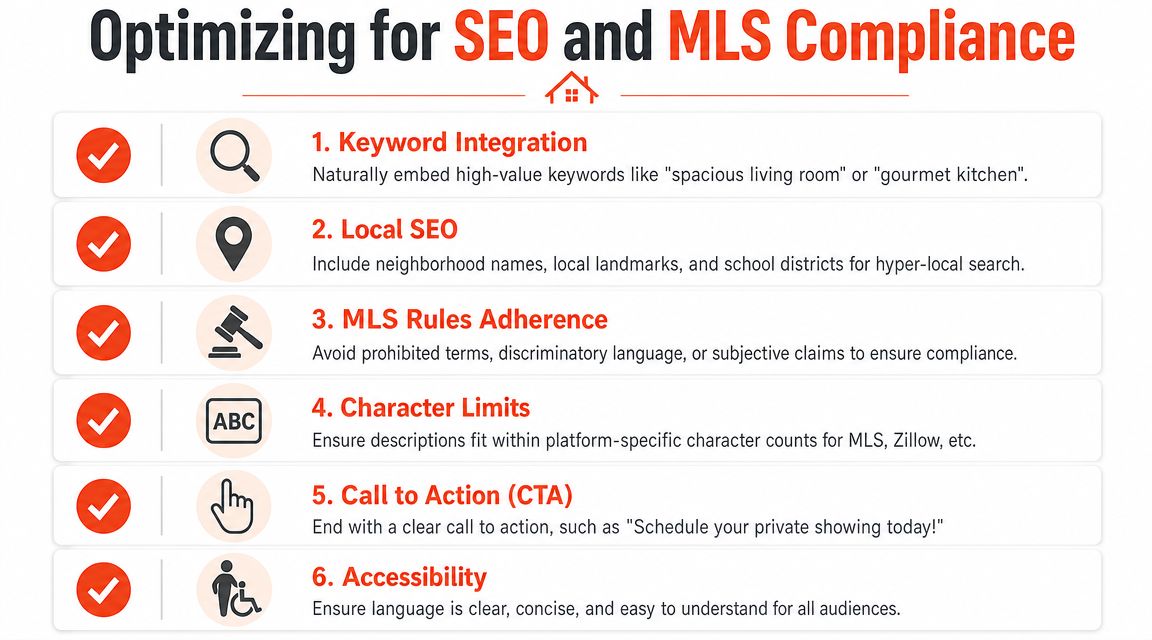
A listing description has three jobs at once. It has to attract the right buyer, survive MLS rules, and avoid language that creates fair housing risk. Most discussions treat those as separate topics. In a real workflow, they belong on the same pre-publication checklist.
A major gap in the market is compliance guardrails. Output quality gets most of the attention, but agents also need systems that trace claims back to verified inputs and flag risky phrasing before publication, which is the core concern raised in Saleswise's discussion of listing description generator compliance.
Think of SEO as precise relevance
Real estate SEO in listing remarks isn't about stuffing keywords. It's about matching how buyers search.
That usually means naturally including:
- Property-defining phrases: open-concept layout, main-level primary suite, fenced backyard, flexible office.
- Local qualifiers: neighborhood name, nearby landmark, school district if verified, commuter convenience.
- Buyer-intent language: move-in ready, investment opportunity, low-maintenance living, indoor-outdoor entertaining.
The copy still has to read like a human wrote it. If the phrase only exists to satisfy a search term, it usually weakens the description.
For teams that want to sharpen how they research discoverability across modern search environments, this guide to effective AI search strategies for marketers is useful because it pushes beyond classic keyword thinking and into how AI-assisted discovery now works.
MLS rules and fair housing belong in the same review pass
Here's the practical reality. A phrase can be great for click-through and still be a compliance problem. That's why the final edit should combine SEO review with MLS and fair housing review instead of treating them as separate approvals.
Use a short checklist:
- Is every claim tied to a verified fact?
- Does any phrase imply preference, exclusion, or a protected class?
- Does the tone drift into unsupported superlatives or subjective claims?
- Will the remarks fit the target platform's format and limits?
- Does the call to action stay neutral and professional?
This is also where workflow-specific tools can help. If your process includes dedicated MLS listing optimization support, use it to pressure-test the final copy before syndication.
Phrases to rethink before publishing
Some wording sounds harmless until you view it through compliance and MLS policy. Replace broad, subjective, or exclusionary phrasing with factual alternatives.
| Risky phrasing | Better alternative |
|---|---|
| perfect for families | spacious layout with multiple living areas |
| safe neighborhood | established residential setting |
| walk to everything | convenient access to nearby shops, dining, and services if verified |
| luxury throughout | premium finishes and recent updates if verified |
| great schools | located in the verified school district |
Later in your review process, it helps to train agents and coordinators with examples. This short video is a useful companion for that conversation.
Compliance isn't a separate step after marketing. It's part of the writing brief from the start.
The agents who handle this well don't just publish faster. They publish cleaner.
Scaling Your Content for Multi-Channel Marketing
The MLS description is still treated like the final product. It's not. It's the approved master copy that should feed everything else.
That matters because current discussion around property description generators often misses cross-channel adaptation. Teams need versions for MLS, portals, email, and social, with changes by channel, property class, and market, a gap highlighted in this discussion of multi-channel real estate copy needs.
One approved narrative, several outputs
Take a single listing. The approved MLS remarks are accurate, reviewed, and compliant. From there, the workflow should branch:
- Portal version: shorter, punchier, front-load the top benefit.
- Email version: one persuasive paragraph plus a direct invitation to book a showing.
- Instagram caption: visual hook, standout feature, concise CTA.
- Facebook ad copy: problem-solution framing tied to audience fit.
- Video reel script: short spoken lines matched to key visual moments.
That's not duplication. It's adaptation.
A real-world pattern that saves time
Say you're marketing a renovated townhome. The MLS version leads with layout, updates, and private outdoor space. The portal version trims the detail and pushes immediacy. The email version emphasizes move-in readiness. The social version focuses on the kitchen, patio, and neighborhood energy.
The property didn't change. The audience context did.
That's where a listing content system becomes more useful than a one-off generator. Tools built for broader asset creation, including a listing kit workflow, make it easier to spin approved property facts and copy into coordinated marketing outputs without rewriting from scratch each time.
Channel adaptation rules that actually work
Keep these rules simple:
- MLS gets the most complete factual narrative.
- Portals need the hook sooner.
- Email should sound personal, not database-generated.
- Social needs one idea, not every idea.
- Video scripts should follow the camera path, not the MLS order.
When agents struggle with multi-channel content, the issue usually isn't lack of creativity. It's lack of a source-of-truth workflow. A property description generator becomes more valuable when it produces the base narrative once, then helps you reshape it for each channel with consistency.
Your Playbook for an Automated Listing Workflow
At this point, the pattern is clear. The winning setup isn't “use AI to write faster.” It's “build a listing workflow where verified property data flows through drafting, review, compliance, and distribution without breaking.”
That reflects a broader milestone in the category. By 2025, vendors were positioning these tools as part of wider real estate marketing workflows, capable of turning a few property details into listing copy, ad text, and social content in minutes, as described in Styldod's overview of real estate description generators.
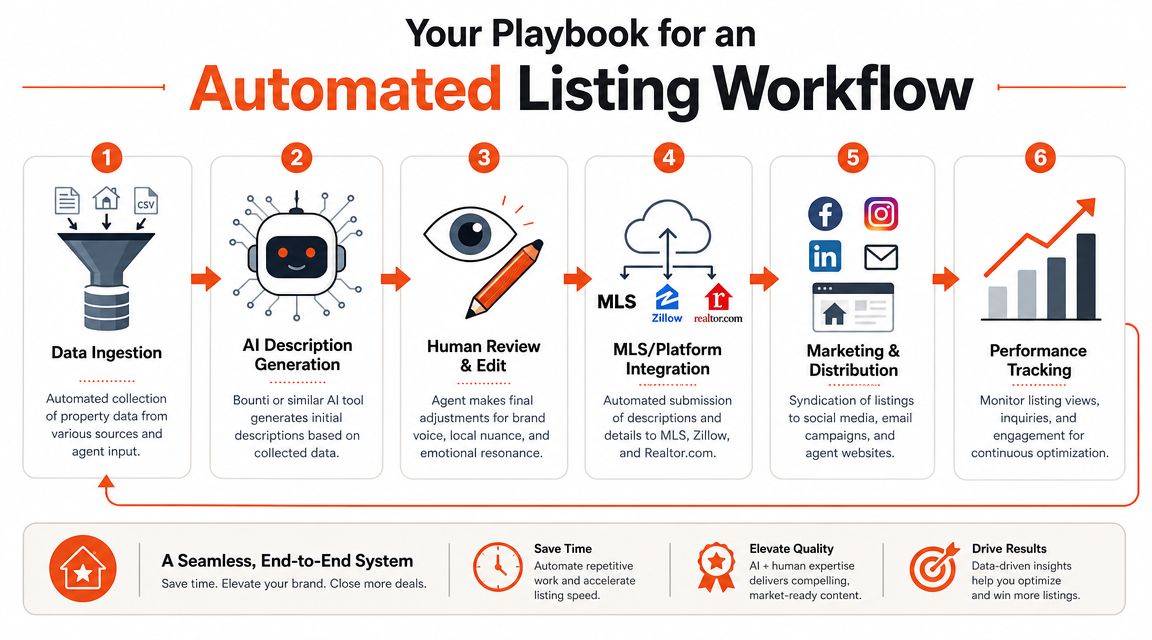
The operating model
The most practical setup for a team or brokerage looks like this:
- Data ingestion: Pull verified facts from the listing file, MLS draft, seller disclosures, and walkthrough notes.
- AI drafting: Generate several versions based on tone, audience, and channel.
- Human review: Approve facts, remove risky language, add local context.
- Platform formatting: tailor the final copy to MLS, portals, email, and social.
- Distribution: push the approved set into the marketing calendar.
That's the backbone. The difference between a smooth operation and a messy one is whether those steps are connected.
Where tools fit without creating more work
A platform can be useful if it reduces handoffs instead of adding them. For example, Bounti Labs is built around a single video walkthrough workflow and can generate a property description, pull stills, create MLS-ready photos, and support visual changes like decluttering or staging from the same property input. In practice, that kind of setup matters because it ties content generation to actual listing production instead of treating description writing as an isolated task.
The same logic applies to lead gen. If you're tightening your listing workflow, you should also think about how that content supports prospecting and conversion. This resource on learn AI-first lead generation for agents is worth reviewing because it connects AI content operations to the top of the funnel, where many teams still work manually.
What a strong automated workflow actually changes
It changes more than speed. It improves consistency across your listing package, makes review easier for coordinators and brokers, and reduces the chance that one channel says something another channel can't support.
The best property description generator is part of a system. If it only writes paragraphs, you'll still spend your time fixing process gaps.
Agents who build this well don't just publish cleaner listings. They free up more energy for pricing strategy, seller communication, and winning the next presentation.
If you want a tighter listing workflow from walkthrough to marketing package, take a look at Bounti Labs. It's built for real estate teams that want property visuals and listing content to come from the same source input, so agents can move from property capture to publish-ready materials with less manual rework.