Homes that arrive on the market with polished presentation, clear visuals, and a credible plan for improvement win more attention from the first scroll. Agents see that every week in listing appointments. The gap now is execution speed.
Property transformation covers more than repairs and design updates. It includes everything that shapes buyer perception before a showing is booked: prep work, staging choices, photography, floor plans, virtual edits, listing copy, and the story the agent tells about the asset. Treated separately, those pieces create delays, inconsistent quality, and unnecessary vendor management. Treated as one system, they become a marketing engine.
That shift matters because sellers are no longer comparing agents only on comps and commission. They are comparing launch strategy.
The strongest agents already package physical improvement and digital presentation together. A paint quote, a staging plan, a twilight render, and a refreshed listing gallery all serve the same goal: stronger demand at launch and fewer wasted days on market. If you need a visual example, these house staging before and after examples show how presentation changes buyer response long before any major renovation enters the conversation.
AI changes the economics of this work. Tasks that used to take multiple vendors and several days can now be scoped, mocked up, and approved in hours. That does not remove judgment. It raises the value of judgment. Agents still need to choose what to change, what to leave alone, and where presentation will produce a return the seller can capture.
The trade-off is straightforward. Full physical upgrades can improve value, but they tie up time, cash, and coordination. Digital transformation moves faster, costs less, and gives agents more room to test positioning before the property hits the market. In practice, top teams use both. They reserve construction for issues that materially affect price and use media, staging, and AI-assisted creative to improve everything else. For a renovation-focused perspective, this guide to boosting Australian home value is a useful reference point.
Why Property Transformation Is Your New Marketing Baseline
Nearly every buyer now meets a property through a screen before they ever step through the door. That changes the job. Property transformation is no longer just prep for open homes. It is part of the marketing system that shapes demand, seller confidence, and launch speed from day one.
Strong homes still lose momentum when the presentation is weak. Buyers judge condition, layout, light, and livability from the listing package first. If those signals are muddy online, the property enters the market with less urgency and more resistance on price.
That is why top agents treat transformation as market positioning, not an optional add-on. The work can include paint, repairs, styling, copy, photography, floor plans, virtual staging, and AI-generated creative. Buyers experience those pieces as one story. Sellers should hear the same message from you. The goal is simple: reduce friction, sharpen perceived value, and put the listing in a stronger negotiating position before the first inspection.
Digital presentation is part of the transformation
Physical improvements matter only when the market can see them clearly. A cleaned-up kitchen, better furniture layout, or minor cosmetic update has limited impact if the photos flatten the space or the gallery fails to explain the upgrade. Good agents close that gap.
I use one standard when deciding what to recommend. If a change improves buyer perception in the listing, it has a path to return. If it does not show up in the media, the seller is often paying for effort the market will never fully price in.
This is also where the economics have changed. A few years ago, testing multiple presentation angles meant more vendors, more back-and-forth, and more time. Now agents can pair selective physical work with fast digital execution, including virtual staging, twilight edits, and AI-assisted concept visuals, to improve launch quality without defaulting to renovation.
For sellers who still view prep work through a renovation lens, this guide to boosting Australian home value is useful because it reflects how owners often think about improvements before sale. The agent's job is to translate that instinct into a sharper listing strategy.
Visual proof helps. These house staging before and after examples make the point quickly because they show how presentation changes perceived space, warmth, and usability without requiring structural work.
Agents who build this into their baseline win more often for a simple reason. They are not just selling a home. They are controlling how the market experiences it, online first and in person second. AI increases the speed and lowers the cost of doing that well, but the strategy starts with judgment.
Understanding the Transformation Spectrum
Think of every listing like a product launch. You don't release a product with weak packaging, poor photography, and an unclear value proposition. A house works the same way.
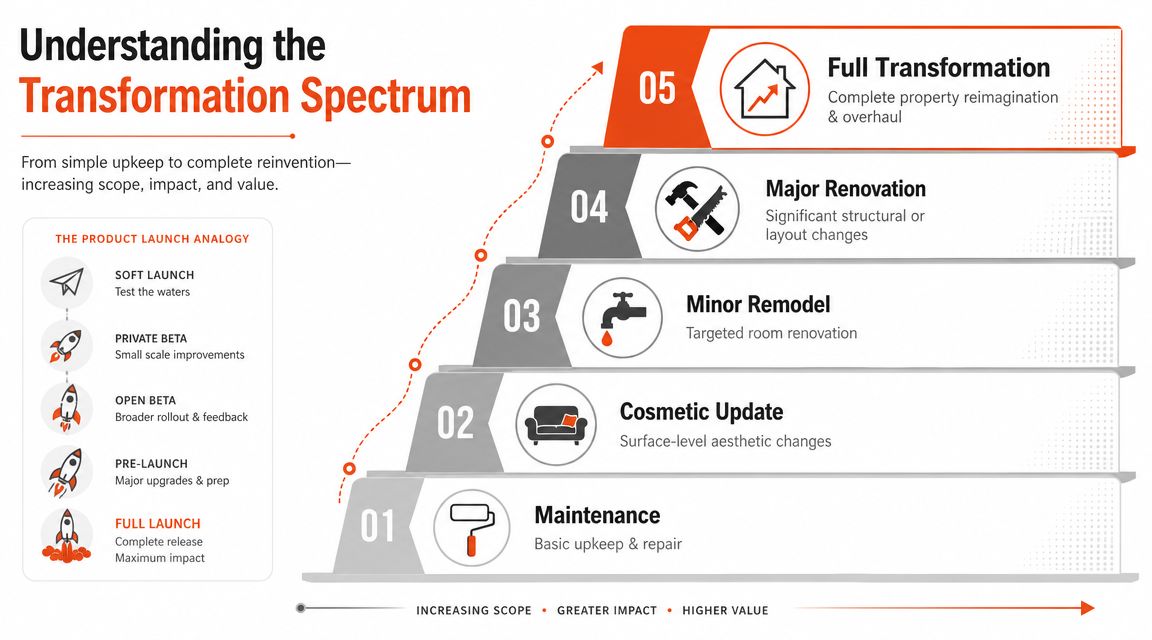
Some properties need only a maintenance pass before launch. Others need cosmetic work, a tighter style story, or a stronger layout presentation. A few need a full repositioning. Agents who lump all of that into “staging” miss the core decision.
Value is a bundle, not a single number
In real estate analytics, property transformation rests on hedonic regression, a method that treats a property not as one price but as a bundle of measurable variables such as rooms, location, age, and other attributes, as explained by the U.K. Office for National Statistics overview. That same explanation notes that the ONS uses high-volume datasets and tracks over half a million privately rented properties for its rent statistic, which shows how serious property analysis depends on scale, not anecdote.
That matters for agents because it gives you a better mental model. You are not selling “a three-bed house.” You are packaging a set of traits that buyers compare consciously and subconsciously: layout efficiency, light quality, finish level, storage, flexibility, condition, curb appeal, and digital presentation.
The five levels agents should recognize
Property transformation works best when you match the intervention to the gap.
- Maintenance means fixing what signals neglect. Scuffed trim, broken hardware, bad bulbs, visible deferred upkeep.
- Cosmetic update changes the feel without changing the floor plan. Paint, fixtures, styling, surface refreshes.
- Minor remodel targets a room that's dragging the listing down, often a kitchen, bath, or entry sequence.
- Major renovation changes usability. That can include layout work, substantial finish replacement, or major system-driven upgrades.
- Full transformation is repositioning. You're changing how the market classifies the asset.
Use the product launch lens
A strong launch has three parts.
The product itself
Condition, design, functionality, and readiness.The packaging
Staging, styling, decluttering, and visual framing.The go-to-market assets
Photos, floor plans, tours, copy, and social-ready media.
A weak listing often isn't suffering from one fatal flaw. It's suffering from several small friction points that stack together.
This is why experienced agents don't ask, “Should we renovate or not?” They ask, “Which attributes are underperforming, which ones can be improved quickly, and which ones need to be presented better?” That's a sharper way to diagnose a listing, and it leads to better recommendations.
Choosing Your Transformation Approach
Most listings don't need the most expensive solution. They need the right one.
I break property transformation into four practical tiers that agents can recommend: decluttering, restyling, staging, and renovations. Those tiers aren't interchangeable. Each one solves a different problem, and when agents blur them together, sellers overspend in the wrong place or underspend where it counts.
Tier one is decluttering
Decluttering is the fastest effective action in residential sales. It doesn't change the house. It changes visual noise.
This tier works when the property is attractive but buried under daily life. Oversized furniture, crowded counters, overfilled shelves, pet gear, cords, and mismatched decor all reduce clarity. Buyers stop reading the room and start reading the owner.
Decluttering is best for:
- Occupied listings where sellers are still living in the home
- Homes with good finishes that aren't being seen
- Tight launch windows where construction isn't realistic
Tier two is restyling
Restyling sits between cleanup and staging. It improves composition, balance, color, and room use without turning the house into a set.
By guiding these transformations, agents earn trust. A few strategic changes can make a room feel larger, brighter, or more current without implying a full makeover. Better bedding, lighter accessories, edited wall art, improved furniture placement, and more disciplined room purpose often do more than a seller expects.
Restyling works when the house is fine, but the story is muddy.
Tier three is staging
Staging gives buyers an easier read on scale, function, and identity. That can be physical or virtual, depending on the listing, the market, and the seller's constraints.
Physical staging is strongest when the property is vacant and the target buyer needs help understanding room use. Virtual staging is useful when speed, budget, or logistics make physical install impractical. The key is honesty and consistency. If the staged look overpromises what the in-person showing can't support, trust drops fast.
Tier four is renovation
Renovation is the most expensive path, and it's the most misused. Sellers often jump here because it feels concrete. New materials are easy to point to. But not every improvement is worth doing before sale.
The right renovation solves one of three problems:
- Functional obsolescence
- Condition that scares buyers
- A visible mismatch with the expected standard of the comp set
If it doesn't solve one of those, it may be better as a credit, a pricing adjustment, or a visualization exercise rather than a live project.
Property Transformation Tiers Comparison
| Transformation Type | Typical Cost | Timeline | Best For |
|---|---|---|---|
| Decluttering | Low to moderate, depending on labor and haul-away needs | Short | Occupied homes, fast launches, visually busy spaces |
| Restyling | Low to moderate | Short | Dated but serviceable interiors that need better presentation |
| Staging | Moderate to higher, depending on physical or virtual approach and home size | Short to medium | Vacant homes, awkward rooms, broad buyer audiences |
| Renovations | Higher and variable | Medium to long | Homes with condition issues, layout problems, or serious comp-set gaps |
How I decide in practice
The fastest decision framework is to ask four questions.
- What's the main buyer objection? If the answer is clutter, don't prescribe renovation.
- What's the launch deadline? If the seller needs to list quickly, choose interventions that compress prep time.
- Is the home occupied or vacant? Occupancy changes almost every tactical recommendation.
- What are the comps telling you? If comparable homes are winning on finish quality, style alone may not close the gap.
Top agents don't recommend the “most transformation.” They recommend the least transformation required to remove friction and improve market perception.
Measuring the ROI of Property Transformation
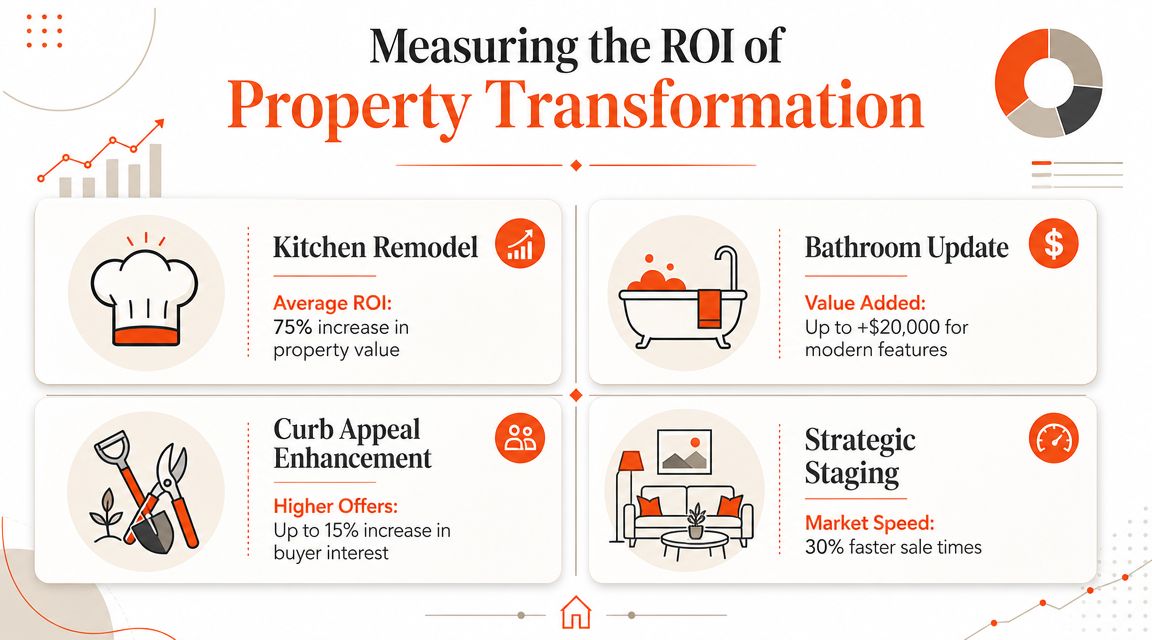
The cleanest way to talk about ROI with sellers is to stop arguing about taste and start measuring listing performance.
Agents already track the right signals. They just don't always tie those signals back to property transformation. The useful metrics are straightforward: days on market, showings per week, inquiry quality, offer strength, and offer-to-asking behavior. If transformation improves those, it's working.
The ROI conversation sellers actually understand
Sellers rarely need a lecture on design. They need a decision framework.
Use language like this:
- Will this increase buyer interest early?
- Will it reduce objections during showings?
- Will it help the home compete against current inventory?
- Will it improve how the property reads online?
That's a better conversation than pretending every update creates equal value. It doesn't.
A simple way to present ROI is to separate improvements into three buckets:
| Bucket | What it includes | How to judge it |
|---|---|---|
| Presentation ROI | Decluttering, styling, staging, better media | Worth doing when perception is the bottleneck |
| Functional ROI | Repairs, layout fixes, system issues | Worth doing when buyers may hesitate or discount heavily |
| Strategic ROI | Targeted upgrades tied to comp-set expectations | Worth doing when it changes market position |
Climate risk changes the math
One of the most overlooked parts of property transformation is that cosmetic upgrades don't automatically create durable value in climate-exposed markets. Harvard's Digital Innovation platform notes a growing “protection gap” and describes models that combine weather, satellite, and soil data to forecast losses more accurately, which makes the underwriting side of property value harder to ignore in exposed areas, as discussed in Harvard's climate-related property insurance analysis.
That changes the agent's job. In some markets, the strongest transformation isn't quartz counters or a new vanity. It's mitigation work that protects insurability, financing, and long-term buyer confidence.
Advisory lens: Ask not only whether an upgrade looks better, but whether it still makes financial sense once insurers, lenders, and buyers account for exposure.
For a broader homeowner-oriented perspective on upgrade planning, this piece on boosting home renovation value is useful because it highlights the need to think beyond appearance alone.
A short explainer can help frame the visual side of return:
If you want a more analytical way to evaluate which changes are likely to matter before advising a seller, this AI renovation value analysis for real estate agents use case is a relevant reference point.
A Modern Workflow for Agents and Teams
The old workflow is familiar. Walk the house. Call the photographer. Call the stager. Wait on floor plans. Chase copy. Coordinate edits. Hope the visuals align. Rework the package if the seller changes direction.
That process breaks because every handoff adds delay and inconsistency.
Property operations have already shown a better model. Rewisoft describes digital transformation through centralized monitoring, where IoT sensors for water and electrical systems feed real-time condition data into a single dashboard for predictive maintenance and remote oversight in its digital transformation guide for real estate. The principle matters even if you're not talking about building ops. Centralized inputs produce cleaner workflows.
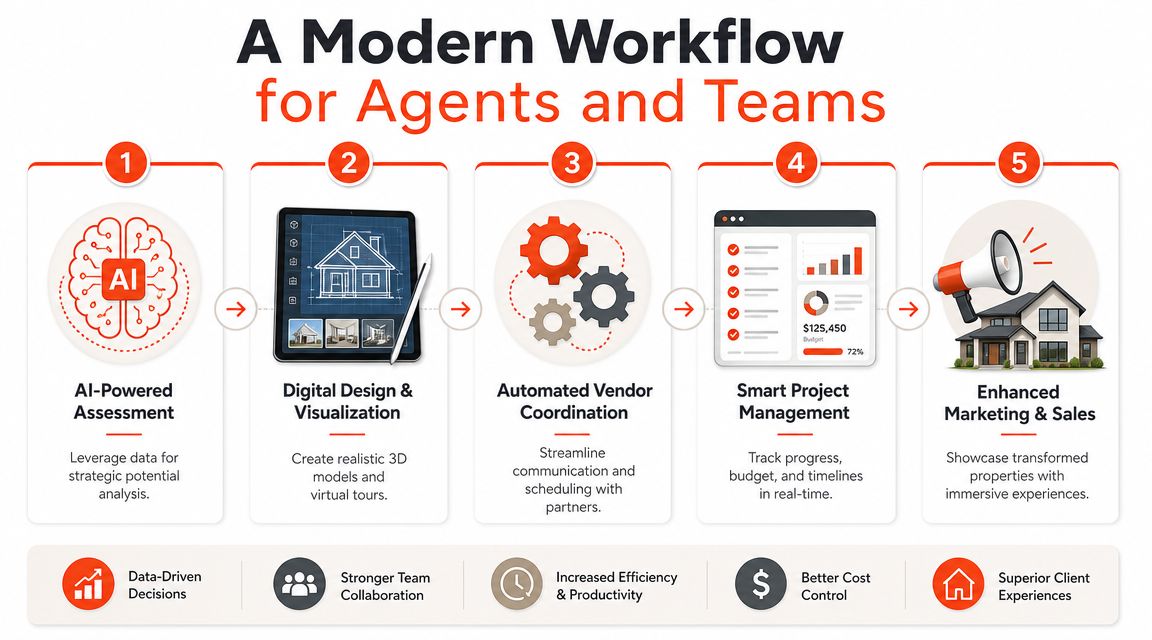
The modern listing prep sequence
A stronger workflow starts with one capture event and turns that into multiple outputs.
Initial walkthrough capture
Record a single, thorough property walkthrough. The goal is not artistic perfection. The goal is complete visual input.Transformation diagnosis
Decide what the listing needs. Is the issue clutter, styling, vacancy, room confusion, or condition?Digital optioning
Generate visual alternatives before committing to labor-heavy work. Sellers make better decisions when they can compare options.Approval and coordination
Once the path is selected, coordinate only the work that supports the strategy.Marketing asset production
Build the listing package from the same source material so the visuals, copy, and positioning stay aligned.
Why teams benefit most
Solo agents can use this process. Teams need it.
When a brokerage standardizes property transformation, three things happen:
- Recommendations become more consistent across agents and listing coordinators
- Seller communication gets easier because options are clearer and repeatable
- Marketing output improves because every asset starts from the same strategic brief
The best workflow doesn't just save time. It reduces opinion drift between agent, seller, marketer, and vendor.
Many high-performing teams gain an advantage. They don't improvise listing prep from scratch each time. They run a repeatable launch process, then adjust only where the asset demands custom treatment.
How AI Accelerates Your Transformation Strategy
Matterport reports that 67% of buyers want floor plans and 58% want virtual tours in listings, according to its article on digital transformation in real estate. Buyer expectations have already shifted. The speed of your transformation process now affects marketing performance, seller confidence, and time to launch.
AI cuts the time between property diagnosis and market-ready execution. Instead of asking a seller to wait for separate staging concepts, photo edits, copy drafts, and marketing revisions, agents can move from one walkthrough to multiple usable outputs in far less time. That changes the economics of listing prep. It also changes who can afford to use transformation as a strategy, because the model no longer depends on a long chain of manual production.

AI fits the new definition of transformation
Property transformation used to mean physical work first and marketing second. Now the order is often reversed. Teams test presentation options digitally, choose the version that will attract the right buyer pool, and then decide how much physical work is worth doing.
That shift matters because every listing has a cost ceiling. A vacant condo, a dated primary bath, and an overfurnished family home do not need the same response. AI helps agents compare scenarios faster, show sellers realistic options earlier, and avoid spending on improvements that will not change buyer perception enough to justify the cost.
What changes in day-to-day execution
AI improves production speed, but the bigger gain is decision speed.
Bounti Labs can use a single walkthrough to generate listing copy, extract stills, produce MLS-ready visuals, and support decluttering, staging, restyling, or renovation concepts. For a listing team, that reduces handoffs and keeps the marketing story aligned across assets. The same source material can shape the visuals, the description, the presentation deck, and the follow-up campaign.
The operational gains are straightforward:
- Seller approvals happen faster because options are visual, not hypothetical
- Production costs stay tighter because agents can test ideas before booking more vendors
- Launch quality becomes more consistent because the listing package is built from one strategic input
- More listings qualify for transformation because the workflow scales beyond high-end inventory
Agents comparing tools should review this guide to the best AI photo editing software for real estate marketing.
If your team also needs to turn listing assets into ongoing distribution, Automate social media with AI pairs well with this approach. One property capture can support MLS, email, social clips, seller updates, and recruiting content if the system is set up correctly.
The practical takeaway is simple. AI turns property transformation into a unified marketing system, not a series of disconnected tasks. Agents who adopt that model can price the strategy more clearly, present it more convincingly, and get listings to market with less delay.