Most advice on a real estate agent description is backwards.
It tells agents to sound impressive. Use polished adjectives. Mention passion. Add a few community details. Maybe say you're dedicated, client-focused, and committed to results. That advice produces copy that looks harmless and performs badly.
A description isn't there to flatter you. It's there to answer a prospect's silent questions fast: Do you know my market? Can you execute? Will working with you feel organized or chaotic?
That is the essential job. In a category where trust is fragile and many agents sound interchangeable, your wording has to do more than describe. It has to sort you into the “credible” pile within seconds. Every sentence either adds proof, removes friction, or wastes attention.
The strongest real estate agent description also does something most agents miss. It reduces uncertainty. Buyers and sellers aren't reading bios and listings for poetry. They're scanning for signals. Specificity, process, local relevance, and clean structure beat hype almost every time.
Why Your Real Estate Descriptions Aren't Working
Most underperforming descriptions fail for one reason. They try to sound good instead of trying to move someone forward.
A weak real estate agent description usually reads like this: “Dedicated professional with a passion for helping clients achieve their dreams. Known for exceptional service, local knowledge, and strong negotiation skills.” Nothing in that copy is offensive. Nothing in it is persuasive either.
The problem isn't tone. The problem is non-transferable language. Any agent can say they care. Any brokerage can claim market expertise. If the same paragraph could sit on a thousand websites without anyone noticing, it won't win trust.
Generic copy signals risk
Consumers don't read generic copy as neutral. They often read it as evasive.
In real estate, that hurts more than agents realize because descriptions now function as credibility screens. A seller deciding who gets the listing is judging your process before they ever hear your pitch. A buyer scanning listings is judging whether the home is worth a click, a save, or a showing request. If your wording feels padded, they assume the substance is padded too.
Practical rule: If a sentence could describe both a rookie and a veteran, cut it or rewrite it.
Instead of “I provide exceptional service,” use details that imply service. Mention the neighborhoods you cover. Mention your property focus. Mention how you prepare a listing before it hits the market. Mention how you keep clients updated and how you coordinate the moving parts after contract.
That's also why tools that sharpen the actual listing language matter more than agents think. Clean, search-friendly, buyer-focused copy often starts with stronger input and tighter structure, which is exactly the point of MLS listing optimization.
A better description does three jobs at once
The best descriptions don't just summarize. They:
- Build trust: They sound specific, not inflated.
- Create momentum: They move the reader toward a call, inquiry, or showing.
- Pre-qualify the lead: They make clear who the agent or property is for.
Compare the weak bio line above with something tighter:
Residential listing agent serving North County sellers who need fast, organized launch execution. My process covers pricing strategy, pre-listing prep, visual marketing, vendor coordination, and contract-to-close communication so sellers know what happens next at every stage.
That version isn't flashy. It works because it makes the reader think, “This person has a system.”
That's the shift. Stop writing like a tour guide. Start writing like a marketer who understands that credibility is the first conversion.
The Unbreakable Framework of a High-Converting Description
A high-converting description isn't built from inspiration. It's built from sequence.
Real estate agents handle far more than showings. The role spans client advising, pricing, paperwork, negotiation, and marketing, which helps explain why the profession requires broad communication and execution skills. The U.S. Bureau of Labor Statistics also reports that real estate sales agents had a median annual wage of $56,320 as of May 2024, and employment is projected to grow 3% from 2024 to 2034 in its occupational outlook for real estate brokers and sales agents. That mix of responsibilities is exactly why vague copy fails. You're not describing a simple sales role. You're describing an operator.
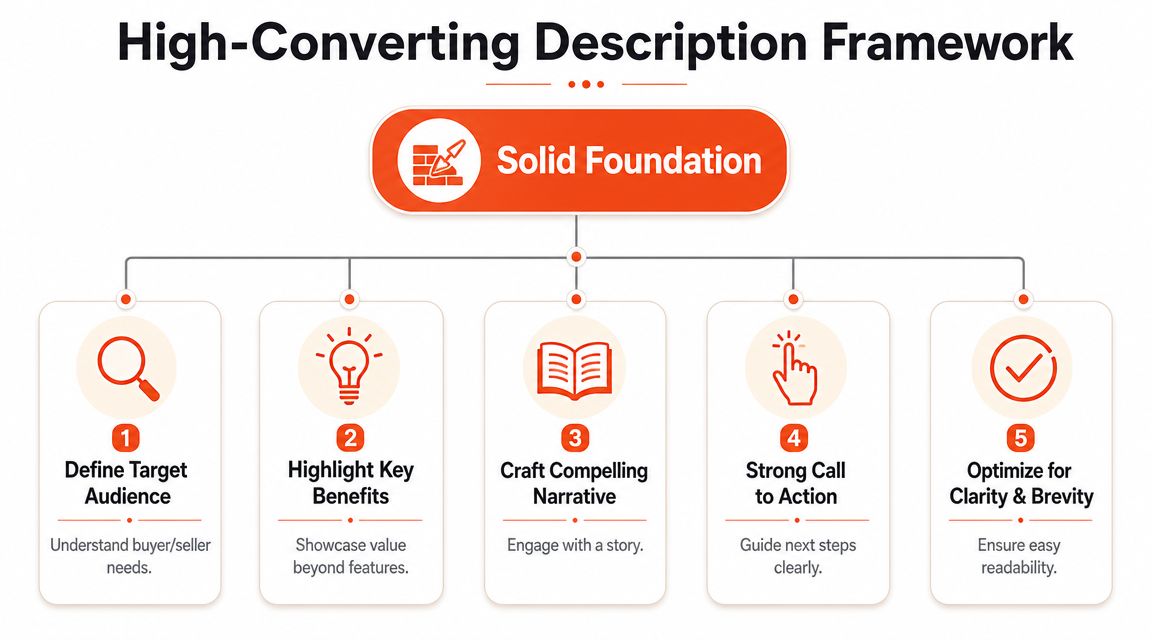
Audience comes first
Write to one person, not “everyone looking to buy or sell.”
A seller in a suburban move-up market has different concerns than a first-time condo buyer or an investor comparing rentals. If you don't choose the reader first, your copy gets blurry fast. Strong descriptions narrow the lens on purpose.
Use this test: can a stranger tell who this description is meant for in the opening lines? If not, the copy is still too broad.
Purpose keeps the copy honest
Every description needs a single job.
An agent bio might need to book consultations. A listing description might need to generate showings. A leasing description might need to filter out low-fit inquiries. Once you know the action, the wording gets cleaner because you stop stuffing in irrelevant details.
A lot of bad copy comes from trying to do five jobs at once. Explain everything, impress everyone, cover every feature, sound warm, sound premium, sound local. That creates mush.
Hook earns attention
The first line has to do more than announce the obvious.
“Welcome to this beautiful home” is filler. So is “I'm a passionate Realtor who loves helping families.” A hook should either identify the right audience, frame the opportunity, or signal a strong point of difference.
Try openings like these:
- For an agent bio: “I help condo sellers in high-competition neighborhoods launch cleaner listings with tighter marketing and faster follow-up.”
- For a property: “Single-level layout, oversized pantry, and a shaded backyard that feels usable.”
The point is not cleverness. The point is immediate relevance.
Value proves why the reader should care
Features matter. Benefits close the gap.
If you write “new windows, updated kitchen, detached garage,” you've listed facts. If you write “updated kitchen with better prep flow, detached garage for storage or hobby use, and new windows that brighten the main living areas,” you've connected features to lived experience.
A description should answer “why this matters” before the reader has to ask.
Call to action removes drift
Most descriptions fade out. They don't finish with direction.
Give the next step plainly. For agents, invite a strategy call, consultation, or listing review. For listings, invite a showing, ask buyers to review the full photo set, or direct them to request disclosures and details. The best CTA feels like a logical continuation, not a generic sales line.
Use this final checklist before publishing:
- Can the reader identify the audience quickly
- Is there one clear action the copy is trying to create
- Does the opening earn attention
- Does the body translate features into outcomes
- Does the final line tell the reader what to do next
If one of those is missing, the description may still sound polished. It just won't convert the way it should.
How to Write an Agent Bio That Wins Business
An agent bio is not your autobiography. It's your risk-reduction document.
That sounds less romantic than “tell your story,” but it's far more useful. A prospect reading your bio wants evidence that you're stable, capable, and organized. If your copy leads with where you grew up, your hobbies, or how much you love helping people, you're answering the wrong questions first.
That mistake matters because weak positioning gets punished in this business. One industry summary cites data that 87% of new real estate agents fail within five years, and it ties that failure to weak systems and poor pipeline discipline in this discussion of why new agents fail. Whether you're new or experienced, your bio has to signal the opposite of fragility.
The three questions every prospect asks
A good real estate agent description should answer these questions quickly:
- Do you work in my market
- Are you competent
- Can I trust your process
That means your bio should open with business relevance, not personality filler.
A sharper structure looks like this:
- Market fit: Name your geography, neighborhood type, and deal focus.
- Execution proof: Explain how you approach pricing, prep, marketing, negotiation, or communication.
- Trust signal: Show consistency, professionalism, and client handling style.
If you have real transaction data or specific operational metrics you're allowed to share, use them. If you don't, don't fake precision. Describe your method instead.
What to remove from your bio
Most bios need subtraction before they need polish.
Cut phrases like these:
- “Passionate about real estate” because it's expected, not persuasive.
- “Committed to excellent service” because every agent claims it.
- “Treats every client like family” because it sounds borrowed.
- “Expert negotiator” unless you immediately support it with process or context.
Replace them with real operating language. Talk about pre-listing preparation. Talk about visual marketing standards. Talk about how you manage updates, vendor coordination, or buyer education. Prospects trust detail more than praise.
Your bio should read like a business case for hiring you, not a yearbook paragraph.
A before and after example
Weak bio
Local Realtor with a passion for helping buyers and sellers achieve their goals. Known for dedication, honesty, and excellent customer service. Proud to serve families throughout the area.
Stronger bio
Residential agent serving sellers and buyers across established suburban neighborhoods and newer construction communities. My work centers on pricing discipline, listing prep, clear communication, and marketing assets that help clients make decisions faster. Clients hire me when they want a process that feels structured from launch through closing.
The second version works because it says something concrete. It also sounds like someone who intends to stay in business.
Your bio also has to travel well
Your website bio isn't the only version that matters. The same core positioning should carry into your Google profile, listing presentation, social platforms, and professional network. If you're tightening that broader presence, it helps to build your LinkedIn brand with the same discipline you use on your website. Prospects notice when your positioning is consistent across channels.
A final rule. Keep the personal details, but demote them. A line about community roots or local involvement can help after you've established capability. Before that, it's a distraction.
Crafting Property Descriptions That Generate Showings
A listing description should create clarity, not clutter.
Agents often think the job is to squeeze every upgrade and amenity into one paragraph. That produces bloated copy that nobody remembers. Buyers don't need a transcription of the feature sheet. They need a reason to care, a reason to believe, and a reason to book the showing.
Start with the angle, not the adjective
“Beautiful,” “stunning,” and “charming” are lazy shortcuts unless the rest of the sentence proves them.
Lead with the property's actual marketable angle. Maybe it's the layout. Maybe it's natural light. Maybe it's a backyard that feels private. Maybe it's proximity to a known neighborhood feature. Maybe it's flexibility for multigenerational living or work-from-home use.
A stronger opening usually follows one of these patterns:
- Lifestyle angle: Built for buyers who want open gathering space and a backyard that earns weekend use.
- Functional angle: Efficient single-level floor plan with separated bedrooms, generous storage, and easy indoor-outdoor flow.
- Location angle: Set on a quieter residential stretch with quick access to neighborhood retail, commuter routes, and daily essentials.
That opening gives the reader a frame. After that, the features make more sense.
Write for scan behavior
Most buyers won't read a long block of text. They skim, jump, compare photos, and come back.
So structure the copy accordingly:
- Opening paragraph: State the main appeal fast.
- Middle section: Group features by experience, not random order.
- Closing line: Add the practical next step.
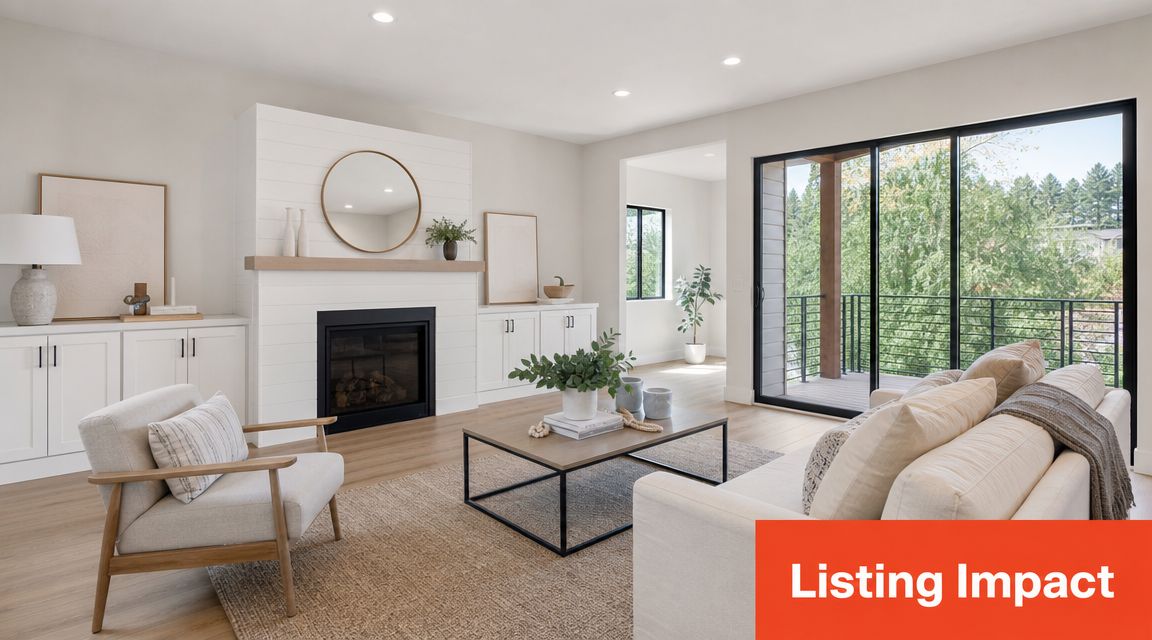
If the home has been staged or visually improved, your words should align with what the buyer sees. Strong copy and strong presentation reinforce each other. If you're thinking through that visual side, reviewing house staging before and after examples can help sharpen what details deserve mention in the description.
Educate when the market requires it
In a supply-constrained market, the listing description has to do more than sell fantasy. It should also set expectations.
Realtor.com advises agents to use listing content to set realistic expectations and highlight alternative housing options in response to the housing supply gap, as noted in its guidance for agents on the housing supply shortage. That's a useful correction to the old “just hype the property” approach.
For example, if a home is compact but well planned, say that. If a property offers an appealing alternative to a harder-to-find category, say that too. Buyers don't need spin. They need context that helps them make a decision.
Some of the strongest listing copy sounds less like advertising and more like informed guidance.
Don't bury the overlooked features
Agents routinely emphasize kitchens and primary suites, then ignore the details that often tip a showing decision. Storage. Garage use. Pantry depth. Mudroom function. Covered outdoor areas. Side yards. Laundry placement. Entry flow.
Those aren't filler features. They're friction reducers. They help buyers imagine how the home functions.
A simple writing formula helps:
- Name the space
- State the practical benefit
- Tie it to a use case
Example: “The walk-in pantry keeps daily storage out of sight while leaving the kitchen work zones cleaner and more functional.”
End with a useful invitation
“Schedule your showing today” is fine, but generic.
A better CTA matches the property and the buyer's likely next question. Try something like:
- For a turnkey listing: Review the full photo set, then book a private tour to experience the layout and light in person.
- For a unique home: Reach out for the full details on room flexibility, lot use, and recent updates before touring.
- For a competitive segment: If you've been waiting for a home with better storage and outdoor usability, this is one to see early.
That final line should push the buyer one step closer to action without sounding canned.
Editable Description Templates for Every Listing Type
Templates work when they preserve strategy, not when they mass-produce sameness.
The right template gives you structure while leaving room for specifics. The wrong template fills your listings with the same empty phrases every other agent is already using. In a trust-sensitive category, that's a problem. Industry commentary notes a real trust gap in the field, and strong descriptions help close it by showing professionalism and attention to detail, including often-missed spaces like garages, pantries, and outdoor areas, as discussed in this Hondros article on industry knowledge gaps.
Buyer-focused resale template
This format works when the likely buyer is comparing trade-offs and wants practicality more than polish.
Template
[Property type] in [area or neighborhood cue] with [top functional benefit] and [second practical benefit]. Inside, [mention layout or living flow]. The [kitchen/living/main area] connects to [outdoor space, work area, or dining use], making the home easy to live in day to day. Additional highlights include [storage feature], [parking or garage detail], and [another overlooked but useful feature]. Ideal for buyers who value [lifestyle or efficiency outcome]. Contact for [showing, disclosures, or full details].
Why it works
It centers usability. It also avoids overclaiming.
Luxury property template
Luxury buyers aren't buying adjectives. They're buying confidence, quality, and distinction.
Template
Set within [location cue], this [property type] pairs [design characteristic] with [craftsmanship or material cue]. The home opens to [signature visual or spatial moment], followed by [key entertaining or private retreat detail]. Features include [notable finish or appliance brand if relevant], [architectural detail], and [outdoor or wellness feature]. Every major space is designed for [privacy, hosting, indoor-outdoor living, or another high-value outcome]. Inquire for a private showing and full property materials.
Use this carefully
Luxury copy should sound controlled. If every line screams “exclusive,” the whole thing starts to feel insecure.
Rental listing template
Rental shoppers move fast. They want fit, convenience, and fewer surprises.
Template
Available [timing if appropriate], this [unit type] offers [main lifestyle benefit] in [location cue]. The layout includes [bed/bath or core layout note if allowed], [storage or parking detail], and [daily convenience feature]. Close to [transit, retail, parks, campus, or major employer area], it works well for renters who want [commute ease, low-maintenance living, or neighborhood access]. Reach out for availability, terms, and showing details.
Commercial space template
Commercial descriptions should sound commercial. Too many read like residential copy with square footage removed.
Template
Positioned in [trade area or district], this [space type] supports [retail, office, medical, showroom, or mixed use] with [access, visibility, layout flexibility, or parking advantage]. The space includes [buildout cue], [customer or team functionality], and [operational feature]. Suitable for tenants or users who need [workflow, presentation, client traffic, or service access]. Request property materials and touring information.
Description Template Focus by Property Type
| Property Type | Primary Audience | Key Focus | Example CTA |
|---|---|---|---|
| Buyer-focused resale | Owner-occupant buyer | Layout, usability, overlooked practical details | Request disclosures and book a private tour |
| Luxury | High-end buyer | Craftsmanship, design, privacy, distinction | Inquire for a private showing and full materials |
| Rental | Prospective tenant | Convenience, timing, amenities, location fit | Reach out for availability and leasing details |
| Commercial | Tenant, investor, user | Function, access, visibility, layout utility | Request property materials and touring information |
Details buyers can use build more trust than adjectives buyers can't verify.
A template should never finish the job for you. It should force you to add the details another agent would skip.
Using AI Tools to Generate and Refine Descriptions
AI is useful for description writing, but only if you give it the right role.
It shouldn't replace market judgment. It should remove blank-page friction, speed up first drafts, and help you produce consistent listing assets without rebuilding the same copy from scratch every time. The agents who get the most value from AI use it as an execution layer on top of a clear strategy.
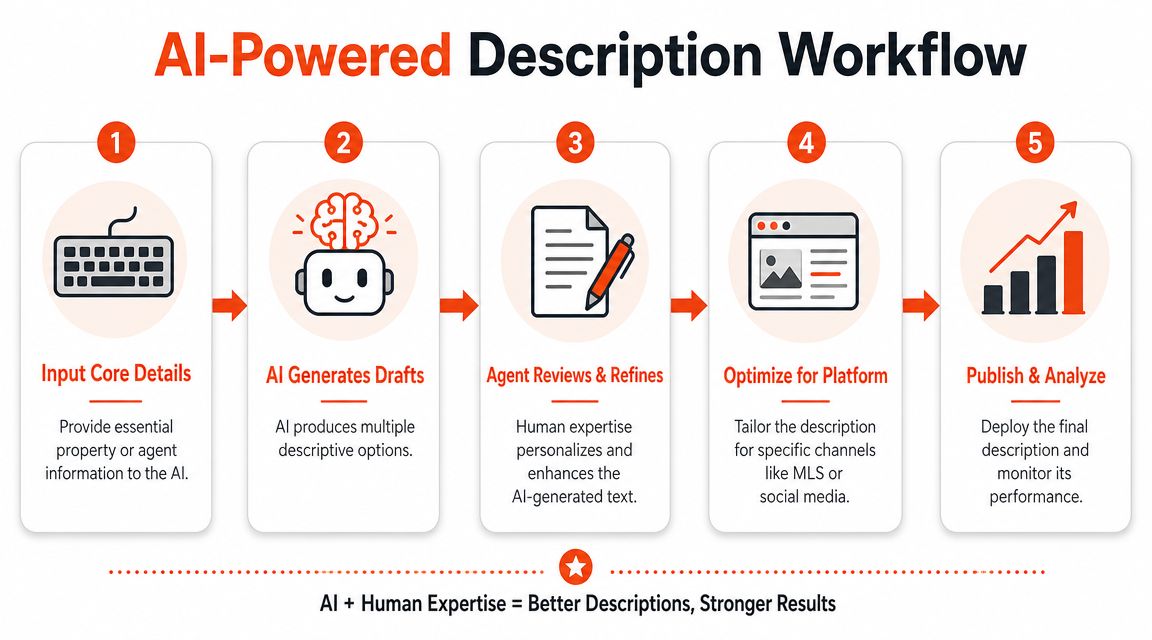
A repeatable workflow matters because early wins don't always become durable businesses. Relitix reports that nearly 49% of agents who secured their first closing did not repeat that result the following year, according to its analysis of first-time closers and repeat transactions. Descriptions alone won't solve that, but systems around marketing and follow-up can reduce inconsistency.
A practical AI workflow
Use a process like this:
Capture strong raw input
Start with a walkthrough video, notes on layout, neighborhood cues, and any details that change buyer perception. AI can't rescue weak source material.Generate a first draft
Ask the tool to create multiple versions for MLS, portal copy, social captions, or email promotion. If you want examples of AI support built for agents, AI assistants for real estate agents show the broader workflow well.Refine for truth and tone
Remove generic adjectives. Add local specifics. Tighten any line that sounds inflated or repetitive.Match the platform
MLS copy, Instagram captions, email intros, and brochure text should not all sound identical.Reuse what works
Save prompt structures, approved phrasing, and listing-type templates so the next draft starts from a better place.
What to tell the AI
Bad prompts create bland copy. Good prompts create usable copy.
Try prompts that include:
- Audience context: “Write for move-up buyers comparing storage, yard use, and school-area convenience.”
- Property angle: “Emphasize single-level flow, covered patio use, and pantry storage.”
- Tone control: “Direct, specific, no empty luxury language.”
- Output rule: “Use short paragraphs and end with a showing-oriented CTA.”
If you're also thinking about visibility beyond the listing itself, this roundup of top AI solutions for SEO is a useful companion because search behavior and listing language increasingly overlap.
A tool like Bounti can fit into this workflow by turning a video walkthrough into a draft property description, still images, and MLS-ready visual assets. That's useful when the bottleneck is time, not ideas.
Here's a practical example of the workflow in motion:
Where agents still have to do the hard part
AI won't know your market nuance unless you supply it.
It won't know which neighborhood reference carries weight locally. It won't know whether the garage matters more than the guest room. It won't know when a description should educate instead of hype. Those are judgment calls. The agent still owns them.
That's why the best use of AI is simple. Let it produce the first 80 percent. Then do the 20 percent that creates trust.
Bounti Labs helps real estate teams turn a single walkthrough into listing-ready marketing assets, including property descriptions, stills, and AI-enhanced visuals for decluttering, staging, restyling, or renovation concepts. If your current description workflow is slow, inconsistent, or too dependent on manual vendors, Bounti Labs is worth a look.