
What if you had a digital assistant who never slept, never forgot a follow-up, and handled all the tedious parts of your job? That’s the idea behind real estate automation software. It’s less a tool and more a digital partner, built to wrangle all the moving parts of your business so you can focus on what actually matters.
Your New Digital Partner in Real Estate

Think of it as the central nervous system for your business. It connects the dots between a new lead clicking on your website and the final signature on a contract, taking the administrative weight off your shoulders. This frees you up to spend your time on the high-value work: building relationships, negotiating, and closing deals.
Let’s be clear: this isn't about replacing agents. It's about amplifying your strengths. The best agents win because of their market insight and personal connections, not because they’re good at data entry. Automation just clears your plate so you have more time for the human side of the business.
And the industry is catching on, fast. The market for real estate software was valued at USD 10.29 billion in 2023 and is on track to more than double to USD 21.77 billion by 2030. This isn't just a trend; it's a fundamental shift away from clunky spreadsheets and manual work. If you're curious about the numbers, you can dive into the full market analysis on real estate software growth from Grand View Research.
The Core Purpose of Automation
At its heart, this software solves one of the biggest problems in real estate: inconsistency. We've all been there. A lead comes in late at night, you tell yourself you'll follow up in the morning, and it slips through the cracks. A missed email or a forgotten text can cost you a commission.
Automation creates a safety net for your business. It makes sure the important stuff gets done, every single time, so you never drop a ball again.
This system works 24/7 in the background, like the best assistant you’ve ever had. It doesn’t just do tasks—it organizes them into a smart, cohesive workflow.
To give you a clearer picture, here’s a quick breakdown of what these platforms actually handle and why it matters for your day-to-day.
Core Functions of Real Estate Automation Software at a Glance
| Core Function | Primary Benefit for Agents |
|---|---|
| Lead Management & Routing | Instantly captures and assigns new leads so you respond in minutes, not hours. |
| CRM & Communication | Automates follow-up texts and emails to nurture leads without manual effort. |
| Marketing & Content | Creates property flyers, social posts, and newsletters from listing data automatically. |
| Transaction Coordination | Sends deadline reminders and status updates to keep deals on track and compliant. |
These are the core jobs that automation takes over, giving you back hours every single week.
This shift from manual grunt work to automated systems is no longer a nice-to-have. It’s essential for any agent who wants to grow their business without burning out. You get to deliver a consistently great experience for every client, whether you’re juggling five deals or fifty.
Adopting real estate automation isn’t just about buying another piece of software. It's an investment in a smarter, more sustainable business.
Key Features That Drive Real Estate Success

To really get what real estate automation software can do, you have to look past the buzzwords and get into the specific features that actually do the work. These aren't just flashy add-ons; they're the engines that run your business, handling mission-critical tasks faster and more accurately than any human could.
For most agents, teams, and brokers, these features fall into three core pillars. Understanding them is the first step to taking back your time.
The first, and maybe the most important, pillar is lead and CRM automation. This is your digital doorman and your memory bank, making sure no opportunity ever gets lost. It’s what ensures every single inquiry gets a professional response, instantly.
Automate Your Lead Capture and Nurturing
Think about it. A potential buyer finds your listing on Zillow at 11 PM. Instead of that lead going cold in your inbox overnight, automation jumps into action. The software grabs their info, adds them to your CRM, and can even fire off a quick text to let them know you got their message.
That immediate contact is everything. The data doesn't lie: agents who respond to a lead within the first five minutes are massively more likely to turn that lead into a client. This feature makes that first touchpoint happen without you lifting a finger.
But it goes deeper. The system can then enroll that lead into a personalized email campaign, sending them similar homes, local market stats, or helpful tips for buyers. It keeps you on their radar for weeks, so when they’re ready to talk, you’re the first person they call.
Key lead automation functions usually include:
- Instant Lead Capture: Pulls every lead from portals like Zillow, Realtor.com, and your website right into your contact database.
- Automated First Response: Sends a pre-written text or email the second an inquiry hits, confirming you’re on it.
- Smart Lead Routing: For teams, it can pass new leads to agents based on zip code, price range, or who's next in line.
- Lead Scoring: Some systems can even "score" leads by tracking their activity, like how many times they view a property on your site, flagging the hottest prospects for you.
By automating the top of your sales funnel, you're building a reliable machine for engaging new business. It’s like having a dedicated intake coordinator who works 24/7, making sure every single lead is greeted and guided from their very first click.
Once your lead flow is under control, the next pillar is all about how you market yourself and your listings.
Streamline Your Marketing and Content Creation
Let's be honest—creating compelling marketing for every single listing is a huge time suck. This is where the second pillar, marketing and content automation, changes the game. Think of it as your personal marketing assistant, one that can produce professional materials in seconds.
For instance, you upload your new listing photos and details. The platform then automatically generates a complete marketing package: a stunning single-property website, printable flyers, social media posts correctly sized for Instagram and Facebook, and even video slideshows.
This isn't about replacing creativity; it's about eliminating grunt work. Instead of wrestling with Canva templates or paying a freelancer for every new property, you get a consistent, high-end brand look with a few clicks. It also acts as a checklist, ensuring you never miss a critical marketing step. As your system gets more advanced, you'll see how a modern marketing stack is built to support this kind of automated horsepower.
Use AI for Stunning Visual Assets
The newest and, frankly, most exciting features in real estate automation software are built on artificial intelligence. This third pillar is completely changing property marketing by giving every agent access to high-end visuals that used to be incredibly expensive and slow.
Today's AI-powered tools can take a simple video you shot on your phone and automatically:
- Enhance Photos: Correct bad lighting, fix colors, and sharpen images to make them pop on the MLS.
- Generate Floor Plans: Create an accurate 2D floor plan directly from the video.
- Virtually Stage Rooms: Take an empty room and fill it with photorealistic furniture that helps buyers imagine themselves living there.
- Declutter and Renovate: AI can digitally erase clutter from a messy room or even show potential upgrades, like new kitchen counters or a different wall color.
This tech gives you the power to show every listing in its best possible light. You can help buyers see the hidden potential in a vacant or dated home without the cost and headache of traditional staging. This is what turns a good listing presentation into one that buyers can't forget, driving more interest and better offers.
Putting Your Automation into Practice

It’s one thing to talk about the features of real estate automation software. It’s another thing entirely to see how it holds up in the trenches of a busy week. The real magic happens when you apply these tools to the daily grind.
Let's move past the abstract and look at three real-world scenarios: the top-producing agent, the team lead, and the property manager. Each one faces a different set of headaches, and each one finds a solution in automation.
The High-Volume Listing Agent
Picture Alex, a rockstar agent juggling 15 active listings. Before automation, every new contract meant a mad dash. Manually creating flyers, writing property descriptions, calling photographers, and blasting social media posts—all while the phone never stopped ringing. It was organized chaos.
Now, a single click changes everything. The moment Alex marks a listing as "signed," a workflow kicks in:
- Instant Marketing: The system grabs MLS data and photos to spit out a beautiful single-property website, a "Just Listed" email campaign, and a full suite of social media graphics. No design skills needed.
- Hands-Off Scheduling: A link goes out to Alex’s favorite photographer to book the shoot. At the same time, other agents can schedule showings based on the seller's pre-approved availability.
- Automated Feedback: An hour after a showing, the buyer's agent gets an automatic text and email asking for feedback. The responses are then neatly compiled into a report for the seller.
By putting the repetitive grunt work on autopilot, Alex gets back an estimated 8-10 hours per week. That’s time now spent where it counts: finding new clients and closing deals.
The Brokerage Team Lead
Now, let's look at Maria. She runs a team of twelve agents, and her biggest challenges were lead distribution and brand consistency. Leads were a free-for-all, causing tension, while every agent’s marketing materials had their own… unique… spin.
Real estate automation software brought order to the chaos. Maria set up a "round-robin" rule to ensure every agent gets a fair shot at new leads. The system even monitors response times, automatically reassigning a lead if an agent doesn't follow up within 15 minutes.
This gives her crucial oversight without having to micromanage. Better yet, the platform uses locked-in marketing templates. Agents can add personal touches, but the brokerage’s logo, colors, and key messages stay consistent on every single piece of marketing, finally building a unified brand. It's exactly why we built tools like Bounti's Marketing Autopilot, which centralizes content creation for teams just like Maria's.
The Property Manager
Finally, meet David, who manages a portfolio of 150 rental units. Vacancies were his nightmare. For every empty unit, he was stuck manually posting to dozens of sites, answering the same five questions a hundred times ("Are pets okay?"), and trying to coordinate viewings.
His new automation platform flipped the script. He enters the unit's info once, and the software syndicates the listing across Zillow, Apartments.com, and 20+ other rental sites instantly. An AI chatbot handles 90% of the initial questions 24/7, meaning David only talks to people who are genuinely qualified and ready to see the place.
This explosion in efficiency is why the property management software market, valued at USD 15.2 billion in 2024, is expected to nearly double by 2033. It’s a massive shift, and you can see the full research on property management software's growth for more details.
These stories show that automation isn’t just about working faster. It’s about building a smarter, more scalable business that lets you focus on what you do best.
How to Actually Measure Your Automation ROI
Adding real estate automation software to your business isn't about collecting another subscription. It’s a strategic move, and like any smart investment, it needs to show a clear return. But how do you calculate it? The real ROI isn't just about what you save on the monthly fee; it's a mix of hard numbers and priceless gains that make your business stronger from the ground up.
Thinking about the return on your investment means looking at two things. First, there are the "hard" metrics you can track on a spreadsheet. Then there are the "soft" benefits—the ones that are harder to count but often have a bigger impact on your brand and career in the long run.
Tracking the Hard Numbers
The most straightforward way to measure ROI is by looking at the cold, hard cash and time the software gives back to you. These are the numbers that justify the cost and prove the tool is working.
Start with the most obvious one: time saved. Keep a running tally of the hours you used to sink into admin work—manual data entry, whipping up flyers, or scheduling a week's worth of social media posts. Many agents get back 10+ hours per week. That’s a full workday you can pour back into what actually makes you money: prospecting and talking to clients.
Next, look at your lead conversion. The magic of automation is instant follow-up, which drastically improves your odds of turning a random inquiry into a real appointment. Track your lead-to-appointment ratio before and after you start automating. A 15-20% jump in conversions is a totally realistic goal, and that translates directly to thousands in potential GCI.
Finally, think about your direct marketing costs. The bills for professional photographers, home stagers, and graphic designers stack up fast.
Here’s where you can see immediate cost savings:
- Virtual Staging Savings: Compare the price of AI staging (often baked into the software) to the $500-$2,000+ per home you'd spend on physical staging.
- Photo Enhancement: How much do you save by using AI to perfect your own photos instead of hiring a pro editor for every single listing?
- Automated Content Creation: Add up the hours (or freelance fees) you’re no longer spending on one-off flyers, social graphics, and property websites.
The Priceless "Soft" Benefits
These are the returns that don’t show up on a P&L statement but are arguably more valuable. They’re what separate a business that’s just surviving from one that’s thriving. These benefits build on each other, creating a more resilient and reputable brand over time.
The real ROI from automation isn't just about closing more deals; it's about building a better business. It’s the difference between constantly feeling behind and being confidently in control.
Let's talk about agent burnout. It's real. By taking the soul-crushing weight of repetitive tasks off your shoulders, automation frees up your mental and emotional bandwidth. This leads to higher job satisfaction, sharper decision-making, and a career that feels sustainable. A happy, less-stressed agent delivers a far better client experience.
And that client experience is a massive win. When every lead gets a quick response and every client receives consistent updates with professional marketing, their perception of you goes through the roof. That consistency builds rock-solid trust and fuels the repeat and referral business that every top agent lives on.
Task Efficiency: The Manual Way vs The Automated Way
This isn't just a hunch; the industry is betting big on this shift. The global real estate marketing automation software market was valued at USD 1.12 billion in 2024 and is on track to hit USD 4.26 billion by 2034. That 14.3% annual growth is fueled by one simple fact: automation just works better. You can get a deeper sense of these trends by exploring the real estate software market insights from Market.us.
Sometimes, seeing the difference side-by-side is all it takes to understand the impact.
| Task | The Manual Way (Time/Effort) | The Automated Way (Time/Effort) |
|---|---|---|
| New Lead Follow-Up | 15-30 minutes per lead (if you don't miss it). High risk of costly delays. | Instant. A personalized text or email is out the door in under 60 seconds. |
| Create Listing Flyers | 1-2 hours per listing using design tools. Often results in off-brand work. | 5 minutes. Generated automatically from MLS data with perfect branding. |
| Gather Showing Feedback | 30+ minutes chasing down agents via calls and emails. Easy to forget. | Zero minutes. A feedback request is sent, and all replies are compiled for you. |
When you track the hard numbers and appreciate the game-changing soft benefits, you see the full picture. Real estate automation software isn’t just another expense—it’s an investment in your efficiency, your growth, and frankly, your own sanity.
Choosing and Implementing the Right Software
With so many automation tools out there, picking the right one can feel like a full-time job. It’s easy to get distracted by flashy features and marketing hype. The key is to cut through the noise and focus on what actually matters.
A great piece of software should feel like a natural part of your business, not another clunky app you have to wrestle with every day. Think of it like buying a car. You wouldn't just choose the one with the best paint job; you'd look under the hood. You need to know how it performs, if it fits your real-world needs, and if it will still be the right fit a year from now.
Key Criteria for Choosing Your Software
Before you even think about pulling out a credit card, measure every platform against these four non-negotiable benchmarks. If a tool doesn't score high on all four, it’s not a real asset—it’s just another subscription.
Ease of Use: Can your team actually use it tomorrow without hiring an IT guy? The best software is intuitive. If setting up a simple follow-up sequence requires a computer science degree, it's going to create more work, not less.
Integration Power: Does it play well with the tools you already use? Your business already runs on a tech stack—your CRM, MLS, calendar, and email. The right automation platform is a central hub that connects everything, not another isolated island of data.
Scalability: Will it work for you as a solo agent and still support you as a growing brokerage? A tool that's perfect for one person can easily fall apart when a team of ten starts using it. Look for software that can handle more volume and complexity as your business expands.
Real Estate Specialization: Was this built for an agent, or is it a generic business tool? A generic platform might handle basic emails, but true real estate automation software understands the specific flow of a transaction, from a new lead all the way to the closing table.
For those in property management, these criteria are just as important. When sizing up your options, digging into the best property management apps for 2025 can give you insights into tools designed for your unique day-to-day challenges.
A Simple Roadmap for Implementation
Rolling out new software doesn't have to be a nightmare. The secret is to start small and build momentum. Trying to automate everything on day one is a surefire recipe for frustration and a tool that nobody uses.
Instead, follow this simple roadmap for a smooth transition:
- Start Small: Pick one high-impact, low-effort task to automate first. A perfect starting point is your follow-up sequence for new leads.
- Secure Team Buy-In: Don't just email everyone a login and hope for the best. Show your team exactly how this tool will make their jobs easier, not just add another to-do.
- Measure the Results: Track the metrics that prove it's working. How much time did you save? Did your lead response time get faster? Use that data to show the value.
- Expand and Optimize: Once you've nailed one workflow and have the numbers to prove it works, then you can move on to the next process.
This is all about proving the return on your investment. You can boil it down to three simple questions: How many hours did we save? How many more leads did we convert? And how much did we cut from our costs?
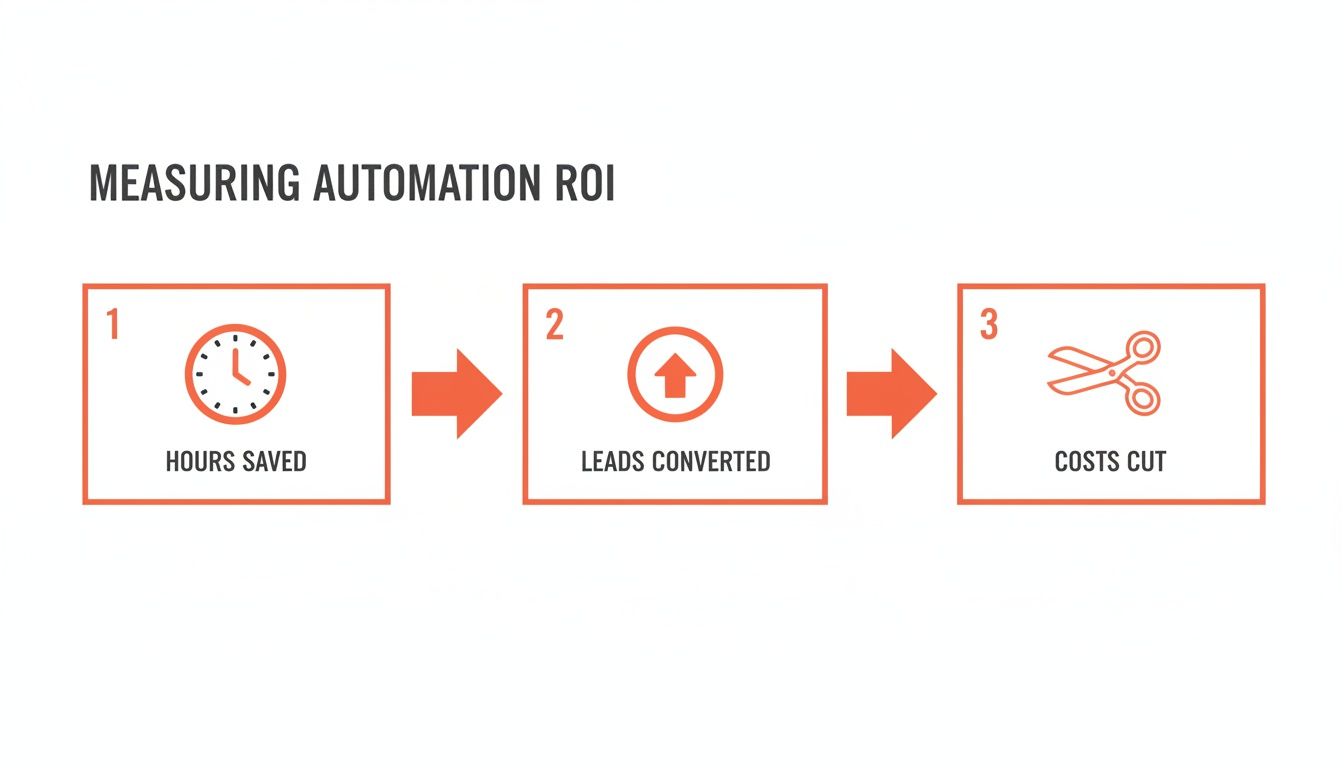
When you focus on these three core metrics, you can clearly show how automation is making a real financial impact. An AI-powered platform that handles everything from lead nurturing to creating visual marketing can be the engine for this growth. You can see how this all comes together in an AI operating system for real estate. This step-by-step approach gets your team on board and ensures your investment starts paying off fast.
Your Next Steps Toward an Automated Future
Let’s be honest. Bringing real estate automation software into your business isn't just about adding another app to your phone—it’s about deciding to work smarter, not just harder. We’ve seen how these tools can claw back hours from your day, turn dormant online leads into active clients, and build stunning marketing materials while you sleep. The result is simple: more deals, less burnout.
So, where do you start?
First, find the single biggest time-suck in your day. Is it the endless back-and-forth chasing showing feedback? The hours you lose creating property flyers for every new listing? Or that constant, nagging pressure to reply to a new lead within seconds?
Identify Your Biggest Pain Point
Pinpointing where your time and energy disappear is the only way to choose a tool that will actually make a difference. Don't try to automate your entire business overnight. That’s a recipe for disaster.
Just solve one problem. The one that, if fixed, would give you the most breathing room.
- Lead Follow-Up: If you're losing leads to radio silence, a CRM that sends automated texts and email drips is your first move. No question.
- Marketing Creation: If you dread the thought of another Canva session, a platform with AI content generation will feel like a superpower.
- Transaction Management: If you're drowning in contracts and deadlines, a tool that automates reminders and tracks signatures is what you need.
Once you know the problem, the solution becomes obvious. As you explore options, looking at the best real estate investment software can offer a helpful perspective, especially if you have an eye on growing your own portfolio down the line. This was never about replacing your expertise; it's about amplifying it.
Automation handles the repetitive, soul-crushing tasks. It frees you up to focus on what actually moves the needle: the human conversations and strategic negotiations that no machine can replicate.
Start with your most pressing need. You'll get a fast win, see an immediate impact, and build the momentum to tackle the next bottleneck. This is how you finally stop working in your business and start working on it—securing your spot for 2026 and beyond.
Frequently Asked Questions
It's smart to ask questions before adding any new tech to your workflow. When it comes to real estate automation software, we hear the same concerns from agents about the impact on their business, their wallet, and their future. Let's tackle them head-on.
Will Automation Replace Me?
Let’s be clear: absolutely not. The goal isn't to replace you; it's to clone the parts of your job that are repetitive and low-value. Think data entry, sending the first few follow-up texts, or cranking out marketing materials for a new listing.
This frees you up to double down on the skills that actually close deals—the human stuff no software can touch.
Think of it this way: automation handles the admin so you can master the relationships. Your expertise in negotiation, reading a room, and building trust just became even more valuable.
The right software works like a tireless assistant, running the back office flawlessly while you focus on what you do best.
What's This Going to Cost Me?
There’s no single price tag for real estate automation software, and that's a good thing. The cost varies wildly, which means you can find a solution that fits your budget and solves your most immediate problem.
- Specialized Tools: You can find point solutions—like an email parser or a social media scheduler—for a simple monthly fee. They do one thing well.
- All-in-One Platforms: For teams and brokerages needing a single system for everything from lead gen to transaction management, there are more comprehensive platforms. They cost more, but the impact is far broader.
The key is to match the tool to the pain. Start with the task that’s costing you the most time or money, and build your tech stack from there.
How Fast Will I See an ROI?
You'll feel the time savings almost immediately. The hours you get back from not having to manually design property flyers or nag other agents for showing feedback? That’s an instant win you'll notice on day one.
The bigger financial returns take a bit more time to show up in your bank account. You can expect a measurable lift in your core metrics—like lead conversion rates and revenue—within 3 to 6 months. That’s the typical runway needed for your automated systems to start nurturing leads and consistently contributing to your bottom line.
Ready to see how AI can reinvent your listing marketing? Bounti generates stunning property descriptions, photos, and virtual staging from a single video walkthrough. Try it today and see how you can win more clients and close more deals, instantly.