
Your brokerage's problem probably isn't that agents lack tools. It's that they have too many disconnected ones. The clearest sign is adoption data. NAR's REALTOR® Technology Survey shows eSignature is used by 79% of agents, social media by 75%, and drone photography/video by 52%. That tells you something important: agents adopt tech fast when it removes friction from execution and marketing. They ignore or abandon tools that add clicks, handoffs, and duplicate data entry.
That's the key split in 2026. One brokerage runs on a coherent operating stack. Another runs on logins, workarounds, and agent memory. The first one launches listings faster, keeps compliance tighter, and gives agents more selling time. The second burns hours moving the same information from inbox to CRM to transaction file to marketing folder.
Modern real estate brokerage tools matter because the business itself is now built on standardized data and rapid content production. NAR publishes monthly housing data that firms turn into listing presentations and market reports, while brokerage platforms increasingly package national-to-zip-code datasets into searchable visuals and downloadable files for custom analysis, which has shifted many teams away from manual spreadsheet workflows toward software-built market narratives in minutes rather than hours, as outlined in NAR research and statistics resources.
If you want to modernize your stack, stop shopping by feature list. Shop by labor saved, handoffs removed, and agent adoption. And if your listing marketing still depends on manual vendors, patchwork design tools, and inbox chaos, start by looking at purpose-built AI production platforms like ShortGenius AI ad creative tool.
1. Bounti Labs
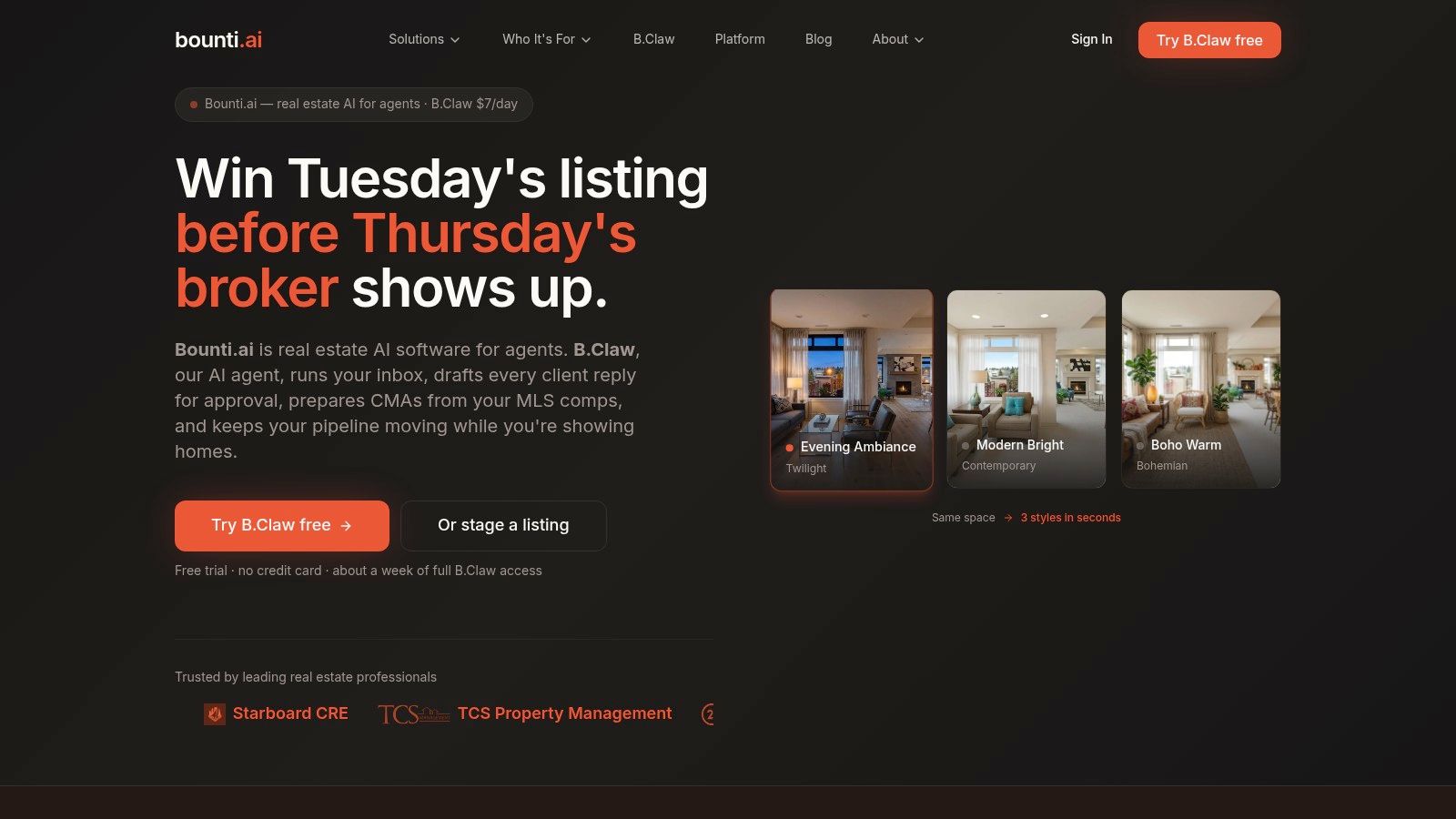
Bounti Labs is a strong option for brokerages that want one AI layer to cut work across listing prep, client communication, and marketing production. That matters because the AI era is creating a new split in brokerage software. Useful tools remove handoffs inside real workflows. Weak tools generate content but still leave agents copying details between inboxes, CRMs, design apps, and transaction systems.
Bounti's value is operational. B.Claw supports inbox workflows, CMA prep, and listing execution, while the visual side can turn a walkthrough video or room photo into listing copy, stills, staged images, reveal videos, and campaign assets fast enough for live production schedules.
Why Bounti stands out
Brokerages do not need another isolated AI app. They need a system that fits the stack they already run. Analysts at Technavio project the U.S. real estate brokerage software market will add USD 1.3235 billion from 2026 to 2030 at a 10.3% CAGR, with demand centered on automated marketing campaigns, secure document storage, and regulatory compliance monitoring. Bounti aligns with that shift because it connects with Gmail, calendar, MLS, major CRMs, DocuSign, Canva, and other core tools brokerages already use.
That integration point is the true buying test.
If an AI product forces agents to leave their normal workflow, export data manually, and rebuild the same listing assets in multiple places, it adds labor. If it drafts copy, creates visuals, and supports execution inside the systems your agents already touch every day, adoption gets much easier.
Practical rule: Buy AI that removes at least one real handoff. Copywriting, staging, still extraction, or inbox triage. If it only produces content and leaves the same workload in place, skip it.
Best use case
Bounti fits listing-heavy teams, brokerages with centralized marketing, property managers, and commercial groups that need fast turnaround without vendor delays. It also covers two jobs that are usually split across separate tools: front-end listing presentation and back-office workflow support.
That makes it especially useful for firms trying to build a tighter 2026 tech stack instead of stacking point solutions.
If your brokerage is comparing all-in-one operating systems against more flexible AI-first stacks, this guide to kvCORE alternatives for 2026 is a useful next read.
Pros:
- End-to-end AI workflow: B.Claw, visual generation, listing copy, and marketing outputs live in one real-estate-specific system.
- Strong workflow fit: Integrations with MLS, CRM, email, calendar, DocuSign, Canva, and other tools reduce duplicate entry.
- Fast creative production: Useful for MLS-ready visuals and campaign assets when internal teams or agents need speed.
- Broad buyer fit: Works for solo listing agents, teams, brokerages, and commercial operators.
- Flexible entry point: Free trial, free-to-try staging tools, and plan options that scale.
Cons:
- Human review is still required: Agents still need to check copy, comps, disclosures, and visuals for accuracy and compliance.
- Higher-tier plans need real usage: Smaller operators should confirm they will use the workflow automation, not just the visual tools.
In summary, if your brokerage wants an AI layer people will use because it saves time on live listings, start with Bounti Labs.
2. kvCORE

kvCORE is a brokerage platform for firms that want to standardize lead generation, websites, CRM, and marketing automation under one roof. If you're running a larger roster and you're tired of every agent choosing a different website, a different CRM, and a different follow-up process, kvCORE solves that governance problem quickly.
Its core value isn't that it has every feature. It's that it gives a brokerage a common operating environment. IDX sites, lead capture, behavioral automation, lead scoring, and brokerage-level analytics all sit in a stack built for consistency.
Where kvCORE fits best
kvCORE makes sense when leadership wants to control the front office. You can set a common website standard, automate follow-up, and connect into transaction systems like Dotloop, SkySlope, and Brokermint to bridge lead-to-close operations.
That said, kvCORE works best when the brokerage is willing to enforce process. This is not a “buy it and adoption happens” platform. If managers don't coach to it, agents will still default to text messages, spreadsheets, and inbox folders.
A lot of brokerages comparing front-office platforms end up asking whether kvCORE's bundling is worth it versus assembling a more open stack. If that's your debate, review these kvCORE alternatives for 2026.
kvCORE is strongest when brokerage leadership values standardization more than flexibility.
Pros:
- Brokerage-wide consistency: Good fit for firms that want one approved stack.
- Integrated front office: Website, CRM, automation, and analytics are connected.
- Mature add-on ecosystem: Helpful if you need vetted extensions rather than custom patchwork.
Cons:
- Opaque pricing: Quote-based buying slows evaluation.
- Adoption risk: Without training and accountability, agents won't use the automation effectively.
For multi-agent brokerages that want control and repeatability, kvCORE remains a serious contender.
3. MoxiWorks

MoxiWorks has a different philosophy from the lead-gen-heavy platforms. It's built around relationship management, sphere-based selling, presentations, websites, and brokerage oversight. That makes it a better fit for firms that want to improve agent process and client presentation, not just buy more internet lead infrastructure.
MoxiEngage is the center of gravity. It aligns with a sphere and sales-flow approach that many established agents already understand. MoxiPresent adds a polished layer for interactive CMAs and listing presentations, which matters if your brokerage wins business through trust, process, and polished market storytelling.
Best for relationship-driven brokerages
MoxiWorks is especially strong in brands and independents that care about coaching and manager visibility. Admin dashboards help leaders track goals, adoption, and activity. That's useful when your challenge isn't generating leads from scratch, but helping agents work their existing database more consistently.
The modular setup is also a smart advantage. Brokerages don't have to buy the whole suite at once. They can start with CRM or presentations, then add websites and management features as operations mature.
Pros:
- Strong for sphere-based selling: Better fit for relationship-driven agents than pure lead-funnel systems.
- Presentation quality: MoxiPresent is valuable for CMAs and listing pitches.
- Modular deployment: Easier to phase in than some all-or-nothing suites.
Cons:
- Pricing varies by brokerage arrangement: Harder to compare cleanly.
- Implementation choices matter: A weak rollout can make a good platform look average.
If your brokerage values agent coaching, listing presentations, and database discipline more than flashy lead funnels, MoxiWorks is a smart pick.
4. Lone Wolf Technologies

Lone Wolf is a control platform. If your brokerage is juggling forms, compliance reviews, commissions, accounting, and agent-facing presentation tools across separate systems, this is one of the clearest ways to consolidate the mess.
Its value is not flashy lead generation. Its value is operational consistency. Lone Wolf brings forms, transaction management, back-office accounting, commission processing, CMA tools, and listing ad automation under one vendor, which matters if your real problem is broken handoffs between admins, agents, brokers, and finance.
The core products cover distinct jobs. zipForm Edition handles forms and transaction workflows. brokerWOLF covers accounting, billing, commissions, and reporting. Cloud CMA gives agents a solid presentation tool. Boost adds automated listing advertising. That mix makes Lone Wolf more useful as a brokerage operating system than a point solution.
Why Lone Wolf makes sense
According to Matterport, real estate professionals can spend 80 to 100 hours per property on the full transaction journey, and modern platforms now combine AI-assisted marketing with transaction automation across 114+ steps. That is exactly why brokerage leaders should care less about shiny AI demos and more about where work gets removed.
Lone Wolf reduces risk in the parts of the business that break first under scale. Files go missing. Commission calculations get messy. Accounting lives in one tool while transactions live in another. Agents tolerate that chaos until volume rises. Then margins shrink and broker oversight gets harder.
This platform fits brokerages that want one system to anchor the operation, then layer AI tools around it with discipline. In the AI era, that is the smarter architecture. Start with the system that governs money, documents, and approvals. Add marketing and prospecting tools after the core recordkeeping is stable.
Fix your system of record before you buy more lead-gen software. Brokerages do not lose margin because they lacked one more chatbot. They lose margin because ops teams waste time chasing forms, correcting payouts, and cleaning up preventable errors.
Pros:
- Covers the operational core: Forms, transactions, accounting, commissions, and CMAs in one ecosystem.
- Good fit for broker oversight: Useful for firms that need process control and cleaner compliance workflows.
- Works well as a hub: Strong choice if you want a stable back-office foundation before adding AI and marketing tools.
Cons:
- Implementation takes work: Smaller firms can end up paying for more system than they will use.
- Buying can feel fragmented: Packaging across modules and association benefits is not always easy to compare.
- Marketing depth is not the main draw: Teams focused first on inbound lead generation may want a stronger front-end growth platform.
If your priority is operational discipline from contract to commission, Lone Wolf Technologies deserves serious attention.
5. SkySlope
SkySlope is a compliance-first platform. That sounds less exciting than CRM or AI content generation, but for a brokerage leader it's often the right priority. If your transaction coordinators, auditors, and brokers need clean review queues, file oversight, and checklist discipline, SkySlope is one of the clearest choices in the category.
It handles transaction checklists, broker dashboards, and audit workflows well. You can extend it with forms, DigiSign for e-signatures, Breeze for disclosures, and Books for accounting. The suite is built for process control more than growth marketing.
Who should choose SkySlope
Choose SkySlope if your brokerage already has a CRM and lead machine but lacks transaction discipline. It's especially useful for multi-office environments where inconsistent file handling creates risk and admin headaches.
Another practical advantage is budgeting clarity. Published starting pricing and no mandatory long-term contracts make it easier to test fit without a giant strategic commitment.
Pros:
- Strong compliance oversight: Built for review, audit trails, and broker control.
- Useful add-on suite: E-sign, disclosures, and accounting are available when needed.
- More transparent buying motion: Easier to budget than many quote-only alternatives.
Cons:
- Add-ons raise total cost: The base platform isn't the full spend.
- Limited front-office value: You'll still need separate CRM and marketing tools.
For brokers who need tighter files and cleaner oversight, SkySlope is one of the most practical real estate brokerage tools available.
6. dotloop
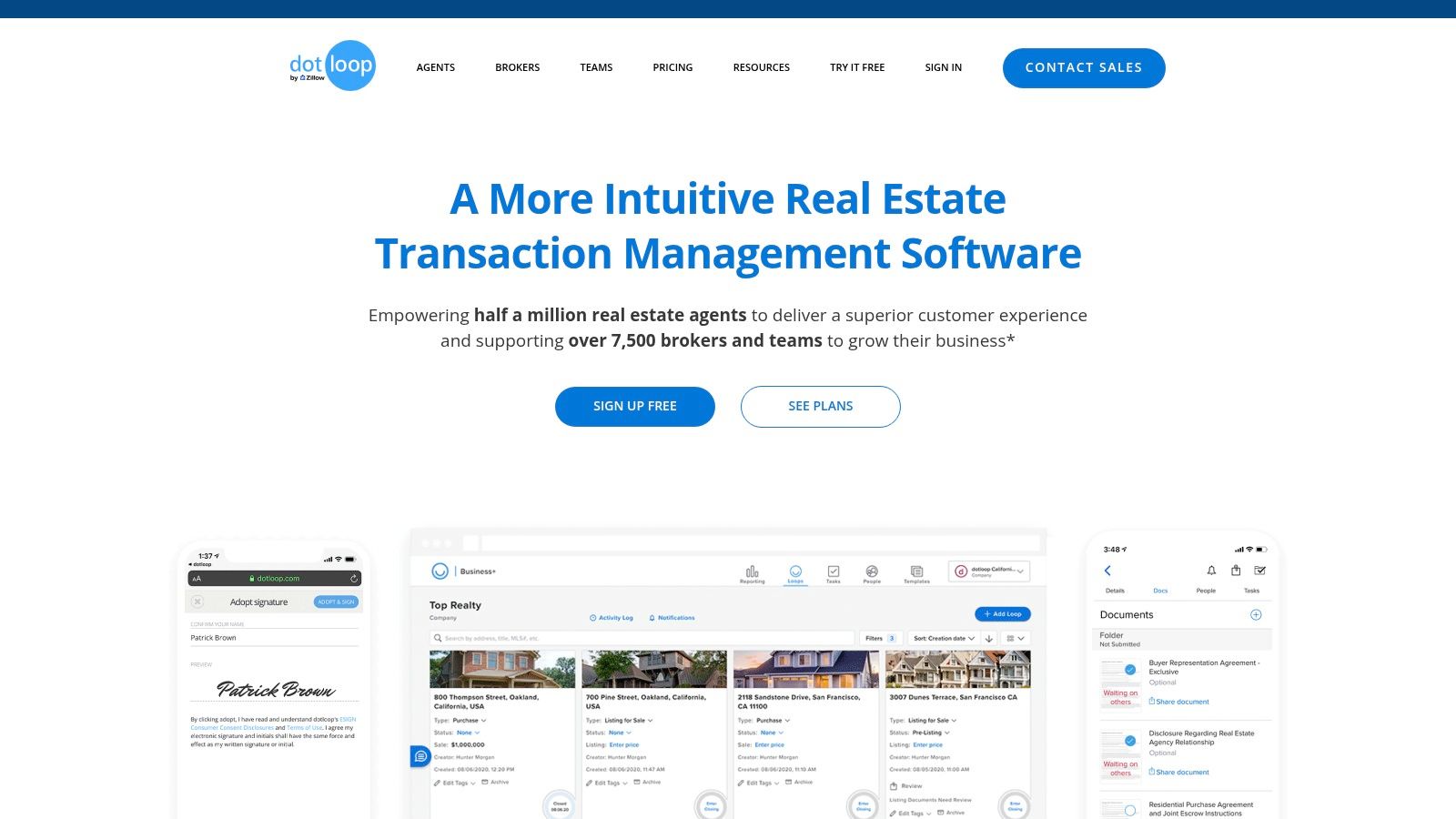
dotloop remains one of the most familiar names in transaction management, and familiarity matters. Agents don't need another learning curve if they're already comfortable creating templates, routing signatures, and managing deal files inside one environment.
The platform covers document editing, templates, e-signatures, in-person signing, mobile access, and broker dashboards. It's collaborative by design, which is why teams like it. It's easy to understand who has the file, what's missing, and what needs a signature.
dotloop's real advantage
The strongest case for dotloop is agent comfort paired with mobile usability. If your people are constantly in the field, mobile execution matters more than a long feature checklist. Teams and brokers also get compliance workflow visibility without forcing every user into a complex operating model.
Still, administrators should validate tier differences and broker pricing carefully. dotloop can be a great execution layer, but it's not your lead-gen engine and it's not your accounting system.
Pros:
- High familiarity: Easier adoption when agents already know the product.
- Solid collaboration: Good for team-based transaction workflows.
- Strong mobile experience: Useful for field-heavy agents and coordinators.
Cons:
- Broker pricing is quote-based: Harder to compare side by side.
- Tier variation matters: Not every feature is available in every plan.
If your brokerage wants dependable transaction collaboration with broad agent familiarity, dotloop is still a strong option.
7. Follow Up Boss
Follow Up Boss earns its place because it solves one of the most expensive problems in brokerage operations: leads die when follow-up lives across too many systems. If your brokerage already has a website, paid lead channels, and outside marketing tools, this CRM gives you a clean operating layer for routing, response speed, outreach, and pipeline accountability without forcing a full platform replacement.
That matters more in the AI era. A modern brokerage tech stack should reduce agent workload, not bury agents in one more dashboard with one more half-finished feature. Follow Up Boss is at its best when you treat it as the command center for lead conversion and keep your other systems focused on what they do well.
Where Follow Up Boss actually fits
This is a strong choice for teams that want flexibility and know how to build around integrations. Calling, texting, email, automations, action plans, reporting, mobile access, and broad app connections make it useful for brokerages that prefer a modular stack over a bundled system.
The tradeoff is clear. Follow Up Boss is a CRM, not the whole brokerage operating system. You still need to choose your website platform, transaction management, accounting, and back-office tools carefully. That is a weakness for brokerages that want one vendor to dictate process. It is a strength for operators who care about stack design, data flow, and keeping the front office adaptable as tools change.
The adoption case is still strong. As Ohio REALTORS' summary of NAR's 2025 technology survey shows, 46% of agents use AI-generated content, 21% use CRM with AI-powered insights, and 1% use digital twins. Real estate tech use is still fragmented. Brokerages do not need more AI badges. They need a CRM agents will open, update, and use every day.
If you are weighing an open CRM against a more bundled platform, review these Follow Up Boss alternatives for 2026 before you commit.
Pros:
- Flexible stack fit: Works well if you already have lead sources, websites, and marketing systems in place.
- Strong follow-up execution: Useful for routing, response speed, nurture, and manager visibility.
- Lower commitment risk: Trial and month-to-month options make testing easier.
Cons:
- No built-in website layer: You need separate tools for lead capture and front-end experience.
- Costs can rise with add-ons: Map pricing to team size and workflow needs before scaling.
For brokerages that want a CRM built for conversion instead of a walled garden, Follow Up Boss remains one of the smartest picks.
8. BoomTown
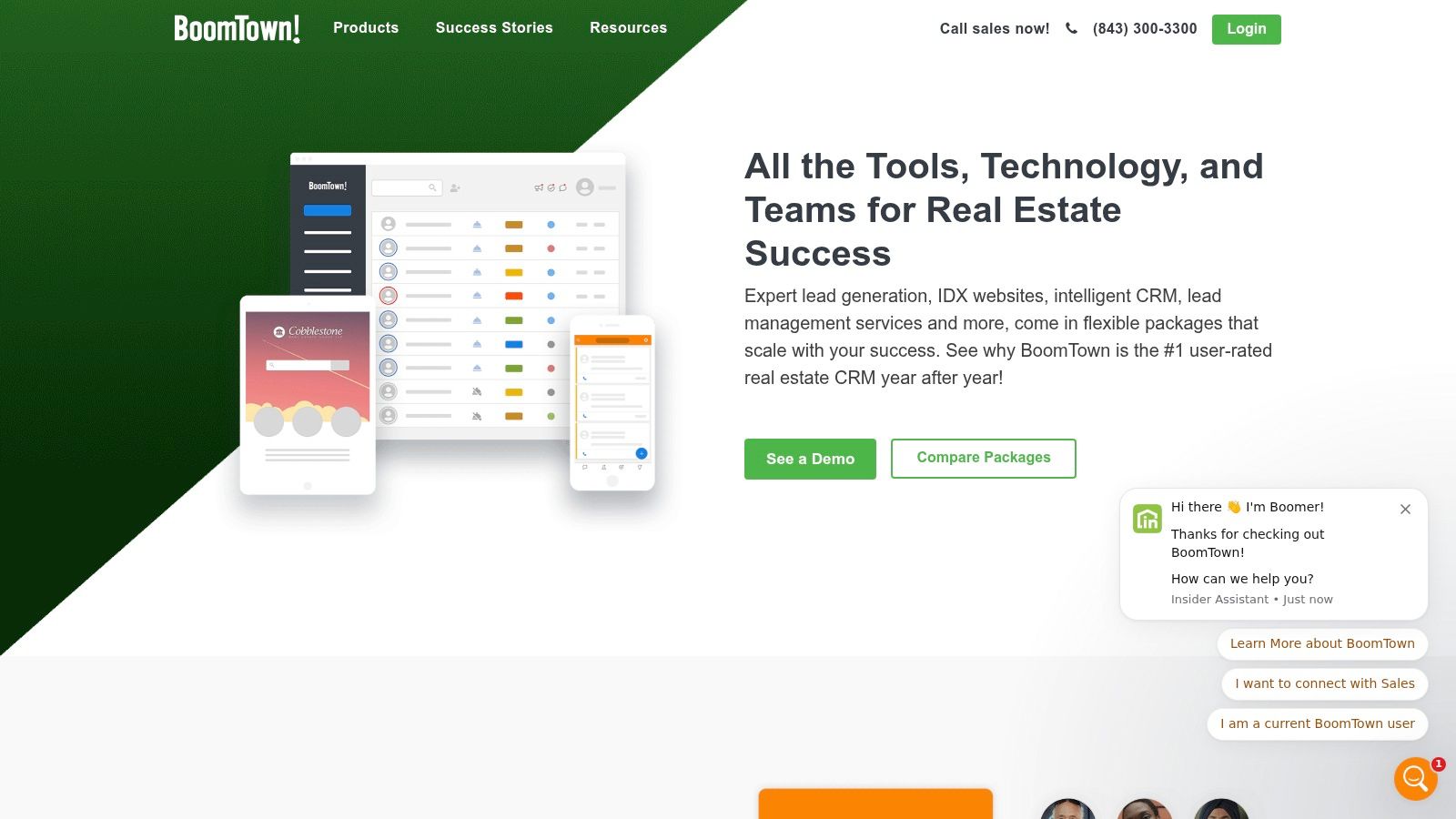
BoomTown is for growth-minded teams that want a more managed front-office machine. It combines IDX websites, lead generation, CRM, accountability workflows, coaching support, and marketing add-ons in a platform designed to create structure.
That structure is the appeal. Some teams don't need maximum flexibility. They need a vendor with playbooks, routing logic, and support around conversion discipline. BoomTown gives them that.
Where BoomTown makes sense
Choose BoomTown when your team's biggest problem is inconsistent execution after leads arrive. The platform is known for registration-focused websites, lead routing, accountability workflows, and implementation support that helps managers enforce process.
The tradeoff is freedom. BoomTown is more opinionated than open CRMs. It also tends to involve a bigger spend once setup, add-ons, and ad strategy enter the picture. That's fine if you're committed to the model.
Pros:
- Strong lead-gen orientation: Better fit for teams that want pipeline growth with structure.
- Manager-friendly workflows: Useful when accountability is the bottleneck.
- Support-led implementation: Helpful for teams that need vendor guidance.
Cons:
- Typically pricier: Budget for more than the base platform.
- Less open by design: Not ideal for teams that want to assemble a custom stack.
If your team wants a guided path to lead conversion rather than a flexible toolbox, BoomTown is worth the investment.
9. Lofty

Lofty is one of the stronger “operating system” plays in this market. It brings together CRM, IDX websites, marketing automation, dialer, mobile tools, lead scoring, and optional transaction or back-office modules. If you want one vendor across lead gen, nurture, and a growing chunk of operations, Lofty is built for that.
This is the right fit for brokerages that want automation depth and don't mind committing to a broad platform. Smart Plans, forecasting, website tools, routing, and team performance controls give managers a lot to work with.
The real decision with Lofty
The question isn't whether Lofty is capable. It is. The question is whether you want the convenience of a single vendor badly enough to accept future switching costs. That's the core tradeoff in every all-in-one platform.
Lofty works especially well for teams that need heavier automation and prefer one contract over a stitched stack. If you're weighing bundled convenience against flexibility, these Lofty alternatives for 2026 can help frame the decision.
Pros:
- Broad automation depth: Strong for follow-up, scoring, and marketing execution.
- Single-vendor simplicity: Useful when leadership wants one accountable provider.
- Team and broker controls: Solid oversight for scaling operations.
Cons:
- Quote-based pricing: Confirm modules and terms early.
- Potential lock-in: Unbundling later can be painful.
For brokerages that want one system to run much of the business, Lofty is a credible option.
10. TotalBrokerage
TotalBrokerage is not trying to be your marketing engine, and that's why it's useful. It focuses on brokerage operations: transaction management, compliance queues, commissions, agent payouts, billing, onboarding, and reporting. If your brokerage is profitable on paper but messy in payout execution, this is the kind of tool that fixes the leak.
Its strength is centralization. It can pull key contract data into commission calculations, route files through compliance review, support onboarding, and sync with QuickBooks and transaction systems like dotloop and SkySlope.
Best use for TotalBrokerage
This platform fits broker-operators who already have a front-office stack but need tighter financial and compliance control. It's especially practical for firms that want transparent per-seat pricing in a category where many vendors still hide the number until a sales call.
Pros:
- Brokerage-first design: Built around operations, not agent vanity features.
- Commission automation: Useful for reducing manual payout work.
- Transparent pricing structure: Easier to evaluate than many back-office tools.
Cons:
- No front-office marketing engine: You'll need separate lead-gen and CRM layers.
- Can be more than a small shop needs: Pick the plan carefully.
If you need cleaner commissions, reporting, and compliance without rebuilding your whole sales stack, TotalBrokerage is a strong operations choice.
Top 10 Real Estate Brokerage Tools Comparison
| Product | Core features ✨ | UX / Quality ★ | Value & Pricing 💰 | Best for 👥 | USP / Why choose 🏆 |
|---|---|---|---|---|---|
| Bounti Labs 🏆 | ✨ AI agent (B.Claw), video→copy/stills, virtual staging, renovation viz | ★★★★☆ Fast results (~60s) + enterprise integrations | 💰 Free trial; B.Claw $7/day; $99–$599/mo; staging free try | 👥 Listing agents, brokerages, property managers | 🏆 Instant, unlimited MLS‑ready visuals + inbox/workflow automation; deep 250+ tool integrations |
| kvCORE (Inside Real Estate) | ✨ IDX sites, Smart CRM, lead gen, analytics | ★★★★ Mature, broad feature set | 💰 Quote/enterprise pricing | 👥 Large brokerages standardizing tech stack | Single‑vendor brokerage stack with marketplace add‑ons |
| MoxiWorks | ✨ MoxiEngage CRM, MoxiPresent, sites, admin dashboards | ★★★★ Familiar in big broker networks | 💰 Broker‑negotiated pricing | 👥 National brands & independent brokerages | Modular adoption + strong training/knowledge base |
| Lone Wolf Technologies | ✨ Transactions (zipForm), brokerWOLF accounting, Cloud CMA, Boost ads | ★★★★ End‑to‑end front→back office | 💰 Varies by member vs. brokerage | 👥 Brokerages needing forms & accounting | System of record with deep forms & commission handling |
| SkySlope | ✨ Transaction checklists, audit trails, DigiSign, Books (opt.) | ★★★★ Strong compliance & file review | 💰 Published starting pricing; add‑ons raise cost | 👥 Compliance teams & transaction coordinators | Fast audit/review tools and broker oversight |
| dotloop (Zillow Group) | ✨ Document editor, e‑sign, mobile apps, team dashboards | ★★★★ Mobile‑first collaboration | 💰 Broker/enterprise quote pricing | 👥 Teams & brokers managing transactions | Familiar UX, templates, and team collaboration |
| Follow Up Boss | ✨ Open CRM, lead distribution, automations, AI summaries | ★★★★ Speed‑to‑lead and flexible integrations | 💰 Transparent trial; month‑to‑month billing | 👥 Teams that want flexible, open CRM stacks | Integrates with existing lead gen; fast follow‑up automation |
| BoomTown (Inside Real Estate) | ✨ IDX + lead gen, CRM, coaching, PropertyBoost | ★★★★ Premium lead‑generation focus | 💰 Generally pricier; quote + setup fees | 👥 Growth‑oriented teams & brokerages | Vendor‑managed advertising + structured accountability |
| Lofty (formerly Chime) | ✨ AI CRM, IDX sites, marketing suite, dialer | ★★★★ Heavy automation & AI assistants | 💰 Quote‑based; module pricing | 👥 Agents/teams wanting full‑stack OS | All‑in‑one automation with AI lead scoring & Smart Plans |
| TotalBrokerage | ✨ Commission calc, compliance queues, reporting, QuickBooks sync | ★★★ Brokerage ops focused UX | 💰 Published per‑seat pricing options | 👥 Brokerage operations & finance teams | Purpose‑built commission automation and transparent pricing |
How to Build Your 2026 Brokerage Tech Stack
Choosing among real estate brokerage tools isn't about finding the platform with the longest feature page. It's about deciding what your brokerage is trying to control. Lead flow. Compliance. Listing launch speed. Agent follow-up. Financial visibility. The mistake most firms make is buying tools in the order agents complain, not in the order operations break.
Start with your system of record. Decide whether your brokerage runs lead-to-close through a CRM or compliance-to-commission through transaction and accounting software. There's no universal answer. A team-heavy, internet-lead-driven business may build around Follow Up Boss, kvCORE, or Lofty. A brokerage with complex oversight and accounting needs may build around Lone Wolf, SkySlope, or TotalBrokerage. But pick one operational center first. If two systems both think they own the truth, your data gets messy fast.
Then focus on adoption. At this stage, most rollouts die. Agents will use tools that save them time immediately. They won't use tools that require duplicate entry, long onboarding, or ten clicks to complete a routine task. Involve working agents in demos. Test mobile experience. Ask how long it takes to complete a real task, not a canned demo task.
What a strong stack actually looks like
A resilient stack usually has four layers:
- Core system of record: CRM or transaction/back-office platform.
- Transaction and compliance layer: dotloop, SkySlope, Lone Wolf, or TotalBrokerage.
- Marketing and listing production layer: Bounti Labs, plus your website or lead platform if needed.
- Integration layer: Native integrations first, then careful use of connectors where necessary.
AI should enter, not as a badge, but as a tool for labor reduction. The most useful AI in brokerage work handles tasks agents hate repeating: listing descriptions, image enhancement, staging, still extraction, email drafting, and workflow triage. Bounti stands out because it applies AI directly to listing launch and communication work that agents already do every week. That's where time comes back.
Buy AI for one reason only: it removes expensive human effort from a recurring workflow without lowering quality below client-facing standards.
Also calculate total cost of ownership, not just subscription cost. Implementation, add-ons, mandatory ad spend, training time, admin complexity, and migration pain all count. A cheaper tool that nobody adopts is more expensive than a pricier one that becomes part of daily workflow.
Finally, keep your stack open where it matters. Brokerages change. Teams split. vendors get acquired. Strategies shift. If your CRM can't talk to your transaction platform, or your listing production tool can't plug into your actual workflow, you'll pay for that rigidity later. Build for operational resilience, not just this quarter's convenience.
If you want a practical next step, map your current workflow from new listing to live marketing to signed contract to paid commission. Mark every manual handoff. Every re-entered field. Every outside vendor delay. Then replace the ugliest bottleneck first.
That's how you build a stack that helps agents sell instead of slowing them down. And if you're refining the CRM side of that stack, this guide can help you find your ideal small business CRM.
If you want one tool that immediately upgrades listing production while fitting into a broader brokerage stack, start with Bounti Labs. It's built for the work agents do every day: preparing listings, generating visuals, drafting marketing copy, and reducing the manual steps that drag deals forward. For teams that want faster launch speed without adding more vendor chaos, Bounti is one of the clearest wins in the market.