The worst advice in real estate marketing is still the most popular: spend a fixed percentage of GCI and call it a plan.
That rule is easy to repeat and hard to use. It ignores whether you're trying to break into a new farm, push a luxury listing, recruit agents into a brokerage, or build a repeatable inbound pipeline that doesn't depend on your next open house. It also ignores a basic truth. Different listings require different levels of production, different channels, and different speed.
A real estate marketing budget should work like an operating system, not a slogan. It should tell you what to spend, where to spend it, when to increase spend, and when to cut it fast. If it can't do that, it's not a budget. It's a guess.
The agents who grow on purpose usually stop thinking in terms of “What percent should I spend?” and start asking better questions. What outcome am I buying? Which activities create closings? Which costs are fixed, and which belong to the listing? That's the shift that makes marketing spend easier to defend and much easier to improve.
Your Budget Starts with Goals Not Percentages
The flat-percentage model sounds disciplined, but it often creates lazy decisions. If your income rises, the model tells you to spend more. If your income dips, it tells you to spend less. That may feel neat in a spreadsheet, but it has nothing to do with what your business needs right now.
A serious real estate marketing budget starts with targets. Closings. Listings taken. Average price point. New market share in a neighborhood you want to own. Recruiting goals if you run a team or brokerage. Marketing only works when each dollar has a job.
What top producers understand
One benchmark makes the gap obvious. A widely cited industry benchmark reports that the average real estate agent spends $10,600 per year on marketing, while the top 10% of producers spend over $30,000 annually. The same benchmark notes that digital advertising accounts for 52% of real estate marketing budgets. That tells you two things. First, stronger production usually comes with more aggressive marketing investment. Second, online channels now hold the largest share of spend in the category, not print or broadcast (real estate marketing statistics benchmark).
That doesn't mean spending more automatically makes you better. It means serious operators fund the level of visibility their goals require. If you want premium listings, faster response times, consistent lead flow, and listing media that looks current, you can't budget like a hobbyist.
Practical rule: If your goals require more reach, better visuals, and faster follow-up than last year, your budget can't stay frozen at last year's comfort level.
Set goals that force useful budget decisions
Good goals create clear spending choices. Weak goals create random activity.
Use goals like these:
- Production goals: Decide how many closed transactions or signed listings you want, then ask what lead volume and nurture effort that requires.
- Market goals: If you're entering a new farm, your budget needs repeated visibility and local trust builders, not just occasional ads.
- Price-point goals: Moving upmarket usually requires better creative, stronger listing presentation materials, and more polished property media.
- Business model goals: A solo agent needs efficient lead generation and nurture. A team leader may need a larger brand layer plus listing promotion. A brokerage may need consumer marketing and recruiting support at the same time.
There's also a difference between baseline marketing and listing-specific marketing. Your baseline budget keeps your brand in motion. Your property budget changes by listing, urgency, and audience. Blending those together is one reason agents lose track of ROI.
Stop treating marketing like overhead
Many agents encounter a common pitfall. They classify marketing as a painful expense, then they spend defensively and inconsistently. That mindset leads to underfunded launches, weak follow-up systems, and cheap creative that undercuts the perceived value of the listing.
A better view is simpler. Marketing is an investment in pipeline and conversion. Some of it supports long-term brand equity. Some of it should be expected to produce short-term appointments and closed business. The budget has to reflect both. If you only fund what feels safe, you'll usually get safe results.
Building Your Budget From the Bottom Up
The cleanest way to build a real estate marketing budget is to start at the bottom, not the top. Don't begin with a percentage. Begin with the number of closed deals you want, the number of leads required to produce them, and the cost to generate and convert those leads.
That approach is more defensible because it ties spending to output. It also gives you a way to compare channels that behave differently. One channel may bring cheaper leads that convert poorly. Another may cost more upfront but produce better clients and better close rates.
A practical budgeting method is to use cost per lead, lead-to-close conversion rate, and average revenue per sale, then track every channel back to closed business so decisions are based on realized ROI rather than vanity metrics (bottom-up budget method for real estate marketing).
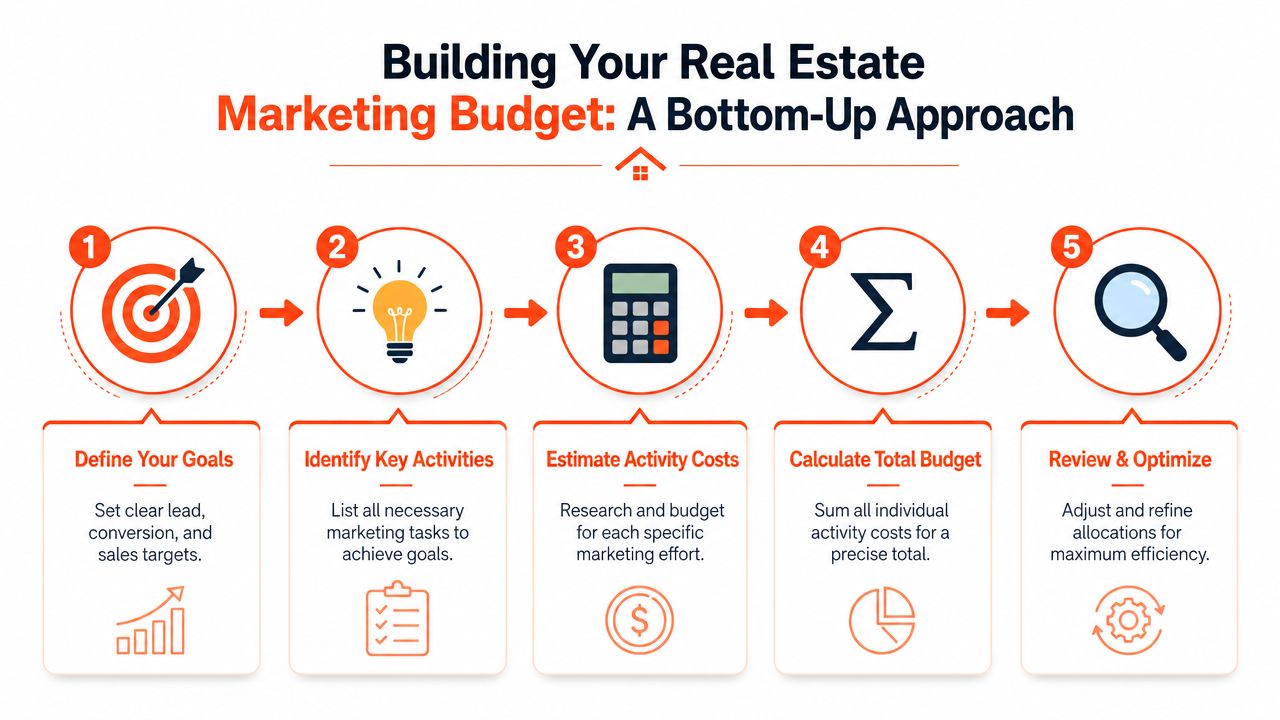
The working model
Here's the model in plain English:
Set your target outcome
Decide how many closings, listings, or signed clients you want this year.Know your conversion rate
Look at your real numbers, not your optimistic ones. How many leads become appointments? How many appointments become clients? How many clients close?Estimate lead volume required
Once you know your conversion profile, you can calculate how many leads your goal requires.Assign expected acquisition costs
Estimate what each lead source costs you. Paid social, Google, portal spend, direct mail, sphere events, SEO content, and referral nurture all have a cost, even when that cost shows up as time or vendor fees.Track closed business back to source
If a channel generates activity but not revenue, it shouldn't keep winning budget by default.
What this looks like in practice
Most agents don't need a complex finance model. They need a repeatable operating routine.
Use a simple worksheet with these fields:
- Target closings
- Lead sources
- Estimated lead volume by source
- Expected cost per lead
- Expected conversion rate
- Closed business attributed to source
- Keep, cut, or increase decision
That last field matters. A budget without a decision rule turns into a scrapbook of subscriptions and ad spend.
If you want a useful reference point for the systems side of execution, this breakdown of a real estate marketing stack is a good example of how tools and workflows fit together around production goals instead of random software purchases.
The budget isn't the strategy. It's the financial expression of the strategy.
Judge channels by revenue, not applause
Plenty of agents overvalue what's easy to see. Views. Likes. Opens. Clicks. Saves. Those aren't worthless, but they're not the finish line.
The only metrics that deserve real budget protection are the ones that move business forward. Did the channel produce quality leads? Did those leads convert? Did the closed business justify the spend and effort required? If you can't answer those questions, your budget is still top-down, even if you pretend it isn't.
How to Allocate Your Marketing Spend
Once you know the total budget, the next mistake is splitting it evenly across every tactic you've ever heard at a conference. Allocation should reflect two realities: your ongoing brand needs and the specific demands of the inventory you market.
That second part matters more than most budget advice admits. Florida Realtors notes that listing marketing is “uniquely determined” by the individual property, and that listing-services fees alone can consume 20-50% of the marketing pot, with more spend shifting toward digital than print or broadcast (Florida Realtors on listing-specific marketing budgets). That's exactly why a rigid allocation model fails in practice.

Separate baseline spend from listing spend
This is the cleanest way to allocate.
Baseline marketing supports the business whether or not you have a new listing this week. Think CRM, website content, email nurture, social content, brand ads, lead routing, and follow-up systems.
Listing-specific marketing belongs to the property. Photography. Video. drone work. staging decisions. landing pages. paid promotion for the listing. feature sheets. open-house support. Those costs rise or fall based on property type, competition, and the likely buyer journey.
When agents mix these together, they usually underinvest in one of them. They either spend everything on “branding” and leave listings underproduced, or they pour money into each listing with no stable engine underneath the business.
The major budget buckets
A modern real estate marketing budget usually needs these categories, even if the mix changes.
Digital ads
This bucket buys reach on platforms where buyers and sellers already spend time. Search, social, portal exposure, retargeting, and listing promotion live here. If you want a practical reference on channel execution, this guide to real estate social media marketing is useful for understanding how social fits into the broader plan.Visual assets
Visual assets often determine whether agents win the listing or appear generic. Photography, video, floor plans, virtual staging, decluttering, and property marketing graphics all shape perceived value. For luxury or unusual inventory, this bucket often expands fast.Technology and systems
CRM, email automation, lead routing, scheduling tools, reporting, and transaction-adjacent marketing systems belong here. These don't always produce leads directly, but they strongly affect response time and conversion discipline.Traditional and local marketing
Direct mail, signs, print collateral, local events, sponsorships, and client appreciation efforts still have a role when they support a specific market position or sphere strategy.
How allocation changes by property type
A standard home in a fast-moving neighborhood usually doesn't need the same production package as a luxury waterfront property or a commercial space with multiple possible uses. The same commission percentage rule applied to both is sloppy.
Use a decision lens like this:
| Property type | Budget posture | Main trade-off |
|---|---|---|
| Standard residential listing | Keep production efficient and promotion targeted | Avoid overspending on assets buyers won't use |
| Luxury listing | Increase media quality and tailored promotion | Weak creative hurts brand and listing presentation |
| Commercial or mixed-use asset | Budget for audience education and multiple use cases | Generic consumer marketing won't explain the opportunity |
A listing isn't expensive to market because it's expensive. It's expensive to market when the buyer needs more information, better visualization, or more targeted reach before acting.
That's why fixed templates should be treated as starting points, not rules.
Smart Ways to Reduce Costs and Maximize ROI
The goal isn't to spend less at all costs. The goal is to stop paying premium prices for work that no longer needs to be manual.
Visual marketing is one of the clearest examples. Agents still lose time and margin waiting on fragmented vendors for decluttering, virtual staging, photo edits, copy support, and listing materials that should move much faster.
Cut production waste before you cut lead generation
A lot of budget “optimization” is really just fear. Agents slash ads, stop content, or cancel nurture tools before they clean up the bloated parts of production.
Start with the slow, repetitive, vendor-heavy tasks:
- Property visuals: AI tools can now handle decluttering, virtual staging, restyling, and renovation concepts without the delays of manual back-and-forth.
- Listing content: Draft descriptions, pull image selections, and generate reusable marketing copy faster, then edit for voice and compliance.
- Content repurposing: One walkthrough can become short-form clips, stills, captions, email content, and listing-page assets.
- Follow-up automation: Better nurture usually improves conversion without forcing you to buy more leads.
This is where modern tooling changes the math. For example, Bounti's AI guide for real estate agents outlines how agents are using AI workflows to produce listing visuals and marketing materials from a single property walkthrough. Used correctly, that can reduce coordination overhead and let teams apply polished visual marketing more consistently across listings, not only the highest-end ones.
Spend where quality changes conversion
Not every cost deserves the same scrutiny. Some expenses are easy to cut and expensive to lose.
Keep funding what changes buyer response and seller confidence:
- Fast listing launch
- Clear, attractive visuals
- Reliable follow-up
- Channel-level attribution
- Content that compounds over time
Be skeptical of costs that mostly produce motion. Custom one-off designs no one reuses. Subscriptions the team barely touches. Sponsorships with no follow-up plan. Ads running to bad landing pages. Print pieces with no reason to respond.
A practical walkthrough helps here:
The cheapest lead isn't always the best buy
Agents often chase lower lead costs and ignore what happens after the lead arrives. That's backwards. A more expensive source that fits your market, price point, and sales process can outperform a cheaper source that fills your CRM with low-intent contacts.
That's why ROI work starts after lead capture, not before it. Better intake, faster response, cleaner segmentation, and stronger presentation materials often lift performance more than another round of broad targeting.
Sample Budget Templates for Your Business
Templates are useful when they show logic, not when they pretend every business should spend the same way. A solo agent, a growing team, and a brokerage don't fund marketing for the same reasons. One needs near-term lead flow. Another needs amplified efforts and consistency. The third often has to support brand, agent enablement, and recruiting all at once.
The table below gives you a planning structure, not a universal formula. Because every market, price point, and conversion profile is different, the numbers are intentionally left as working fields you can fill in with your own data.
Sample Real Estate Marketing Budgets for 2026
| Category | Solo Agent Monthly/Annual | 5-Person Team Monthly/Annual | 50-Agent Brokerage Monthly/Annual |
|---|---|---|---|
| Digital ads | [fill with your monthly target] / [annualized] | [fill with your monthly target] / [annualized] | [fill with your monthly target] / [annualized] |
| CRM and lead management | [fill with your monthly target] / [annualized] | [fill with your monthly target] / [annualized] | [fill with your monthly target] / [annualized] |
| Content and organic marketing | [fill with your monthly target] / [annualized] | [fill with your monthly target] / [annualized] | [fill with your monthly target] / [annualized] |
| Photography and video | [fill with your monthly target] / [annualized] | [fill with your monthly target] / [annualized] | [fill with your monthly target] / [annualized] |
| AI visual editing and staging | [fill with your monthly target] / [annualized] | [fill with your monthly target] / [annualized] | [fill with your monthly target] / [annualized] |
| Print and direct mail | [fill with your monthly target] / [annualized] | [fill with your monthly target] / [annualized] | [fill with your monthly target] / [annualized] |
| Open house and event marketing | [fill with your monthly target] / [annualized] | [fill with your monthly target] / [annualized] | [fill with your monthly target] / [annualized] |
| Client nurture and database marketing | [fill with your monthly target] / [annualized] | [fill with your monthly target] / [annualized] | [fill with your monthly target] / [annualized] |
| Recruiting and employer brand | minimal or not applicable | selective if hiring | core line item |
| Listing-specific upgrade reserve | create a separate reserve | larger reserve for concurrent listings | centralized reserve or agent co-op model |
How the solo agent should think
The ambitious solo agent usually needs focus more than breadth. That means protecting a small set of high-impact categories: lead generation, database nurture, listing visuals, and a content rhythm that builds trust over time.
A solo operator shouldn't try to look like a brokerage. Don't scatter money across too many channels just to appear “everywhere.” Pick the few places where your market already pays attention, then make your execution look sharper than your size.
How the team should think
A growing team has a different problem. Volume creates operational drag. More leads, more listings, more follow-up, and more media requests can expose weak systems fast.
That's why team budgets usually need stronger investment in process. Shared CRM discipline, creative templates, repeatable listing launch systems, and central oversight matter as much as the spend itself. The team should also distinguish between brand campaigns that benefit everyone and listing campaigns tied to a specific property.
The right team budget buys consistency before it buys complexity.
How the brokerage should think
A brokerage-level real estate marketing budget usually serves multiple audiences at once. Consumers. Agents. Recruits. Sometimes landlords, investors, or commercial clients too.
That requires cleaner budgeting lanes. Corporate brand spend should not hide under listing costs. Agent enablement tools should not be confused with consumer lead generation. If the brokerage subsidizes property marketing, it needs a transparent structure for baseline support versus premium upgrades. Otherwise, the whole system turns political.
Track Your Spend Treat Your Budget as a Living Document
The biggest budget mistake isn't overspending. It's refusing to adjust.
Industry guidance warns against treating the budget as static. Agents who don't categorize spend, set guardrails, and review results regularly can spread money too thin and wreck ROI. The same guidance points out that consistent follow-up and audience segmentation by buyer type or intent improve campaign efficiency because the message matches the prospect's actual need across touchpoints (real estate marketing pitfalls and budget discipline).
Review cadence matters
A working budget needs a rhythm.
Use a simple review cycle:
- Monthly review: Check spend by channel, active campaigns, lead quality, response speed, and any tools you're paying for but barely using.
- Quarterly review: Compare channels by closed business, not just lead count. Reallocate from weak performers to channels with stronger conversion and cleaner follow-up.
- Listing postmortem: After each listing closes or expires, review what was spent, what assets were used, what channels mattered, and what you'd skip next time.
This doesn't need to become an analytics obsession. It just needs to be consistent.
What to track without getting lost
Most agents track too much of the wrong stuff and too little of the right stuff.
Focus on a short list:
- Cost per lead
- Cost per acquisition
- Closed business by channel
- Response time
- Follow-up completion
- Pipeline by audience segment
- ROI at the campaign and channel level
If you want a plain-language framework for the math side, this guide on proving marketing works for businesses is worth reading because it keeps the conversation tied to outcomes instead of surface-level engagement.
The budget loop that actually works
Strong operators run the same loop repeatedly. Budget. Launch. Track. Adjust. Repeat.
That sounds basic because it is. But most wasted marketing spend comes from breaking that loop somewhere in the middle. They launch and never track. They track and never cut. They cut, but only after months of obvious underperformance. Or they keep adding channels before proving the first ones work.
A key advantage isn't perfection. It's responsiveness. When you know what your money is doing, you stop arguing with the budget and start using it as a decision tool. That's when your real estate marketing budget becomes something much more useful than an annual estimate. It becomes a growth system.
If you want to tighten listing production without adding more vendor sprawl, Bounti Labs is built for that workflow. It helps agents and teams turn a single property walkthrough into marketing-ready visuals and listing materials, including MLS-ready photos, descriptions, decluttering, staging, restyling, and renovation concepts. For anyone trying to make the budget work harder, that kind of speed and consolidation is worth evaluating.