Let's be clear: a real estate photographer isn't just someone with a fancy camera. They're a specialist, a visual storyteller who knows how to translate a three-dimensional space into a two-dimensional image that grabs a buyer's attention.
Their job is to make a property look its absolute best, using a combination of expert lighting, composition, and editing to help it sell faster and for more money. Simple as that.
Why a Great Real Estate Photographer Is Your Best Investment

In a market where almost every buyer starts their search online, your listing photos are your first—and often only—chance to make an impression. Stop thinking of a photographer as a line-item expense. They are a direct investment in the success of your listing and the strength of your personal brand.
A skilled pro creates powerful marketing assets, not just snapshots. They know how to use a wide-angle lens to make a room feel open and airy, not distorted and fish-eyed. They use advanced lighting to create a bright, welcoming vibe and then spend time in post-production making sure every color pops and every detail is crisp.
The Financial Impact of Professional Visuals
This isn't just a feeling or an opinion; the return on this investment is backed by hard numbers. Professional photography has a direct, measurable impact on how fast you sell, the final price, and how much attention your listing gets online.
The data is conclusive: sales agents who hire a professional real estate photographer earn twice as much commission compared to those who do not. Yet only 35% of agents currently use professionals, leaving a huge competitive advantage on the table for the rest.
The stats tell a compelling story. Research consistently shows that professionally photographed homes:
- Sell 32% faster
- Sell for $3,400 to $11,200 more
- Generate 118% more online views
- Drive a 1,200% increase in social media shares
These aren't small gains. They are a clear result of investing in quality visuals, as you can see in these real estate photography trends and statistics.
Building Your Brand and Winning More Listings
Beyond the immediate payoff on a single sale, hiring a pro is a long-term strategy for growing your business. When you walk into a listing presentation and show potential clients a portfolio of stunningly photographed properties, you're making a powerful statement.
It shows you’re a serious agent who invests in top-tier marketing to get the best results. It's a massive differentiator. In fact, 72.2% of Realtors report that high-quality photography is a key tool that helps them win more listings.
Your listings are your resume. A portfolio of dark, blurry phone pictures tells sellers you cut corners. A collection of beautiful, professionally shot homes positions you as a premium agent who delivers superior results—attracting both high-value clients and motivated buyers. That’s an investment that pays you back long after the deal is done.
How to Find and Brief Your Ideal Photographer

Let’s be clear: finding a great real estate photographer isn’t a quick Google search. It’s more like hiring a key marketing partner. The photos they produce are the very foundation of your listing's campaign, so getting this choice right is absolutely critical.
You're not just hiring someone with a nice camera. You’re paying for their creative eye, their reliability, and their ability to see the property the way a buyer will.
So, forget just typing "real estate photography near me" and picking the first result. Start by asking for referrals from agents you trust in your brokerage. From there, check out local agent groups on Facebook or professional networks to see who the top performers are consistently using.
Once you have a shortlist, it's time to dig in. This is where you separate the good from the great.
Vetting Potential Photographers
Before you even think about making a call, do your homework. A photographer's website and social media are their portfolio, their storefront, and their reputation all rolled into one.
Scrutinize Their Portfolio: Don't get distracted by one or two jaw-dropping "hero shots" of a luxury mansion. You need consistency. Click through multiple galleries. Do all the homes look bright and inviting? Are the vertical lines actually straight? Their portfolio should prove they can make any property look its best, not just the easy ones.
Hunt for Real Reviews: Check their Google Business Profile, website testimonials, and social media comments. Are other agents talking about their professionalism and fast turnaround times? A clear pattern of praise from your peers is the strongest signal you can get.
Check Their Gear and Process: You don't need to be a tech expert, but you should know if they're using professional equipment—a full-frame camera, wide-angle lenses, and off-camera lighting. This gear ensures they can handle tricky lighting and deliver high-res images for both print and web. If they specialize in advanced techniques, you can learn more about HDR photography in our detailed guide.
This initial research will quickly help you narrow your list down to a few top contenders who have the skills and track record to back it up.
Creating a Powerful Creative Brief
Once you’ve found your photographer, the next step is the most important one: the brief. Just telling them to "go shoot the house" is a recipe for disappointment and wasted money. A solid brief gets you and the photographer perfectly aligned.
Think of it as your shared game plan. It’s your chance to translate your marketing strategy and the property’s unique story into a concrete shot list.
A clear, concise brief is the single most important tool for getting the exact photos you need. It turns the photographer from a simple vendor into a strategic partner who understands the "why" behind each shot.
Your brief doesn't have to be some formal, ten-page document. It can be an email, but it must cover these key points before the shoot:
- Tell the Property's Story: What’s the narrative? Is this a perfect family home with a huge backyard for the kids? A sleek downtown condo for a young professional? A quiet retreat for empty-nesters? Give them the story you're going to tell.
- Define the Target Buyer: Who are you trying to reach? Knowing the audience helps the photographer focus on the features that will resonate most, whether it's the home office, the gourmet kitchen, or the new deck.
- Outline a "Must-Have" Shot List: You're hiring them for their eye, so trust their judgment. But you must list any non-negotiable shots. This includes unique architectural details, recent upgrades (like a new HVAC or roof), or specific views that are major selling points.
- Set Crystal-Clear Expectations: Lock in the details. Confirm the total number of photos you'll receive, the delivery format (high-res for print, web-optimized for MLS), and the exact turnaround time. A 24-48 hour turnaround is pretty standard, but get it in writing.
A little preparation here ensures a smooth shoot and delivers images that do the heavy lifting for you, making your investment pay off from day one.
Your Pre-Photoshoot Property Preparation Checklist

Let's be blunt: even the best photographer on the planet can't make a cluttered, unprepared house look amazing. Their skill is limited by what you put in front of their camera.
Getting those magazine-quality shots that stop the scroll is a team sport. The agent and the homeowner have to prep the space before the photographer ever walks through the door.
Think of it this way: the photographer brings the gear and the eye, but you and your client provide the canvas. A clean, well-prepped canvas means they can focus on capturing stunning angles and perfect light, not mentally editing out the dog bowls and laundry baskets.
This isn't just about pretty pictures. It’s about saving time, avoiding reshoots, and getting the property sold faster. Your goal is to create a blank slate, an inviting space where buyers can immediately see themselves living.
Phase 1: Declutter and Depersonalize
This is the most important step, and it's non-negotiable. You have to erase the seller's life from the picture so the buyer can imagine their own. It’s about making rooms feel bigger, brighter, and ready for a new owner.
Before the photographer even schedules the shoot, it’s time to pack up anything that screams "someone else lives here."
- Toss the personal photos. Family portraits on the wall, kids' art on the fridge—it all has to go.
- Clear every single surface. Kitchen counters, coffee tables, and bathroom vanities should be almost bare. A single vase or a stack of books is staging; a pile of mail is just clutter.
- Hide the daily grind. Get rid of trash cans, pet food bowls, remote controls, and soap dispensers.
- Thin out the furniture. An oversized armchair or an extra end table can make a room feel cramped. If it blocks a walkway or a window, move it out.
Depersonalizing isn't about being cold; it’s about being strategic. You're creating a welcoming, neutral space that allows buyers to project their own dreams onto the home instead of being distracted by the seller's taste.
Phase 2: The Deep Clean and Final Staging
Once the clutter is gone, the real cleaning begins. And we're not talking about a quick Saturday morning tidy-up. For a photoshoot, the standard is spotless.
Every room needs a critical eye to make it look its absolute best on camera.
- Exterior: Curb appeal is your opening shot. Mow the lawn, trim the bushes, and hide the trash bins and garden hoses. A new welcome mat and a pot of flowers by the door can work wonders.
- Living Areas: Fluff every pillow and fold every throw blanket. Arrange furniture to encourage conversation and create a sense of flow. And make sure the windows are crystal clear, inside and out, to let in as much natural light as possible.
- Kitchen & Bathrooms: These are the money rooms, so they need to be flawless. Wipe down every appliance and countertop. Clear the fridge of all magnets and notes. In the bathrooms, hide all the toiletries—shampoo, toothbrushes, razors—and hang fresh, clean towels.
In the bedrooms, make the beds with military precision. Clear the nightstands of everything but a simple lamp and maybe one book. This level of detail is what separates a decent listing from an irresistible one.
To help you and your clients get every detail right, we've put together a room-by-room checklist.
Ultimate Property Prep Checklist
Use this table to make sure no corner is overlooked. It's your blueprint for a picture-perfect property every single time.
| Area | Declutter & Depersonalize | Clean & Repair | Staging & Lighting |
|---|---|---|---|
| Exterior | Hide trash bins, hoses, toys | Mow lawn, weed beds, touch up paint | Add new doormat, potted plants |
| Entryway | Remove shoes, coats, mail | Wipe down door, clean floors | Add a small, stylish rug |
| Living Room | Clear surfaces, hide remotes | Dust all furniture, clean windows | Fluff pillows, fold blankets, open blinds |
| Kitchen | Clear all counters, remove magnets | Wipe down appliances, clean sink | Place a bowl of fresh fruit or a vase |
| Dining Room | Remove extra chairs, personal items | Polish table, clean light fixtures | Set a simple, elegant place setting |
| Bedrooms | Remove clothes, clear nightstands | Make beds perfectly, dust surfaces | Add decorative pillows, turn on lamps |
| Bathrooms | Hide all toiletries, remove mats | Scrub grout, polish fixtures, clean mirror | Hang fresh white towels, close toilet lid |
| Office | Organize papers, hide cords | Dust desk and shelves | Style with a few books and a nice pen |
When you put this much care into the prep work, you're not just cleaning a house—you're crafting the perfect raw material for your photographer to create marketing magic.
To see just how powerful these changes can be, check out these stunning examples of house staging before and after and see the transformations for yourself.
AI vs. The Human Eye: Choosing Your Photography Weapon
The world of real estate photography is at a crossroads. For years, the workflow was set in stone: book a pro, prep the house, wait for the photos, and upload to the MLS. Simple enough. But now, artificial intelligence has arrived, and it's doing more than just touching up photos—it's rewriting the entire marketing playbook.
We're talking about a fundamental shift. Tools like Bounti can take a simple smartphone video and, in minutes, spit out a full set of MLS-ready photos, compelling property descriptions, and even virtual renovations. This leaves agents with a new, crucial question: When do you need the seasoned eye of a photographer, and when is an AI assistant the smarter, faster play?
The Artist vs. The Automator
A traditional real estate photographer is an artist. They bring a trained eye for composition, a mastery of light, and an instinct for capturing a home's soul. Their value is in the human touch—the ability to see a space, understand its character, and translate that into a curated set of images that tells a story. For unique or high-end properties, that nuance is everything.
AI tools, on the other hand, are built for speed and scale. They are the ultimate efficiency play. An assistant like Bounti ingests raw footage and produces a whole suite of marketing assets almost instantly. It’s not just about photos; it's about decluttering messy rooms, virtually staging empty ones, and restyling dated interiors. The power here isn’t in crafting one perfect shot, but in generating dozens of possibilities on the fly.
This isn’t just a trend; it's a tectonic shift. Research shows that 37% of tasks in real estate are ripe for automation, potentially unlocking $34 billion in efficiencies. As AI-powered marketing packages become standard, the agents who learn to blend these tools into their workflow will be the ones who win, no matter the market.
When to Hire a Traditional Photographer
Even with AI's rapid rise, a great photographer is still indispensable for certain listings. Their artistic judgment is the gold standard for the upper end of the market.
You'll want to call a pro for:
- Luxury and High-End Listings: For multi-million dollar properties, the expectation is magazine-quality marketing. A photographer can capture the subtle textures, custom finishes, and unique atmosphere that AI might flatten.
- Architecturally Unique Homes: A property with dramatic angles, historical details, or a complex layout needs a human to find its best angles and tell its story visually.
- Creating "Hero" Images: Even if you use AI for the bulk of your interior shots, hiring a photographer for a few jaw-dropping twilight exteriors or a killer shot of the main living space can elevate your entire campaign.
This whole debate mirrors a larger conversation happening around creativity and technology. Getting a handle on the arguments around AI art vs human art can offer some really valuable perspective on where we're headed.
When to Use an AI Assistant Like Bounti
For the majority of everyday listings, an AI assistant is a game-changer. It offers a powerful mix of speed, cost-savings, and flexibility that’s tough to beat. The goal for most properties is to get clean, bright, appealing images online fast, and that’s precisely where AI excels.
The screenshot above shows just how simple it is. With a few clicks, an agent can completely transform a room, showing buyers what’s possible without needing any technical skills.
The real magic of AI isn't just creating photos, but creating possibilities. You can show a single room ten different ways, helping buyers see past an empty space or dated decor and envision their future home.
An AI assistant is your go-to tool when you need to:
- Move Quickly: Get a new listing live in hours, not days.
- Visualize Potential: Show buyers what an empty room could look like with virtual staging or how a dated kitchen could be renovated.
- Manage Budgets: Generate a full marketing package for a fraction of the cost of traditional shoots.
- Scale Your Efforts: Efficiently market a high volume of listings without your quality taking a nosedive.
The choice isn't about AI replacing photographers. It's about having more tools in your belt and knowing exactly which one to pull out for the job at hand. You can explore even more options in our guide to the best AI photo editing software.
Building a Smarter Workflow with a Hybrid Approach
Not long ago, the choice was simple: hire an expensive photographer or snap some subpar photos on your phone. Thankfully, those days are over. The modern agent’s toolkit is way bigger, and the smartest play isn't about picking one tool over the other. It’s about building a hybrid workflow that pulls the best from both.
This is all about being strategic. It’s knowing when to spend the money on a professional real estate photographer’s artistic eye and when to lean on the incredible speed of an AI assistant like Bounti. This approach gives you the power to make smarter, more cost-effective decisions that squeeze the maximum ROI out of every single listing.
The Best of Both Worlds: A Hybrid Model
Let’s say you just landed a $2 million luxury listing with stunning architectural lines and a killer view. This is a no-brainer. You call your go-to professional. Their talent for capturing the unique vibe, texture, and light of a high-end property is something technology can’t replicate. Those artistic “hero shots” become the centerpiece of your premium marketing blitz.
Now, fast-forward to your next listing: a standard, three-bedroom home in the suburbs. It’s vacant. Great bones, but it needs a little help to spark a buyer’s imagination. Instead of shelling out for a full-day shoot and the cost of physical staging, you turn to an AI tool. In minutes, you have beautifully staged photos for the MLS, showing buyers what the home could be.
That’s the hybrid model in action. You're not firing your photographer; you're just sending them where they’ll make the biggest impact and letting technology handle the rest with impressive efficiency.
Practical Examples of a Hybrid Workflow
So how does this look day-to-day? A sharp agent can mix and match tools to build a killer marketing package for any type of property, all without blowing their budget.
- The Luxury Flip: You hire a pro to nail the dramatic twilight exterior shots. But for the empty interior? You use Bounti to virtually stage every room in a chic, modern style that speaks directly to your target buyer.
- The Dated But Solid Home: A photographer comes in to capture the home's "good bones" and generous layout. Then, you use an AI restyling tool to show buyers what that 80s kitchen would look like with new cabinets and countertops, turning a potential objection into a selling point.
- The Volume Agent: For your bread-and-butter listings, an AI assistant is your go-to for speed and consistency. When that one-off luxury or truly unique property comes along, you bring in your trusted real estate photographer for the white-glove treatment it deserves.
This strategic mix lets you keep quality high across your entire portfolio while keeping a tight grip on your marketing budget. You save the big investment for the listings that will deliver the biggest return.
The flowchart below makes this even simpler, showing you when to deploy a pro versus an AI tool to get the job done right.
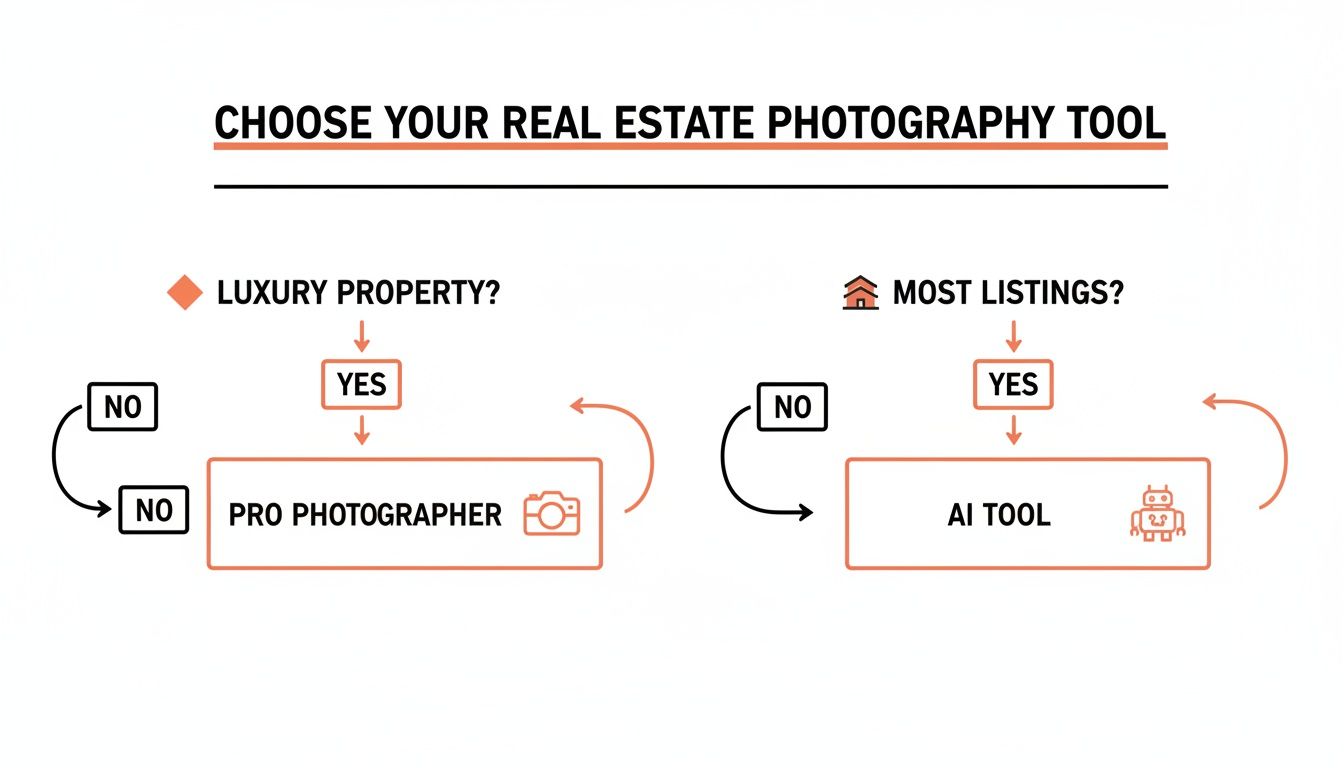
As you can see, the best tool is all about the specific property and what you’re trying to achieve with your marketing.
Decision Matrix: Professional Photographer vs. AI Assistant (Bounti)
Deciding between a human expert and an AI tool can feel tricky, but it often comes down to a few key variables. This table breaks down the trade-offs to help you make the right call for each listing.
| Consideration | Professional Photographer | AI Assistant (e.g., Bounti) |
|---|---|---|
| Price Point | Best for high-value, luxury listings ($750k+) where a premium feel is non-negotiable. | Ideal for standard, mid-range listings where budget and speed are key. |
| Property Condition | Excellent for pristine, well-staged homes where they can capture existing beauty. | A lifesaver for vacant, cluttered, or dated homes needing virtual staging or item removal. |
| Turnaround Time | Slower; typically 24-72 hours from shoot to final delivery. | Nearly instant; results are ready in minutes. |
| Unique Features | Essential for capturing one-of-a-kind architecture, dramatic views, or custom details. | Focuses on showing potential through staging and restyling, not capturing existing art. |
| Cost | Higher initial investment ($200 - $1,000+ per shoot). | Low cost per listing, often through a subscription or per-image model. |
| Scalability | Limited by their schedule and your budget. | Infinitely scalable; handle as many listings as you need, whenever you need them. |
Ultimately, there's no single "best" answer. A professional photographer delivers unparalleled artistry for your trophy listings. An AI assistant like Bounti gives you speed, scale, and the power to sell a vision for everything else.
Making the Right Call for Each Listing
Before you book anything, just run through these quick questions. Your answers will point you in the right direction.
- What’s the price point? High-end listings almost always justify the investment in a top-tier photographer.
- What’s the property’s condition? Is it empty, cluttered, or just a little dated? The virtual staging and restyling powers of AI might be far more valuable than a traditional shoot.
- How fast do I need to go live? If you need to hit the market yesterday, nothing beats the instant turnaround of an AI marketing assistant.
- What's the unique selling proposition? If the home’s value is all about its incredible architecture or a view that can’t be replicated, you need a photographer’s artistic eye.
For agents who want to stay ahead, adding an AI-powered photography app to their process adds even more flexibility to this hybrid workflow. By thinking like a marketing director for every property, you can match the right tool to the right job every time. This is the kind of strategic thinking that separates good agents from great ones—and helps you win more listings and close them faster.
Frequently Asked Questions About Real Estate Photography
As the tools for marketing a property get more complex, it’s easy to get lost in the noise. You’ve got traditional photographers, drone operators, and now AI tools all competing for your marketing dollars.
Let's cut through the confusion. Here are straight answers to the most common questions agents ask about real estate photography, so you can build a smarter, more effective plan for every single listing.
What Does a Real Estate Photographer Actually Do?
A professional real estate photographer does a lot more than just point and shoot. Their real job is to create a visual asset that sells a lifestyle, not just a house. They’re masters of composition, lighting, and editing, and they show up with specialized gear like wide-angle lenses and off-camera flashes to make a space feel bright, expansive, and irresistible.
Think of them as your visual storyteller. They know how to capture a property's best features and unique character, making sure every image highlights a core selling point. From the moment they arrive to the final edited photos, their entire process is designed to do one thing: stop buyers from scrolling and get them to book a showing.
How Much Does Real Estate Photography Cost?
The price tag can swing wildly depending on the photographer’s experience, the size and type of property, and your local market. As a general rule, expect to pay anywhere from $200 for a basic package on a small condo to over $1,000 for a luxury estate that needs the works—like drone shots and a twilight session.
It's tempting to shop on price alone, but that's a classic mistake. You're not just buying photos; you're investing in the home's final sale price. A slightly higher upfront cost for a top-tier photographer almost always pays for itself with a faster sale and stronger offers.
The most critical takeaway is this: Clients don’t want works of art; they want technically correct, accurate photos that show a property at its best. Your job as an agent is to make it as easy as possible for them to get those images with minimal hassle.
How Long Should a Photoshoot Take?
The time on-site depends on the property's size and what you've ordered. For a standard shoot on an average-sized home (think 2,000 sq. ft.), your photographer will likely be there for about 60 to 90 minutes.
But that number can change quickly. Keep these factors in mind:
- Larger Homes: Properties over 3,000 sq. ft. will naturally take longer, often pushing the shoot to 2 hours or more.
- Add-On Services: If you booked drone photography, a video walkthrough, or a 3D tour, plan for extra time on site. A good photographer will schedule these efficiently, but they still add to the clock.
- Property Readiness: This is the big one. A prepped, clean, and decluttered home lets the photographer work smoothly and quickly. A messy or unprepared one causes delays for everyone.
Always confirm the estimated time with your photographer beforehand. It helps you set clear expectations with the homeowner and keeps your day on track.
What’s the Standard Turnaround Time for Photos?
In real estate, speed is everything. You can't afford to wait a week for photos while buyer interest fades. The industry standard for receiving your edited photos from a professional real estate photographer is a tight 24 to 48 hours after the shoot.
Most pros get it. They understand you need to go live now, and they’ve built their entire workflow around hitting that deadline.
This is a non-negotiable point to confirm before you hire anyone. While some might offer a same-day rush delivery for an extra fee, a 24-hour turnaround is a completely reasonable expectation. Getting those photos back fast lets you launch your listing with momentum and capture buyers while they're most engaged.
Ready to see how Bounti can generate your entire marketing package in minutes, not days? Transform a single video into MLS-ready photos, virtual staging, and compelling descriptions instantly. Get started at https://www.bounti.ai.