Video stopped being a nice-to-have in real estate a while ago. The agents winning more attention, more listing appointments, and more qualified buyer conversations are usually the ones who make a property easier to understand before anyone schedules a showing.
That shift is easy to see in the numbers. According to the National Association of Realtors 2024 research, listings with video generate 403% more inquiries than listings without video (National Association of Realtors 2024 research). That's not a small lift from better branding. It's a major change in lead volume at the top of the funnel.
The practical takeaway is simple. Real estate video marketing works when it helps buyers answer the questions photos leave open: How does the home flow? How big does the kitchen feel when you walk into it? What's visible from the living room? How does the property connect to the street, the yard, or the neighborhood? If your process answers those questions faster than the competition, you win attention earlier and more often.
Why Your Competitors Are Winning with Video
Agents who win more listing appointments usually show a stronger marketing system before they talk about price. Video is a visible part of that system, and sellers notice it fast.
The advantage is not just that video looks polished. It answers practical questions earlier in the buying process and makes the listing feel easier to understand. That changes how buyers screen properties, how long they stay engaged, and whether they decide to reach out.
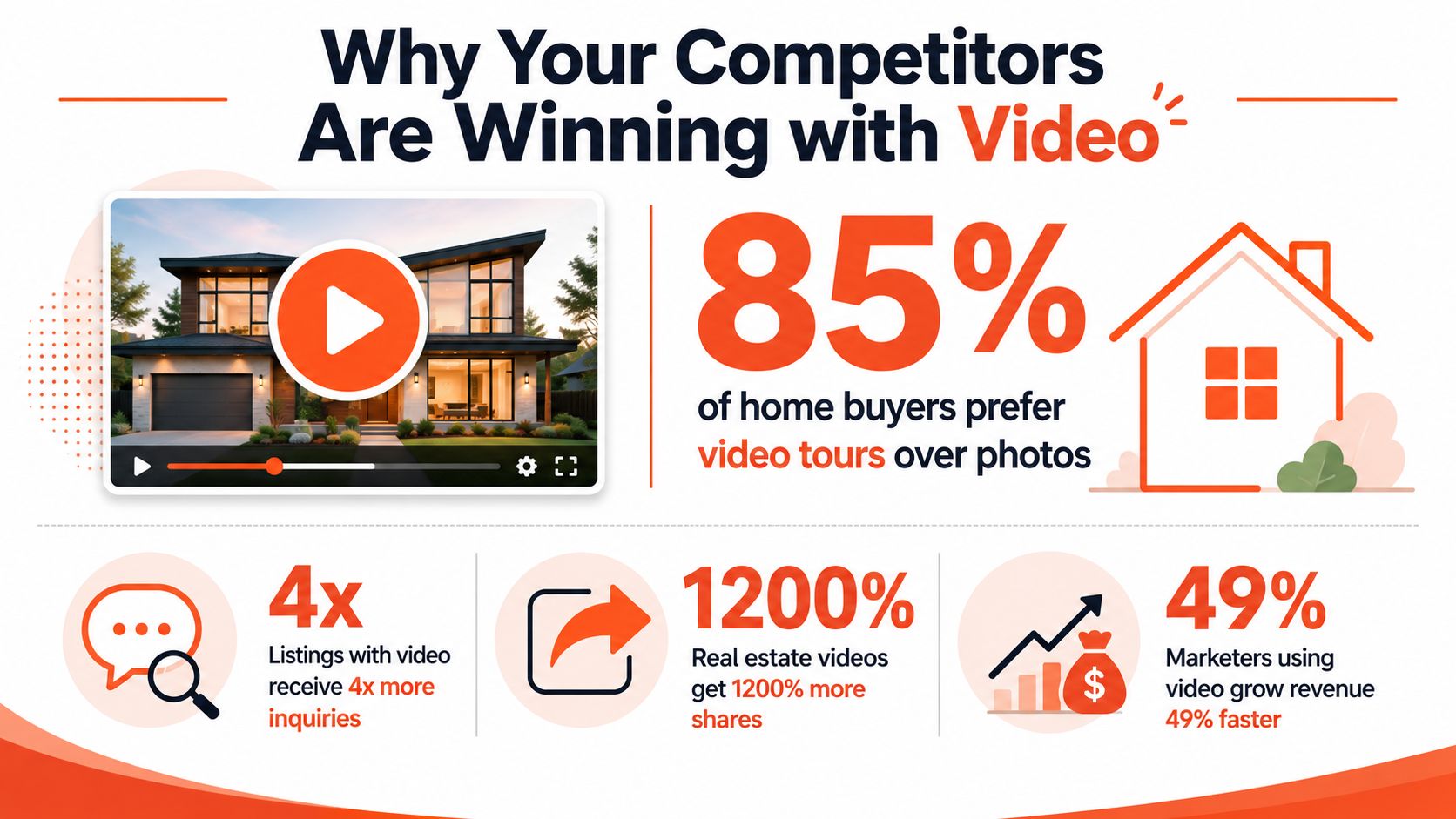
Why video changes buyer behavior
Photos can make a room look attractive. Video shows whether the home works. Buyers can judge flow, sightlines, natural light, transitions between rooms, and whether the space feels tight, open, dated, cluttered, or worth a visit.
That matters even more on imperfect listings. Empty rooms can feel cold. Dated finishes can distract from good bones. Clutter can hide scale. The agents getting better results use video to control that first impression, and AI tools such as Bounti help solve the hard part by improving how those spaces are presented without requiring a full reshoot or a large production budget.
One shoot can also do far more work than a lot of agents realize. Instead of producing a single walkthrough and stopping there, strong teams turn the same footage into short listing clips, social posts, neighborhood edits, vertical reels, and follow-up assets for email and paid campaigns. If you want that system tied to a broader pipeline, this guide to real estate social media marketing shows how distribution supports lead generation.
Video also wins listings because it changes seller perception. In a presentation, the agent with a repeatable video process looks more prepared than the agent promising to “post it everywhere” with a photo gallery and a few boosted posts.
Practical rule: Every listing video should do two jobs. Market the current property and prove to the next seller that you know how to create demand.
What winning agents do differently
Top agents use video consistently, not occasionally. They do not wait for the perfect property.
They also make smart trade-offs. A fully cinematic production can help on a flagship listing, but consistency usually beats occasional polish. A clear, well-planned video that answers buyer objections will outperform an expensive video that looks great and says very little.
The agents pulling ahead usually get three things right:
- They show the property accurately: Buyers can understand the layout, condition, and strongest features without guessing.
- They improve weak presentation points: They use tools and editing choices that make vacant, cluttered, or dated homes more marketable.
- They multiply output from one shoot: One property visit becomes multiple assets for listings, social channels, retargeting, and seller prospecting.
That is the competitive edge. Your competitors are not winning because they post more video for the sake of it. They are winning because their video process makes average listings look stronger, stretches every shoot further, and gives buyers and sellers a clearer reason to respond.
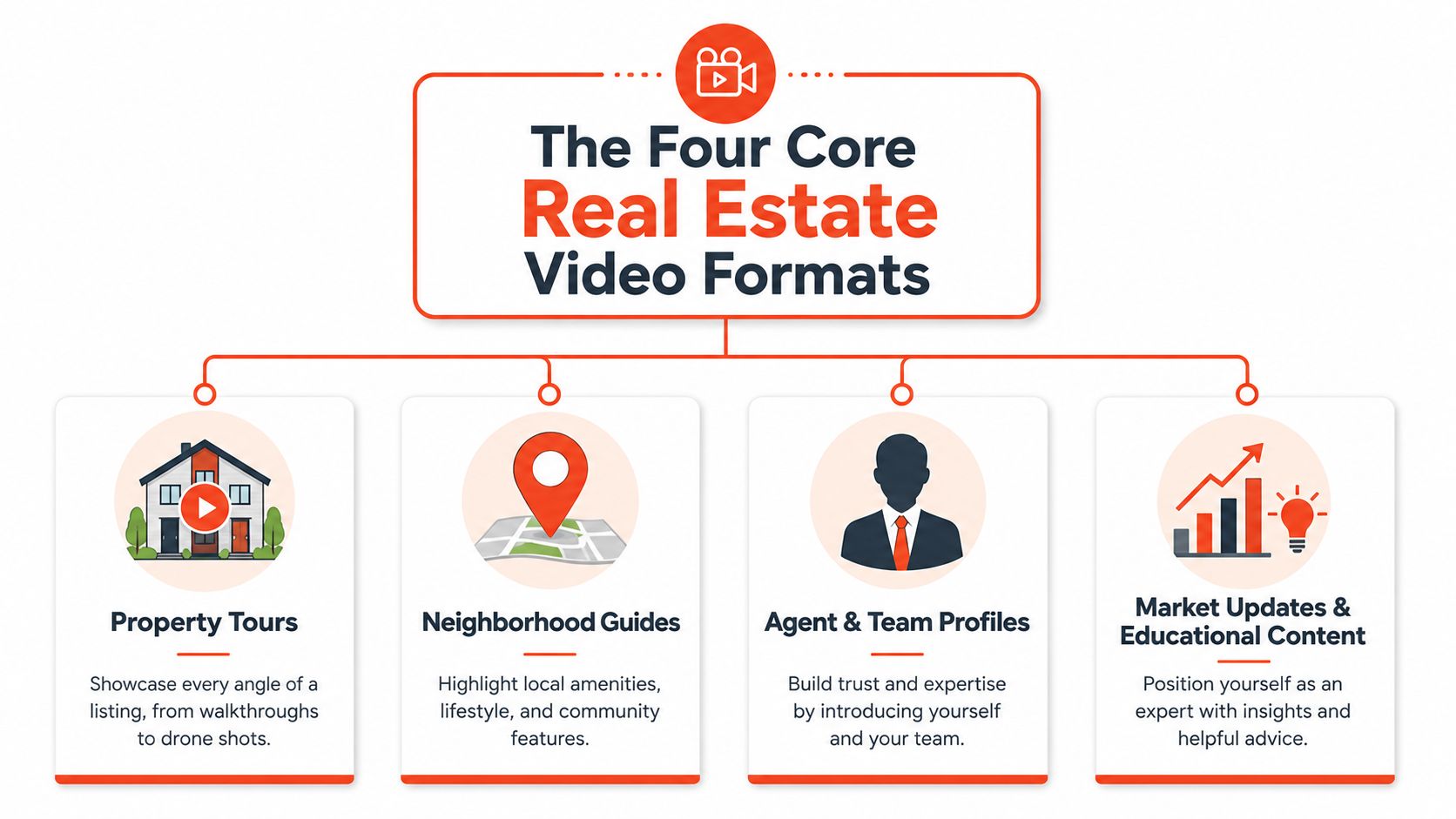
The Four Core Real Estate Video Formats
Agents lose time and budget when they treat every video like a custom production. A tighter system wins. Four formats cover the jobs that drive revenue: selling the listing, selling the location, selling your process, and proving you can deliver results.
Walkthroughs deserve the most attention because buyers use them to screen homes before they ever book a showing. Zillow's past Consumer Housing Trends Report identified video walkthroughs as the most useful content type for many home shoppers. That lines up with what happens in the field. Listings get more serious interest when buyers can understand the flow, condition, and standout features before they reach out.
Listing walkthroughs
This is the revenue driver.
A walkthrough should help a buyer answer three questions fast. Does the home feel right? Does the layout make sense? Is it worth seeing in person? If the video cannot answer those questions, it is decoration, not marketing.
Prioritize the rooms that influence decisions. Start with curb appeal, the best living space, or the feature that separates the listing from nearby alternatives. Then move through the home in a logical order. Buyers should be able to track how the kitchen connects to the dining area, how the primary suite sits off the main hall, and whether the backyard feels usable.
This format also benefits the most from AI. Empty rooms often look cold on camera. Cluttered homes feel smaller. Dated finishes can distract from good bones. Tools like Bounti's real estate video creator help agents produce cleaner versions of the same property footage and spin that shoot into multiple assets without booking a second visit.
A strong walkthrough usually includes:
- A sharp first frame: Lead with the exterior, view, kitchen, or another image that earns the next 10 seconds.
- A clear route through the home: Show the property the way a buyer would experience it.
- Context around key features: Show how spaces connect instead of isolating every room into disconnected clips.
- A direct next step: Invite viewers to schedule a showing, ask for disclosures, or request the full listing package.
Later, the same footage can be recut for Reels, Stories, listing ads, and seller prospecting. One shoot should not produce one asset.
A useful example of how agents present listing videos in practice is below.
Neighborhood tours
Some listings compete on location more than finishes. A neighborhood tour helps buyers decide whether the area supports the life they want to live there.
Keep these videos practical. Show the streets, nearby parks, coffee shops, school pickup flow, commute access, or waterfront path if those features matter to the target buyer. Generic drone footage of the whole town rarely moves a decision. Useful context does.
This format is especially effective for relocation buyers and out-of-area leads. It also gives you reusable local content that keeps working after the listing is gone.
Agent introduction videos
Sellers watch these with one question in mind. Can this person market my home better than the next agent?
That means the usual personal branding script is weak. Skip broad claims about passion and service. Explain how you price, prep, market, communicate, and adjust when a listing does not get the first wave of activity. Specifics build trust.
Keep it short. Show your face, your voice, and your standards. If you use AI in your marketing workflow, say so in plain English. Sellers understand the value quickly when you explain that one property shoot can turn into listing videos, short-form social clips, and follow-up assets for retargeting. For teams building that workflow, this AI video creation guide is a useful reference.
Client testimonials
Testimonials close the credibility gap that self-promotion cannot.
The strongest ones focus on the client's starting problem and the result. A seller worried about showing a dated property. A buyer relocating and needing fast video context. An owner who wanted stronger marketing without paying for a full production crew every time. Those details make the testimonial believable.
Ask clients to talk about:
- What concern they had at the start
- What your process looked like in practice
- What result or experience changed their opinion
- Why they would refer you
Over time, these videos do more than support one transaction. They build a library of proof that helps win the next listing.
Your Practical Video Production Blueprint
The biggest mistake agents make is assuming video requires a production crew. It doesn't. A modern phone, a stabilizer if you want one, decent audio for talking segments, and a repeatable process are enough to get started.
The better way to think about production is plan, shoot, edit. If those three parts are tight, the final video usually feels professional even without expensive gear. If they're sloppy, no camera upgrade will save the result.
Plan the story before you enter the property
Walk the home once before filming. Don't start shooting as you discover the layout. That's how you end up with redundant clips, missed angles, and awkward transitions.
Build a short shot list around the property's strongest selling points. For most listings, that means exterior approach, entry, main living area, kitchen, primary suite, best bathroom, backyard, and one or two detail shots that carry emotion. If there's a view, natural light moment, or architectural feature, put it near the beginning.
Create a basic script if you're speaking on camera. Not a word-for-word performance. Just a map of what matters. If you want help tightening that workflow, this AI video creation guide is a useful reference for turning rough content into polished outputs more efficiently.
Shoot for clarity, not for flashy movement
Real estate video fails fast when the camera moves too much. Slow down. Hold shots longer than feels natural. Buyers need time to process space.
A few field rules matter on almost every listing:
- Use natural light well: Open blinds, turn on practical lights if they improve warmth, and avoid blown-out windows when possible.
- Keep the lens height consistent: Too low can distort. Too high can flatten the room.
- Stabilize movement: Smooth walking shots beat dramatic pans every time.
- Record clean audio: If you're speaking, bad sound will hurt trust faster than average video quality.
- Stage before shooting: Remove trash bins, cords, pet bowls, and countertop clutter.
Clean framing beats fancy editing. If the room reads clearly on the first watch, the footage is doing its job.
Edit once, publish many times
Editing is where most agents either waste time or leave opportunity on the table. The goal isn't to make one master file and call it done. The goal is to create a flexible asset library from one shoot.
Start with the main property video. Then cut alternate versions for listing pages, email, and short-form platforms. Add simple titles, light branding, captions when appropriate, and a CTA at the end. Keep pacing tight and remove anything repetitive.
If you want a workflow built specifically for listing content, Bounti's Video Creator is designed around producing listing videos and related marketing assets from property footage. That matters when you're trying to turn one walkthrough into multiple usable outputs instead of editing each version from scratch.
A practical production blueprint is boring by design. That's the point. The agents who publish consistently usually aren't waiting for inspiration. They're running a system.
Strategic Distribution on Key Platforms
Listings with video only perform when the edit matches the platform. Buyers scroll differently on TikTok than they search on YouTube, and a full walkthrough that works on a listing page often loses attention fast in a vertical feed.
As outlined in Rex Software's guide to video marketing for real estate, listing videos generally work best when they stay tight, put the strongest selling points early, and are reviewed against watch time, audience retention, and drop-off points. That matters because distribution is not a reposting task. It is an editing decision.
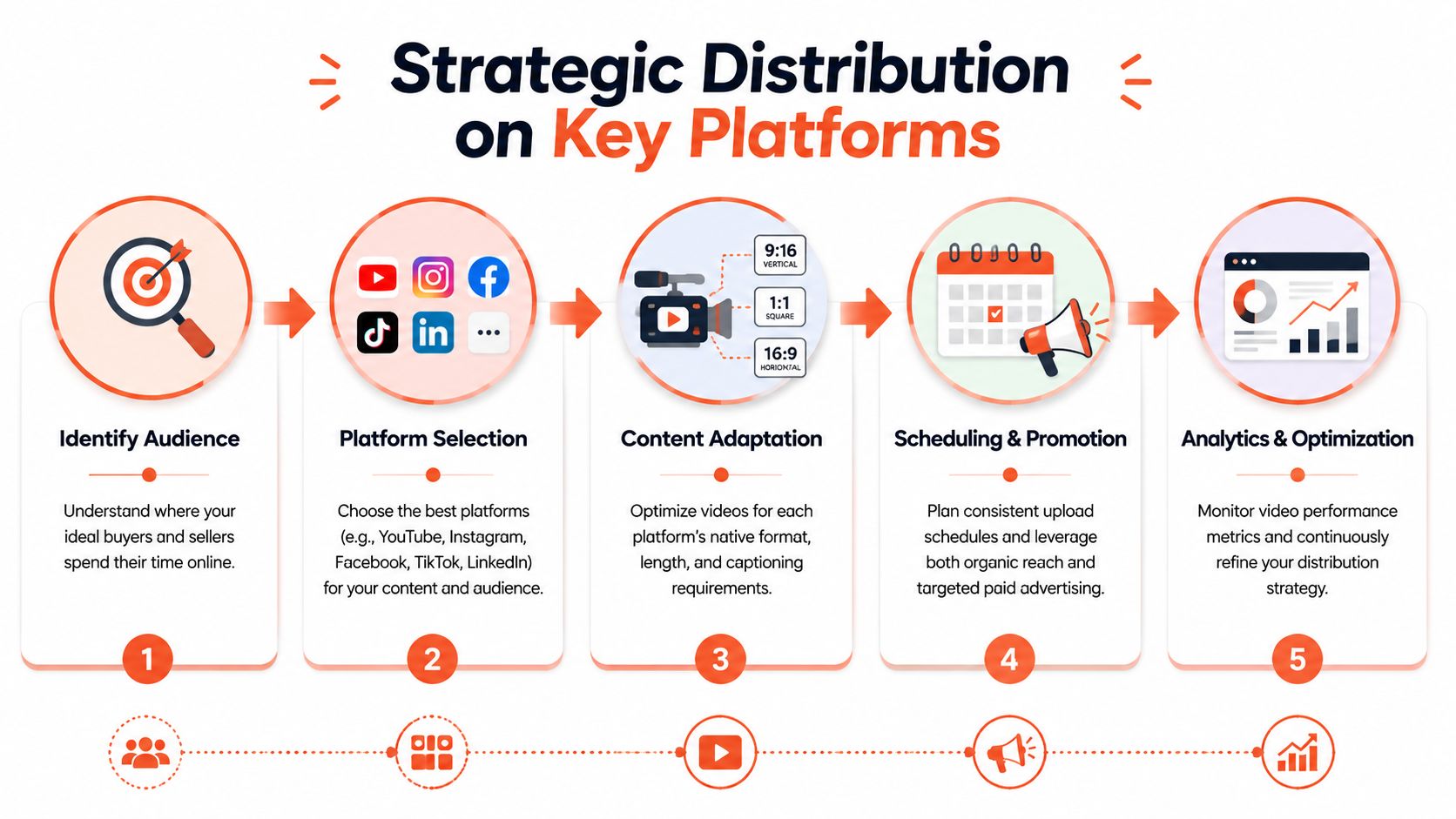
How each platform should change the cut
Use the same property footage differently based on buyer intent.
| Platform | What viewers expect | Best use |
|---|---|---|
| MLS and listing page | Clean, informative property presentation | Full walkthrough with clear room flow |
| YouTube | Searchable, slightly longer viewing session | Horizontal listing tour, neighborhood overview, evergreen content |
| Instagram Reels | Fast hook, visual punch, captions | Vertical short-form clips, highlights, before-and-after moments |
| TikTok | Immediate attention and fast pacing | Vertical cuts with a clear angle, such as unique feature or value story |
| Shareable local content and community reach | Listing promo, neighborhood videos, testimonial content |
One mistake costs reach everywhere. Agents often post the same horizontal tour across every channel, then assume video “doesn't work.” The problem is usually packaging, not the footage.
A luxury kitchen reveal can lead on Reels. A school-zone and commute angle may win on Facebook. A longer cut with chapter points and neighborhood context can keep qualified buyers on YouTube longer.
One property shoot should produce several assets
Plan distribution before the camera turns on. That changes what you capture and saves editing time later.
A practical asset stack looks like this:
- Main listing video: Website, YouTube, listing support
- Vertical social cut: One strong feature, one buyer angle, one CTA
- Agent-led clip: Short explanation of who the property fits and why
- Lead follow-up clip: A quick video sent by text or email after inquiry
- Visual alternate: A version that helps a buyer see potential in an empty, cluttered, or dated space
That last asset matters more than many agents realize. Standard distribution advice assumes the home already shows well. In the field, plenty of listings do not. Empty rooms feel cold. Clutter hides square footage. Dated finishes create instant resistance. AI-assisted workflows help fix that at scale by turning one shoot into multiple usable versions, including treatments that make hard-to-market properties more appealing. If you want the technical side, Bounti explains how declarative video AI systems generate property marketing assets from source footage.
Hooks, captions, and calls to action
Short-form performance is decided early. Lead with the feature that gets a buyer to stop. The view, the renovated kitchen, the oversized lot, the price position, or the upside after light updates should appear first.
Captions need to sell the click, not label the post. “Corner lot with detached office and room for a pool” gives a buyer a reason to care. “Just listed” does not.
Match the CTA to the channel and stage of intent:
- Instagram: DM for price, disclosures, or showing times
- TikTok: Comment for the full tour or renovation breakdown
- YouTube: View full listing details and schedule a showing
- Facebook: Message for neighborhood comps or open house info
If your team is reviewing a lot of footage across listings, tools that get concise video insights can speed up content review before you decide which clips become listing videos, reels, or follow-up assets.
The strongest distribution strategy is simple. Publish native cuts, lead with the selling point, and use one shoot to produce more than one result. That is where ROI shows up.
How AI Supercharges Your Video Marketing
Traditional advice on real estate video marketing breaks down when the property isn't easy to sell visually. Empty rooms look cold. Cluttered homes look smaller. Dated interiors create resistance before the buyer ever asks whether the layout is strong. Under-construction spaces are even harder because the buyer has to imagine what doesn't yet exist.
That gap is real. One of the major challenges in property marketing is making video useful for buyers who can't easily picture a home's future state, especially when the property is empty, cluttered, dated, or under construction, and much of the common advice doesn't solve how to show alternative layouts or renovation potential at scale (Momenzo on common mistakes in real estate video marketing).
Where AI changes the workflow
The old approach required separate vendors and separate timelines. You'd shoot the property, wait on edits, order staging if needed, request revised imagery, then build listing assets from multiple files. That process is slow, fragmented, and hard to repeat across a busy pipeline.
AI changes that by letting you treat a single walkthrough as the source file for multiple outputs. Instead of creating one video and stopping there, you can generate stills, alternate visual treatments, captions, descriptions, and platform-specific versions from the same footage.

Practical use cases agents actually need
AI becomes operational, not theoretical.
- Vacant listings: Create visuals that help buyers understand scale and possible furniture placement.
- Cluttered homes: Remove distractions so the room's layout and light read clearly.
- Dated properties: Show a cleaner restyled version that highlights potential without forcing the buyer to imagine everything alone.
- Renovation or tenant scenarios: Present alternate looks or layouts when the current condition doesn't tell the full story.
One practical example is Bounti's declarative video AI workflow, which is built around turning property footage into multiple marketing assets, including visuals that support decluttering, staging, restyling, or renovation concepts. That kind of workflow is useful when the home's current condition is getting in the way of the sale.
Why this matters for ROI
The value isn't only lower production friction. It's better merchandising.
A buyer who can see a room's potential is more likely to stay engaged. A seller who sees that you can market a difficult property more effectively is more likely to trust your listing presentation. A marketing coordinator who can repurpose one video shoot into several assets saves time across every campaign.
If you're reviewing long property footage and need to get concise video insights before deciding what to clip or repurpose, summarization tools can also speed up editorial decisions. That's especially helpful when one listing has multiple possible story angles and you need to choose the most marketable one quickly.
Tracking What Matters and Avoiding Costly Mistakes
Agents who judge video by view count usually miss the part that affects revenue. A video can collect plenty of plays and still fail to generate seller confidence, buyer inquiries, or showing requests.
Track performance against the job the video was supposed to do. Hold attention long enough to communicate the property, then move the viewer to a clear next step. That means focusing on watch time, drop-off points, and leads, as noted in this analysis of video performance guidance for real estate marketers.
What to measure first
Start with three questions that tie directly to results.
Are viewers staying long enough to understand the listing?
Watch time and retention show whether the opening earns attention and whether the edit moves fast enough to keep it.Where do viewers leave?
Drop-off points usually expose the exact problem. The intro takes too long. The strongest room appears too late. The narration wanders. The footage starts repeating itself.What happens after the view?
Direct messages, inquiry form submissions, showing requests, and listing-page clicks matter more than passive reach.
This review process gets practical fast. If retention falls off in the first few seconds, the fix is usually story structure, not better editing polish. Lead with the room, feature, or transformation that sells the property.
Common mistakes that waste good footage
Underperforming listing videos tend to fail for the same reasons:
- Weak opening: The first shot is a logo, a slow driveway clip, or a generic exterior instead of the feature that creates interest.
- No hierarchy: Every room gets equal screen time, so the kitchen, view, yard, or primary suite never gets the emphasis it deserves.
- Poor audio: Echo, traffic noise, and rushed narration lower perceived professionalism fast.
- Too much runtime: Repeated angles and slow pacing make the property feel less compelling, not more complete.
- No CTA: The video ends without telling the viewer to book a showing, request details, or contact the listing agent.
- Wrong format for the platform: A horizontal walkthrough posted into a vertical feed without reframing usually loses attention early.
- Poor visual prep: Cords, clutter, pet gear, or dated furnishings distract from the actual selling points.
One mistake deserves extra attention. Teams often spend money capturing footage, then publish the same version everywhere and hope it works. That approach leaves money on the table.
The better system is to treat one shoot as raw material for multiple assets. A full walkthrough can become a short-form teaser, a seller update clip, vertical social cuts, stills, and AI-enhanced visuals that help a vacant, cluttered, or dated property show better online. That is where tools like Bounti earn their keep. They help teams improve difficult visuals at scale and get more usable marketing pieces from the same production effort.
A simpler video that gets to the selling point fast and asks for the inquiry clearly will often outperform a polished video with no clear next step.
A simple interpretation framework
Use this framework after every campaign.
If the video gets attention but not leads, check the CTA, audience targeting, and landing experience.
If it gets clicks but weak retention, the opening promise is probably stronger than the footage that follows.
If it gets strong retention but weak inquiry volume, inspect the handoff. The listing page may be weak. The contact path may be clumsy. The follow-up may be too slow.
If a hard-to-sell property gets low engagement across versions, the issue may be merchandising rather than distribution. Empty rooms can feel cold. Clutter can make the layout hard to read. Dated finishes can stop buyers before they picture the upside. In those cases, AI-assisted restyling, decluttering, or alternate presentation can improve performance because the marketing finally shows the home in a way buyers can respond to.
If you want a faster way to turn one property walkthrough into listing videos, stills, descriptions, and visuals that help buyers see a home's potential, take a look at Bounti Labs. It's built for real estate teams that need practical marketing assets from a single shoot, especially when the property is vacant, cluttered, dated, or hard to visualize.