Leasing teams lose deals long before a prospect reaches the front door. In self-guided touring, failure points usually show up earlier: weak listing visuals, slow scheduling, clunky ID verification, poor unit readiness, and generic follow-up after the visit.
That is why self-guided apartment tours should be evaluated as a conversion system, not an access feature. The lockbox, smart lock, or access panel matters, but it only handles one moment in the funnel. Demand is created by the listing. Confidence is built by the photos, floor plans, and unit representation. Intent is either reinforced or damaged by the scheduling flow. Conversion often depends on what happens in the first few hours after the tour.
The visual layer deserves more scrutiny than it gets. Teams are using AI-generated or AI-edited images to improve speed and coverage across listings, and that can help. It can also create a costly mismatch if the tour experience does not match the marketing promise. If the prospect arrives expecting brighter finishes, larger rooms, or a more polished common area than what is on-site, self-guided convenience will not save the lead.
Operators that get stronger results usually align three teams around one funnel. Marketing sets accurate expectations and attracts qualified traffic. Operations makes access, wayfinding, and safety work without staff intervention. Leasing follows up fast, with enough context to move from tour completion to application.
Self-guided tours work best when each handoff is intentional. More tour volume alone does not improve occupancy. Better conversion does.
The New Standard in Flexible Leasing
Self-guided tours moved from differentiator to baseline fast. Prospects now expect to choose how they tour, when they tour, and how much human contact they want at each stage. Properties that force every lead into a staff-led appointment create friction before the prospect ever reaches the unit.
The operating question is broader than access. Flexible leasing has to improve the full funnel, from the listing that earns the click to the follow-up that gets the application. That is where many teams miss the return. They install the tour technology, but leave weak photos, slow scheduling, confusing identity checks, and generic post-tour messaging untouched.
The visual layer has become especially important. AI-edited and AI-generated listing images can speed up content production and help fill gaps across a portfolio. They can also lower conversion if they oversell the experience. If the unit looks brighter, larger, or newer online than it does in person, tour completion will not save the lead. It will just make the disappointment easier to confirm.
Flexible leasing works best as a coordinated system across marketing, operations, and leasing. Marketing sets accurate expectations and drives qualified traffic. Operations makes entry, wayfinding, and unit readiness dependable. Leasing follows up quickly with context from the tour, not a generic drip campaign. Teams that connect those handoffs usually get more value from self-guided traffic than teams that treat touring as a standalone feature.
There is also a channel mix decision here. Self-guided tours handle speed and after-hours demand well. Agent-led tours still matter for objection handling, premium units, and complex renters. Video helps with relocation and early-stage screening. The best model gives prospects options while steering each lead toward the format most likely to convert.
Execution matters more than the access device. Tools like Nimbio's Guestview solution can support the tour experience, but the business case depends on how well that experience connects to lead routing, communication, and leasing action. Properties that pair self-guided scheduling with fast text follow-up through Twilio integrations for leasing communication workflows usually respond faster after the visit, which is often where the application decision starts.
More tour volume alone does not improve occupancy. Better alignment across attraction, access, and follow-up does.
Building Your Self-Guided Tour Tech Stack
The stack needs to do three jobs well. It has to let prospects book easily, verify they are who they say they are, and grant temporary access without creating confusion on-site. Anything beyond that is secondary.
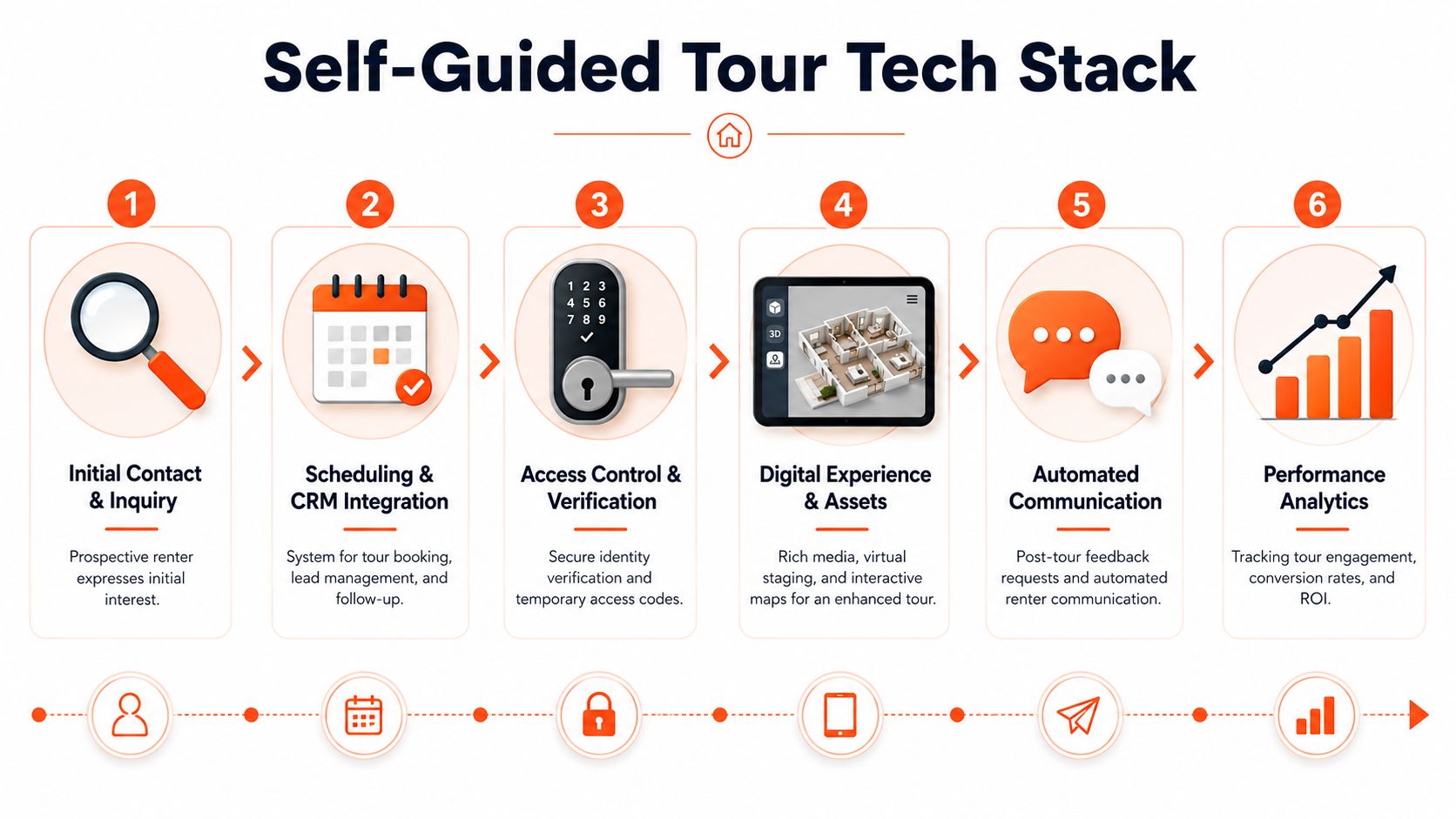
The operating model is already mature. Industry guidance from iApartments describes a standardized workflow built around online scheduling, QR-code entry, identity verification, and temporary access, often without requiring an app download. That last point matters. Every extra download, login, or handoff adds abandonment risk.
Layer one is scheduling and lead routing
Your booking flow should work like a leasing intake, not a calendar widget bolted onto a website.
A good setup includes:
- Real availability controls: Only show units and time windows your team is prepared to support.
- CRM synchronization: Tour requests should create or update the lead record automatically.
- Channel attribution: You need to know whether the prospect came from ILS traffic, paid media, your website, or a QR code on-site.
- Immediate confirmation: The prospect should know the request is received and understand the next step right away.
If you want a reference point for visitor access workflows, Nimbio's Guestview solution is worth reviewing because it shows how guest entry, verification, and property access can be organized as one experience instead of separate tools.
Layer two is identity verification
Many implementations struggle at this point. Teams either overcorrect and create too much friction, or they underbuild and expose the property.
The best identity flow feels short to the prospect and strict to the operator. It should verify the person before issuing credentials, and it should log enough information for your team to respond confidently if something goes wrong.
Use this as a vendor screen:
| Question | Why it matters |
|---|---|
| Does it work without an app? | Fewer steps usually means fewer abandoned bookings. |
| Can it verify ID before access is issued? | Verification has to happen before the lock event, not after. |
| Does it support real-time status updates? | Leasing needs visibility into who booked, verified, entered, and exited. |
| Does it feed tour data into the CRM? | If not, your team ends up chasing information manually. |
Layer three is access control and communications
Smart locks and lockboxes get the most attention, but reliability matters more than brand preference. If the code fails, the entire experience fails. If the code works but can be reused too broadly, you've created a security gap.
What works in practice is simple:
- Issue unique, time-boxed credentials
- Limit access to the approved route
- Trigger reminders before the tour
- Pass entry and exit events into your leasing workflow
A communications layer matters just as much as the lock. Prospects need reminders, access instructions, and follow-up texts or calls without waiting on manual outreach. Teams already using messaging workflows can connect that orchestration into systems such as Twilio integrations for real estate workflows, which helps keep scheduling, reminders, and post-tour outreach in one motion instead of several.
App-free usually wins. Prospects want to open a link, verify identity, and start the tour. They don't want to install software in the parking lot.
Creating an Irresistible Unaccompanied Tour Experience
A self-guided tour can expose a unit's strengths. It can also expose every weakness in your marketing.
If the apartment is vacant, echoey, and visually flat, the prospect has to do all the imagination work alone. That's risky. In an agent-led tour, a strong leasing associate can reframe an awkward corner, explain furniture fit, and redirect attention to the best features. In an unaccompanied tour, your visuals have to do that job before the prospect arrives.
The tour starts in the listing, not at the lock
Teams often separate “marketing assets” from “tour operations.” Prospects don't. They experience one continuous journey.
That means your pre-tour package needs to answer three questions fast:
- Can I picture myself here
- Can I understand the layout
- Does this look worth my time to visit
Professional photography is table stakes. Video walkthroughs help with orientation. But for vacant inventory, virtual staging and visual enhancement often determine whether the prospect books at all.
That's where AI-generated visuals can help or hurt.
When AI visuals improve leasing outcomes
AI visuals work when they reduce ambiguity. They should make a room easier to understand, not less trustworthy. Good AI staging clarifies furniture scale, shows a credible use for odd spaces, and keeps finishes consistent with reality.
Poor AI visuals do the opposite. They oversell room size, introduce impossible lighting, change materials, or create a style mismatch between the listing and the physical unit. When the in-person experience feels different from the digital one, self-guided apartment tours underperform because no one is there to recover the moment.
For teams trying to strengthen the listing-to-tour handoff, enhanced property galleries for real estate marketing are useful because they let you present a more coherent visual story across photos, layout cues, and staged variants.
The best staged image doesn't just look attractive. It reduces the number of questions a prospect has before they click “Book tour.”
What to include inside the unit
The apartment also needs to “sell itself” once the prospect walks in. A bare lock-and-leave experience wastes the channel.
Use in-unit prompts that are concise and placed where the eye naturally lands:
- Entry card: Wi-Fi details if applicable, tour support contact, and next-step instructions
- Kitchen note: Call out appliance package, storage advantages, and any recent upgrades
- Workspace or nook marker: Show intended use for non-obvious spaces
- Amenity route cues: Direct the prospect toward the spaces that strengthen the leasing decision
Video helps here too because some renters want a guided narrative before or after the physical visit. This kind of media can support the self-guided flow without replacing it.
Implementing Strong Security and Safety Protocols
A self-guided tour program fails fast when access control is loose. One bad entry, one resident complaint, or one missing key can wipe out the labor savings and create a leasing problem your team then has to explain.
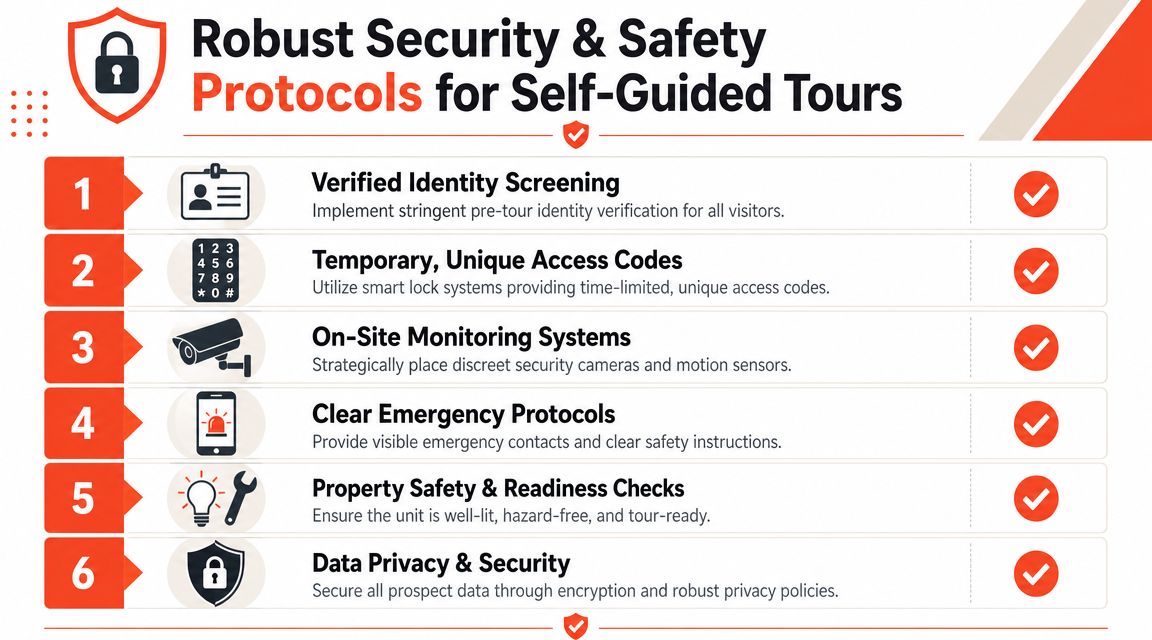
According to Apartments.com's guidance on self-guided apartment tours, operators should require qualification with an ID or credit card before granting access. The same guidance also points to three avoidable mistakes: skipping screening, skipping identity verification, and failing to follow up after the tour. Those are process gaps, not technology gaps.
Start with controlled eligibility
Access should be earned in stages. Collect the prospect's contact details, verify identity, confirm the appointment window, and then issue a one-time credential tied to that specific unit or route.
That sounds straightforward, but the trade-off is real. Every added checkpoint can reduce tour completion if the flow feels clumsy on mobile. The goal is not maximum friction. The goal is enough verification to filter out bad actors without losing qualified renters who expect to book in minutes.
A workable sequence looks like this:
- Collect core prospect details during booking
- Run identity verification before access approval
- Issue unique credentials only for the approved time window
- Log entry and exit events for operational review
- Trigger post-tour outreach automatically so the lead does not go cold
The fifth step matters more than many operators admit. Security and conversion are tied together. If a prospect clears verification, shows up, and tours, that lead has intent. Teams using AI inbox triage for real estate agents can route post-tour replies faster, prioritize high-intent prospects, and reduce the lag between visit and lease conversation.
Limit exposure on site
Temporary credentials should open only the doors required for that tour. If the prospect needs to access one building entrance, one unit, and a defined amenity path, configure the credential for that route and nothing else.
Site condition matters too. A self-guided tour shifts more responsibility onto the setup itself. Burned-out lights, a sticking door, a tripping hazard, or a unit that does not match the listing photos all create risk. They also hurt trust, which is expensive when your marketing team worked hard to get the prospect there in the first place.
Use this checklist with site teams:
- Access scope: Limit each credential to the approved doors and time period.
- Wayfinding: Post clear signs from parking to entry to unit.
- Emergency contact visibility: Put support information where the visitor can find it without searching.
- Unit security reset: Confirm doors relock, windows are secured, and marketing materials are removed or refreshed as needed.
Monitor the right spaces
Camera coverage should focus on approaches, entrances, hallways, and other shared areas. Skip intrusive placement inside the apartment. The point is to create an audit trail, confirm access events, and help your team resolve disputes quickly.
For portfolios comparing centralized options, Meraki camera solutions for business show how camera management can fit into day-to-day property operations.
If your team cannot verify who accessed a unit, when they entered, and whether they completed the tour window, the process is under-instrumented.
Treat prospect data like an operating risk
Identity documents, phone numbers, payment tokens, and access logs should sit inside secure systems with clear retention policies and role-based permissions. Leasing convenience is not a reason to keep sensitive data longer than needed or spread it across disconnected tools.
This is also where the full funnel matters. If your ads or AI-generated images attract prospects with one story, but your verification flow, unit condition, and follow-up sequence feel inconsistent, trust drops at every step. The best operators protect the asset, protect resident privacy, and keep the handoff from marketing to touring to leasing tight enough that conversion does not stall.
Marketing Your Tours and Capturing Every Lead
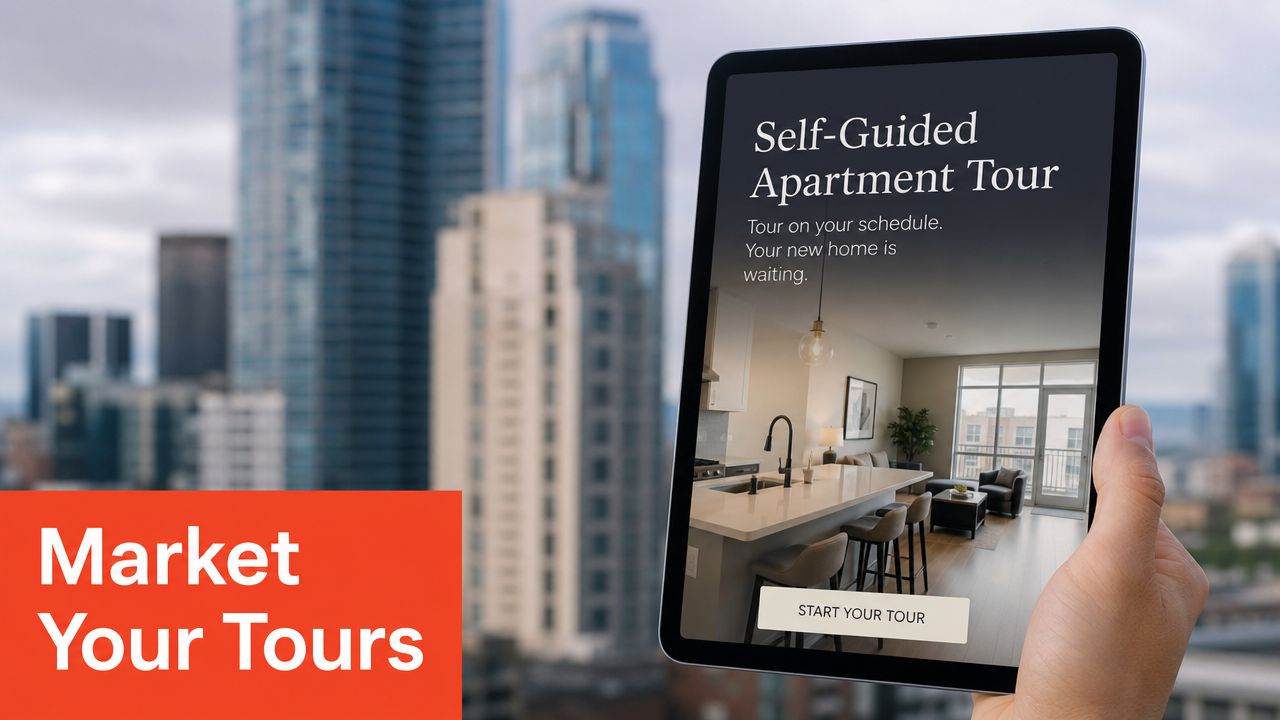
Self-guided apartment tours don't produce ROI just because the technology is live. You have to market the option aggressively and capture every inquiry cleanly.
That matters because adoption can become meaningful quickly. In a National Apartment Association example, 61.3% of visitors selected only a self-guided tour, while 30.1% selected only an associate-led tour and 8.6% booked both. If self-guided becomes a major share of your tour mix, weak intake processes turn into a revenue leak fast.
Put the offer where prospects already look
Many properties bury the self-guided option on a secondary page. That's a mistake. The call to action should appear in the same places prospects evaluate the unit in the first place.
Priority placement usually includes:
- ILS listings: Add clear “tour on your schedule” language in the body copy and CTA areas.
- Property website pages: Put booking access above the fold on unit and floor plan pages.
- Google Business Profile and local landing pages: Make sure prospects can move from local search intent to scheduling without hunting.
- On-site signage: QR codes on monument signs and window placards convert drive-by interest into booked tours.
If your existing intake forms are clunky, it's worth reviewing examples that streamline property inquiries for real estate so the handoff from inquiry to tour request feels shorter and more structured.
Make the CRM the single source of truth
A self-guided tour request is not just a calendar event. It's a lead event, a qualification event, and a follow-up trigger.
If your teams are copying booking data manually into the CRM, they'll miss people. If they're relying on voicemail callbacks after a completed tour, they'll lose momentum. Every inquiry should create a record automatically and route into the correct nurture path based on source, unit, and tour status.
That's where workflow automation earns its keep. Tools that support AI inbox triage for real estate agents can help teams classify inbound inquiries, prioritize tour-ready leads, and reduce the lag between first contact and booking.
Market the convenience, not the technology
Most renters don't care what lock you installed. They care that they can visit without waiting for office hours.
Message the benefit directly:
| Channel | Strong angle |
|---|---|
| Listing copy | Tour on your own schedule |
| SMS follow-up | Pick a time that works today |
| Signage QR code | Scan to book a self-guided visit |
| Retargeting ads | Revisit the unit without coordinating calendars |
The strongest campaigns make the process feel easy, immediate, and credible. That's what fills the top of the funnel with people who are likely to show up.
Measuring ROI and Optimizing for Conversions
Tour volume is a vanity metric if you can't connect it to leases. The harder question is the one operators care about. Are self-guided apartment tours bringing in qualified renters, or just making it easier for casual traffic to walk units?
That's the gap SmartRent's discussion of self-guided home and apartment tours points toward. The right answer comes from funnel measurement, not assumptions. Teams need to track the tour's effect on application rates and cost-per-lease, not just the number of bookings.
The metrics that matter
A portfolio manager should look at self-guided performance in relation to the full leasing path:
- Inquiry-to-tour rate: Are your listings and booking flow generating completed visits?
- Tour-to-application rate: Do self-guided visitors start applications at an acceptable pace?
- Application-to-lease rate: Are those applications converting, or is lead quality weak?
- Cost-per-lease by tour type: Compare self-guided, agent-led, and blended paths.
- Time-to-follow-up: How fast does your team respond after the tour ends?
Where optimization usually pays off
Most underperformance comes from one of three places:
Weak pre-tour merchandising
Prospects book without a clear picture of the apartment, then walk away unimpressed.On-site confusion
Access works, but wayfinding, unit presentation, or amenity routing is sloppy.Generic follow-up
The prospect tours, leaves, and receives the same canned message as every other lead.
Track where prospects stall, then fix that stage first. Don't assume the lock is the problem just because the lock is visible.
A mature self-guided program behaves like a measured leasing channel. You refine listing visuals, simplify access, test follow-up cadence, and compare outcomes by property and unit type. Once you do that, self-guided apartment tours stop being a convenience feature and start acting like a conversion system.
Bounti Labs helps real estate teams improve the very top of that funnel by turning simple walkthrough footage into polished listing assets, including descriptions, stills, decluttered images, staged visuals, and gallery-ready marketing content. If you want your self-guided tour program to start with stronger visuals and better first impressions, take a look at Bounti Labs.