
The primary bedroom is not a side room in your staging plan. It’s one of the rooms that moves the listing. According to the NAR staging data summarized here, 43% of buyers’ agents rank the primary bedroom as highly critical, second only to the living room. The same data set ties professional staging to stronger outcomes overall, with staged homes selling for 20-25% more and spending 73% less time on the market.
That’s why I don’t treat bedroom staging as fluff, décor, or a last-minute tidy. I treat it like pricing and photography. If you stage a bedroom well, buyers stop evaluating only square footage and start imagining a routine. That mental shift matters because bedrooms aren’t judged only on size. They’re judged on calm, order, privacy, and whether the room feels easy to live in.
The playbook in 2026 is also different from the one most agents used a few years ago. Physical prep still matters. Clean rooms, the right layout, and restrained styling still win. But the fastest agents now pair that groundwork with AI so they can test styles, fix visual problems, and publish stronger listing photos without waiting on a traditional vendor.
Why Staging a Bedroom Is Your Highest-Impact Move
43% is high enough to change how an agent allocates time, budget, and photo priority. The primary bedroom is not a cleanup room. It is a conversion room.
Buyers read bedrooms differently from kitchens and living areas. They are less forgiving of friction here because the room represents a repeated daily experience. If the space feels tight, dim, mismatched, or too personal, the objection is immediate. They are not mentally pricing a cosmetic update. They are questioning whether the home will feel good to live in.
I see this play out in showings all the time. Buyers slow down in a good bedroom. They linger, look at the windows, check the bed wall, and test whether the path to the closet makes sense. In a weak one, they step in, register the problem, and move on.
The bedroom shapes how buyers judge the whole listing
A neglected primary bedroom lowers confidence beyond that one room. Buyers start to assume the seller cut corners elsewhere, or that the home will ask for more compromise than the photos suggested.
That shift matters for ROI. A bedroom stage does not need expensive furniture or a designer install to do its job. It needs proportion, restraint, and a clear use of space. If you need a baseline for scale and fit, this guide to selecting bedroom pieces is a useful reference. Its goal is simple. Make the room feel settled, easy, and current enough that buyers stop editing it in their heads.
Practical rule: If the primary bedroom looks unresolved in the listing gallery, buyers assume the rest of the house may be unresolved too.
Good bedroom staging reduces buyer friction fast
The room has one job. It has to communicate rest, privacy, and ease within a few seconds of scrolling or stepping through the doorway.
That usually comes down to four signals:
- A bed that reads as the anchor: Properly placed, scaled to the room, and visible first.
- Clear walking paths: Buyers should understand circulation without studying the photo.
- Controlled styling: Enough warmth to feel lived-in, not enough personality to distract.
- Clean visual lines: Fewer small items, less contrast, less work for the eye.
In 2026, the agents getting the best result do not choose between physical staging and AI. They use both. Physical prep fixes what buyers will encounter in person. AI helps test layouts, preview style directions, and polish listing images faster. If you want to tighten the photo side of that workflow, this roundup of AI photo editing software for real estate listing images gives a good starting point.
That combination tends to produce the strongest payoff. The room shows better online, feels better in person, and supports the price instead of arguing against it.
The Foundation for a Flawless Stage
You can’t stage over clutter. You can only distract from it for a minute, and buyers always catch up.
Most bedrooms need subtraction before they need styling. The seller usually wants to discuss bedding, lamps, and art. I usually start with what has to leave the room. That’s where the main work is.
Strip the room back before you add anything
Use a simple four-box sort with the seller: keep, store, donate, discard. It keeps the conversation practical and helps move emotional decisions into clear categories.
Start with the obvious offenders:
- Personal identity items: Family photos, monogrammed bedding, diplomas, medication, hobby gear.
- Visual bulk: Extra chairs, oversized benches, trunks, redundant dressers.
- Surface noise: Chargers, mail, water bottles, skincare products, loose jewelry, tissue boxes.
- Closet overflow: Anything that makes storage feel strained.
If the room is occupied, I tell sellers we’re not trying to erase their life. We’re trying to stop their life from competing with the sale.
Keep only what supports the story of the room
A staged bedroom should answer one question quickly: what is this room for, and how good would it feel to use it every day?
That means keeping the essentials and cutting almost everything else. The bed stays. Nightstands usually stay. One dresser may stay. A bench, chair, or small desk only stays if it helps the room read larger or more useful.
If a seller needs help judging scale, this guide to selecting bedroom pieces is useful because it frames furniture choices around proportion instead of preference.
Remove the item if buyers will notice it before they notice the room.
Clean like the camera is harsher than the showing
It is.
A room can feel acceptable in person and still photograph as tired, dusty, and dim. Before I schedule photos, I want every bedroom checked at floor level, eye level, and window level. That catches the details people miss when they clean only for themselves.
Use a final prep checklist:
- Wash windows and mirrors: Dusty glass kills light.
- Wipe baseboards and trim: Cameras pick up grime along edges.
- Clear under-bed storage: Buyers notice hidden overflow.
- Steam or smooth bedding: Wrinkled textiles read as neglect.
- Neutralize odors: Skip heavy fragrance. Clean air is enough.
If you’re pairing physical prep with digital enhancement later, good inputs matter even more. A clean, bright original gives editing tools far more to work with. For agents comparing editing workflows, this review of AI photo editing software for real estate is a practical place to evaluate where simple cleanup ends and staged imagery starts.
Arrange Furniture and Light for Aspiration
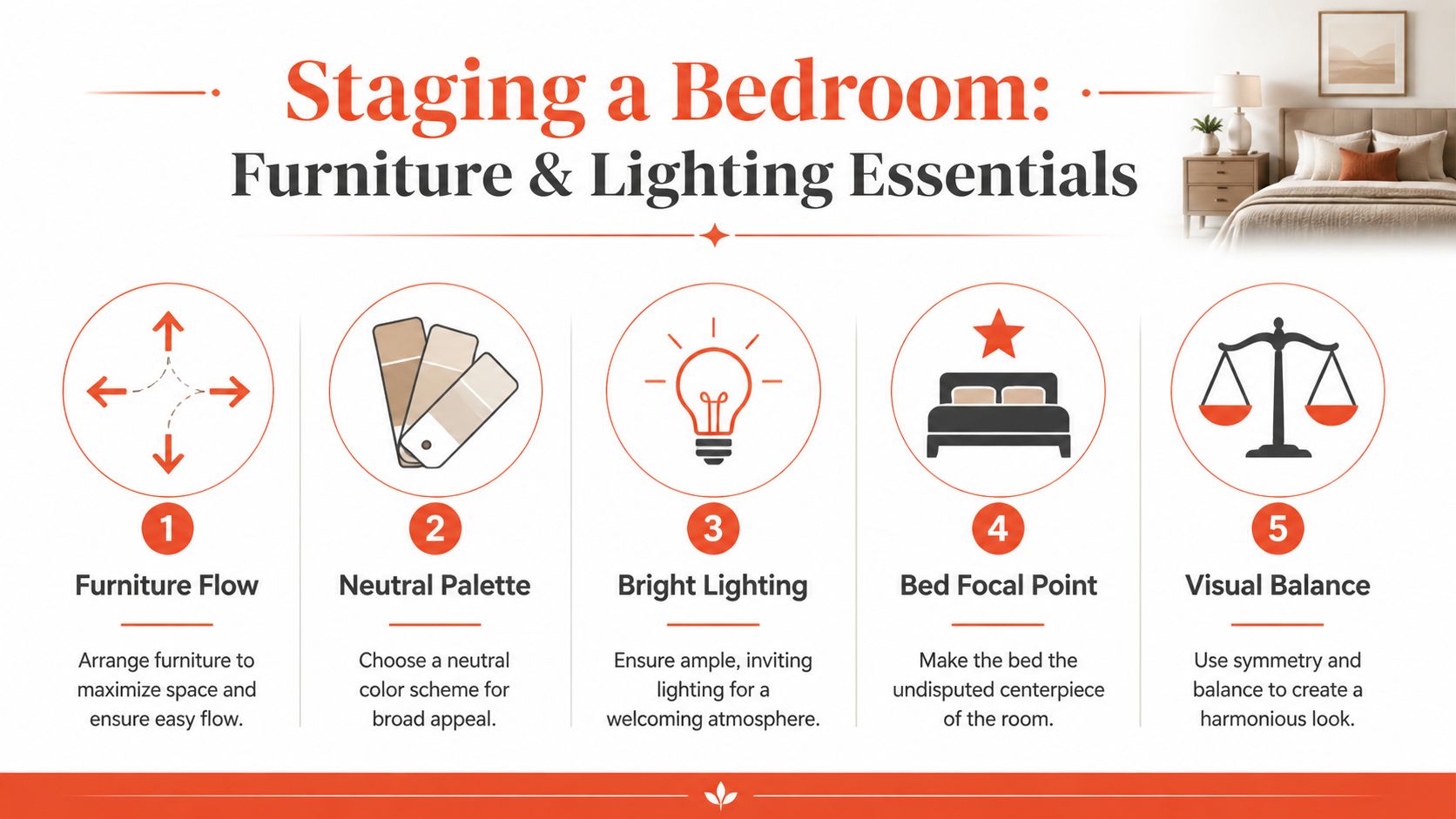
Buyer attention is won in seconds online, and bedroom photos do better when the room reads open, calm, and easy to use. Layout drives that reaction more than almost anything else after cleaning. A smart furniture plan and controlled light can make an average bedroom feel larger, quieter, and more expensive.
Start with the bed and build around it
The bed sets the room.
In most bedrooms, the strongest placement is on the main uninterrupted wall, with enough clearance on both sides for the room to feel balanced and usable. Buyers notice circulation fast. If they have to sidestep a dresser, squeeze past a nightstand, or mentally solve an awkward corner, the room shrinks in their mind.
Use this order when arranging the space:
- First: Bed placement
- Second: Clear path from the door to the bed, windows, and closet
- Third: Nightstands that fit the scale of the room
- Fourth: One secondary piece, usually a dresser, bench, or compact desk
- Last: Anything optional
I cut harder in small bedrooms than sellers expect. A room that feels 10 percent emptier often photographs 25 percent better.
Edit furniture for function, not fullness
Overcrowding is expensive because it hurts both photos and showings. An overcrowded room stops feeling aspirational and starts feeling solved for one person’s life. Buyers need enough visual space to project their own routine into the room.
My doorway test is simple. Stand at the entrance and see where the eye lands first. It should land on the bed and the open floor around it, not a stack of furniture competing for attention.
That usually means removing at least one piece sellers thought had to stay. Extra chairs, oversized benches, bulky armoires, and second dressers are frequent offenders. If a piece adds storage but steals floor space, it usually loses in staging.
For a clear visual benchmark, these bedroom staging before-and-after examples show how much stronger the room reads once the layout is edited down.
Buyers do not pay more because a bedroom holds more furniture. They pay more when the room feels easier to live in.
Use color to widen appeal
Color choices should broaden the buyer pool, not narrow it.
Bedrooms photograph best with a quiet base palette and a small amount of contrast. White, warm ivory, soft beige, pale taupe, and restrained gray usually work because they reflect light well and keep attention on the room’s size and shape. Texture does the heavy lifting here. Quilts, wood tones, linen, and one controlled accent color add enough interest without turning the room into a style statement.
The choices that tend to work against resale are predictable:
- Highly specific palettes: deep red, saturated navy, bright teal, jewel tones
- Theme-driven decor: farmhouse text art, coastal signage, glam overload
- Too many wood finishes: mixed tones without a plan make the room feel accidental
Light the room like a place to rest
Bedroom lighting has one job. Make the room feel bright, soft, and private at the same time.
Start with daylight. Open the coverings fully, pull furniture away from windows if needed, and make sure the bed is not blocking the best light angle for photos. Then layer in fixture light so the room still looks warm on a cloudy day or in a late afternoon shoot. One overhead source rarely carries the room by itself.
For sellers rethinking window treatments, a practical guide to enhancing bedroom sleep can also help balance privacy, softness, and light control without making the room feel shut in.
A dependable lighting plan usually includes:
- Ambient light: ceiling fixture or flush mount for full-room coverage
- Task light: bedside lamps for function and visual balance
- Accent light: a small lamp on a dresser or reading corner if the room needs depth
Pair physical staging with AI before you move furniture twice
For agents adept at combining physical prep and AI, 2026 staging becomes faster and cheaper. I still require the actual room to be cleaned, edited, and lit properly first. But before asking a seller to buy lamps, swap nightstands, or repaint a strong color, I use Bounti to test layout and styling directions on the listing photos.
That changes the conversation. Instead of debating preferences, you can show two or three credible versions of the same room and choose the one that fits the price point, buyer profile, and architecture. Then the seller spends money only on the physical changes that improve the final images and in-person experience.
The best results come from using AI as a filter, not a substitute. Physical staging sets the truth of the room. AI helps refine the plan, speed up decisions, and avoid wasting budget on pieces that looked good in theory but were wrong for the listing.
The Final Layer of Styling and Photography
Furniture gives the room structure. Styling gives it polish.
This is the point where a bedroom stops looking merely furnished and starts looking market-ready. Good styling is controlled. It adds comfort cues without bringing clutter back into the room.

Style the bed in layers, not piles
The bed should look complete, not overstuffed. I like a hotel logic here. Clean base layer, moderate texture, one controlled accent moment.
A simple good, better, best framework works well:
| Level | Bed styling approach | What it communicates |
|---|---|---|
| Good | Smooth white or neutral bedding with standard pillows | Clean and move-in ready |
| Better | Add a folded quilt or coverlet and two accent pillows | Warmth and finish |
| Best | Add one more textural layer and sharpen symmetry | Premium presentation |
The mistake is adding too many decorative pillows or mixing too many patterns. That starts to feel fussy, and buyers read fussiness as maintenance.
Use the rule of threes on surfaces
Nightstands and dressers shouldn’t look empty, but they also shouldn’t look inhabited. Three items often solves that tension.
Try combinations like:
- Lamp, book, small tray
- Lamp, low plant, object
- Art, candle, bowl
For rentals or homes where permanent changes are limited, these renter-friendly bedroom solutions are useful because they show how to create finish without committing to invasive updates.
Good staging edits the seller out of the room without making the room feel vacant.
Art, textiles, and what to skip
Art should support the scale of the wall and the calm of the room. One larger piece over the bed usually works better than multiple small pieces. Textiles should introduce softness, not visual noise.
Skip these common distractions:
- Busy gallery walls
- Tiny art above a large headboard
- Excess patterned bedding
- Visible cords and device clutter
- A dresser covered in products
If you want a quick visual benchmark for what strong staging transformations look like in listing imagery, these house staging before and after examples show the difference that restraint and cleaner styling decisions can make.
Photograph the room for the scroll
A bedroom that looks good in person can still underperform online if the photo set is weak. Before the photographer arrives, do a final camera pass from the doorway, each side of the bed, and the main corner angle.
Use a short shot list:
- Hero angle from the doorway: Shows layout immediately.
- Corner angle: Gives the room depth.
- Bed wall straight-on: Useful when symmetry is strong.
- Feature angle: Window, seating corner, or architectural detail if it adds value.
This walkthrough is a useful visual refresher before photo day:
Staging Solutions for Common Problem Bedrooms
Problem bedrooms are where staging judgment shows up. A standard checklist falls apart fast when the room is too small, too big, or shaped by awkward architecture.
I see three versions of this constantly. The undersized guest room that feels cramped before a buyer even steps inside. The oversized primary that reads flat and impersonal. The angled bedroom where sellers fight the room instead of staging around what it gives them.
The fix is different in each case, but the objective stays the same. Make the room read clearly in person and in photos, then use a clean image set to test stronger marketing versions later with AI if needed. If you want a side-by-side on where virtual staging fits into that process, this virtual staging guide for real estate listings is a useful companion.
Small guest room
Small bedrooms sell best when the layout feels obvious within two seconds. Buyers should understand where the bed goes, how they move through the room, and whether there is enough breathing room for everyday use.
That usually means subtracting, not adding.
Use fewer pieces and tighten the scale. If a queen bed crowds the room, remove one nightstand or swap both for slimmer options. If the bedding has too much loft, flatten it. Big pillows, bulky benches, and extra storage pieces steal visual space even when they technically fit.
Quick fixes that usually pay off:
- Use one appropriately scaled bedside table: Matching matters less than preserving circulation.
- Choose lower-volume bedding: Heavy layering makes a tight room feel tighter.
- Keep more floor exposed: Visible flooring helps the room read larger on camera.
- Skip accent chairs unless they solve a real function: Dead-corner furniture makes the room look smaller.
Large primary suite
A big bedroom has the opposite problem. Empty square footage can make the room feel unfinished, and overfilling it turns the suite into a furniture display.
I stage these rooms around hierarchy. The bed stays dominant. Then I add one secondary zone only if the footprint supports it, usually a reading corner, a bench, or a small writing desk. More than that usually weakens the room.
What works:
- Anchor the sleeping area first: The bed wall should still lead the composition.
- Add one secondary use with a clear purpose: Reading chair, bench, or compact desk.
- Use softness to keep scale from feeling cold: Drapery, an area rug, and restrained layers help.
- Leave open space on purpose: Buyers need to feel the size, not watch you spend it.
A large suite should feel expensive, not busy.
Sloped ceilings and awkward angles
These rooms need acceptance and control. Fighting the ceiling line with tall furniture or trying to disguise every odd corner usually makes the room feel more awkward.
Use the architecture as a boundary for placement. Low beds, lower headboards, and horizontal pieces sit more comfortably under the slope. Short walls are often best for low dressers, benches, or a compact writing table. Mirrors can help if they reflect light or a clean sightline. If they bounce back clutter or a harsh angle, skip them.
This supports a clear strategy:
- Use low-profile furniture: It keeps the ceiling line from competing with the bed.
- Place shorter case goods where the ceiling drops: That makes the layout feel intentional.
- Use mirrors selectively: They should improve light or depth, not multiply visual noise.
- Light the room at multiple lower points: Lamps and soft wall-mounted lighting usually photograph better than one harsh overhead source.
| Room Type | Primary Goal | Key Tactic |
|---|---|---|
| Small guest room | Preserve usable space | Reduce furniture count and keep floor visible |
| Large primary suite | Create warmth and structure | Build clear zones without filling every wall |
| Sloped or angled room | Make architecture feel intentional | Use low-profile pieces and controlled lighting |
Awkward bedrooms rarely need more styling. They need better decisions.
The Hybrid Workflow Physical Prep Meets AI Staging
The most efficient bedroom workflow now is hybrid. Do the physical work that improves the room in real life, then use AI to extend the presentation in marketing.
That means you still declutter, clean, simplify furniture, and improve light before you photograph anything. AI doesn’t fix a lazy prep job. It amplifies a good one.

The workflow that saves time without sacrificing judgment
I like a simple sequence.
First, prep the actual room so the base imagery is clean. Second, capture a straightforward video walkthrough and stills with consistent light. Third, use AI staging to test versions of the room that fit the likely buyer profile.
Input quality matters. In the virtual staging guidance summarized here, poor quality inputs lead to 70% of unprofessional-looking virtual stages. The same source notes that AI platforms such as Bounti Labs can deliver less than 5-minute turnaround versus 48+ hours for manual vendors, with 95% accuracy in proportion and scaling when trained on large property datasets.
That speed changes listing operations in a practical way. You can prepare one room properly, generate multiple visual directions, and avoid publishing a single weak interpretation because the vendor queue was backed up.
Where AI helps most
AI is most useful when the room needs help showing possibility rather than reality.
Examples:
- Vacant bedrooms: Add context without renting furniture.
- Awkward layouts: Test furniture arrangements before you commit.
- Style mismatch: Shift the look toward the likely buyer pool.
- Photo cleanup: Remove visual noise so the room reads faster online.
For agents building this into their media process, this virtual staging guide is a solid operational reference.
The key trade-off is honesty. The image still has to represent the room faithfully. Don’t add fictional windows, impossible scale, or features the property doesn’t have. Use AI to clarify the room, not to invent it.
If you want to stage a bedroom faster without losing control of the result, Bounti Labs gives you a practical way to pair real-world prep with AI decluttering, staging, and restyling from a simple property walkthrough. For agents, teams, and marketers who need MLS-ready visuals without the usual delays, it’s a useful addition to the listing workflow.