Let's get one thing straight: staging isn't just about making a property look nice. It's about getting potential buyers to feel an emotional tug, to start picturing their own lives unfolding within those four walls.
You’re not just arranging furniture; you're setting the stage for a faster sale and a better offer. It’s the difference between a buyer seeing a house and them seeing a home.
Why Staging Is No Longer Optional
Not too long ago, staging was seen as a premium service, something you’d only roll out for luxury listings. That world is gone. Today, staging is table stakes for any agent who wants to compete.
Think about it. The first showing happens online, with 95% of buyers starting their search by scrolling through photos. An empty room or a cluttered space is an instant swipe-left in a feed filled with perfectly presented homes. Staging is your first, and best, chance to make someone stop and pay attention.
It’s fundamentally about telling a better story. You can transform a cold, vacant property into a warm, inviting space. Or you can take a well-loved (but cluttered) home and make it feel fresh, open, and aspirational. This isn't just fluff—it directly impacts your client's wallet.
The Numbers Don't Lie
If you’re still on the fence, the data should convince you. Staged homes sell a staggering 88% faster and for up to 20% more than their unstaged competition. Across the country, homes staged before hitting the MLS spend 90% less time on the market. We're talking about going under contract in days, not months. You can dig into more of these powerful home staging statistics yourself.
Why such a dramatic difference? It all comes down to how buyers connect with the space.
Buyers spend an average of 40 minutes in a staged home, but only 6 minutes in an unstaged one. That extra time is where the magic happens. They build an emotional bond, making them more likely to overlook minor imperfections they might otherwise fixate on.
Win More Listings, Close Deals Faster
For listing agents, this is a double-win. First, when you walk into a listing presentation and offer professional staging—especially with modern solutions like AI staging—you immediately set yourself apart. It shows sellers you’re serious about getting them top dollar.
Second, the ROI is undeniable. Sellers can see an average gain of 5% to 15% on the sale price, which blows the initial cost out of the water. For vacant homes, that return can be as high as 586%. This means faster closings for you, bigger commission checks, and thrilled clients who will send referrals your way.
With AI tools like Bounti, you can now get these incredible results without the logistical headaches and high costs of physical staging. It's become a no-brainer for every single listing.
Choosing Your Staging Strategy: Physical Versus Virtual
Deciding between physical and virtual staging isn’t just about the budget. It's a strategic call that depends on the property itself, your client's timeline, and who you’re trying to attract. Get it right, and you can drastically cut down market time and boost the final sale price.
Physical staging is all about creating a tangible, immersive experience. When buyers can walk into a fully furnished space, touch the furniture, and feel the flow of a room, it hits different. This approach works wonders for vacant, high-end listings where you need to sell a sense of luxury and scale to justify a premium price tag.
When Physical Staging Makes Sense
Think about that vacant luxury condo with a sprawling open floor plan. It's tough for most buyers to visualize where their own couch might go. Physical staging solves that problem by clearly defining living, dining, and family areas, which is critical for creating an emotional connection. It’s also where a solid understanding of designing a living room layout that works really pays off.
But here's the reality check: physical staging comes with heavy costs, logistical headaches, and long lead times. It's a big investment, best saved for properties where the potential ROI makes the upfront expense a no-brainer.
The Rise of Virtual Staging
On the flip side, virtual staging—especially with AI tools like Bounti—gives you a flexible, fast, and incredibly cost-effective option. It's a total game-changer for occupied or cluttered homes where hauling in physical furniture just isn't practical. Forget spending thousands on movers and rental fees; you can digitally declutter and furnish an entire home in minutes.
Picture an owner-occupied house with dated decor. You can snap photos of the rooms as-is and use an AI tool to instantly show potential buyers a modern, stylish version online. This helps them see past the current owner's taste and focus on the home's true potential. We break down the whole process in our complete virtual staging guide.
No matter which route you take, the data is clear: staging works.
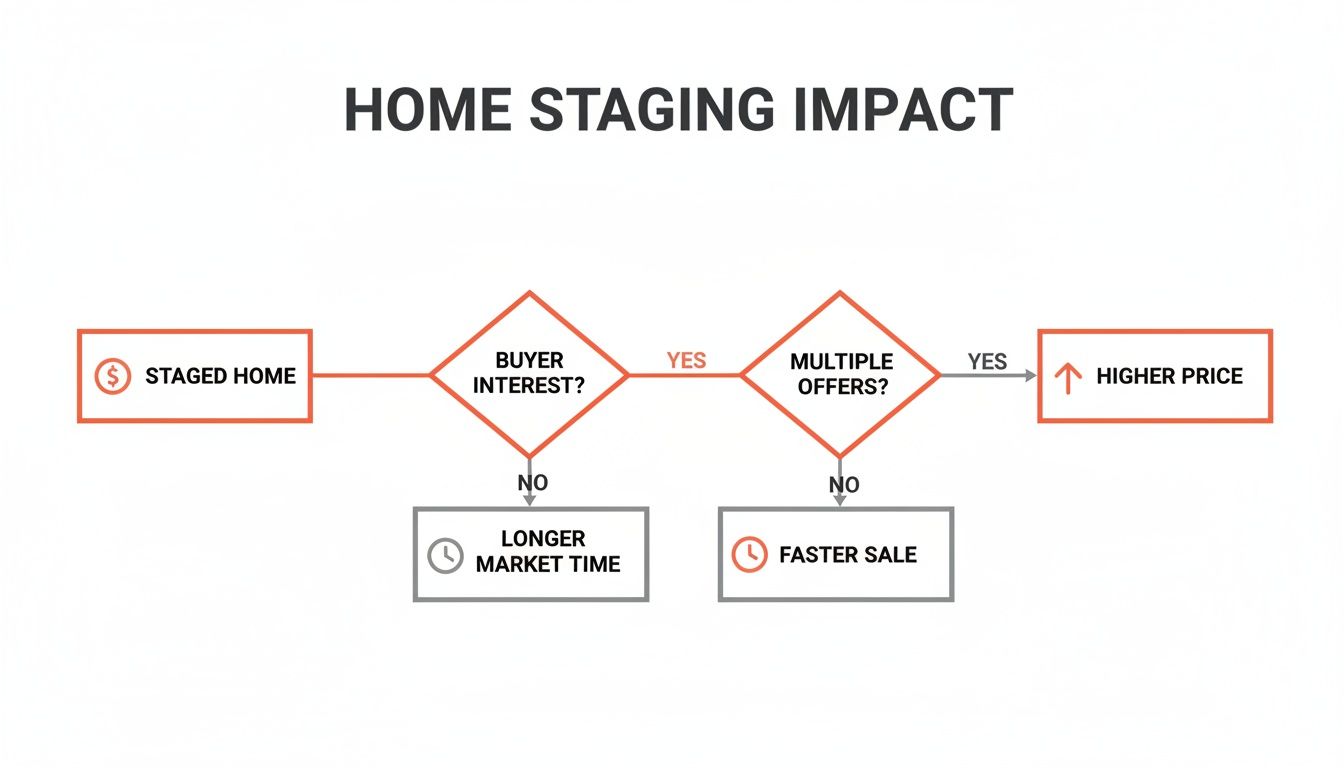
The numbers show that a staged home doesn't just sell faster—it consistently pulls in higher offers.
A recent NAR report drove this point home: 49% of agents said staging slashed a property's time on market, and 29% saw a direct increase in the final price buyers were willing to pay.
Making the Strategic Decision
So, how do you decide? Let's get practical. To help you weigh the pros and cons for your next listing, here’s a quick decision matrix.
Staging Strategy Decision Matrix
| Consideration | Physical Staging | Virtual Staging (with AI like Bounti) |
|---|---|---|
| Best For | Vacant, high-end properties; when an immersive feel is critical. | Occupied, cluttered, or dated homes; budget-conscious listings. |
| Cost | High ($$$$) – thousands in rental fees, moving, and design costs. | Low ($) – a fraction of the cost, often a simple per-image fee. |
| Speed | Slow – days or weeks for consultation, delivery, and setup. | Fast – minutes or hours to get final images back. |
| Flexibility | Low – locked into one design style once furniture is in place. | High – can create multiple styles (modern, farmhouse, etc.) for the same room. |
| Logistics | Complex – coordinating movers, designers, and de-staging. | Simple – just need good photos; no physical access required. |
Ultimately, the smartest move is rarely an either/or choice. Often, a hybrid strategy delivers the biggest bang for your buck. You might physically stage the main living area of a vacant home to create that initial "wow" factor, then use virtual staging to show how the empty spare bedrooms could be a home office, a gym, or a nursery.
This balanced approach maximizes your marketing impact while keeping costs in check. The National Association of Realtors' data backs this up—agents who stage see real results, with 46% of 3,500 staged homes selling for 10% more than their unstaged counterparts. You can dig into these NAR staging findings yourself.
By combining the best of both worlds, you can build a powerful visual narrative that helps buyers see not just a house, but a home.
Capturing Perfect Pre-Staging Visuals
The foundation of any great virtual staging is the photo you start with. It’s like cooking: the best ingredients yield the best results. The same is true when you stage real estate with AI—the cleaner your initial photos, the more believable the final images will be.
Good news: you don't need to hire a pro photographer to get this right.
Your smartphone is more than capable. With a few simple techniques, you can capture the perfect canvas for an AI tool like Bounti to work its magic. The goal is to give the AI a clean, well-lit, and accurately proportioned space to fill with virtual furniture and decor.
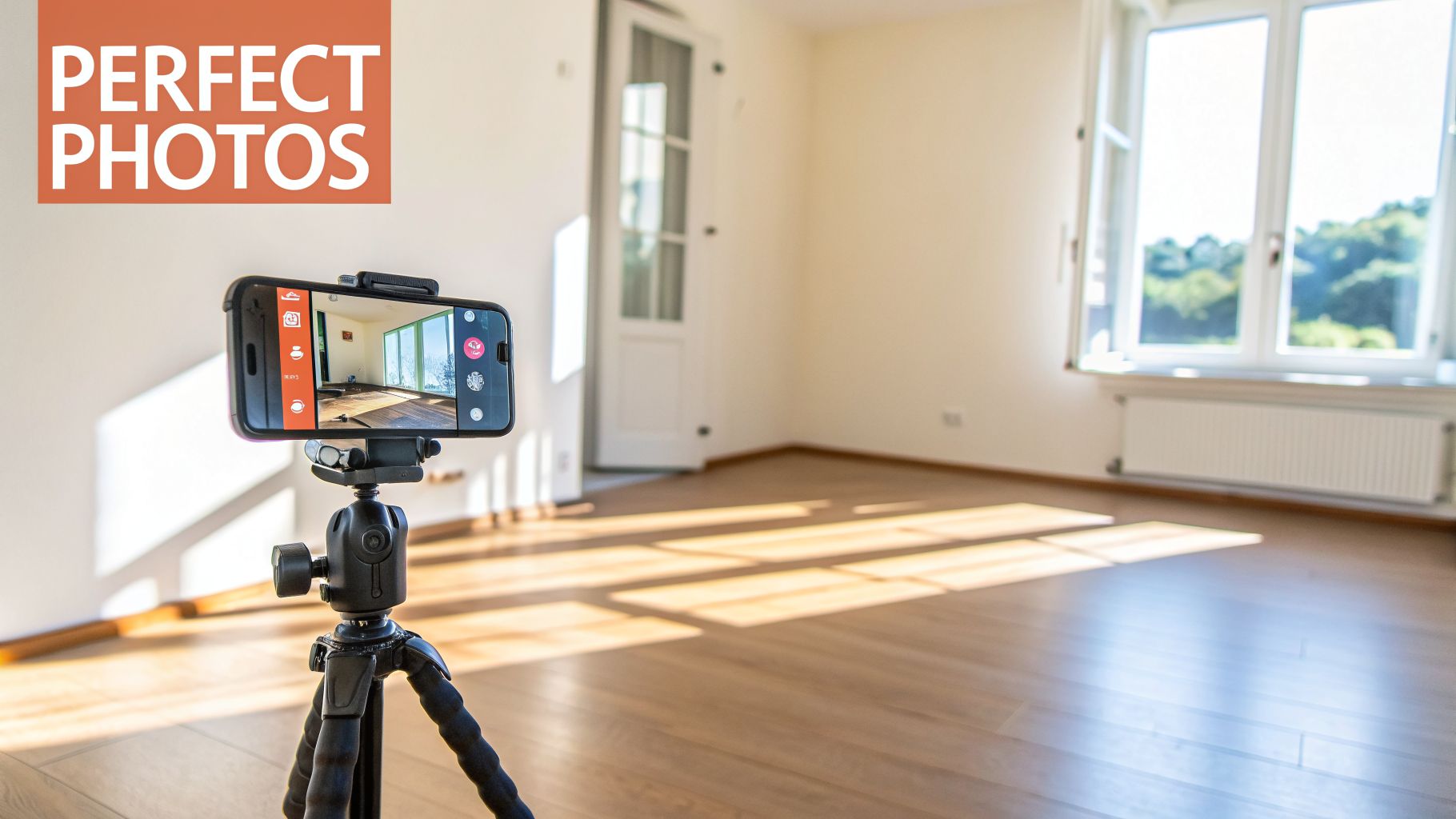
Getting that shot starts long before you ever press the shutter. It's all about prepping the space to show off its best features, even when it's completely empty.
Mastering Light and Angles
Natural light is everything. Plan your shoot for daytime, ideally on a bright but slightly overcast day. This gives you soft, even light without the harsh shadows or blown-out windows you get from direct sun.
Once you're there, open every blind and curtain. Then, flip on every single light in the house. This combination fills the room, kills shadowy corners, and creates a bright, welcoming atmosphere.
Your camera angle is just as critical. A common mistake is shooting from too low or too high, which distorts the room and makes it feel 'off.' The sweet spot is always chest height—about four to five feet off the ground. This perspective mimics how we naturally view a space, making the final staged photo feel authentic and correctly proportioned.
- Go wide, but not too wide. Your phone's wide-angle lens (the 0.5x or 0.6x setting) is great for capturing the whole room. Just be careful not to overdo it and create that "fisheye" look where the walls start to curve.
- Shoot from the corners. This is a classic real estate photography trick for a reason. Standing in a corner and shooting towards the opposite side of the room makes the space feel bigger and shows the layout most effectively.
- Keep it level. Nothing screams "amateur" like crooked photos. Hold your phone perfectly straight so that vertical lines like door frames and window edges are parallel with the sides of your screen. A cheap smartphone tripod is your best friend here.
Prepping for the AI Transformation
Before taking any photos or recording a video walkthrough, do a quick "pre-declutter." You don't need a deep clean, but getting personal items out of the shot is non-negotiable.
Your goal is to create a neutral-enough space for the AI to work its magic. Clear off countertops, hide family photos, and remove any stray shoes or pet toys from the floor. A clean slate gives you more flexibility when you virtually stage the real estate later on.
If you're recording a video for an AI tool like Bounti, the key is to move slowly and steadily. Pan smoothly across each room, making sure to capture every wall, corner, and window. This gives the AI all the spatial data it needs to generate a variety of photorealistic stills and design options.
By nailing these simple photography fundamentals, you're not just taking pictures—you're setting your listing up for a faster sale.
Your AI-Powered Staging Workflow with Bounti
The real magic of AI staging isn't just the tech—it's the speed and simplicity. Forget the clunky tools and uncanny-valley results of the past. With a platform like Bounti, your entire staging and content creation workflow can kick off from a single video you shoot on your phone.
That one video walkthrough becomes the source material for everything. The AI understands the space, letting you generate a whole suite of marketing assets without ever booking a photographer or calling a stager. It completely changes the game for getting a listing ready for market.
From Messy Room to Marketing Gold
Picture this: you walk into a seller's living room and it’s… a mess. The stuff of staging nightmares. In the old days, that meant hours of decluttering before a single photo could be taken. The AI workflow flips that script entirely.
Just take a quick video of the room, clutter and all. In a few clicks, you can use an AI declutter tool. This isn't just blurring things out; the AI intelligently removes the items and rebuilds the walls, floors, and windows behind them. You're left with a clean, empty canvas. For occupied homes, this feature alone is a lifesaver.
This is the moment you switch from problem-solver to creative marketer. Once the space is digitally cleared, you can start testing different design styles to hit the right note with your target buyers.
The Bounti interface lets you instantly apply different looks to that same empty room. You can see right here how one space can be transformed to match completely different tastes.
Being able to test-drive design concepts this quickly is huge. You're not stuck with one look, which gives you the freedom to market the property in several ways at once.
Visualizing Potential and Expanding Your Audience
This workflow is about more than just plopping virtual furniture into a room. It's about showing buyers the hidden potential they might otherwise miss.
- Experiment with Styles: Is your ideal buyer a young professional or a growing family? Why not market to both? Generate one set of images in a sharp 'Scandinavian Minimalist' style and another in a welcoming 'Modern Farmhouse' theme.
- Showcase Renovations: Help buyers see past a home’s current state. You can digitally "knock down" a non-load-bearing wall to create an open-concept floor plan or give an outdated kitchen a full facelift with modern cabinets and countertops.
- Commercial Versatility: This approach works wonders for commercial listings, too. Take one empty commercial shell and, in minutes, show it as an open-plan office, a series of executive suites, or a chic retail boutique. You can market the same listing to different types of businesses simultaneously.
You're no longer just making a space look nice; you're using a strategic tool to overcome objections before they even come up and widen your pool of potential buyers. If you want to take those visuals to the next level, you can even turn them into high-performing campaigns with specialized AI ad creative for real estate.
The speed and flexibility here mean you can create a full marketing package in a fraction of the time and cost. And if you're looking to round out your toolkit, it’s worth exploring the best AI photo editing software that agents are using today. This kind of efficiency helps you win more listings and close them faster. That's a real competitive edge.
Integrating Staged Assets into Your Marketing Plan
Getting incredible staged photos is just the first step. The real magic happens when you get those assets in front of the right buyers, and that requires a launch plan as thoughtful as the staging itself.
Once you have your final images—whether from a physical stager or an AI tool like Bounti—your first job is picking the perfect hero shot for the MLS. Don't just default to the prettiest picture. Choose the one that tells the best story about the lifestyle this property offers.

Tell a Story with Your Photos and Words
Your property description shouldn't just list features; it should be a tour guide that connects directly to your visuals. Instead of a flat "spacious living room," try something like, "Imagine hosting game night in the expansive living room, with more than enough space for everyone to gather, just like you see in the photos." You’re not just selling a room; you’re selling the life someone could live in it.
One of the most effective moves you can make is showing "before and after" transformations, especially if you've used virtual staging or AI decluttering. This instantly demonstrates the property's hidden potential and highlights the value you bring. You can create compelling visual stories by pairing these images side-by-side using tools that offer enhanced galleries for your listings.
The numbers don't lie. Data from the Real Estate Staging Association (RESA) shows staged homes command an average sale-to-list ratio of 109%. One report even documented a staggering 4,415% average ROI on a staging investment of just $4,387. You can dig into more of these impressive staging statistics on RESA's website.
Get Your Staged Content Everywhere
Your gorgeous photos can't do their job if they're only sitting on the MLS. You need to get them in front of buyers wherever they’re scrolling.
- Social Media: Build an Instagram carousel that shows the home's transformation. Lead with the stunning "after" shot, then swipe to the "before" for a dramatic reveal that stops the scroll.
- Video Tours: Turn your staged photos into a quick video slideshow with some background music. It’s an easy-to-digest piece of content perfect for YouTube, Instagram Reels, and Facebook.
- Email Blasts: Announce your new listing to your network with a dedicated email campaign. Make that hero shot the star of the show right at the top to grab immediate attention.
- Open House Materials: Have high-quality flyers printed with the staged photos. If the home is virtually staged, have a tablet or printouts ready to show buyers exactly how an empty space can come to life.
And when you're using virtually staged photos, always be transparent. Most MLS platforms require disclosure, and it’s a good practice anyway. A simple watermark like "Virtually Staged" builds trust. This isn't a weakness—it's an honest way of helping buyers see the possibilities, and they'll appreciate you for it.
Common Questions About Real Estate Staging
Even when everyone agrees staging works, the practical questions always pop up. We get it. These are the conversations you're having in the field every day with sellers, buyers, and even your own team.
Here’s how to handle the most common objections and questions with total confidence.
How Do I Convince A Seller To Invest In Staging?
Stop talking about the cost. Start talking about their net profit.
Frame staging as a strategic investment designed to get them a higher final sale price. Arm yourself with the facts: staged homes don't just sell faster; they often sell for 5% to 15% more. A faster sale also means fewer carrying costs for them, which is more money in their pocket.
But don't just tell them. Show them. Use a tool like Bounti to generate a virtually staged "after" photo of their actual living room. The moment they see their cluttered space transformed into a bright, modern home, the lightbulb goes on. It's no longer an abstract expense; it's a clear path to a bigger check.
Think of it this way: you’re not asking them to spend money. You’re showing them how to make more. A single, powerful visual is the most convincing argument you have.
Is Virtual Staging Misleading To Buyers?
Not if you’re transparent. And transparency is everything in this business.
Virtual staging isn't meant to mislead; it’s an incredible tool for helping buyers who struggle to see the potential in an empty or dated room. It helps them visualize a future, not trick them about the present.
The key is clear disclosure. Most MLS guidelines—and basic best practices—require you to label the images. A simple watermark like "Virtually Staged" or a note in the photo description is all it takes. The goal isn’t to fool anyone. It’s to inspire them.
What Is The Real ROI Of Staging An Average Home?
The return on investment for staging is consistently one of the best you can get when prepping a home for sale. While the exact numbers shift, it’s common for sellers to see a 586% return or higher, especially when a property moves quickly and sparks a bidding war.
In fact, some recent industry data shows an average ROI climbing past 3,500% on staging investments. For a tiny cost—especially with hyper-efficient AI virtual staging—the seller gets a massive financial upside. It’s one of the smartest bets they can make.
Can I Use AI To Stage A Commercial Real Estate Property?
Absolutely. And this is where AI staging becomes a huge competitive advantage for commercial brokers.
You can take a single video of an empty shell space and instantly market it to dozens of different industries. Imagine showing the same exact listing as:
- A sleek, open-plan tech office
- A functional medical clinic with private exam rooms
- A high-end retail boutique with custom displays
This lets you cast a much wider net and attract a diverse pool of tenants without spending a dime on physical build-outs. You can tailor your marketing on the fly, showing each prospect a vision that speaks directly to their business.
Ready to transform your listings and win more deals? Bounti is your AI assistant for creating stunning, MLS-ready visuals in minutes. Discover how Bounti can elevate your real estate marketing.