Virtual staging can cut costs by up to 97% compared with physical staging, while a full-home project typically runs between $25 and $300 instead of $2,500 to $5,000 or more, according to AI HomeDesign's virtual staging statistics roundup. That cost gap changes how agents should think about listing presentation in 2026. You're no longer deciding whether to stage only premium listings. You're deciding how to use visual strategy on nearly every listing that needs help.
That's the shift behind the best virtual staging examples. The strongest results don't come from dropping generic furniture into an empty room. They come from matching design choices to the buyer, the platform, and the speed of the deal. A downtown condo needs a different visual story than a dated suburban family home, and a commercial warehouse needs something different again.
This is a playbook, not a gallery. You'll see seven virtual staging examples through the lens that matters to agents: target buyer, design logic, ROI potential, and how to replicate the move with current tools and services. If you want a broader view of how visuals affect decision-making, this companion piece on visualizing real estate insights is worth your time.
1. Bounti Labs
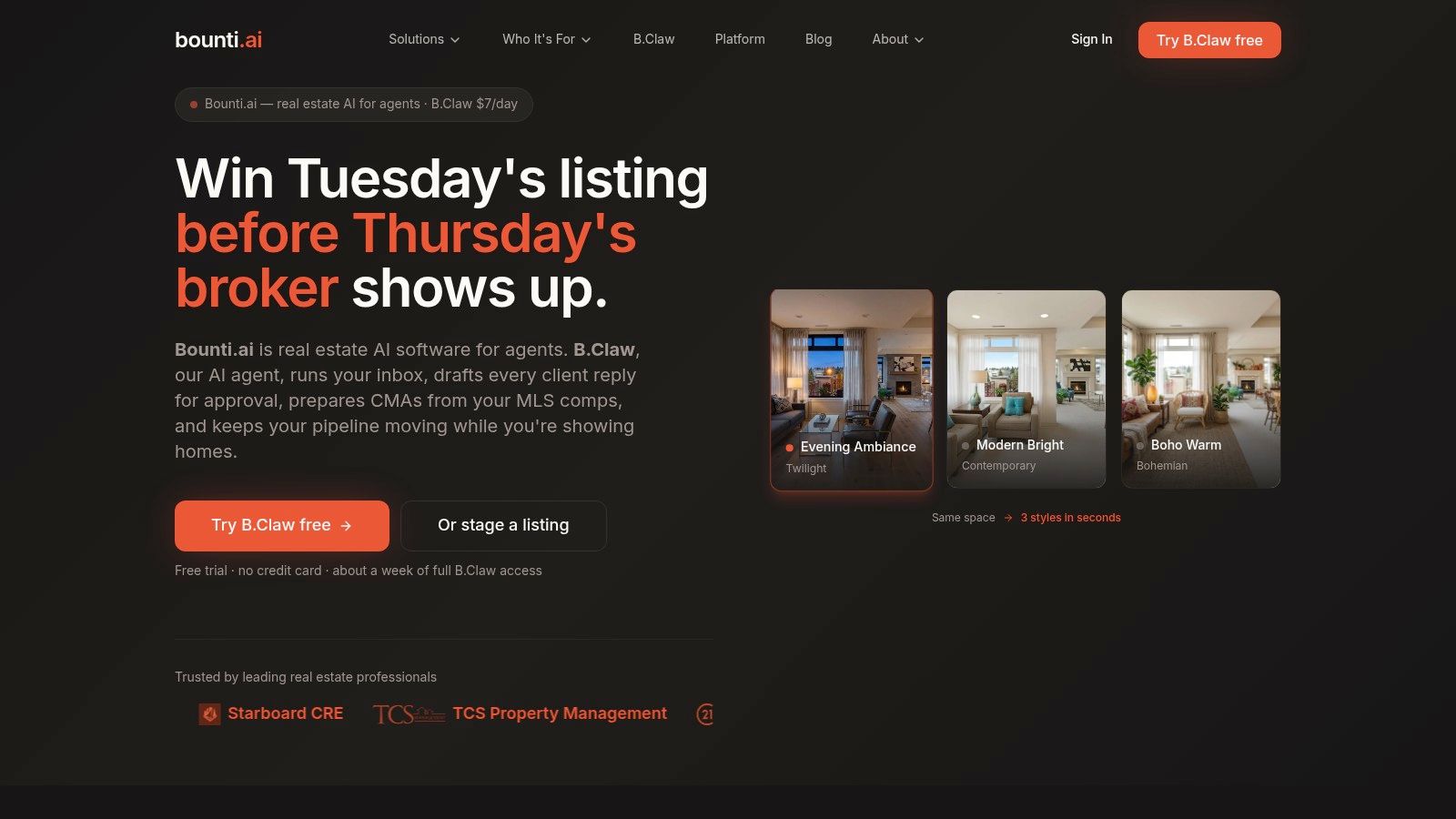
Bounti Labs is the best choice when you need more than a staged photo. It's built for agents who want a single walkthrough to turn into a listing package fast, then push that package through the rest of the workflow without bouncing between disconnected tools.
The strategic example here is simple. Use one walkthrough, not a scattered set of uploads, to produce staged stills, decluttered versions, renovation concepts, before-and-after reveal content, and listing assets that are ready for MLS and social distribution. That approach fits the way agents work when a seller wants the property live now, not after a long vendor cycle.
Why this example works
Bounti's strength is speed plus workflow fit. The company positions its platform around an AI assistant and Virtual Staging Studio, so the staging step doesn't sit off to the side. It supports listing execution, marketing output, and communication inside the same operating flow.
That matters because visual marketing only pays off when the listing launches quickly. According to StageChimp's virtual staging statistics roundup, staged homes, including those enhanced by virtual staging, can see a 1 to 10% price increase in NAR 2025 data, and RESA 2024 reports 73% faster sales compared with unstaged properties. You don't capture that upside if the creative process slows the launch.
Field move: Use AI staging first on the living room, primary bedroom, and the image you expect to lead on portals. Those are the frames that shape the first click and the first showing request.
Bounti is especially strong for these listing situations:
- Vacant listings with weak emotional pull: Generate furnished visuals immediately so buyers can understand scale and use.
- Cluttered homes with decent bones: Start with AI decluttering, then stage only the highest-impact rooms.
- Listings that need seller buy-in: Show multiple directions quickly so the seller sees the plan before you spend time on revisions.
- Teams managing volume: Standardize output across agents without forcing every listing through a manual production queue.
How to replicate the strategy
Don't think “add couch.” Think “build a buyer-specific visual package.” For a first-time buyer listing, keep furniture approachable and practical. For move-up buyers, show a cleaner, more aspirational layout. For investors or flippers, use renovation visualization to sell the upside, not the current condition.
Bounti also stands out because it connects the visual step to broader agent operations through B.Claw and its stated integrations. That's useful if your bottleneck isn't just image production but follow-up, CMA drafting, calendar coordination, and listing launch admin.
The practical recommendation is direct. If you're a solo agent or team that wants instant visual output and less operational drag, start here. Bounti gives you the fastest path from walkthrough to usable marketing.
2. BoxBrownie
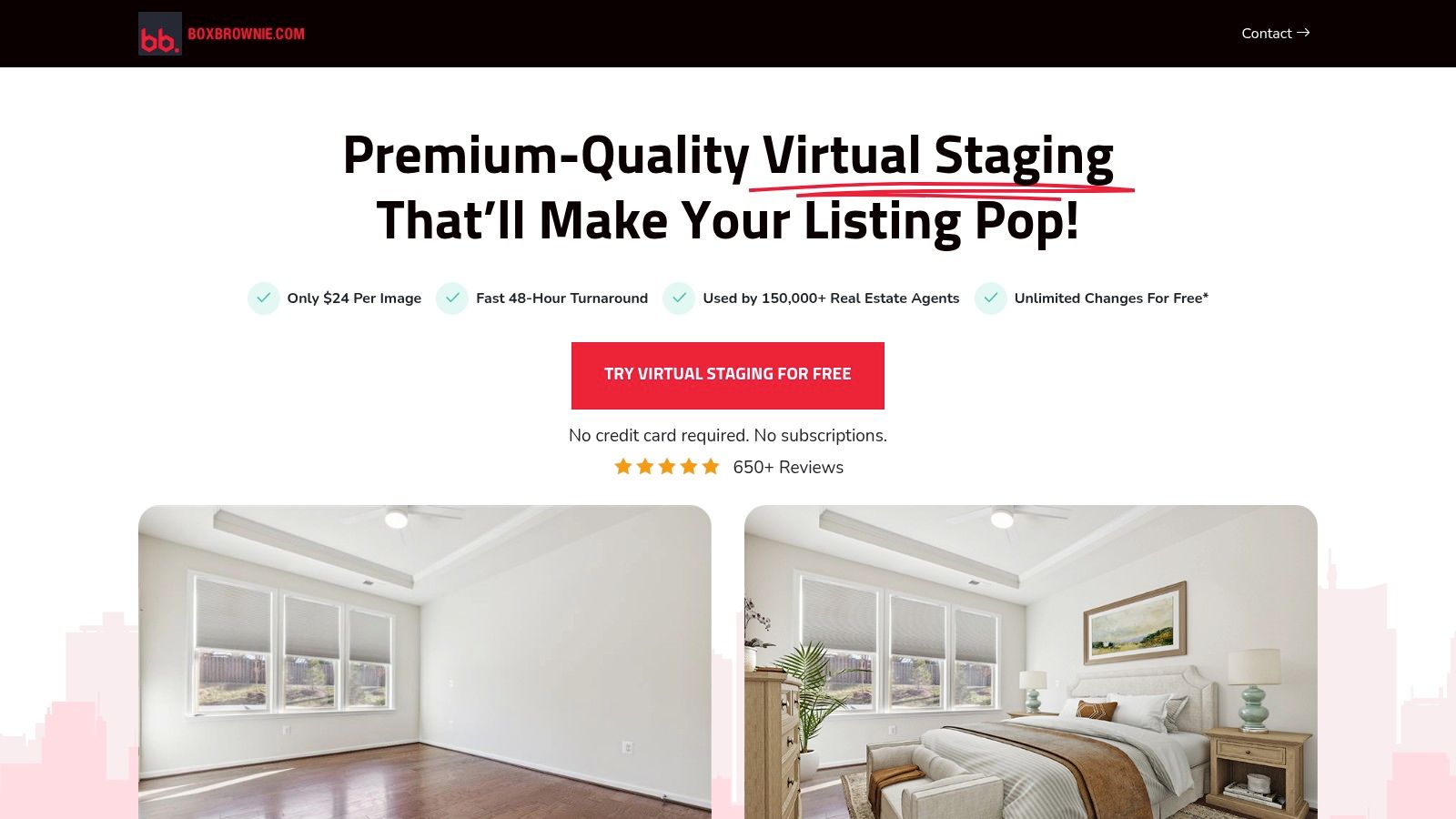
BoxBrownie provides predictable, human-edited virtual staging at scale. Use it when your business runs on repeatable listing prep, clear pricing, and seller-friendly before-and-after examples.
The strategic lesson here is simple. BoxBrownie works best when the buyer target is broad and the goal is reducing friction, not showing off design originality. For a standard suburban resale, clean contemporary furniture, open traffic flow, and neutral finishes usually outperform bolder concepts because they photograph well across portals and create fewer objections in showings.
That makes BoxBrownie a strong fit for agents who want a full visual package. Stage the main room, remove distracting items, add twilight conversion if the exterior needs more impact, and include floor plans when buyers need help understanding layout. This service is less about one dramatic transformation and more about building a consistent marketing system your team can repeat on every listing.
Best use case
Use BoxBrownie for vacant or thinly furnished homes that already have solid photography and need a market-ready presentation fast. The target buyer is the middle of the market: owner-occupants who need help reading room scale, function, and flow. You are selling clarity.
Its public pricing structure supports that use case: $24 per image, 360° staging at $48 per image, standard 48-hour turnaround, and unlimited changes. That matters for ROI because predictable costs make it easier to decide, room by room, where staged imagery will improve inquiry volume.
If the source photos are weak, fix those first. Poor lighting, warped verticals, and muddy window exposures lower the credibility of every staged image. This guide to best AI photo editing software is a useful companion if you need to clean the raw files before sending them out. For a broader process on choosing rooms, visual style, and rollout timing, review this virtual staging guide for agents.
Clean source images raise staging quality immediately. Bad photography forces the editor to solve problems that should have been fixed before the order was placed.
Replicable playbook
- Target the buyer before you pick the furniture. For entry-level buyers, use practical layouts and approachable finishes. For move-up buyers, tighten the palette and leave more negative space.
- Start with one conversion room. The living room or primary bedroom usually gives you the clearest test of whether staging will improve click-through and seller confidence.
- Bundle edits on purpose. Item removal, brighter exposures, and staging should work together so the final image feels believable.
- Keep the style broad. Neutral, lightly warm, and current beats overly personalized decor on listing portals.
- Use flat pricing to standardize decisions. Teams can build a simple rule set for when to stage, how many rooms to order, and what visual package each listing tier gets.
Choose BoxBrownie if you want consistency, human review, and an easy service model to operationalize across steady listing volume. It is a practical option for agents who care less about experimentation and more about reliable visual ROI.
3. VirtualStaging.com
VirtualStaging.com wins on one thing that matters in real listings. Speed to market.
That makes it a smart fit for a specific staging strategy in 2026. Use it when the goal is not design experimentation, but fast, credible images that help a vacant listing launch stronger and start generating buyer interest immediately.
Its own published example shows the appeal. In Texas, where the average time to offer was 45 days, one realtor's virtually staged property got 12 showings and 4 offers in 3 days, then sold $5,000 over asking, according to VirtualStaging.com's case study. Treat that as a directional signal, not a guaranteed outcome. The strategic takeaway is clear. Staging worked because it gave buyers enough context to act fast.
The example to copy
Target buyer: buyers scrolling fast through portal results, comparing vacant listings against staged competitors.
Design choice: stage only the rooms that sell the floor plan. Start with the living room, primary bedroom, and the main open-concept area connected to the kitchen. Keep the style broad, current, and neutral. Avoid dramatic furniture, heavy color stories, or niche decor that narrows appeal.
ROI logic: this approach protects budget and improves the images that drive the first showing. You do not need to stage every room to improve listing performance. You need to remove uncertainty from the rooms buyers use to judge livability.
If you want more visual benchmarks before ordering edits, review these house staging before and after examples.
How agents should use it
This service is built for agents with fixed launch dates, vacant inventory, and sellers who need fast evidence that presentation affects response. Public pricing stays simple: $24 per image standard, volume discounts, 24-hour standard turnaround, and rush delivery options.
That pricing model is useful because it makes staging easier to operationalize across a team. You can set a rule. If the home is vacant and the first photo set feels cold, stage the top conversion rooms before going live. Do not wait for the listing to stall first.
For a broader tactical framework, this virtual staging guide for agents is worth reading alongside the service.
Vacant rooms rarely lose because they are empty. They lose because buyers cannot judge scale, function, or how the home will live day to day.
Choose VirtualStaging.com when turnaround time is the constraint and listing photos need to start working now. It is a practical option for agents who want a repeatable launch play, fast revisions, and staged images that can get a property into the market without delay.
4. Stuccco
Stuccco is the pick when your listing needs visual discipline across the full photo set. That is the actual strategy behind this virtual staging example. Buyers do not evaluate staged images one by one. They scroll the gallery and decide whether the home feels coherent, credible, and ready to buy.
Stuccco focuses on realism, scale accuracy, and design consistency across rooms. That matters most on larger homes, suburban family properties, and move-up listings where the buyer is comparing lifestyle fit across multiple spaces, not just reacting to one polished living room shot. If the primary bedroom reads as warm transitional, the office cannot suddenly shift into ultra-modern black and chrome. That kind of mismatch lowers trust fast.
The example to copy
Use Stuccco when the target buyer is purchasing a complete lifestyle package. A family shopping in the mid-to-upper tier wants to see how the kitchen, dining area, bedrooms, and flex spaces work together. Your job is to reduce friction in that decision.
The practical play is simple. Set one design direction before you place the order, then apply it across the rooms that drive perceived livability. Start with the living room, primary bedroom, dining area, and office or bonus room if the floor plan supports it. If you need visual benchmarks before briefing the vendor, this set of house staging before and after examples gives you a useful standard for whole-home consistency.
How agents should use it
Stuccco offers quick turnaround, unlimited revisions, and a free property listing page with each order. That package is useful for agents who need a repeatable system, not one-off creative experiments.
Use these rules:
- Choose the buyer before the furniture: Design for a move-up family, downsizer, or remote-working couple. Do not stage for everyone.
- Keep materials consistent: Repeat wood tones, fabric weight, metal finishes, and lighting temperature from room to room.
- Assign each room a job: Show dining where buyers expect gathering, show office where buyers need function, and skip forced furniture plans that make rooms feel smaller.
- Review the gallery as a sequence: The images need to sell one story from photo one through the final bedroom shot.
Cohesion raises confidence. Confidence gets more saves, more showings, and fewer buyer objections about scale or layout.
Choose Stuccco when your listing already has enough square footage and features to compete, but the photography needs one consistent visual story to convert attention into tours.
5. PadStyler
PadStyler is useful when you want both speed and escalation. That hybrid model is smart for agents handling a mix of ordinary listings and occasional premium inventory.
The strategic example here is style testing before final production. Instead of guessing which look will resonate, you can generate quick AI concepts, compare directions, then move the winning option into a higher-touch designer execution for the final marketing set.
Where this wins
This approach is strong on listings that sit between mass-market and luxury. You don't want to pay for bespoke design before you know the angle. But you also don't want to settle for a rough AI result if the property deserves a cleaner finish.
PadStyler supports AI virtual staging, AI remodeling, and backyard design, while also offering bespoke staging and 3D rendering. That lets you use one platform for ideation and final polish.
Start with two distinct looks, not five. Too many options slow seller decisions and blur the positioning of the property.
This is also one of the better virtual staging examples for agents who pitch renovation potential. If a property's current design is dated but the structure is strong, showing both a furnished version and a remodeled concept can change the conversation from “needs work” to “has upside.”
Replicable move
Use AI concepts during the listing appointment or pre-launch phase. Once the seller approves a direction, order the polished set. That sequencing protects your time and helps sellers feel involved without derailing the visual plan.
Choose PadStyler if your business needs flexibility. It's a good fit for agents who want quick iterations on ordinary listings and a path to premium presentation when the listing justifies it.
6. Spotless Agency
Spotless Agency is for listings where mood matters as much as furniture placement. High-end homes, architecturally distinctive properties, and editorial-style marketing all benefit from more intentional lighting, materials, and styling decisions.
The strategic example here is differentiation. Most listings in a price band look visually interchangeable online. A premium design studio can help a property feel singular without slipping into fantasy.
How to think about ROI
Luxury presentation isn't about stuffing more pieces into the room. It's about selecting the right pieces, keeping proportions disciplined, and matching the tone of the architecture. Spotless Agency's furniture-set galleries and tiered packages help set expectations before ordering, which is useful when sellers or marketing coordinators care about exact aesthetic alignment.
This category is best when the listing itself supports high-quality presentation. If the property is architect-designed, newly renovated, or visually minimal, standard mass-market staging can flatten the appeal. A more stylized studio can preserve the identity of the home.
There's another operational advantage. Spotless also supports virtual restaging and architectural visualization. That gives you room to reposition occupied luxury inventory or illustrate alternate design possibilities without relying on physical staging logistics.
Direct recommendation
Use Spotless Agency when the listing photography is already strong and the property can command attention through design nuance. Don't use it on commodity inventory where broad practicality matters more than brand feel.
For premium listings, this is the right move. The best virtual staging examples in luxury don't look “staged.” They look inevitable, as if the home always belonged that way.
7. Styldod
Styldod fits a simple 2026 reality. If you want virtual staging on more listings without letting production costs eat your margin, this is one of the smarter picks.
The appeal is straightforward. Residential staging starts at about $16 per image, and the service menu goes well beyond standard vacant-room staging. You can order virtual renovation, occupied-to-vacant edits, 360 and tour support, and commercial visuals. For agents managing rentals, investor flips, starter homes, and occasional small commercial work, that range matters more than boutique polish.
The strategy to copy
Use Styldod for volume-based visual marketing.
The target buyer here is practical, price-aware, and comparison shopping online across several similar listings. That buyer does not need magazine styling. They need clean, clear, aspirational rooms that explain function fast. A staged second bedroom should read as a nursery, office, or guest room within seconds. A dated living room should feel usable, not designer-curated.
This approach matters in a market with high traditional staging costs, allowing agents to keep visual upgrades in play even when budgets are tight. That is the ROI. You can stage more listings, protect click-through performance, and avoid reserving visual merchandising only for your highest-commission properties.
How to replicate the result
Start with rooms that influence the scroll. Living rooms, primary bedrooms, and awkward bonus spaces usually produce the clearest payoff.
Then brief the job like an operator, not a shopper:
- Name the target buyer: first-time buyer, renter, investor, downsizer, or small-business tenant
- Define the room's job: office, guest room, kid's room, dining area, flex space
- Choose one style direction: modern, transitional, Scandinavian, or builder-grade warm neutral
- Keep edits believable: match furniture scale to the room and avoid luxury cues the property cannot support
- Add renovation visuals only where needed: kitchens, baths, and flooring get attention because they answer the biggest objections fast
Agents who get the best results from lower-cost staging services do one thing consistently. They remove guesswork.
Styldod is the right call when your goal is operational coverage and dependable listing visuals across a mixed portfolio. Use it to make staging routine, not rare. If you need fine-grain art direction for an architecturally significant property, choose a premium studio. If you need solid marketing images at scale, Styldod is built for that job.
Virtual Staging: Top 7 Services Comparison
| Service | Implementation complexity 🔄 | Resource requirements 💡 | Speed/efficiency ⚡ | Expected quality ⭐ | Ideal use cases 📊 |
|---|---|---|---|---|---|
| Bounti Labs | Low, plug‑in AI agent integrated with MLS/CRM; initial setup for connections | Subscription-based (≈$99–$599/mo), photos/videos input; minimal manual editing | ⚡ Instant staging & quick video generation; "60s to first value" claim | ⭐ High, MLS-ready visuals and automated workflows; quality depends on input | End-to-end automation for solo agents to brokerages needing volume and speed |
| BoxBrownie | Low, simple upload/order; human editing pipeline | Pay‑per‑image ($24); predictable budgeting; no subscription required | 48‑hour standard, faster paid options available | ⭐ High, human-edited, photo‑real results | Teams wanting predictable per-image costs and visible before/after examples |
| VirtualStaging.com | Low, straightforward ordering with designer handling | Per-image $24 with bulk discounts; guarantees may reduce risk | ⚡ 24‑hour standard; 4–8 hour rush available | ⭐ High, consistent designer staging with delivery guarantees | Brokerages requiring fast SLAs, volume pricing and money‑back/delivery guarantees |
| Stuccco | Moderate, designer-led workflows with quality controls | Higher per-image rates; team bundles and guarantees; planning required | 12–24 hour delivery including weekends | ⭐ Very high, emphasis on realism, scale and consistent aesthetics | Listings needing cohesive, MLS‑ready styling and high consistency across photos |
| PadStyler | Moderate, hybrid AI + designer escalation workflow | Mix of low-cost AI staging and higher-cost bespoke/3D services; promotions occasionally | ⚡ AI instant for iterations; bespoke services slower | ⭐ Variable, AI for rapid comps; human designers for premium polish | Teams that A/B test AI options then escalate to designer/3D for luxury listings |
| Spotless Agency | Moderate–High, premium studio process and custom briefs | Higher price point; tiered packages and custom requests | Slower on entry tiers; prioritized/paid options can be faster | ⭐ Very high, meticulous photoreal results for premium properties | High‑end, editorial or architecturally distinct properties needing refined visuals |
| Styldod | Low, simple upload and order flow | Low per-image (~$16); affordable add‑ons for full listing prep | ⚡ Generally fast turnaround for budget services | ⭐ Good, designer-led but sometimes more standardized styling | Budget-conscious teams needing low-cost staging and multiple listing add-ons |
Your Next Step From Viewing to Doing
The big lesson from these virtual staging examples isn't just that staged images look better. It's that targeted visual strategy changes how buyers understand a property. Buyers' agents repeatedly report that staging improves visualization, and that's the true mechanism behind better response. Good staging reduces uncertainty.
It also expands what you can market. Pedra's warehouse case study is a strong reminder that this isn't only a residential tactic. In that example, a broker used AI staging and renovation proposals to market warehouses immediately, protect privacy, and sell industrial assets worth several million euros, as described in Pedra's commercial case study. That should push every agent to think bigger about use cases.
There are still two areas where the industry needs better discipline. First, the ROI impact of multi-view staging remains largely undocumented, as noted by Edensign's analysis of the measurement gap. Second, disclosure and buyer trust need more attention, especially as staging gets more photorealistic across multiple angles, a concern raised in ReimagineHome's discussion of ethical edits and disclosure.
Label virtually staged images clearly and keep original photos on hand. Strong marketing and clear disclosure belong together.
Your move now is simple. Pick one active or upcoming listing and apply one strategy from this article. Declutter first. Stage only the lead room. Test two design directions for a target buyer. Or use renovation visualization where condition is blocking imagination.
If you already use video in your listing flow, combine that with staged stills and short reveal content. This primer on using video to attract property leads pairs well with a modern staging workflow.
The agents who win in 2026 won't just publish photos faster. They'll control the story buyers see first, and they'll do it at scale.
If you want the fastest route from walkthrough to listing-ready visuals, try Bounti Labs. It's built for agents who need staged photos, decluttered images, renovation concepts, and marketing assets without waiting on a manual production queue. One walkthrough can become a full visual package that helps you launch faster, pitch better, and move more listings.